This article contains affiliate links: if you buy through them we may earn a commission, at no extra cost to you. Read our affiliate disclosure.
Shopping for a dock means reading listings full of words like drop-stitch, D-ring, 1000D and load rating, and they don’t all mean what they seem. This floating dock glossary explains the terms buyers meet, one plain sentence each, grouped by topic.
In short: the terms that matter most are stated capacity (the maker’s limit), load rating (a weight, not a people count), drop-stitch (how an inflatable deck stays flat), anchor weight and scope (how it stays put), and PWC (what a jet ski dock is rated for).
Dock types and parts of a waterfront
- Floating dock: Any dock that rides on the water and rises and falls with it, whether inflatable, plastic or foam-filled.
- Inflatable dock: A floating dock that gets its shape and stiffness from pressurized air, usually in a drop-stitch panel.
- Rigid floating dock: A floating dock made of molded plastic sections or foam-filled floats, such as EZ Dock or Candock; it is not inflatable.
- Modular dock: A dock built from sections that link together, so it can be extended or rearranged.
- Floating dock kit: A boxed set of sections, connectors and hardware for assembling a dock yourself.
- Swim dock: A dock anchored offshore in deep enough water for swimming, jumping and sunbathing.
- Jet ski dock (PWC dock): A dock sold to hold a personal watercraft, either inflatable (U, L or T shape) or rigid.
- Drive-on dock: A rigid dock, often called a port, with rollers that let a jet ski or small boat ride up out of the water.
- U-shaped dock: A dock with two arms around an open bay that protects a jet ski or small craft on three sides.
- Kayak launch: A low dock or rigid unit that makes getting into and out of a kayak, canoe or SUP easier.
- Tender dock: A dock at a yacht where the tender ties up so people can step on and off.
- Toy island: A large yacht dock with bays and space for several water toys, such as FunAir’s Toy Island.
- Swim platform extension: An inflatable deck that extends a boat’s swim platform at water level.
- Berth: The space where a boat or craft is tied up at a dock.
- Slip: A berth between two docks or arms, open at one end, where a boat sits.
- Gangway: A hinged walkway that joins a floating dock to the shore or a fixed pier and follows the water level.
- Floating walkway: A narrow floating path from shore to a dock or between docks.
- Pontoon: A floating structure used as a landing or work deck; also the tubes under a pontoon boat.
- Landing stage: A floating platform where passengers board or leave vessels; for the public it needs certification.
- Rescue walkway: A linked inflatable walkway that fire and rescue crews lay across ice, water or mud, such as Paratech AIRTRACK.
Materials and construction
- Drop-stitch: A fabric made of two coated layers joined by thousands of threads, which keep it flat and firm when inflated.
- PVC: Polyvinyl chloride, the coated fabric most consumer inflatable docks are made from.
- Hypalon: A tough coated fabric used in professional inflatables; Henshaw uses it for the tube base of its jet ski docks.
- TPU: Thermoplastic polyurethane, a coating used on some inflatables as an alternative to PVC.
- Denier (D): A measure of the thread thickness in the base fabric; a 1000D listing describes a heavier yarn than a lower number.
- Fabric weight (oz): The weight of coated fabric per square yard; Aquaglide’s Docking Station uses a 28 oz fabric.
- Heat-welded seam: A seam joined by melting the coated layers together rather than gluing them.
- Glued seam: A seam joined with adhesive; ask the maker which kind its dock uses.
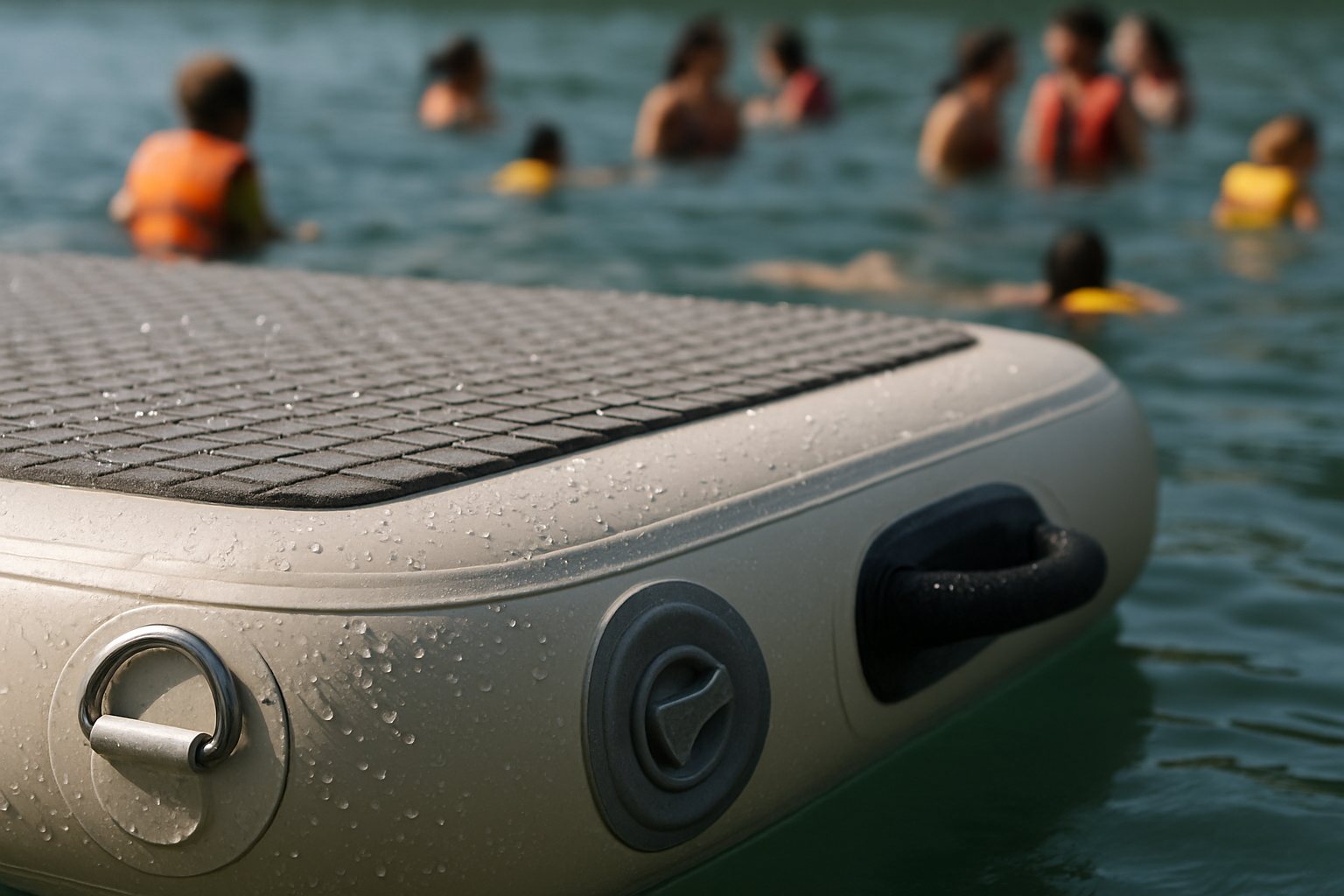
- EVA deck: A soft, textured foam pad on top of the dock that adds grip and comfort.
- Chamber: A separate air compartment; docks with more than one chamber can stay partly afloat if one is punctured.
- Isolation valve: A valve between chambers that keeps a leak in one from emptying the others, as on I.C. Brindle’s Fast Path.
- Ballast bag: A bag under a dock that fills with water to add weight and steady it; NautiBuoy’s fill on launch.
Air, pressure and valves
- PSI: Pounds per square inch, the unit makers use for inflation pressure; consumer docks run about 5 to 12 psi.
- Bar: The metric pressure unit; 0.7 bar is about 10 psi.
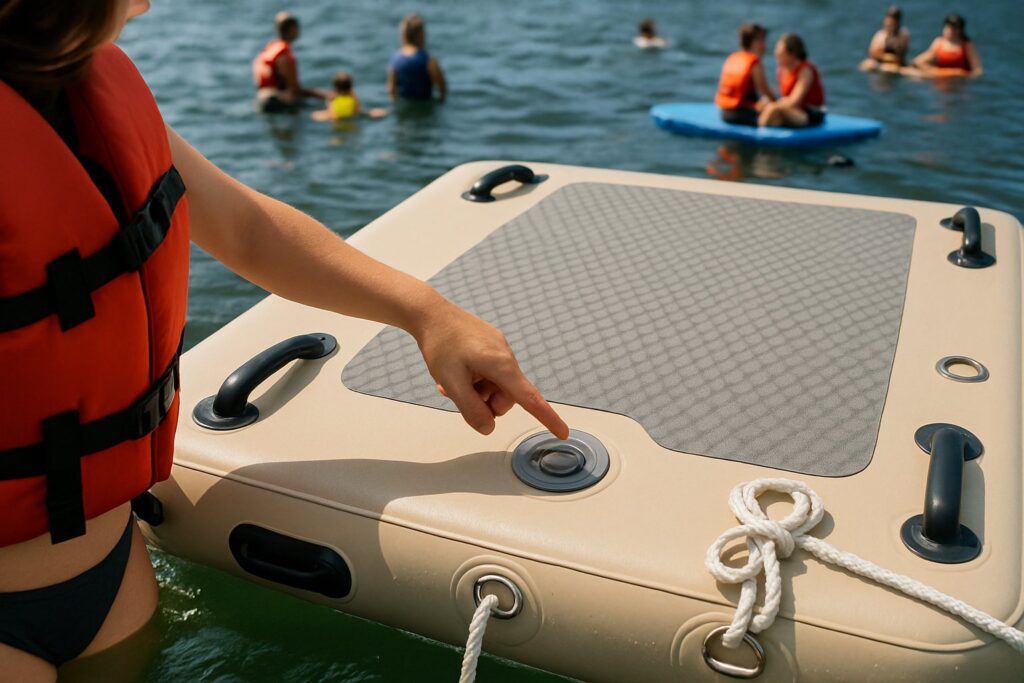
- Halkey Roberts valve: A common spring-loaded inflation valve on inflatables that opens when you press the center.
- H3 valve: A valve style listed on some drop-stitch docks, such as Solstice; check that your pump adapter fits it.
- Hand pump: A manual pump, often dual-action, that pumps on both the up and down stroke.
- Repair kit: Patches, and sometimes adhesive, supplied for fixing small leaks.
Capacity and sizing
- Stated capacity: The load or people limit the maker publishes; always use this, never a figure worked out from size.
- Load rating: A static weight a dock is rated to carry, which is not the same as how many people may use it.
- People rating: The number of adults or children the maker says may be on the dock at once.
- Buoyancy: The upward force of the water; one Candock cube is described as about 150 lb of buoyancy.
- Thickness: The height of the inflated deck, usually 6 in for consumer docks and 20 cm for yacht docks.
- Minimum depth: The shallowest water the maker allows under the dock, often 4 ft.
Anchoring and mooring
- Anchor point: A ring or loop on the dock built to take an anchor line.
- D-ring: A D-shaped metal ring glued or welded to the dock for lines and straps.
- Anchor weight: The total weight of anchors the maker asks for, from 150 to 200 lb (RAVE) to 1,100 lb (Aquaglide Docking Station).
- Mushroom anchor: A bowl-shaped anchor that settles into soft, muddy or weedy bottoms.
- Sand anchor: A screw-in pole or sand-filled bag that holds a jet ski or small craft in sand.
- Bridle: A Y-shaped arrangement of lines that spreads the pull of one anchor line across two points.
- Scope: The ratio of anchor line length to water depth; BoatUS advises about 7:1 for boats.
- Mooring line: A line that holds a dock or boat in place to an anchor, buoy or shore point.
- Dock line: A line, often with a spliced eye, used to tie a boat to a dock.
- Working load: The load a line or fitting is meant to carry in use, well below its breaking strength.
- Breaking strength: The load at which a new line fails in testing.
- Cleat: A metal or plastic fitting with two horns for tying lines, common on rigid docks.
Rules and use
- PWC: Personal watercraft, the general term for jet skis, WaveRunners and Sea-Doos.
- Light commercial use: Business use such as rentals or resort guests; some makers give it a shorter warranty than residential use.
- Classification society: An independent body that certifies vessels and marine structures; some authorities require it for passenger landing pontoons.
- Navigable waters permit: A U.S. Army Corps of Engineers permit that can apply to docks and other structures in navigable waters.
Gear these terms describe
Prices change often. These are the prices we saw on Amazon in October 2026; check the current price before you buy.
AGPTEK 16 PSI Electric Pump
- Preset 0 to 16 psi
- 12 V, built-in battery
- About $130, seen October 2026
Seachoice Double-Braid Nylon Dock Line
- 1/2 in x 20 ft
- 15 in eye splice
- About $19, seen October 2026
SeaSense 10 lb Mushroom Anchor
- 10 lb, vinyl coated
- Sandy, muddy or weedy bottoms
- About $32, seen October 2026
The SeaSense anchor is sold for boats up to 15 ft; dock makers ask for much more total anchor weight. Put the terms to work in Setup & care, the FAQ and floating dock types, or compare picks in best inflatable docks.