This article contains affiliate links: if you buy through them we may earn a commission, at no extra cost to you. Read our affiliate disclosure.
A friend’s 22 ft bowrider noses up to your dock on the Fourth of July, and someone asks the question every dock owner hears sooner or later: “Are we legal? What does the Coast Guard actually need us to have?” It sets out the Coast Guard boat requirements for the recreational boats you board and tie up, by length, then explains what those rules do not cover (your private dock) and where dock rules come from instead.
In short: every recreational boat needs a Coast Guard approved wearable life jacket for each person aboard, and boats 16 ft and longer need one throwable as well (canoes and kayaks excepted). Children under 13 must wear a life jacket while the boat is underway unless below deck or in an enclosed cabin, or under the state’s own age rule where one exists. Add fire extinguishers on most motorboats, visual distress signals on coastal waters and the Great Lakes, navigation lights from sunset to sunrise, a sound signal, and the engine cut-off switch link on boats under 26 ft. None of this applies to a private dock: docks fall to states, local governments and the Corps of Engineers.
Coast Guard boat requirements at a glance
The table summarizes the federal minimums for recreational boats from the Coast Guard’s Boater’s Guide to the Federal Requirements for Recreational Boats (2023 edition) and 33 CFR Parts 83 and 175. It is a checklist, not the regulation: the guide itself says federal requirements are minimums and do not guarantee safety, and your state may add more.
| Item | Under 16 ft | 16 to under 26 ft | 26 to under 40 ft | 40 to 65 ft |
|---|---|---|---|---|
| Wearable life jacket | 1 per person | 1 per person | 1 per person | 1 per person |
| Throwable (Type IV) | Not required | 1 (canoes and kayaks exempt) | 1 | 1 |
| Fire extinguishers (5-B), no fixed system | 1* | 1* | 2 | 3 |
| Visual distress signals (coastal waters, Great Lakes) | Night signals, sunset to sunrise | Day and night | Day and night | Day and night |
| Sound signal | Some means of making an efficient sound signal | Same | Same; whistle from 39.4 ft (12 m) | Whistle (a bell is added from 65.6 ft, 20 m) |
| Navigation lights | Sunset to sunrise and in restricted visibility. Power boats under 39.4 ft (12 m) may show an all-round white light and sidelights. | |||
| Engine cut-off switch link | Operator must use it on plane or above displacement speed (boats under 26 ft) | Not covered by this rule | ||
*Outboard boats under 26 ft whose construction cannot trap explosive or flammable vapors do not have to carry a portable extinguisher. One 20-B extinguisher may replace two 5-B units, and a fixed system in the machinery space reduces the count (33 CFR 175.320).
Life jackets and throwables
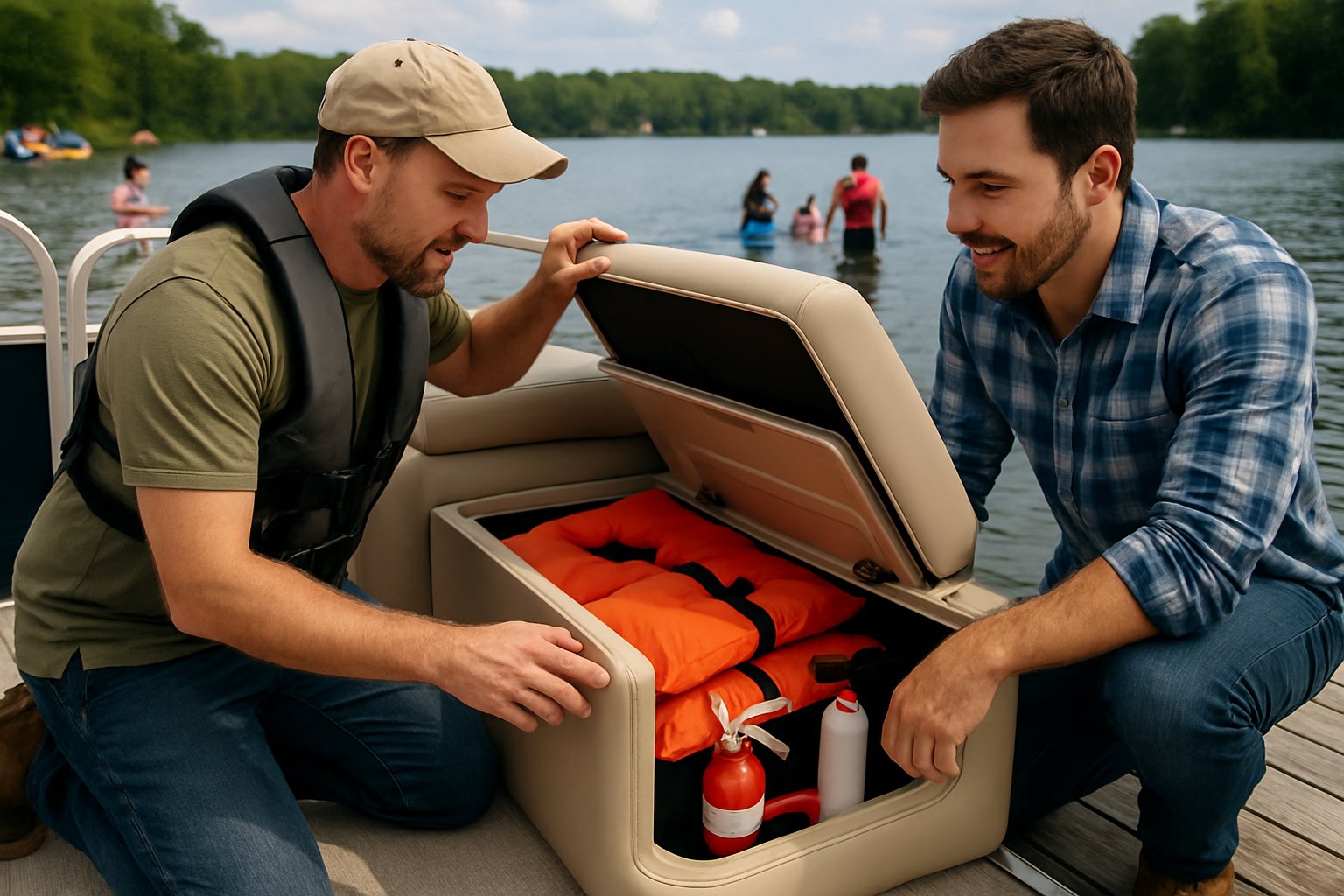
Under 33 CFR 175.15, no one may use a recreational boat unless at least one wearable life jacket is aboard for each person, and boats 16 ft or more must also carry one throwable. Each wearable must be “readily accessible”, and the throwable “immediately available” (175.19). They must be in serviceable condition, the right size for the wearer and legibly marked with the approval number (175.21). The Boater’s Guide adds that jackets should not be stowed in plastic bags, in locked compartments, or under other gear.
Children are the rule dock owners see broken most. Federal law says that on a boat underway, a child under 13 must wear an approved life jacket unless below deck or in an enclosed cabin. Where a state has its own child-wear age, the state rule applies on its waters instead (175.25); Minnesota, for example, sets it at under 10. Our life jackets and throwables page covers fit, sizes and the newer “Level” labels.
Airhead Treasure Child Life Jacket
- USCG approved Type III
- Child 33 to 55 lb
- About $27
Aqua Oceans 7 Kids Life Jacket
- USCG approved
- Child 33 to 55 lb
- About $38
Fire extinguishers, signals, lights and sound
Fire extinguishers. Required where a fire could be expected from the engine or fuel system: closed compartments where portable tanks may be stored, closed living spaces, permanently installed fuel tanks and similar. Boats of model year 2018 and newer must carry 5-B or 20-B rated extinguishers; boats of model year 2017 or older may keep B-I or B-II units until they are no longer serviceable. The Boater’s Guide says a non-rechargeable extinguisher expires 12 years from the date stamped on the bottom.
Visual distress signals. Required on coastal waters, the Great Lakes, the territorial seas and connected waters until they narrow to less than 2 nautical miles. Boats 16 ft and longer need day and night signals; boats under 16 ft need night signals between sunset and sunrise. Pyrotechnic flares expire 42 months after manufacture. On an inland lake, they are not federally required, though the Coast Guard recommends signaling devices wherever you boat.
Navigation lights and sound. Lights are required between sunset and sunrise and in restricted visibility. Boats under 12 m (39.4 ft) need no whistle or bell but must have “some other means of making an efficient sound signal” (33 CFR 83.33).
Engine cut-off switch, ventilation and propellers
Federal law requires the operator of a recreational boat under 26 ft to use the installed engine cut-off switch link while on plane or above displacement speed. Gasoline boats also have ventilation and backfire flame arrestor rules. Around docks, the Coast Guard’s most useful line is about propellers: shut off the engine when approaching swimmers, keep people in the water on the operator’s side and in view. More on that in swimming from docks.
What the Coast Guard does not cover: your dock
Part 175 applies to boats. The Boater’s Guide says the Coast Guard does not regulate anchors, paddles, rearview mirrors or ski flags, and it says nothing about private docks. Rules for a dock come from three places instead:
- The U.S. Army Corps of Engineers for structures in navigable waters (Section 10 of the Rivers and Harbors Act) and fill in waters of the United States (Section 404 of the Clean Water Act).
- Your state: natural resources, water resources or boating agencies, which may set dock sizes, lighting and anchoring. Illinois DNR, for example, requires docks under its statewide permit to be securely anchored against high water and wind and dock posts to carry reflective devices.
- Local rules: counties, towns, lake associations, utilities that manage reservoirs, and HOAs.
See permits and local rules for how to find yours. We do not give legal advice; your state boating agency (listed in the NASBLA directory) and local permit office decide. More on dock safety in our dock and boating safety hub.
Dock-side checklist before a boat leaves
- Count heads and count jackets: one wearable each, sized for each person.
- Children under 13 (or your state’s age) wearing theirs before the lines come off.
- Throwable on deck within reach on boats 16 ft and over.
- Extinguisher charged, in date and mounted.
- Lights tested if anyone might come back after sunset.
- Horn or whistle aboard; flares in date on coastal waters.
- Cut-off lanyard on the driver; swimmers clear of the stern before the engine starts.
Coast Guard requirements FAQ
Does a 14 ft boat need a throwable?
Not under federal rules: the throwable is required on boats 16 ft and longer. Every person still needs a wearable, and your state may require more.
Does the Coast Guard require a life jacket on a dock?
No. Part 175 applies to recreational vessels. Some parks and states have their own rules, and the CDC recommends life jackets for children around natural water.
Is an inflatable dock a boat under these rules?
The Coast Guard’s 2024 statistics list a “floating dock” among items whose incidents are not counted as vessel incidents. Check your state’s definitions before assuming either way.
Are visual distress signals needed on a lake?
Federally, only on coastal waters, the Great Lakes, territorial seas and connected waters wider than 2 nautical miles. Inland lakes are not included, though some states have their own rules.