This article contains affiliate links: if you buy through them we may earn a commission, at no extra cost to you. Read our affiliate disclosure.
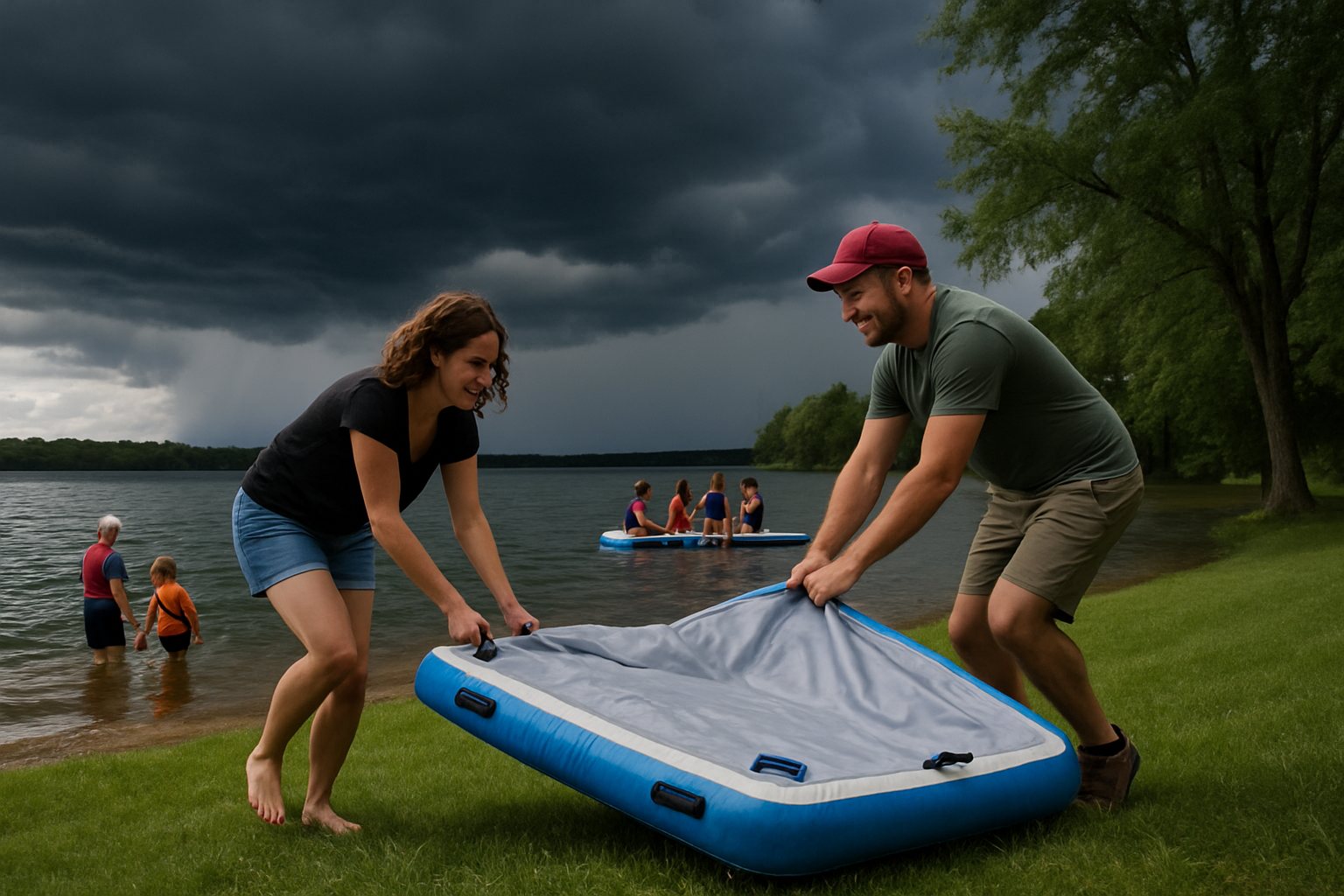
The forecast said “chance of afternoon storms”, and at three o’clock the sky to the west goes dark. The kids are on the inflatable dock, the boat is tied at the end of the pier, and the first gust flips a towel into the lake. This page covers preparing a dock for a storm: reading NOAA and National Weather Service warnings, when to bring an inflatable dock in, securing the boat, and lightning.
In short: watch the NWS forecast and marine warnings, and act early. People come off the water at the first thunder (“When thunder roars, go indoors”) and stay off until 30 minutes after the last. Inflatable dock makers tell owners not to use their docks in high winds, waves, strong currents, storms or lightning, but none we checked publishes a wind speed limit, so the safe rule is to bring an inflatable dock ashore, deflated or secured, before forecast storms. Double up boat lines, add fenders, remove loose gear, and switch off dock power before the weather hits.
Read the warnings: what NWS terms mean
The National Weather Service issues marine products for coastal waters and the Great Lakes, and local forecast offices issue thunderstorm and wind warnings for inland areas. The marine definitions, as the NWS Key West office publishes them:
| NWS product | Wind (sustained or as stated) | What it means for a dock |
|---|---|---|
| Small Craft Advisory | 20 to 33 knots and/or hazardous seas (thresholds vary by region) | No inflatable dock days; check boat lines |
| Special Marine Warning | Short-lived gusts of 34 knots (39 mph) or more, often thunderstorms, usually up to 2 hours | Everyone off the water and dock now |
| Gale Warning | 34 to 47 knots, not tropical | Inflatable dock out; extra lines on the boat |
| Storm Warning | 48 knots or more, not tropical | Full storm preparation |
| Tropical Storm Warning | 34 to 63 knots, tropical cyclone | Full storm preparation; follow local officials |
| Hurricane Warning | 64 knots or more | Follow evacuation and harbor orders |
The right-hand column is our plain-language reading, not an NWS instruction. Inland lakes do not always get marine products, so use your local NWS forecast and severe thunderstorm warnings there. The NWS Melbourne office’s marine safety rules add: check the weather before departure, have an escape plan, watch for a steady increase in wind or seas, and if a thunderstorm threatens, make sure everyone aboard is wearing a life jacket, because gusts can overturn small boats.
Lightning: off the water, off the dock
The National Weather Service’s rule is “When Thunder Roars, Go Indoors”, and to stay in safe shelter at least 30 minutes after the last sound of thunder. NOAA adds: immediately get out and away from ponds, lakes and other bodies of water. A dock is not shelter. On boats, the NWS notes that the vast majority of lightning injuries and deaths happen on small boats with no cabin, and advises not going out if storms are forecast. If you cannot reach land, it says to drop anchor and get as low as possible.
- Get people off docks, lifts and swim rafts and into a large building or fully enclosed vehicle.
- Stay away from water, wet ropes and metal, which the NWS calls excellent conductors.
When to bring an inflatable dock in
Here is what makers actually say. RAVE’s Aqua Dock manual: never use the dock in high winds, waves, strong currents, storms or lightning; go to shore; choose a spot protected from wind; and keep it at full pressure on the water or take it out at night (muskrats chew PVC). Aquaglide’s lakefront manual asks owners to secure the swivel and mooring connections so they cannot loosen or separate in rough weather, and suggests sites with extreme weather, strong tides, currents, winds or swell consider up to 50% more anchor weight. Aquaglide’s Docking Station listing says its 1,100 lb anchor weight recommendation is for extreme weather, waves or other abnormal conditions.
What no maker publishes is a wind limit. None of the consumer inflatable dock listings or manuals we checked gives a wind speed or wave height at which the dock must come out. So we will not invent one. Our reading of the manuals: if a storm, gale or thunderstorm warning is out, or you would not take a small boat out, bring the inflatable dock ashore. Deflate it, or pull it well above the high-water line and tie it down so wind cannot lift it. A loose dock is a hazard to boats and neighbors; Illinois DNR’s statewide dock permit, for instance, requires docks to be securely anchored to prevent them from breaking loose and becoming a floating hazard in high water or winds.
For anchor weights and bridles, see how to anchor a floating dock; for packing it away, how to store an inflatable dock.
Preparing a dock for a storm: checklist
| When | Do this |
|---|---|
| Start of season | Know where dock and shore power breakers are; agree who brings the inflatable dock in; check anchors, lines and swivels |
| Storms forecast (a day ahead) | Bring the inflatable dock ashore; stow cushions, chairs, toys and covers; check boat lines and fenders |
| Warning issued | Double bow, stern and spring lines with chafe protection; extra fenders; or move the boat to a lift, trailer or sheltered mooring |
| Before it hits | Switch off dock power and shore power; everyone off the dock and out of the water |
| After the storm | Inspect lines, anchors and dock hardware; electrician to check wiring before power goes back on; watch for debris and high water |
The “after” step matters for electricity. NFPA’s summer advice is to have a boat’s electrical system checked by a qualified marine electrician each year and after any major storm that affects the boat, and storms are when dock wiring gets soaked or damaged. Read electric shock drowning before anyone swims after a storm.
High water, floods and cold water
Storms raise lakes and rivers. A dock on a river or a reservoir can see big level swings; our floating dock on a river guide covers current and debris. The NWS warns that 6 inches of fast-moving flood water can knock over an adult, so stay off flooded docks and walkways. And if someone does go in during cool weather, the NWS says cold shock can be as severe in 50 to 60°F water as at 35°F.
What stays on the dock
Even on a stormy weekend, a throwable and a ladder should be at the dock for anyone who slips while securing the boat, and life jackets should be on anyone working at the dock edge in wind. Prices as seen on Amazon in October 2026.
4-Step Stainless Telescoping Dock Ladder
- 316 stainless steel
- 600 lb stated capacity
- About $160
Airhead Treasure Child Life Jacket
- USCG approved Type III
- Closed sides, crotch strap
- About $27
Back to the dock and boating safety hub, or see safe boarding and tying up for lines and fenders.
Storms and dock safety FAQ
At what wind speed should I take my inflatable dock out?
No consumer dock maker we checked publishes one. RAVE says not to use its dock in high winds, waves, storms or lightning. Bring it in whenever storms or strong winds are forecast.
How long after thunder can we swim again?
The National Weather Service says to wait at least 30 minutes after the last sound of thunder.
Should I leave my boat at the dock in a hurricane?
Follow your local emergency officials and your marina or harbor instructions. We do not give hurricane plans; your marina, insurer and local officials are the people to plan with, well before a warning.
Do I need to check the dock’s wiring after a storm?
Yes. NFPA advises a marine electrician check after a major storm affects the boat, and Tennessee’s State Fire Marshal recommends inspecting dock electrical systems at least once a year because docks are exposed to the elements.