This article contains affiliate links: if you buy through them we may earn a commission, at no extra cost to you. Read our affiliate disclosure.
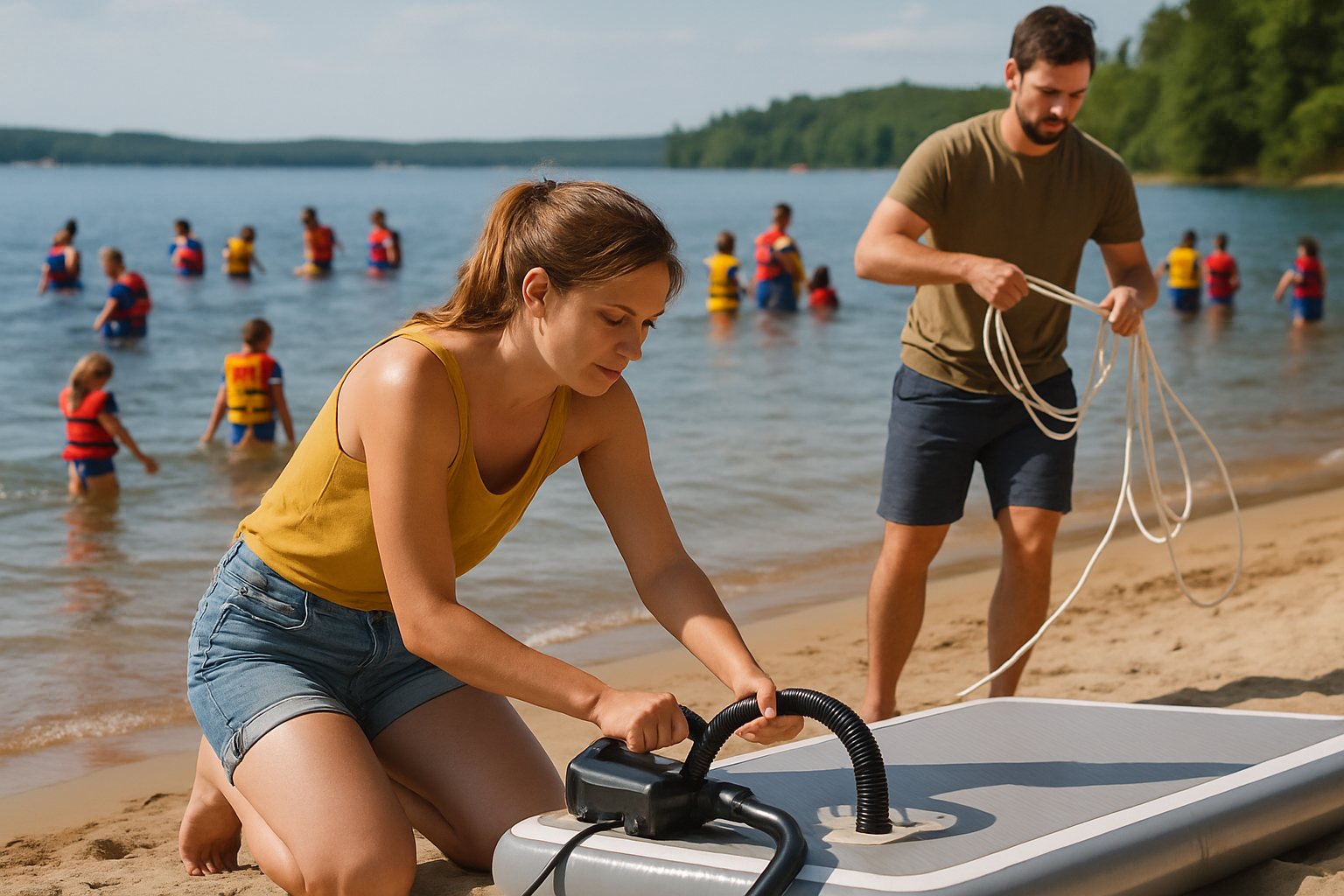
The box arrives on a Friday, and by Saturday morning the whole family is on the lawn watching someone pump. An hour later the dock is on the water, and that is when the real questions begin: is it tight enough, how heavy do the anchors need to be, what happens when the wind comes up tonight? This page gathers floating dock installation, anchoring, inflation, storage, repair and safety in one place, with links to our longer guides.
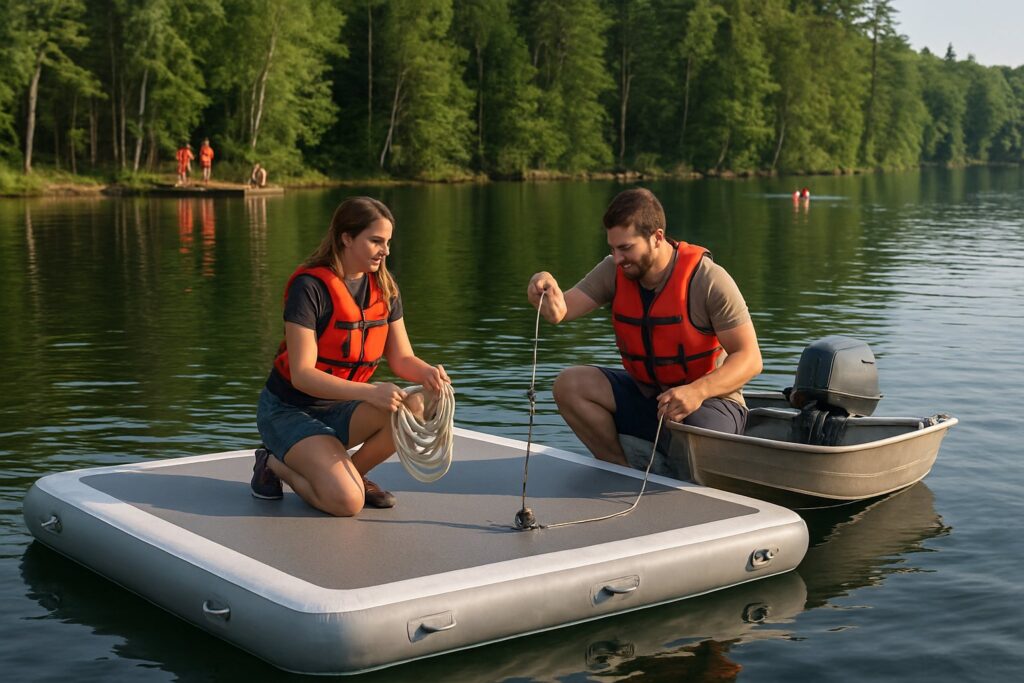
In short: inflate to the maker’s pressure (about 5 to 12 psi for consumer docks), anchor at every point provided with the anchor weight the maker asks for, which ranges from 150 to 200 lb (RAVE) to 1,100 lb (Aquaglide’s Docking Station), and check the lines after the first hour. Clean with mild soap, dry fully, and store rolled loosely somewhere cool and shaded. Bring the dock in for storms and ice.
Floating dock installation, step by step
- Read the manual first. Depth, distance from shore, anchor weight and pressure are all set by the maker.
- Check the spot. Measure depth (RAVE and Aquaglide ask for at least 4 ft), look for rocks and stumps, and stay clear of boat lanes.
- Inflate on clean, flat ground or at the end of a boat with the motor off, as RAVE’s manual says. Carry the dock; don’t drag it.
- Attach the anchor lines before launching, then float the dock into place.
- Lower the anchors rather than throwing them, and set them so the dock can’t swing into shore or other docks.
- Check after an hour and after the first windy day.
Anchoring has its own step-by-step guide, how to anchor a floating dock. Our full setup walk-through is a guide to inflating and installing your boat dock.
How to anchor a floating dock
Anchoring is where most dock trouble starts. Use every anchor point the maker provides: RAVE puts one at each end so the wind can’t swing the dock; Aquaglide’s Docking Station has 5 anchor rings. Anchor weight comes from the maker, not from guesswork: RAVE suggests 150 to 200 lb depending on the lake and bottom; Aquaglide asks for at least 1,100 lb for the Docking Station and, for its large decks, recommends a dock and mooring specialist. Anchors, bridle and lines are often sold separately.
Choose line by working load, not breaking strength. One 3/8 in double-braided nylon anchor line lists an 820 lb working load and 4,035 lb breaking load. For boats, BoatUS advises a scope of about 7:1 (5:1 for a small boat in good weather). RAVE’s manual warns never to swim under the dock and to know where anchor lines run.
Inflation: pressure, valves and pumps
Each dock has its own pressure: 5 psi for RAVE’s Aqua Dock, 6 to 8 psi for BOTE’s 7 ft dock, 7 to 12 psi for Solstice. Don’t go over the maker’s figure. Check the valve type (Solstice uses an H3 valve) and make sure your pump’s adapter fits. Check the pressure each morning while the dock is out. See inflation and maintenance tips.
Care, repair and storage
- Cleaning: mild soap and fresh water; no petroleum products, solvents or power washers (RAVE manual).
- On the water: keep it at full pressure, which RAVE says discourages muskrats, or take it out at night.
- Repair: follow the maker’s steps and use the kit supplied; some kits leave out the adhesive, so check.
- Storage: dry it completely, roll it loosely, and store it cool, dry, shaded, off concrete and away from rodents.
- Ice: take docks out before freeze-up; rigid-dock makers give the same advice where ice shifts.
Safety basics
- Life jackets: one that fits each person; the U.S. Coast Guard notes adult sizes may not fit children.
- Engines: the CDC advises staying at least 20 ft from boats running an engine or generator.
- Lightning: NOAA says get away from lakes and ponds and wait 30 minutes after the last thunder.
- Wind: no consumer dock maker we checked publishes a wind limit. Clear the dock when wind and waves build.
- Rules: some states require permits, lights or reflectors for rafts left out overnight; Minnesota is one.
Setup and care gear
Prices change often. These are the prices we saw on Amazon in October 2026; check the current price before you buy.
AGPTEK 16 PSI Electric Pump
- Preset 0 to 16 psi
- 12 V, built-in battery
- About $130, seen October 2026
Better Boat Anchor Rope, 3/8 in x 100 ft
- 820 lb working load
- 4,035 lb breaking load
- About $46, seen October 2026
HH-66 Vinyl Cement, 4 oz
- Bonds PVC and vinyl
- Brush-on cap
- About $15, seen October 2026
Seachoice Double-Braid Nylon Dock Line
- 1/2 in x 20 ft
- 15 in eye splice
- About $19, seen October 2026
Check that any pump’s nozzle fits your dock’s valve before relying on it.
All setup and care guides
- How to anchor a floating dock
- Floating dock designs and layouts and floating dock cost
- Easy setup: inflating and installing your boat dock
- How to inflate: maintenance tips for inflatable docks
- Choosing the right inflatable dock float
- Inflatable vs rigid floating docks and inflatable vs traditional docks
- Floating dock FAQ and dock glossary
Back to floating dock types or browse products.
Setup and care questions
How heavy should floating dock anchors be?
As heavy as the maker says. Figures we found run from 150 to 200 lb (RAVE) to at least 1,100 lb (Aquaglide Docking Station).
How long does it take to inflate a dock?
It depends on size and pump. Island Hopper says about 8 minutes by hand pump for its 10 x 6 ft dock and about 15 for its 10 x 10.
Can I tie my inflatable dock to my fixed dock?
Check the manual. RAVE says not to connect its dock directly to docks, piers or other hard objects.