This article contains affiliate links: if you buy through them we may earn a commission, at no extra cost to you. Read our affiliate disclosure.
Every lake family knows the scene: a pile of life jackets on the end of the dock, three kids grabbing whichever is closest, one jacket so big it rides up over a seven-year-old’s ears. This page covers life jacket requirements for the boats at your dock, what “Coast Guard approved” means, children’s rules and fit, and why a throwable flotation device and a ladder belong on every dock.
In short: federal rules require one Coast Guard approved wearable life jacket for every person on a recreational boat, plus one throwable on boats 16 ft and longer (canoes and kayaks excepted). Children under 13 must wear theirs while the boat is underway unless below deck or in an enclosed cabin, or follow the state’s own age rule. Jackets must be the right size, in good condition and easy to reach. Docks have no federal life jacket rule, but a throwable within reach and a ladder at the water are the two pieces of gear that turn a fall into a short swim.
Life jacket requirements on the boats at your dock
The rules sit in 33 CFR 175.15 to 175.25. In plain terms:
- One wearable per person on any recreational boat, “readily accessible”.
- One throwable in addition on boats 16 ft or longer, “immediately available”. Canoes and kayaks 16 ft and over are exempt from the throwable.
- Serviceable: no broken hardware, ripped straps, rotted or waterlogged foam; inflatables armed with a full cylinder and green indicators.
- Right size and fit for the wearer, as marked on the approval label, and legibly marked with the approval number.
- Children under 13 wear one while underway, unless below deck or in an enclosed cabin.
The Coast Guard’s 2024 Recreational Boating Statistics show why these rules exist: where the cause of death was known, 76% of victims drowned, and where life jacket use was known, 87% were not wearing one. For the full equipment list by boat length, see Coast Guard boat requirements.
What “Coast Guard approved” means, and the new labels
A Coast Guard approved device meets federal specifications and carries an approval number on its label. You will see two labeling systems. Older jackets carry Type I to V; newer ones carry a “Level” in newtons (50, 70, 100, 150, 275). The Coast Guard’s Boater’s Guide explains that federal regulations no longer mention type codes, only “wearable” and “throwable”, and that a lower level number gives more mobility for calm water near shore while a higher number gives more flotation and turning ability for offshore use. A Type IV, or a Type V marked with Type IV performance, counts as a throwable; a wearable is not a throwable unless marked so.
Inflatable jackets are comfortable but come with limits. The Coast Guard’s “How to Choose the Right Life Jacket” brochure says inflatables are not for children under 16 or non-swimmers, and not for sports where immersion is expected, such as waterskiing. They need regular maintenance per the owner’s manual.
Children: state rules and a proper fit
Under 175.25, where a state has set its own age for children to wear life jackets, the state rule replaces the federal under-13 rule on that state’s waters. Minnesota’s 2026 Boating Guide, for example, requires children under 10 to wear one while a boat is underway. Check your state agency; the NASBLA directory lists them.
The Coast Guard is clear that adult jackets do not work for children. Child jackets are approved for weight ranges such as “less than 30 lb”, “30 to 50 lb” or “50 to 90 lb”. Its fit check:
- Check the label for the wearer’s weight and chest size.
- Fasten every buckle and zipper.
- Have the wearer hold both arms straight up.
- Pull up gently on the tops of the arm openings.
- The jacket should not ride up over the chin or face. Then try it in shallow water under supervision.
The CDC goes further than the boat rules: it says children should use life jackets for all activities while in and around natural water. That covers the dock, the beach and the swim raft, not only the boat.
Airhead Treasure Child Life Jacket
- USCG approved Type III
- Child 33 to 55 lb
- About $27
Aqua Oceans 7 Kids Life Jacket
- USCG approved
- Child 33 to 55 lb
- About $38
Prices as seen on Amazon in October 2026. Whatever you buy, read the approval label on the jacket itself before it goes in the boat.
Throwable flotation device: keep one on the dock
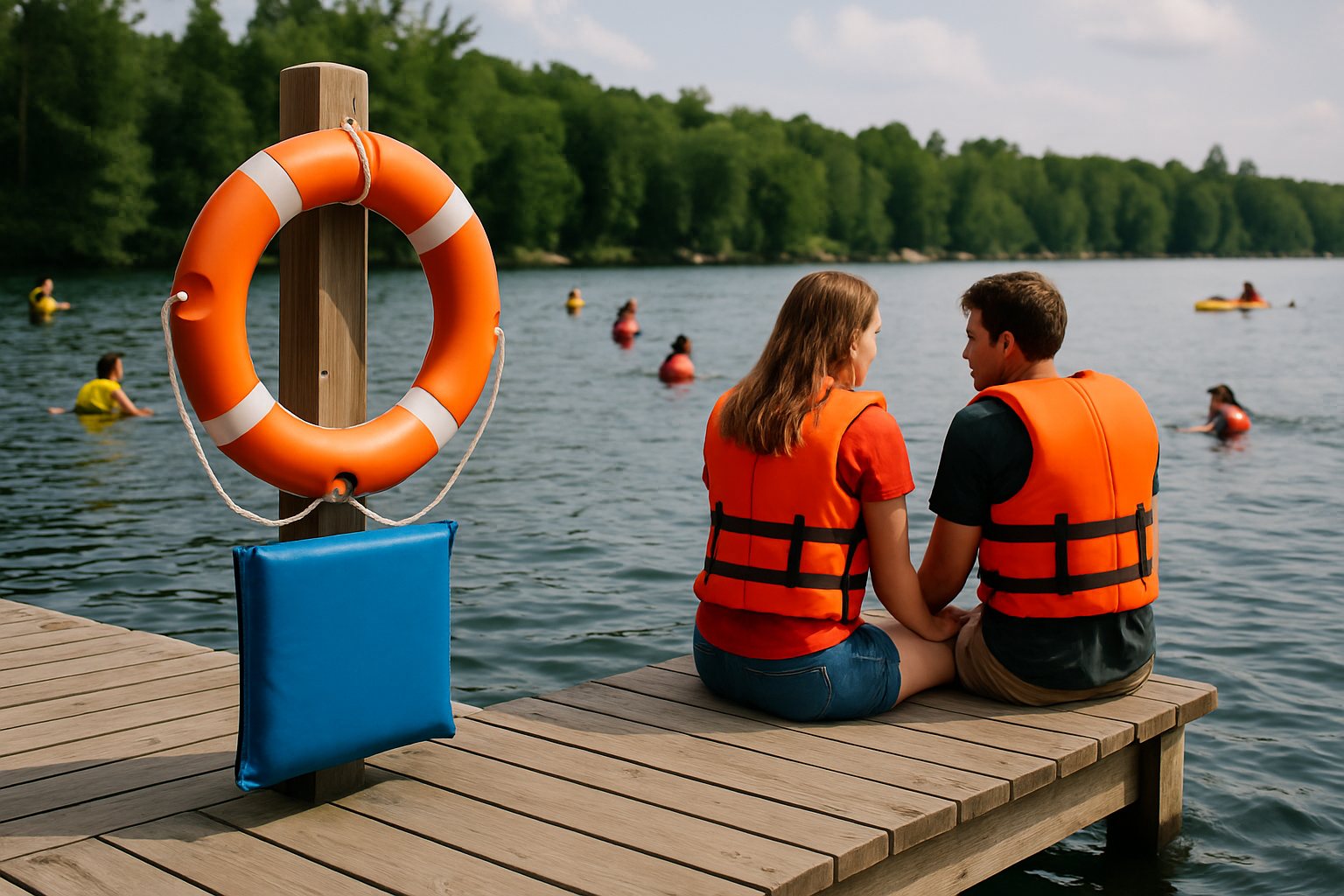
A throwable, such as a Type IV ring buoy or boat cushion, is meant to be thrown to someone in the water. On a boat 16 ft or longer, it is required and must be within immediate reach; the Boater’s Guide suggests the main deck within arm’s reach or hanging on a lifeline. No federal rule requires one on a private dock, but the logic is the same: the person who falls between the boat and the dock, or the swimmer who tires 30 ft out, needs something they can grab in seconds, and the person on the dock should not have to go in after them.
- Mount it where anyone can see and reach it, near the end of the dock, not inside the boathouse.
- Attach a floating line long enough to reach the swim area, and keep the end tied or held when you throw.
- Show the kids and guests where it is.
- Check it with the life jackets: torn covers, hard or waterlogged foam and faded fabric mean replace it. The Coast Guard says foam jackets should be checked for wear and buoyancy at least once a year.
A ladder: the other half of a dock rescue
Floating in a life jacket is not the same as getting out. Many docks sit a foot or more above the water, and an inflatable dock’s soft side is hard to climb in a wet jacket. A dock or swim ladder that reaches below the waterline gives a tired swimmer a way out without help. Some inflatable docks come with soft ladders or ladder connectors; others take a bolt-on stainless ladder. Our dock ladders and accessories guide compares the options.
Amarine Made 4-Step Telescoping Boat Ladder
- 304 stainless steel
- Telescoping, folds over the platform
- About $60
Life jacket checklist for the dock
| Check | Why |
|---|---|
| One wearable per person, sized for each | 33 CFR 175.15 and 175.21 |
| Kids wear theirs before the lines come off | Federal under-13 rule or the state’s age |
| Throwable on deck on boats 16 ft and longer | 33 CFR 175.15(b), 175.19 |
| Throwable and ladder on the dock | Fast rescue without anyone going in |
| Inflatables armed, indicators green; no inflatables on under-16s | 33 CFR 175.23; Coast Guard brochure |
| Foam jackets checked yearly; discard waterlogged or damaged ones | Coast Guard life jacket guidance |
Back to the dock and boating safety hub, or read swimming from docks and safe boarding and tying up.
Life jackets and throwables FAQ
How much buoyancy does an adult need?
The Coast Guard says most adults need only 7 to 12 lb of buoyancy (31 to 53 newtons) to keep their heads above water. Fit matters as much as the number.
Can a wearable life jacket count as the throwable?
Only if it is marked as a throwable. Under 33 CFR 175.13, a wearable PFD is not a throwable unless specifically marked otherwise.
Do kids need life jackets on an inflatable dock?
Federal boat rules do not cover docks, but the CDC recommends life jackets for children in and around natural water, and RAVE’s dock manual asks users to wear a Coast Guard approved Type III (Level 70N) jacket.
Are inflatable life jackets OK for teenagers?
Not for under-16s: the Coast Guard brochure says inflatables are not for children under 16 or for non-swimmers.
How often should I replace life jackets?
There is no fixed date. Replace any jacket with torn fabric, broken buckles, or foam that is hard, waterlogged or compressed (33 CFR 175.23), and check foam jackets at least once a year.