This article contains affiliate links: if you buy through them we may earn a commission, at no extra cost to you. Read our affiliate disclosure.
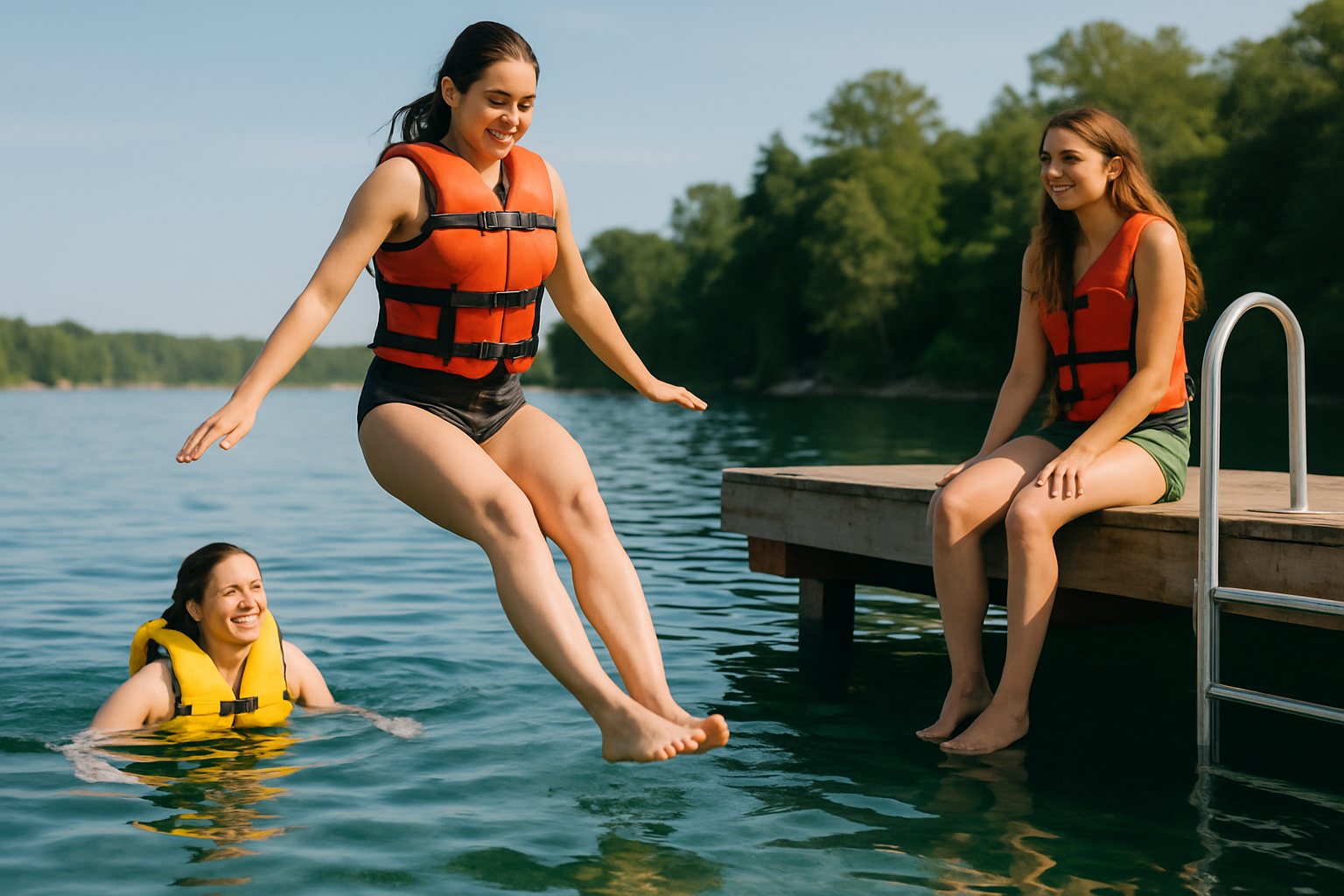
The first warm Saturday of summer, and the cousins have arrived. Within ten minutes someone has run the length of the dock and cannonballed off the end, and someone smaller is lining up to dive after them. Nobody has checked the depth since last fall, when the water was two feet higher. Dock swimming safety comes down to a short list: know the depth, go in feet first, keep boats and swimmers apart, never swim near AC power, and have a sober adult watching.
In short: check the depth at the end of the dock every season and after water levels change, and enter feet first. The American Red Cross says to dive only into water clearly marked safe for diving, at least 9 ft deep with no obstacles, and not to enter from a height such as a bridge or boat. Keep swimmers out of boat lanes, use your state’s swim-area rules and buoys, turn off engines near swimmers, never swim near docks with electrical power, and keep a designated adult watching at all times.
Check the depth, then go in feet first
Lake levels move with rain, drought and dam releases, and bottoms change with storms. The American Red Cross’s lake and river guidance says to always enter unknown or shallow water feet first, to dive only in water clearly marked as safe for diving, at least 9 ft deep with no underwater obstacles, and not to enter the water from a height such as a bridge or boat.
- Measure the depth off the end and sides of the dock with a weighted line or pole at the start of each season and after big level changes.
- Look and feel for rocks, stumps, old pilings, anchor blocks and lines.
Inflatable docks set their own minimums. RAVE’s Aqua Dock manual asks for at least 4 ft of water and says never to dive head first, only feet first, and no flips or somersaults. That 4 ft is not a diving depth. Its manual also says never to swim under the dock and to know where the anchor lines are.
Supervision: one adult, eyes on the water
The CDC’s drowning prevention advice is to designate a responsible adult to supervise closely and constantly when children are in or near water, to avoid alcohol before or during swimming and boating, and to take formal swimming lessons, which can reduce the risk of drowning. The CDC also says more children aged 1 to 4 die from drowning than from any other cause (as stated on its prevention page, checked October 2026). The Coast Guard suggests a designated “Water Watcher”, and the Red Cross says to supervise sober and off the phone.
For children, the CDC recommends life jackets for all activities in and around natural water. See life jackets and throwables.
Aqua Oceans 7 Kids Life Jacket
- USCG approved
- Child 33 to 55 lb
- About $38
Amarine Made 4-Step Telescoping Boat Ladder
- 304 stainless steel
- Telescoping
- About $60
Prices as seen on Amazon in October 2026. A ladder that reaches below the waterline lets swimmers climb out without hauling themselves over the dock edge.
The boat-traffic zone
States keep boats and swimmers apart in different ways. New York’s Navigation Law, section 45, limits boats to 5 mph within 100 ft of the shore, a dock, pier, raft, float or an anchored or moored vessel. Other states set different distances or slow-no-wake zones, and many lakes add local ordinances. Your state boating agency (see the NASBLA directory) has the rule for your water.
- Keep swimming on the shore side of the dock, away from where boats approach.
- No swimming in the path of a boat coming in to the dock, or behind one leaving.
Swim areas and buoys
On U.S. waters, information and regulatory marks are white with orange shapes (33 CFR 62.33). An open orange diamond means danger. A diamond with a cross inside means vessels are excluded from the marked area, the sign you often see on swim-area buoys. An orange circle means operating restrictions, such as a speed limit or no wake. A buoy used as one of these marks is white with two orange bands. Whether a private owner can place a swim-area buoy, and what it must look like, is set by your state. In Minnesota, for example, buoys that do not extend from shore cannot be in the water between sunset and sunrise without a county sheriff’s permit, mooring buoys need a sheriff’s permit, and it is illegal to drive a boat inside an area legally marked off as a swimming area. Ask your state boating agency before putting one out, and see permits and local rules.
Swim rafts and inflatable docks anchored away from shore can fall under the same kind of rule. Minnesota’s 2026 Boating Guide applies its sunset-to-sunrise permit rule to swimming rafts too, and says permitted structures must show the permit number and carry a light or reflectors visible from all directions.
Propellers and exhaust
The Coast Guard’s 2024 statistics counted 169 incidents in which at least one person was struck by a propeller. Its Boater’s Guide is direct: shut off your engines when approaching swimmers, keep people in the water on the operator’s side and in view. The best and safest action when people are in the water near your boat is to shut off the engine.
Exhaust is the quieter danger. The CDC warns that carbon monoxide can build up near the stern and swim deck and advises staying at least 20 ft from boats running a generator or engine. No hanging on the swim platform while the engine idles at the dock.
Never swim near a dock with power
Electric current leaking from a dock, lift or plugged-in boat can paralyze a swimmer. Tennessee’s State Fire Marshal advises never swimming within 100 yards of any dock using electrical power and shutting off all shore power to the boat and dock before swimming off it. Read electric shock drowning before the first swim of the season.
Thunder means everyone out
At the first thunder, everyone out: NOAA says to get out and away from ponds, lakes and other bodies of water and stay in shelter until 30 minutes after the last thunder. See storms and dock safety.
Dock swimming checklist
| Rule | Source |
|---|---|
| Feet first into unknown or shallow water; dive only where marked safe, 9 ft or more | American Red Cross |
| A designated adult watching, sober and off the phone | CDC, Red Cross, USCG |
| Kids in life jackets around natural water | CDC |
| Engines off when swimmers are near | USCG Boater’s Guide |
| 20 ft from running engines and generators | CDC |
| No swimming within 100 yards of powered docks; power off before swimming | Tennessee State Fire Marshal |
| Out of the water at the first thunder | NOAA / NWS |
For docks built around swimming and lounging, see swimming and lounging docks, and for the whole safety section, the dock and boating safety hub. If you also put out a floating mat or water trampoline, InflatablePlatforms has a platform safety checklist.
Dock swimming safety FAQ
How deep does water need to be to dive off a dock?
The American Red Cross says to dive only in water clearly marked as safe for diving, at least 9 ft deep with no underwater obstacles. Otherwise, feet first.
Is it safe to swim under a floating dock?
No. RAVE’s dock manual says never to swim under the dock, and to know where the anchor lines are.
How far from the dock should boats stay when people swim?
It depends on your state. New York, for example, sets 5 mph within 100 ft of docks, rafts and floats. Check your state boating agency for your rule.
Can I put swim buoys off my dock?
Possibly, but buoys and markers are a state matter. Ask your state boating agency what is allowed and whether a permit is needed.