
Tag: Dock Maintenance

  • How to Store an Inflatable Dock (and Winterize a Floating Dock)

    How to Store an Inflatable Dock (and Winterize a Floating Dock)

    Labor Day weekend: the last swim off the dock, the last sunset with your feet in the water, and then the job nobody looks forward to. How you put an inflatable dock away decides whether it comes out next June firm and clean or musty, sticky and chewed. Good inflatable dock storage takes an afternoon and a dry spot in the garage. This guide follows the makers’ own manuals for cleaning, drying, folding and storing, covers overnight and mid-season storage, and explains how winterizing a rigid floating dock differs.
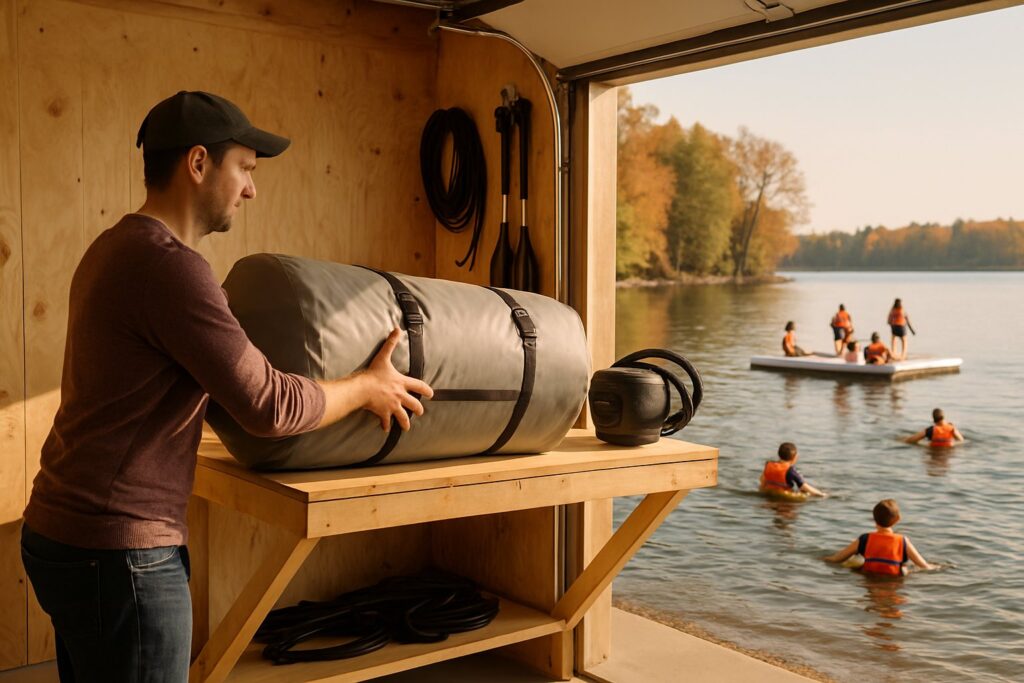
    Deflated inflatable dock rolled up in its bag on a garage shelf

    In short: bring the dock ashore without dragging it, wash it with mild soap and fresh water, dry both sides completely, deflate fully, fold it in thirds and roll it loosely toward the valve, then store it out of the sun in a clean, dry, rodent-proof place. Aquaglide says never to store its products damp or below 40 °F (4 °C). Rigid floating docks are a different job: makers suggest removing them where ice shifts.

    Inflatable dock storage, step by step

    1. Bring it ashore the right way. RAVE’s manual says to carry the dock to land, or deflate it carefully on a flat surface on your boat, and to be “extremely careful not to drag the product.” Unclip anchors and lines first.
    2. Clean it. Use mild soap and fresh water with a soft brush or sponge. Aquaglide says not to use petroleum-based cleaners and to avoid high-pressure washing, which can damage the product; RAVE’s manual also rules out petroleum products and solvents.
    3. Protect it. Aquaglide recommends regularly applying a UV protectant to exposed surfaces and doing so before storage.
    4. Dry it completely. RAVE suggests letting the dock dry for 15 minutes or longer in the sun, flipping it to dry the other side, and towelling off anything still damp. Aquaglide: confirm it is completely dry before folding.
    5. Deflate fully. Aquaglide suggests an electric pump in deflate mode to get the last air out; RAVE’s own rapid inflator has a deflate side.
    6. Fold and roll. RAVE: fold the dock into thirds with the EVA pad sections folded in, then roll it like a sleeping bag starting from the end opposite the valve, and secure it with the straps. Aquaglide: fold in thirds, then roll loosely toward the valve.
    7. Store it well. Out of direct sunlight, in a clean, dry place such as a sealed closet, crate or container that keeps rodents out (Aquaglide), and never damp or below 40 °F.

    Rolling toward the valve lets air left inside escape as you go. A rolled dock is compact, so plan a shelf or closet rather than a corner of the boathouse. Folded sizes that makers and dealers publish:

    DockInflatedFolded or rolledWeight
    BOTE Inflatable Dock 77 x 7 ft, 8 in44 x 19 x 10 inAbout 35 lb
    BOTE Inflatable Dock 1010 x 10 ft, 8 in63 x 22 x 10 inAbout 83 lb
    Solstice 10 x 1010 x 10 ft, 6 in29 x 18 x 11 in54 lb
    Island Hopper Yacht Dock10 x 6 ft, 6 in40 x 16 x 14 in53 lb

    Where to store it: what the makers say

    ConcernRAVE (Aqua Dock manual)Aquaglide (C-Deck manual)
    SunStore in a covered, shaded area to protect against UVOut of direct sunlight; apply UV protectant
    MoistureDry fully before foldingNever store in a damp location
    ColdNot statedNever store below 40 °F (4 °C)
    RodentsMuskrats may chew the PVC; on the water, keep full pressure or take it out at nightStore in a sealed closet, crate or container against rodent damage
    FoldingThirds, EVA pads in, roll from the end opposite the valveThirds, roll loosely toward the valve(s)

    Aquaglide’s 40 °F rule matters for anyone who planned to leave the dock in an unheated shed through a northern winter. If your garage drops below that, store the dock indoors in a basement or closet. Other makers may publish different figures; check your own manual.

    Overnight and mid-season storage

    You don’t have to pack the dock away every evening, but RAVE’s manual does say that after use it is best to deflate and fold it for storage to prevent damage and extend its life. If you leave it out between weekends, keep it at full pressure and well anchored, and check the pressure in the morning and the afternoon: air expands in the sun and contracts at night. RAVE notes that full pressure discourages muskrats, and taking the dock out of the water at night removes the temptation. Before a forecast storm, bring it in; RAVE says never to use its dock in high winds, waves or storms, and no consumer dock maker we checked publishes a wind limit. Some lakes also have rules on what may stay in the water overnight; ask your local agency.

    Winterizing a floating dock that isn’t inflatable

    If you also own a rigid floating dock, winterizing it is a different decision: leave it in or take it out. The makers we checked put the risk on moving ice rather than cold:

    • Connect-A-Dock says freezing temperatures won’t harm its polyethylene docks, but “with shifting ice, we recommend removal for the winter months.”
    • EZ Dock says ice can be very detrimental and floating ice carried by currents can damage docks and gangways. It calls removal the best protection in severe winters, says sectional floating docks generally don’t need removal in normal winters, and recommends removing the dock and pilings where ice flow is severe.

    Whichever you choose, ask your dealer about the anchoring in winter, since water levels change and fasteners can work loose through freeze and thaw. For more on rigid docks, see EZ Dock vs inflatable docks, Wave Armor vs inflatable docks and inflatable vs rigid floating docks.

    Spring: getting the dock back out

    • Unroll on a clean, flat surface free of rocks and sticks, and look over the deck, seams, handles, D-rings and valve.
    • Inflate to the maker’s pressure with a gauge, leave it for a few hours, and check it again before you float it.
    • If it loses air, run the soapy-water test; our inflatable dock repair guide has the patch steps.
    • Check anchor lines, shackles and the anchor itself before it goes back down; RAVE’s manual asks owners to inspect for worn, defective or missing parts.
    • Re-attach anchors only to the anchor points the maker provides. RAVE’s dock has two, one at each end on the bottom, so wind can’t swing it around.

    Handy for storage day

    An electric pump with a deflate setting gets the last air out, and a repair kit stored in the dock bag means a pinhole found in spring is a ten-minute fix. These were in stock on Amazon when we checked:

    Keep in the dock bag

    JLF Repair Kit with HH-66 Vinyl Cement

    • 5 PVC patches
    • HH-66 vinyl cement
    • Valve wrench
    Check price on Amazon
    Small and light

    Stormsure SUP Repair Kit

    • TUFF Tape patches
    • Polyurethane adhesive
    • For small punctures
    Check price on Amazon

    For pumps, lines and ladders, see dock ladders and accessories. Every care guide is on our Setup and Care hub, along with inflating and installing your dock and the FAQ.

    Storage and winterizing questions

    Can I store an inflatable dock inflated?

    For the off-season, the makers we checked say to deflate it: Aquaglide says to deflate completely before folding, and RAVE says it is best to deflate and fold the dock for storage after use.

    Can an inflatable dock stay in a cold garage over winter?

    Check your manual. Aquaglide says never to store its products below 40 °F (4 °C) or in a damp place, so an unheated garage in a cold climate may not qualify.

    How do I keep mice and muskrats away from my dock?

    On the water, RAVE suggests keeping full pressure and taking the dock out at night. In storage, Aquaglide suggests a sealed closet, crate or container.

    Do I need to winterize a floating dock?

    An inflatable dock should simply come out, be cleaned and dried, and be stored indoors. For rigid floating docks, Connect-A-Dock recommends removal where ice shifts, and EZ Dock recommends removal in severe ice conditions.

    Should I use a protectant before storing?

    Aquaglide recommends cleaning the product and considering a UV protectant before storage, and applying one regularly through the season. Avoid petroleum-based cleaners.
  • Inflatable Dock Repair: Find and Fix a Leak the Right Way

    Inflatable Dock Repair: Find and Fix a Leak the Right Way

    You tied the dock off last night firm as a tabletop, and this morning one corner is sitting low in the water while the coffee goes cold. A soft dock is usually a small fix: a pinhole from a sharp rock, a fishing hook, or a valve that needs a quarter turn. This guide covers inflatable dock repair the way the makers describe it in their manuals: how to find the leak, how to patch PVC, why Hypalon needs a different glue, and when to stop and call the maker instead. An inflatable dock is a floating dock held up by air, so most floating dock repair on it means finding and sealing leaks in its air chambers.

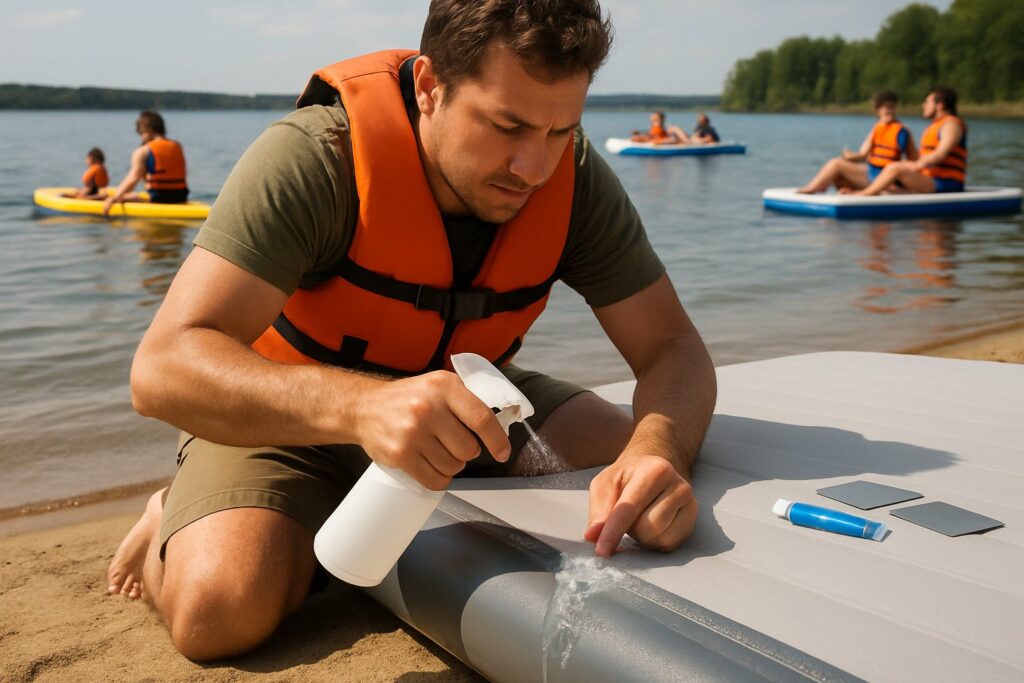
    Man spraying soapy water on an inflatable dock seam to find a leak

    In short: inflate the dock, find the leak with soapy water, deflate, clean the area with rubbing alcohol, glue on a round-cornered patch that overlaps the hole by about an inch, and let it cure for a full day before you pump it up. Use the adhesive made for your dock’s fabric: PVC glue for PVC docks (most consumer docks), Hypalon adhesive for Hypalon. Large tears, seam failures and anything that might be a defect go to the maker first.

    Before you patch: warranty and seams

    Two checks save trouble. First, warranty: Aquaglide’s repair instructions say that if you believe the product has a manufacturing defect, you should submit a warranty claim before making repairs, and a DIY patch may complicate a claim with any maker. Second, the kind of damage: RAVE’s Aqua Dock manual tells owners to contact RAVE for large holes, tears or seam failures, and to handle only minor holes and tears themselves. Seams on many docks are welded (Island Hopper says its docks have no glued edges or corners), which is factory work, not a kitchen-table repair.

    Step 1: find the leak

    1. Inflate the dock to its normal pressure on a clean, flat surface away from sharp objects.
    2. Mix mild soap in water and spray or sponge it over the deck, sides, seams and valve, a section at a time. RAVE suggests mild soapy water; Aquaglide says Windex or soapy water and a sponge.
    3. Watch for a stream of small bubbles. Check the valve and the area around D-rings and handles as well as the flat surfaces.
    4. Mark the spot with a grease pencil or tape, and note how big the hole is.

    If you find nothing and the dock still goes soft, remember that air pressure falls as the deck cools in the evening and rises in the sun. Re-check it at the same time of day before you decide it is leaking.

    Step 2: patch a PVC inflatable dock

    Most consumer docks (RAVE, Solstice, BOTE, Island Hopper, VEVOR and others) are PVC drop-stitch. RAVE’s manual gives these steps for minor holes and tears, using the patch kit that comes in the box:

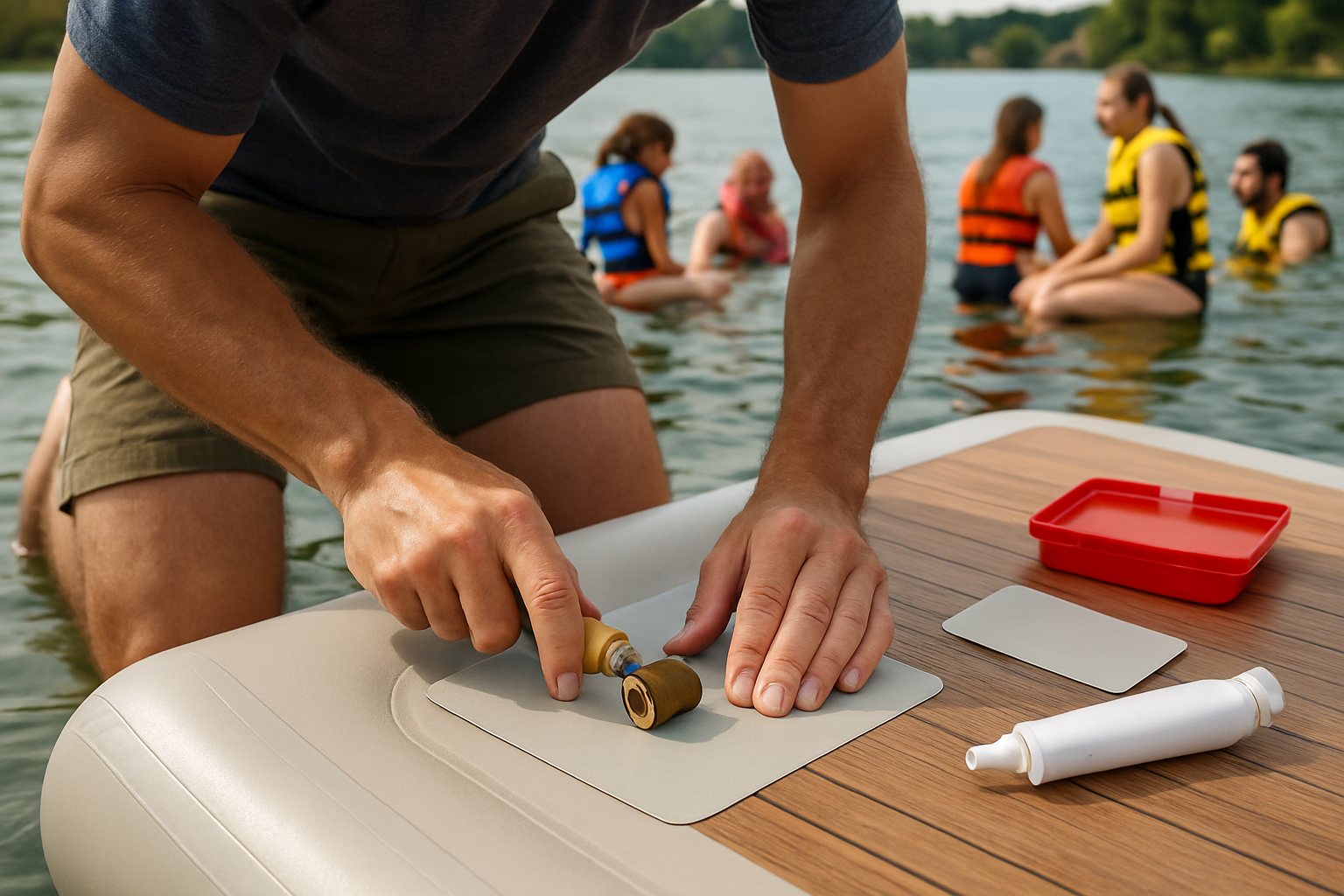
    1. Cut a patch 1 to 2 in (3 to 5 cm) wider than the hole, with all corners rounded. (Aquaglide’s instructions are similar: cover 1 in beyond the leak in every direction, corners rounded to about 1/4 in.)
    2. Deflate the dock.
    3. Clean the patch and the area around the hole with rubbing alcohol, and let both dry completely.
    4. Read and follow the warnings on the glue, and work somewhere ventilated.
    5. Apply glue to the patch and the area around the hole, and let it dry until tacky to the touch (RAVE: about 30 seconds; Aquaglide: 30 to 60 seconds, until the surface glazes slightly).
    6. Lay the dock on a flat, hard surface, place the patch, and rub out air bubbles working from the center to the edges.
    7. Let the patch dry for 24 hours before inflating.

    Then inflate to pressure and run the soapy-water test again over the patch. If bubbles still appear, peel and redo it rather than stacking a second patch on top.

    PVC vs Hypalon: use the right adhesive

    Some docks, mostly on yachts, use Hypalon (CSM rubber) instead of PVC. Henshaw’s superyacht jet ski docks, for instance, have a Hypalon tube base under a drop-stitch top. The two fabrics need different glues. Polymarine, a UK maker of inflatable boat adhesives, says it is “very important to use the correct adhesive” for PVC or Hypalon, and its Hypalon adhesive guide states that the Hypalon glue is not for plasticised PVC.

    PVC dockHypalon dock or tube
    How to tell (Polymarine)Same color both sides; stays glossy when sanded; feels tacky after a light solvent wipeDark grey or black on the inside (look through the valve); sands to a matte, suede-like nap
    AdhesivePVC adhesive (for example the vinyl cement in a PVC patch kit)Hypalon adhesive; Polymarine uses a two-part glue for permanent repairs and calls its one-part tube an emergency fix
    Surface prepClean; Polymarine says don’t sand PVCSand lightly until it looks like suede, then clean with Hypalon solvent
    CureRAVE: 24 hours before inflatingPolymarine: at least six hours to dry; full cure 48 hours per its product sheet

    Polymarine’s two-part Hypalon method is more involved: mix the adhesive with its curative at 25 to 1 and use it within four hours, don’t glue in humid air (it “blooms,” turning slightly white, and must be removed), paint a thin first coat and let it dry at least 30 minutes, add a second coat to both surfaces and wait until tacky (5 to 15 minutes), then press the patch down hard from the middle out. Damage over 75 mm in any direction needs an inside patch as well as an outside one. The solvents involved are very flammable, so work outdoors or with good ventilation and no flames.

    Valve leaks

    If the bubbles come from the valve, it may only need cleaning and tightening. Many docks use H3-style high-pressure valves like those on paddle boards. Check that the stem is in the closed position (on RAVE’s dock you depress the stem and rotate a quarter turn to lock it open or closed), clear any sand from the seal, and if the valve body itself is loose, tighten it with the valve wrench your maker specifies. Replacement valves and parts come from the maker or its distributor; Aquaglide’s manual sends owners to its distributor or website for valves, handles and rings.

    Repair kits worth keeping in the dock bag

    Your dock’s own kit is the first choice because it matches the fabric. As spares for PVC docks, these were in stock on Amazon when we checked:

    PVC patches and glue

    JLF Repair Kit with HH-66 Vinyl Cement

    • 5 PVC patches, 3 x 6 in
    • 1 oz HH-66 vinyl cement
    • 6-prong valve wrench
    Check price on Amazon
    Small field repairs

    Stormsure SUP Repair Kit

    • TUFF Tape strip and patches
    • Polyurethane adhesive tubes
    • Sold for paddle boards
    Check price on Amazon

    The JLF kit’s patches are thick PVC raft material and the listing says its wrench fits 6-prong valves (check yours before relying on it). Stormsure’s kit is a quick, flexible fix sized for small punctures. Neither is Hypalon adhesive; for a Hypalon dock, follow your maker or a Hypalon-specific product.

    Avoiding the next leak

    • Carry, don’t drag. RAVE’s manual repeats it: always carry the dock to the water.
    • Inflate on a clean surface, free of rocks and sticks.
    • Keep it firm on the water. RAVE warns that muskrats may chew PVC; keeping full pressure or taking the dock out at night helps.
    • Don’t over-inflate. Stay within the maker’s pressure (RAVE: never beyond 5 psi on its dock).
    • Store it well. Clean, dry and out of the sun; see how to store an inflatable dock.

    More care guides live on our Setup and Care hub, including inflation and maintenance tips. To understand the fabric you’re patching, read drop-stitch docks explained; for spare pumps, lines and ladders, see dock ladders and accessories.

    Inflatable dock repair questions

    How do I find a slow leak in an inflatable dock?

    Inflate it fully and go over every surface, seam and the valve with soapy water, watching for bubbles. Re-check pressure at the same time of day, since temperature alone changes it.

    What glue do I use on an inflatable dock?

    The adhesive for its fabric. Most consumer docks are PVC and take PVC adhesive, usually supplied in the dock’s repair kit. Hypalon needs Hypalon adhesive; Polymarine says its Hypalon glue is not for plasticised PVC.

    How long before I can inflate after patching?

    RAVE says 24 hours for a PVC patch on its dock. Polymarine gives at least six hours to dry for a two-part Hypalon patch and 48 hours for a full cure.

    Can I fix a leaking seam myself?

    Makers generally say no. RAVE asks owners to contact it for seam failures, large holes and tears, and Aquaglide asks for a warranty claim before repairs if you suspect a defect.

    Can I patch a dock while it’s in the water?

    Not properly. The steps in RAVE’s manual call for a deflated dock, a clean and fully dry surface, and a flat, hard work surface, followed by a day of curing.