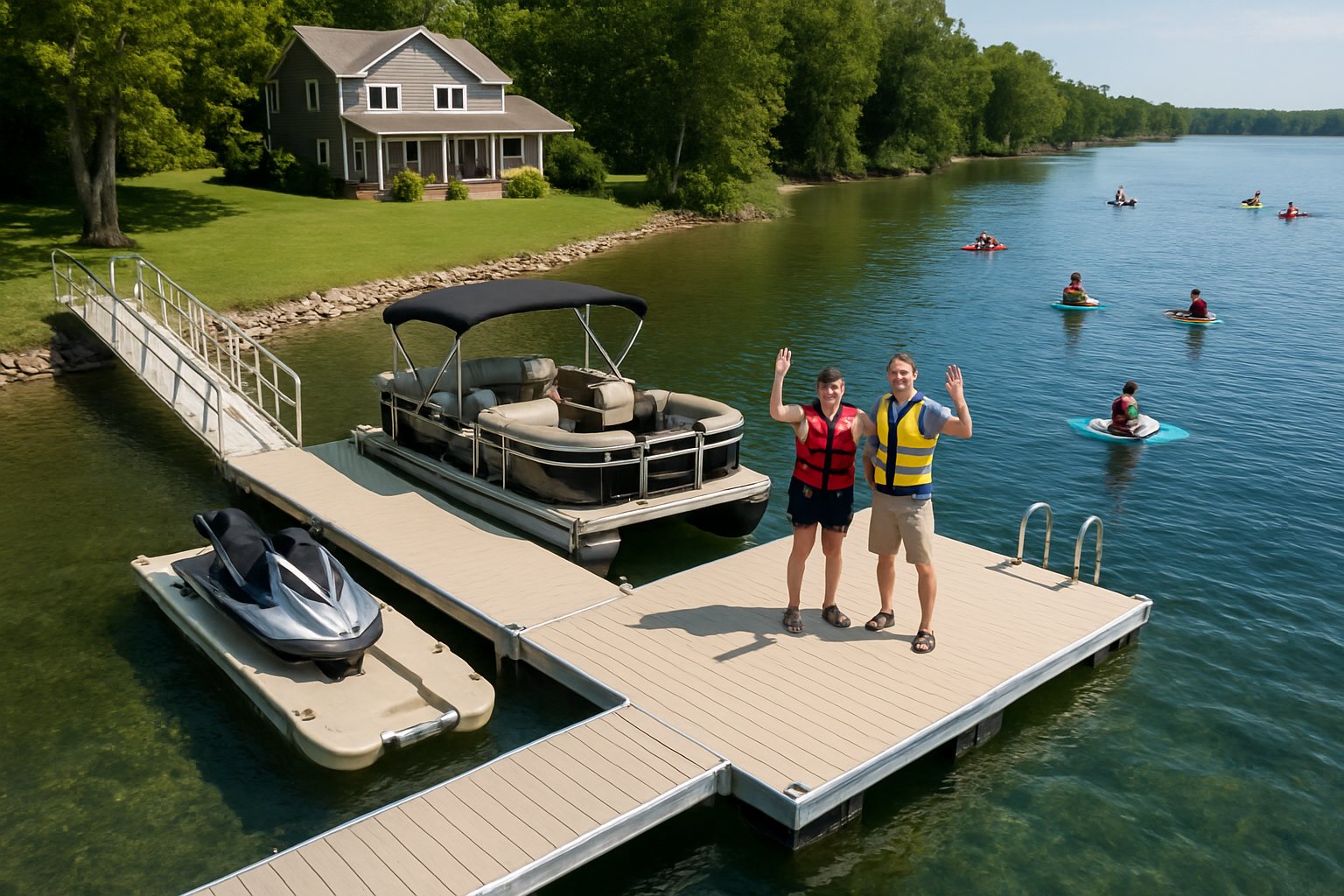
It is the first warm Saturday at the lake house. The boat is in the water, the kids want to swim, and someone has to decide where the new dock goes, how big it should be and who is going to put it in. It is easier when you see the dock as one system. Floating dock systems for homes are built from a handful of pieces that have to work together: the dock sections, what makes them float, the walkway from shore, the anchoring that keeps it all in place, and the accessories you add for boats and people. This guide walks a homeowner through planning one, from sizing to permits, winter and a realistic budget.

In short: a residential floating dock system is the deck, the floats or float sections, a gangway or ramp to shore, anchoring, connecting hardware and accessories, planned as one unit. Size it around your boats, your people, your water depth and how much the water level moves, then check your federal, state and lake rules before you buy. Published prices we found in October 2026 run from $2,550 for a 16 ft DIY kit to several thousand dollars more for a gangway alone, and most full-size systems are priced by quote.
What a floating dock system includes
A floating dock rises and falls with the water instead of standing on legs. ShoreMaster, a large US dock maker, puts the main advantage simply: the system adjusts to water levels on its own, and it suits deep water where posts may not reach the bottom. Every floating dock system, whatever the brand, is built from the same parts:
| Part | What it does | Read more |
|---|---|---|
| Dock sections | The deck you walk on: a wood or aluminum frame with decking, or molded plastic sections that are both deck and float | Modular docks |
| Floats | Encapsulated foam or air-filled floats under a framed dock; built in on plastic modular sections | Dock floats |
| Gangway or ramp | The hinged walkway from shore to the floating part; it pivots as the water moves | Ramps and hardware |
| Anchoring | Pipes or pilings, stiff arms to shore, or weights and chains that hold the dock in place | How to anchor a floating dock |
| Hardware | Connectors, hinges, corner brackets and cleats that join sections and tie off boats | Ramps and hardware |
| Accessories | Boat lifts, PWC (jet ski) ports, kayak launches, ladders, benches, bumpers and lights | Ladders and accessories |
Makers sell these as a family. EZ Dock, for example, lists PWC ports, a boat lift, benches, bumpers and edging that fit its sections, plus gangway options in wood kits, polyethylene up to 18 ft and aluminum. Once you pick a brand, most accessories come from the same family, so check the whole catalog first. The shape of the dock (straight, L, T or U) is a separate decision, covered in floating dock designs and layouts.
Sizing a residential floating dock
Size comes from five things. Write each down before you call a dealer.
Your boats and toys
List every boat, jet ski, kayak and paddleboard that will live at the dock, with lengths and weights. A pontoon needs a long straight side, a jet ski a drive-on port, and a boat perhaps a lift; ports and lifts carry their own maker weight limits. If a PWC is part of the plan, see floating docks for jet skis.
Your people
Think about the busiest day, not the average one: the Fourth of July with everyone at the ladder end. Capacity is set by the maker, section by section. Connect-A-Dock, for example, rates each 1000 Series section (60 x 45 in) at up to 690 lb and each 2000 Series section at up to 2,500 lb. Tommy Docks rates its FLEXX 48 x 48 in floats at 650 lb each. Use the maker’s figures and leave room to spare; we don’t calculate safe loads for individual docks.
Water depth and deck height
Floating docks draw very little water themselves (EZ Dock’s sections are 15 in high and draw about 1 1/2 to 2 in), but your boat and lift need depth at low water, not just on the day you measure. Deck height above the water, called freeboard, also matters. Connect-A-Dock’s 1000 Series sits about 8 in above the water and its 2000 Series about 17 in. Barr Plastics, a float maker, recommends 12 to 14 in for most residential framed docks.
Your shoreline
Measure your frontage, find your property lines and note what the shore is: a seawall, a sandy beach, a steep bank or riprap. The shore end decides how the gangway attaches and which anchoring works. Rules often set the limits here too. Illinois’s statewide permit for minor docks, for example, keeps docks within 50 ft of shore, no more than 10 ft wide and at least 10 ft from the projected property line. Moving water brings its own planning; see a floating dock on a river.
How much the water level moves
This is where floating systems earn their keep. EZ Dock says the best docks for lakes with fluctuating water are those with a gangway, which links the floating dock to shore so it can sit over deeper water. ShoreMaster’s residential gangways are 4 ft wide in 16, 20 and 24 ft lengths, with hinges and rollers that follow the water up and down. The bigger the swing between high and low water, the longer the gangway needs to be to keep the slope comfortable at low water.
Seasonal or year-round floating dock systems
Floating docks are easier to take out than fixed ones, and ShoreMaster says that is one of their strengths for seasonal boaters. Whether you should take yours out depends on ice, not cold. Connect-A-Dock says freezing temperatures will not harm its docks but recommends removing them for the winter where ice shifts. EZ Dock’s winterizing guide says its docks float high enough to resist normal ice pressure, warns that ice can be very damaging to anything in its path, and advises removing the dock and pilings where ice flow is severe. It also suggests a bubbler or deicer to keep water moving. Barr Plastics adds that removing decking and accessories for winter, and placing the dock where it is less exposed to ice and wind, both help.
- Plan for removal if your lake freezes and the ice moves: choose sections you can disconnect, a gangway that unpins at the shore and a place on land to store it all.
- Plan for year-round only where the water stays open or the maker and a local dealer confirm your site and model can stay in, and budget for a bubbler or deicer if they recommend one.
- Ask about spring. Who reinstalls, what it costs, and how the anchoring is reset after the ice goes out.
Floating dock kits or a dealer-installed system
There are two ways to buy. Floating dock kits come with a fixed parts list and a published price, and you install them yourself. Connect-A-Dock’s 20 ft straight kit, for example, includes four 3.75 x 5 ft sections, connectors, pole anchoring connectors, cleats and a gangway hinge, but not the Schedule 40 pipe for piling anchoring. Tommy Docks sells FLEXX packages with polyethylene floats and connectors, with or without pipe guide kits. Kits suit simple sites: a pond or calm lake with little change in water level.
Dealer systems are quoted for your site. EZ Dock says it has no single price list and that cost depends on location, environmental considerations, shipping, local regulations, accessories, PWC weight, size and layout; quotes and financing come through local dealers. EZ Dock also says most of its docks can be installed in a day by you and a helper, or by the dealer. ShoreMaster dealers offer anything from full installation to occasional pointers. A dealer is worth it when the site is hard: deep or moving water, big level swings, ice, a boat lift, or a permit that needs drawings.
Either way, read the exclusions. Kit and dealer prices often leave out anchoring pipe, decking, delivery and installation. Our floating dock installation guide covers the work step by step.
Permits for a residential floating dock
Rules vary by state, county, lake and the agency that manages the water, so treat this as a map of who to ask, not a final answer.
- U.S. Army Corps of Engineers. Federal rules name piers and boat docks as structures that need a Department of the Army permit in navigable waters of the United States, unless a general permit covers them (33 CFR 322). The current Nationwide Permits took effect on March 15, 2026 and expire on March 15, 2031. None of them is a general permit for a new private dock. NWP 3 covers maintenance and replacement of a previously authorized, still serviceable structure; NWP 10 covers non-commercial single-boat mooring buoys; NWP 11 covers small floating docks placed temporarily for events or seasonal use, removed within 30 days after use ends. Private docks are often handled under regional general permits issued by each Corps district. The Corps’ Buffalo District, for instance, says a simple private dock in New York may need a Corps permit and points to its Regional General Permit 87-000-1. Your district regulatory office can tell you what applies.
- Corps-managed lakes. On lakes the Corps owns and operates, floating structures are allowed at the district commander’s discretion through Shoreline Use Permits under each lake’s Shoreline Management Plan (36 CFR 327.19).
- States. Minnesota’s DNR says docks from shore generally need no DNR permit unless they exceed width or mooring-space limits, though local ordinances may apply. Illinois covers minor docks under Statewide Permit No. 5 with size and anchoring conditions.
- Lake authorities and utilities. Reservoirs run by TVA, power companies or lake associations often have their own dock rules, including what flotation you may use. TVA, for one, prohibits new unencased foam and used drums as flotation.
More detail, and how to find each office, is in our permits and local rules guide. Ask before you order, since some rules limit size, length and width, which ShoreMaster also flags.
Budgeting: real prices for floating dock systems
These are prices published on maker and dealer pages when checked in October 2026. They are list prices for parts, before delivery, anchoring and installation unless the listing says otherwise.
| Item | Where listed | Price seen |
|---|---|---|
| Tommy Docks FLEXX 16 ft straight package (four 48 x 48 x 15 in floats, connectors) | tommydocks.com | $2,550 |
| Same package with two 8 ft pipe guide kits | tommydocks.com | $3,050 |
| Tommy Docks FLEXX 16 x 8 ft package (eight floats) | tommydocks.com | $4,950 |
| Connect-A-Dock 20 ft straight kit (four sections, pipe not included) | Amazon | $4,878 |
| Tommy Docks FLEXX floating PWC port | tommydocks.com | $2,300 |
| Tommy Docks FLEXX floating kayak launch | tommydocks.com | $1,595 |
| ShoreMaster 4 x 24 ft residential gangway frame and handrails (decking not included) | Boat Lift and Dock | $5,525 |
| Candock 4 x 16 ft welded gangway with transition plate and railings (decking separate) | Boat Lift and Dock | $4,855 |
| Tommy Docks 7-step angled ladder with mounting hardware | tommydocks.com | $325 |
| EZ Dock systems | ez-dock.com | No price list; quote through a dealer |
A long gangway can cost as much as the dock itself. For a wider look at costs, including inflatable and framed docks, see floating dock cost.
Questions to ask a dock dealer
- What is the stated capacity of each section, and the freeboard with and without people on it?
- How will you anchor it at my site, and is the anchoring included in the price?
- What gangway length do I need for my lowest water level, and what will the slope be then?
- Can it stay in over winter here, and if not, what does removal and spring installation cost each year?
- Which permits do I need, and will you prepare drawings or file them?
- Which lifts, PWC ports and accessories fit this system, and what are their weight limits?
- What does the warranty cover, for how long, and who handles a claim?
- What exactly is in the quote: delivery, decking, hardware, installation, haul-away of an old dock?
- Can I add sections later, and will the parts still be available?
Floating dock kits and parts you can buy online
For DIY builders and for adding to an existing dock, these were available on Amazon when checked in October 2026. Prices change often.
Connect-A-Dock 20 ft Straight Floating Dock Kit
- Four 3.75 x 5 ft sections, up to 690 lb each
- Cleats, gangway hinge, pole connectors; pipe not included
- About $4,878, seen October 2026
Taylor Made Dock Float 24 x 48 x 16 in
- 600 lb stated buoyancy
- PE shell, EPS foam, made in USA
- About $198, seen October 2026
Extreme Max 3005.5588 Floating Dock Link Connector Kit
- Two 5 in hinge-link assemblies
- Backer plates, galvanized hardware
- About $81, seen October 2026
4-Step Stainless Telescoping Dock Ladder
- 316 stainless, flip-up
- 600 lb capacity (seller)
- About $160, seen October 2026
Where inflatable docks fit
An inflatable dock is a lighter option for swimming, lounging and launching kayaks, and it packs into a bag for winter. It is not a replacement for a full floating boat dock system with a gangway and a boat lift, but many lake homes use one alongside the main dock. Our homeowners and lake houses page shows how the two fit together.
Your floating dock planning checklist
- List boats, PWCs and paddle craft with lengths and weights.
- Estimate the most people you will have on the dock at once.
- Measure water depth at low water where the dock and boats will sit.
- Note high and low water levels, current, wind and boat wake.
- Map your frontage, property lines and the type of shore.
- Decide: seasonal removal or year-round, based on ice.
- Call your Corps district, state agency and lake authority about permits.
- Choose a layout and a brand family, then the gangway and anchoring.
- Get two or three written quotes and compare what each includes.
- Schedule installation and plan winter storage.
Planning something larger, such as a shared dock for an HOA or a lake association? Request more information and tell us about your site.
Floating dock system questions
What is a residential floating dock system?
A dock for a home that floats on the water and is planned as a set: deck sections, floats, a gangway to shore, anchoring, connecting hardware and accessories such as ladders, PWC ports and boat lifts.
How much does a floating dock system cost?
Published prices in October 2026 started at $2,550 for a 16 ft Tommy Docks FLEXX kit and $4,878 for a 20 ft Connect-A-Dock kit, before anchoring pipe and delivery. EZ Dock and most dealer systems are priced by quote.
Do I need a permit for a floating dock?
Often, yes, from at least one agency. On navigable waters the Army Corps may require a permit, usually through a regional general permit from your district. States, counties and lake authorities have their own rules. Some, like Minnesota for docks within its limits, require none.
Can a floating dock stay in the water all winter?
Sometimes. Moving ice, not freezing, is the problem, so makers such as Connect-A-Dock and EZ Dock recommend removal where ice shifts or flows hard. Ask your dealer about your lake.
Can I install a floating dock kit myself?
Many homeowners do. Connect-A-Dock says one person can install its sections, with two or more recommended, and EZ Dock says most of its docks go in within a day with a helper. Hire a dealer for deep or moving water, big level changes or a boat lift.