
Labor Day weekend: the last swim off the dock, the last sunset with your feet in the water, and then the job nobody looks forward to. How you put an inflatable dock away decides whether it comes out next June firm and clean or musty, sticky and chewed. Good inflatable dock storage takes an afternoon and a dry spot in the garage. This guide follows the makers’ own manuals for cleaning, drying, folding and storing, covers overnight and mid-season storage, and explains how winterizing a rigid floating dock differs.
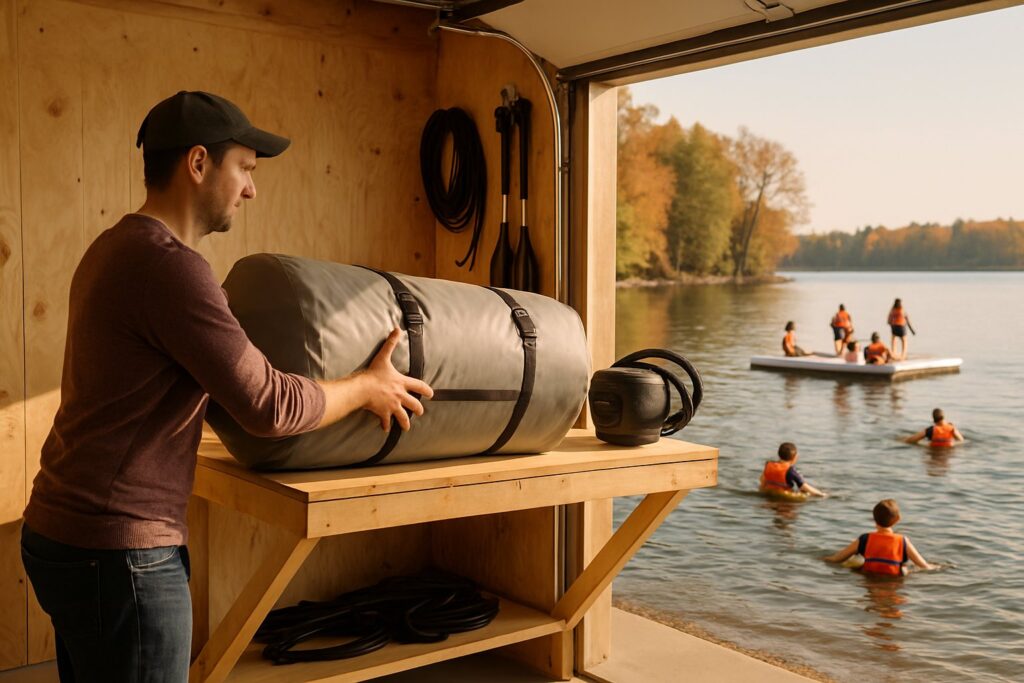
In short: bring the dock ashore without dragging it, wash it with mild soap and fresh water, dry both sides completely, deflate fully, fold it in thirds and roll it loosely toward the valve, then store it out of the sun in a clean, dry, rodent-proof place. Aquaglide says never to store its products damp or below 40 °F (4 °C). Rigid floating docks are a different job: makers suggest removing them where ice shifts.
Inflatable dock storage, step by step
- Bring it ashore the right way. RAVE’s manual says to carry the dock to land, or deflate it carefully on a flat surface on your boat, and to be “extremely careful not to drag the product.” Unclip anchors and lines first.
- Clean it. Use mild soap and fresh water with a soft brush or sponge. Aquaglide says not to use petroleum-based cleaners and to avoid high-pressure washing, which can damage the product; RAVE’s manual also rules out petroleum products and solvents.
- Protect it. Aquaglide recommends regularly applying a UV protectant to exposed surfaces and doing so before storage.
- Dry it completely. RAVE suggests letting the dock dry for 15 minutes or longer in the sun, flipping it to dry the other side, and towelling off anything still damp. Aquaglide: confirm it is completely dry before folding.
- Deflate fully. Aquaglide suggests an electric pump in deflate mode to get the last air out; RAVE’s own rapid inflator has a deflate side.
- Fold and roll. RAVE: fold the dock into thirds with the EVA pad sections folded in, then roll it like a sleeping bag starting from the end opposite the valve, and secure it with the straps. Aquaglide: fold in thirds, then roll loosely toward the valve.
- Store it well. Out of direct sunlight, in a clean, dry place such as a sealed closet, crate or container that keeps rodents out (Aquaglide), and never damp or below 40 °F.
Rolling toward the valve lets air left inside escape as you go. A rolled dock is compact, so plan a shelf or closet rather than a corner of the boathouse. Folded sizes that makers and dealers publish:
| Dock | Inflated | Folded or rolled | Weight |
|---|---|---|---|
| BOTE Inflatable Dock 7 | 7 x 7 ft, 8 in | 44 x 19 x 10 in | About 35 lb |
| BOTE Inflatable Dock 10 | 10 x 10 ft, 8 in | 63 x 22 x 10 in | About 83 lb |
| Solstice 10 x 10 | 10 x 10 ft, 6 in | 29 x 18 x 11 in | 54 lb |
| Island Hopper Yacht Dock | 10 x 6 ft, 6 in | 40 x 16 x 14 in | 53 lb |
Where to store it: what the makers say
| Concern | RAVE (Aqua Dock manual) | Aquaglide (C-Deck manual) |
|---|---|---|
| Sun | Store in a covered, shaded area to protect against UV | Out of direct sunlight; apply UV protectant |
| Moisture | Dry fully before folding | Never store in a damp location |
| Cold | Not stated | Never store below 40 °F (4 °C) |
| Rodents | Muskrats may chew the PVC; on the water, keep full pressure or take it out at night | Store in a sealed closet, crate or container against rodent damage |
| Folding | Thirds, EVA pads in, roll from the end opposite the valve | Thirds, roll loosely toward the valve(s) |
Aquaglide’s 40 °F rule matters for anyone who planned to leave the dock in an unheated shed through a northern winter. If your garage drops below that, store the dock indoors in a basement or closet. Other makers may publish different figures; check your own manual.
Overnight and mid-season storage
You don’t have to pack the dock away every evening, but RAVE’s manual does say that after use it is best to deflate and fold it for storage to prevent damage and extend its life. If you leave it out between weekends, keep it at full pressure and well anchored, and check the pressure in the morning and the afternoon: air expands in the sun and contracts at night. RAVE notes that full pressure discourages muskrats, and taking the dock out of the water at night removes the temptation. Before a forecast storm, bring it in; RAVE says never to use its dock in high winds, waves or storms, and no consumer dock maker we checked publishes a wind limit. Some lakes also have rules on what may stay in the water overnight; ask your local agency.
Winterizing a floating dock that isn’t inflatable
If you also own a rigid floating dock, winterizing it is a different decision: leave it in or take it out. The makers we checked put the risk on moving ice rather than cold:
- Connect-A-Dock says freezing temperatures won’t harm its polyethylene docks, but “with shifting ice, we recommend removal for the winter months.”
- EZ Dock says ice can be very detrimental and floating ice carried by currents can damage docks and gangways. It calls removal the best protection in severe winters, says sectional floating docks generally don’t need removal in normal winters, and recommends removing the dock and pilings where ice flow is severe.
Whichever you choose, ask your dealer about the anchoring in winter, since water levels change and fasteners can work loose through freeze and thaw. For more on rigid docks, see EZ Dock vs inflatable docks, Wave Armor vs inflatable docks and inflatable vs rigid floating docks.
Spring: getting the dock back out
- Unroll on a clean, flat surface free of rocks and sticks, and look over the deck, seams, handles, D-rings and valve.
- Inflate to the maker’s pressure with a gauge, leave it for a few hours, and check it again before you float it.
- If it loses air, run the soapy-water test; our inflatable dock repair guide has the patch steps.
- Check anchor lines, shackles and the anchor itself before it goes back down; RAVE’s manual asks owners to inspect for worn, defective or missing parts.
- Re-attach anchors only to the anchor points the maker provides. RAVE’s dock has two, one at each end on the bottom, so wind can’t swing it around.
Handy for storage day
An electric pump with a deflate setting gets the last air out, and a repair kit stored in the dock bag means a pinhole found in spring is a ten-minute fix. These were in stock on Amazon when we checked:
JLF Repair Kit with HH-66 Vinyl Cement
- 5 PVC patches
- HH-66 vinyl cement
- Valve wrench
Stormsure SUP Repair Kit
- TUFF Tape patches
- Polyurethane adhesive
- For small punctures
For pumps, lines and ladders, see dock ladders and accessories. Every care guide is on our Setup and Care hub, along with inflating and installing your dock and the FAQ.
Storage and winterizing questions
Can I store an inflatable dock inflated?
For the off-season, the makers we checked say to deflate it: Aquaglide says to deflate completely before folding, and RAVE says it is best to deflate and fold the dock for storage after use.
Can an inflatable dock stay in a cold garage over winter?
Check your manual. Aquaglide says never to store its products below 40 °F (4 °C) or in a damp place, so an unheated garage in a cold climate may not qualify.
How do I keep mice and muskrats away from my dock?
On the water, RAVE suggests keeping full pressure and taking the dock out at night. In storage, Aquaglide suggests a sealed closet, crate or container.
Do I need to winterize a floating dock?
An inflatable dock should simply come out, be cleaned and dried, and be stored indoors. For rigid floating docks, Connect-A-Dock recommends removal where ice shifts, and EZ Dock recommends removal in severe ice conditions.
Should I use a protectant before storing?
Aquaglide recommends cleaning the product and considering a UV protectant before storage, and applying one regularly through the season. Avoid petroleum-based cleaners.