This article contains affiliate links: if you buy through them we may earn a commission, at no extra cost to you. Read our affiliate disclosure.
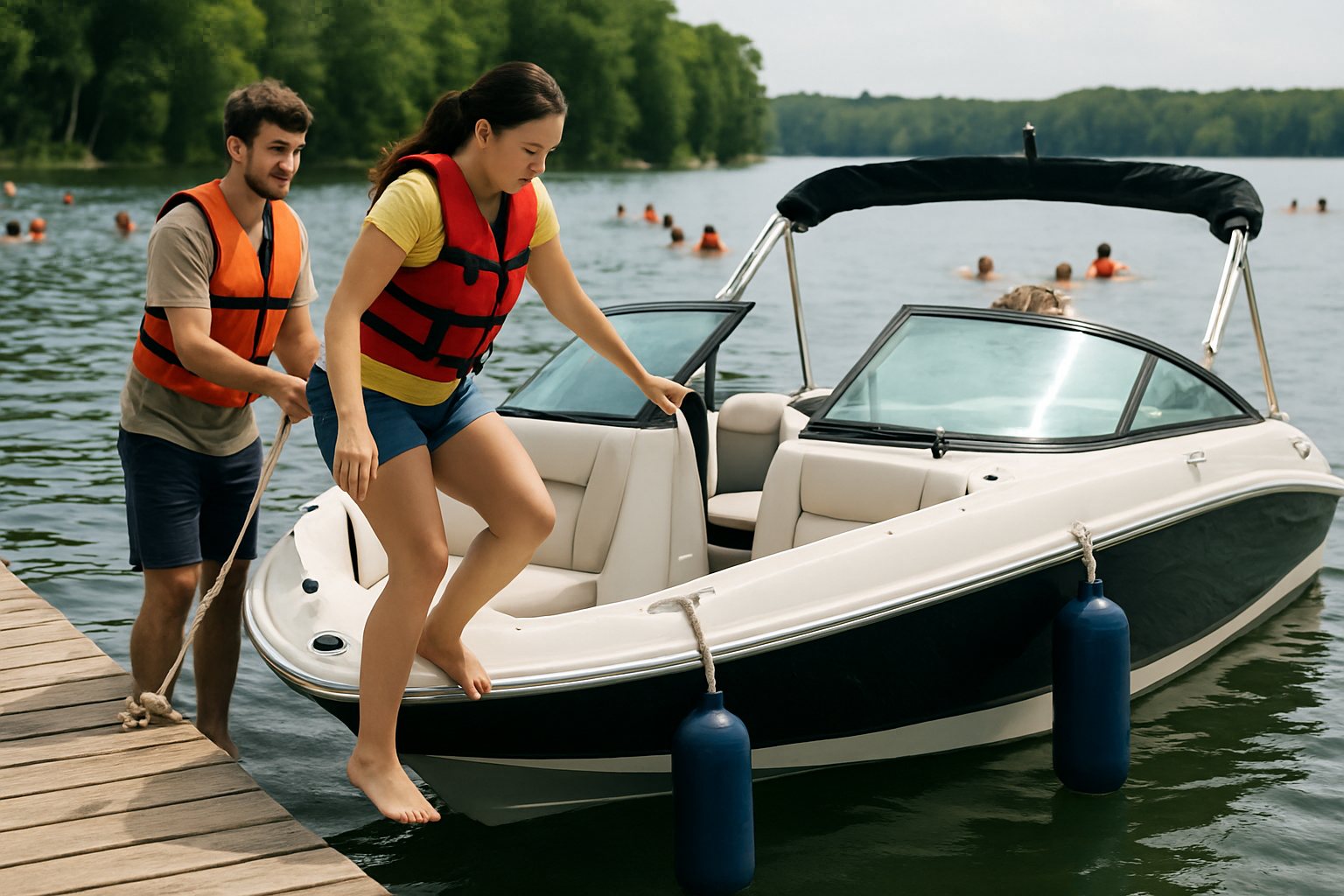
Late afternoon, the wind has picked up, and the boat is bumping against the dock. Grandpa has a cooler in one hand and a fishing rod in the other and is about to step across the gap. Knowing how to board a boat from a dock safely is mostly about a few habits: a secured boat, a free hand, a low center of gravity, and no hurry. This page covers the step itself, lines and cleats, fenders, wakes and weather, carrying gear and lighting the dock at night. Most of these steps apply to any floating dock; an inflatable dock moves a little more underfoot, so keep your weight low and centered as you step.
In short: make the boat fast to the dock before anyone steps, ideally with bow and stern lines, so it cannot drift away mid-step. Step onto the boat near its middle, low and onto a flat, non-slip surface, with at least one hand free for a grab point. Hand gear across; don’t carry it across. Use fenders between hull and dock, wait out passing wakes, and light the dock edge after dark. If the boat or dock is moving too much, stop and wait.
Why boarding deserves its own page
On the step from dock to boat, you are between two moving things. Under the Coast Guard’s reporting rules, injuries “while boarding or departing a docked, moored, or anchored vessel” with nothing else involved are not reportable, so there is no official total of dock falls to quote. What we can say from the Coast Guard is that most drowning deaths happen near shore in calm weather, many within a few feet of safety, and that most victims were not wearing a life jacket.
How to board a boat from a dock, step by step
- Secure the boat first. Bow and stern lines on the dock cleats, snug enough that the boat cannot swing away from the dock. The engine should be off or in neutral, and no one should be in the water near the stern.
- Pick your spot. Step aboard near the middle of the boat, where it is most stable, onto a flat deck or step, not onto a seat cushion, gunwale cap or wet swim platform.
- Keep a hand free. Hold a grab rail, the windshield frame or someone’s hand. Three points of contact is the habit to teach children.
- Stay low and step, don’t jump. Bend the knees and step down into the boat; keep your weight centered as you land.
- Time it. Wait for the boat to settle against the fenders, and wait out any passing wake.
- Life jackets on first for children and weak swimmers, before they step across. Federal rules require children under 13 to wear one once the boat is underway (or your state’s age).
Getting off is the same in reverse: boat secured, step up onto the dock with a hand on a post or rail, and do not step off until the boat is alongside. Watch the gap. If someone does fall in between the boat and the dock, get the engine off immediately and use a throwable or ladder, not another person, to get them out. See life jackets and throwables.
Lines, cleats and fenders
Use real dock lines, not leftover rope. Seachoice, for example, sells a 1/2 in by 20 ft double-braided nylon dock line with an eye splice and notes that nylon absorbs shock loads. Tie to cleats or posts rated for a boat, not to rails, ladders or the D-rings of an inflatable dock unless its maker says they are for mooring. RAVE’s Aqua Dock manual says not to connect the dock directly to docks, piers or other hard objects, and one of Aquaglide’s manuals says never to tie the product to a dock. Inflatable docks are anchored, not used as a mooring point for a boat, unless the maker sells them for that.
Fenders keep the hull off the dock and keep the boat from rolling as it rubs. Taylor Made’s Hull Gard chart, for example, suggests 4-1/2 x 16 in fenders for boats of 10 to 15 ft, says the chart is a minimum, and recommends 2 psi inflation. Set fenders at the height where hull meets dock, and check them as the water level changes.
Wakes, wind and weather
Boarding is easiest in flat water and hardest when a wake rolls in. Some states limit speed near docks to protect people there: New York’s Navigation Law, section 45, bans operating a vessel within 100 ft of the shore, a dock, pier, raft, float or an anchored or moored vessel at more than 5 mph. Your state may have a different distance or rule; check with your state boating agency.
When wind and waves make the boat surge against its lines, wait, move the boarding to a sheltered side, or skip the trip. The National Weather Service warns that a steady increase in wind or seas can signal approaching bad weather. More in storms and dock safety.
Carrying gear: hand it across
- One person boards empty-handed; the other passes coolers, bags and rods across.
- Set heavy items down in the middle of the boat, low, and keep within the boat’s capacity plate. The BoatUS Foundation notes that powered boats under 20 ft built after November 1, 1972 must display one, with maximum persons and weight for good to moderate weather.
- On an inflatable dock, keep the total load within the maker’s stated figure; see inflatable dock capacity explained.
Boarding from an inflatable dock
An inflatable dock moves more under your feet than a fixed pier. Keep it at the maker’s working pressure (RAVE’s Aqua Dock: 5 psi) so it stays firm, and keep it anchored as the maker says. The surface can be slippery when wet; RAVE’s manual says so plainly. Approach a boat’s swim platform only with the engine off. Our boarding and vessel access page covers docks built for this job.
Night lighting on the dock
After dark, the dock edge disappears. Some states set lighting rules for structures in the water: Illinois DNR requires dock posts under its statewide dock permit to be marked with reflective devices, and Minnesota’s 2026 Boating Guide says swimming rafts may not be in the water between sunset and sunrise without a county sheriff’s permit and must carry a light or reflectors. Check your state and local rules before you install lights, and if you add wired lighting, have a licensed electrician do it (see electric shock drowning).
Boarding checklist
| Before | During | After |
|---|---|---|
| Bow and stern lines on, fenders set, engine off | Step mid-boat, low, one hand on a grab point | Lines checked for the night |
| Kids’ jackets on | Gear handed across, not carried | Dock edge lit or marked |
| Swimmers clear of the stern | Wait out wakes | Throwable and ladder back in place |
4-Step Stainless Telescoping Dock Ladder
- 316 stainless steel
- 600 lb stated capacity
- About $160
Amarine Made 4-Step Telescoping Boat Ladder
- 304 stainless steel
- Folds over the platform
- About $60
Ladder prices as seen on Amazon in October 2026; capacity figures as the sellers state them. Back to the dock and boating safety hub.
Boarding and tying up FAQ
Should I board from the bow or the side?
From the side, near the middle, is usually the most stable point on a small boat. Some boats have a bow or stern boarding step; use what the boat’s maker designed for boarding.
Can I tie my boat to an inflatable dock?
Only if the maker sells it for mooring. Several manuals, including RAVE’s, warn against connecting the dock to docks, piers or hard objects.
How many dock lines do I need?
At least a bow and a stern line for boarding. Add spring lines where wind, current or wakes push the boat along the dock.
Is it safe to start the engine with people at the stern?
No. The Coast Guard says to shut engines off when people are in the water near the boat, and the CDC warns that carbon monoxide gathers near the stern and swim deck.