This article contains affiliate links: if you buy through them we may earn a commission, at no extra cost to you. Read our affiliate disclosure.
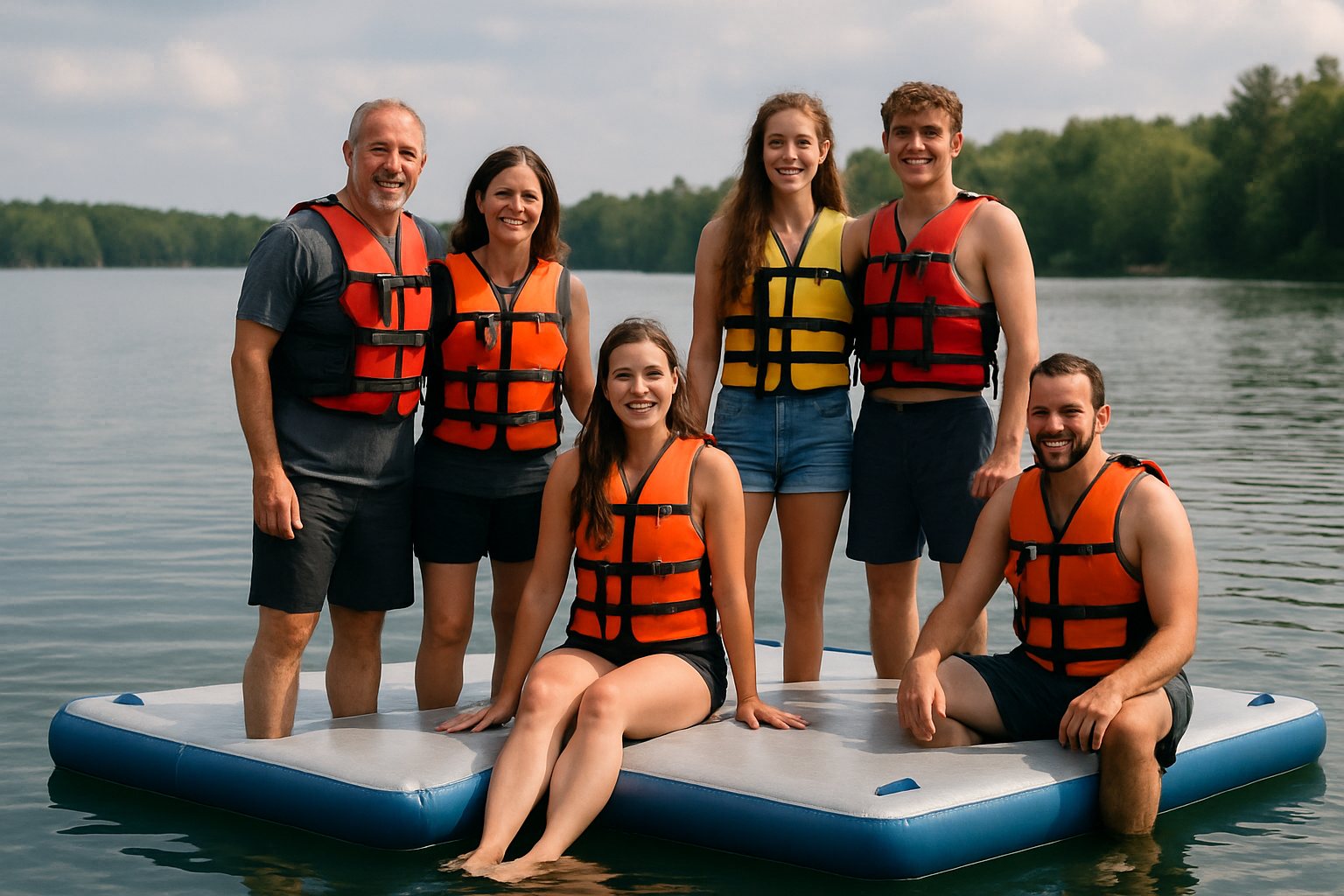
Late afternoon, the whole crew swims over to the dock at once: four adults, three kids and a dog, everyone climbing up the same side. The deck dips at that corner and someone asks the obvious question: how many of us can this thing actually hold? The answer is on the label, but it isn’t always one number. This guide explains inflatable dock weight capacity: the three kinds of figures makers publish, why they disagree, what “heavy duty” really means, and how to use them without guessing. Like any floating dock, an inflatable dock’s rated capacity depends on how much water it can displace before the deck sits too low.
In short: makers state capacity in one of three ways: a weight in pounds (sometimes called a load rating), a people count, or both tied to a specific pressure. They are not interchangeable, and a figure for static load is not a figure for people moving around or for a jet ski. Use the lowest figure your maker publishes for your exact model, inflated to the pressure it names, and if two sources disagree, ask the maker.
The three ways makers state capacity
| How it’s stated | Example (maker’s own figure) | What it tells you |
|---|---|---|
| Weight in pounds | Island Hopper: 1,000 / 1,500 / 2,000 lb load ratings for its 10 x 3, 10 x 6 and 10 x 10 ft docks | A total weight; it doesn’t say how many people |
| People count | Solstice: 3-5 people (6 x 5 ft) up to 8-10 people (10 x 10 ft) | How many people the maker expects on it, not their weight |
| Both, at a set pressure | RAVE: 1,800 lb, 14 users maximum; 5 psi recommended for up to 10 adults or 14 children | The most useful form: people, weight and the pressure that goes with them |
| People and pounds together | Aquaglide Docking Station: 600 lb (3 adults + 3 children) | A conservative people rating on a big deck |
| Per user | Jobe Infinity Dock: 300 kg maximum user weight | The maker’s maximum user weight for that module |
Look at how far apart the numbers sit. Aquaglide’s Docking Station is almost 15 ft long, yet Aquaglide rates it for 600 lb, while RAVE rates its 10 x 10 ft Aqua Dock for 1,800 lb. That is not proof that one is stronger. The makers are measuring different things, with different assumptions about how people move, where they stand and how much the deck may sink or flex.
Inflatable dock weight capacity vs people count
A pound figure on its own invites a bad shortcut: dividing it by an average body weight. Don’t. People jump, crowd one edge and climb on from the water, and a dock that floats a static load evenly can tip or fold at one corner. That is why the best ratings come with a people count. RAVE’s manual for the Aqua Dock lists a maximum capacity of 14 users and a maximum weight of 1,800 lb, and then says that 5 psi is “a recommended inflation pressure for up to 10 adults or 14 children.” Island Hopper’s figures, by contrast, appear in listings as load ratings in pounds with no people count, so ask the maker how many people a given dock is meant to carry.
We never work out a “safe load” from a dock’s size, and we suggest you don’t either. A larger deck doesn’t come with a proportionally higher rating (Aquaglide’s case above shows that), and nothing in the area of a deck tells you how its seams, valves or drop-stitch threads were tested. The figure that counts is the one printed on your dock and in its manual.
Pressure is part of the rating
A drop-stitch dock is only as stiff as the air in it. Makers state very different pressures: RAVE 5 psi for its Aqua Dock (and not to inflate beyond it), BOTE 6-8 psi for its 7 ft and 8-10 psi for its 10 ft dock, Island Hopper 8-15 psi for its Yacht Dock, and Solstice 10 psi on a dealer listing. A dock run soft will sag under the load it is rated for; one over-pressured can be damaged. Check with a gauge before people climb on, and again in the afternoon, since air expands as the deck warms in the sun. Our drop-stitch docks explained guide covers why pressure matters so much.
When the numbers conflict
It happens more than you’d think. BOTE’s own page lists its 10 ft Inflatable Dock at 2,100 lb, while some retailers list the same model at 1,500 lb. Solstice rates its 10 x 10 by people (8-10), while Overton’s lists it at 1,650 lb. When sources disagree, plan around the lower figure and ask the maker in writing which one applies to people on the deck. Our Solstice vs BOTE vs VEVOR comparison lays out these conflicts brand by brand.
Docks don’t have a capacity plate
Boaters know the capacity plate: the BoatUS Foundation explains that powered boats under 20 ft built after November 1, 1972 must display one, showing maximum persons and maximum weight, and that those limits apply in good to moderate weather (keep well below them in rough water). Inflatable boats are exempt, and inflatable docks aren’t boats, so there is no federal plate or common test standard behind their ratings. Each maker sets its own. The same caution applies, though: no consumer dock maker we checked publishes a wind or wave limit, and RAVE’s manual says never to use its dock in high winds, waves, strong currents or storms.
What “heavy duty inflatable dock” really means
“Heavy duty” and “military grade” appear all over listings, but neither is a defined spec; on consumer docks they are seller copy. What you can compare are the things makers actually publish:
- Thickness: most consumer docks are 6 in; BOTE’s are 8 in; yacht docks from Jobe and Yachtbeach are 20 cm (about 8 in).
- Fabric: Island Hopper lists a 1000-denier outer layer; Aquaglide 0.80 mm, 28 oz Duratex on its Docking Station.
- Seams: heat-welded (Island Hopper) or welded three-layer seams (Aquaglide) versus glued.
- Warranty and use: RAVE’s lifetime warranty is for personal use; Aquaglide gives 3 years residential but 1 year light commercial on its Half Deck.
Heavy duty for a family is not the same as rated for work. Recreational docks are not sold for passenger boarding, rental fleets or crews with equipment, and in some places passenger landing pontoons must be certified (a 1998 circular from Singapore’s maritime authority requires it). For commercial or rescue use, see the purpose-built products on our dock types hub and use Request more information.
Jet skis need a jet ski rating
A people count is not a jet ski rating. A flat swim dock is not sold for parking a personal watercraft, whatever its pound figure. Purpose-built docks such as Jobe’s Infinity PWC Dock or the yacht jet ski docks in our jet ski docks guide are the ones to look at, and even then, confirm with the maker which craft and weights a dock is rated for.
How to use a capacity rating
- Find the rating for your exact model and size in the manual or on the label, not a listing for a similar dock.
- Inflate to the pressure the maker ties to that rating, and check it with a gauge.
- Use the lowest figure when sources disagree, and the people count when both are given.
- Spread people out, climb on from different sides, and keep the deck clear of coolers that load one corner.
- Check the water depth the maker asks for (RAVE: at least 4 ft) and keep life jackets on non-swimmers and kids.
Two docks that publish clear ratings and were in stock when we checked:
RAVE Aqua Dock 10 x 10
- 1,800 lb, 14 users max
- 10 adults or 14 children at 5 psi
- 10 x 10 ft, 6 in
Island Hopper Yacht Dock 10 x 6
- 1,500 lb (maker)
- 8-15 psi
- 10 x 6 ft, 6 in
| Spec | RAVE Aqua Dock 10 | Island Hopper Mega Yacht Dock 10 x 10 | Aquaglide Docking Station |
|---|---|---|---|
| Size (as stated) | 10 x 10 ft x 6 in | 10 x 10 ft | 14 ft 9 in x 10 ft 5 in x 6 in |
| Thickness | 6 in drop-stitch | 6 in | 6 in (15 cm) welded drop-stitch |
| Stated capacity | 1,800 lb / 10 adults | 2,000 lb load rating | 600 lb (3 adults + 3 children) |
| Minimum water depth | 4 ft | not published | 4 ft; at least 10 ft from shore |
| Construction | Drop-stitch PVC | Heat-welded PVC with EVA top | 0.80 mm 28 oz Duratex, 3-layer seams |
| Inflation pressure | 5 psi | not published | not published |
| Weight | 68 lb | 75 lb rolled | not published |
| Anchoring / attachment | 2 anchor points | not published | 5 anchor rings; at least 1,100 lb anchor weight; anchors, bridle and pump not included |
| Warranty | Limited lifetime | not published | 3-year limited |
| Price signal | not published | not published | About $2,530 to $2,640 at dealers |
| See it at Bart's | See it at Overton's | See it at Bart's |
Figures as each maker states them; makers measure capacity differently. Check the product page for sources and dates.
More reading: our Setup and Care hub, best inflatable docks, lake docks, and the terms in our glossary and FAQ.
Capacity questions
How much weight can an inflatable dock hold?
It depends entirely on the model. Stated figures we found run from 265 lb (VEVOR 6 x 5 ft) and 600 lb (Aquaglide Docking Station) to 1,800 lb (RAVE 10 x 10 ft) and 2,100 lb (BOTE 10 ft, per BOTE). Use your dock’s own rating.
Is a load rating the same as a people limit?
No. A load rating is a total weight, often for a static, evenly spread load. A people limit accounts for how people move and gather. When a maker gives both, follow both.
Does a bigger dock always hold more?
No. Aquaglide’s nearly 15 ft Docking Station is rated 600 lb; RAVE’s 10 x 10 ft dock 1,800 lb. Ratings reflect each maker’s own testing and assumptions, not just area.
What is the most heavy duty inflatable dock?
There is no standard for “heavy duty.” Compare the published thickness, fabric, seams, stated capacity and warranty terms instead; among consumer docks, BOTE’s are thickest at 8 in, and yacht docks such as Jobe’s run 20 cm.
Does underinflating reduce capacity?
Makers tie their ratings to a pressure. RAVE, for example, gives 5 psi as the recommended pressure for up to 10 adults or 14 children. Below the stated pressure the deck is softer and the rating no longer reflects how it will behave, so pump to spec.
Leave a Reply