This article contains affiliate links: if you buy through them we may earn a commission, at no extra cost to you. Read our affiliate disclosure.
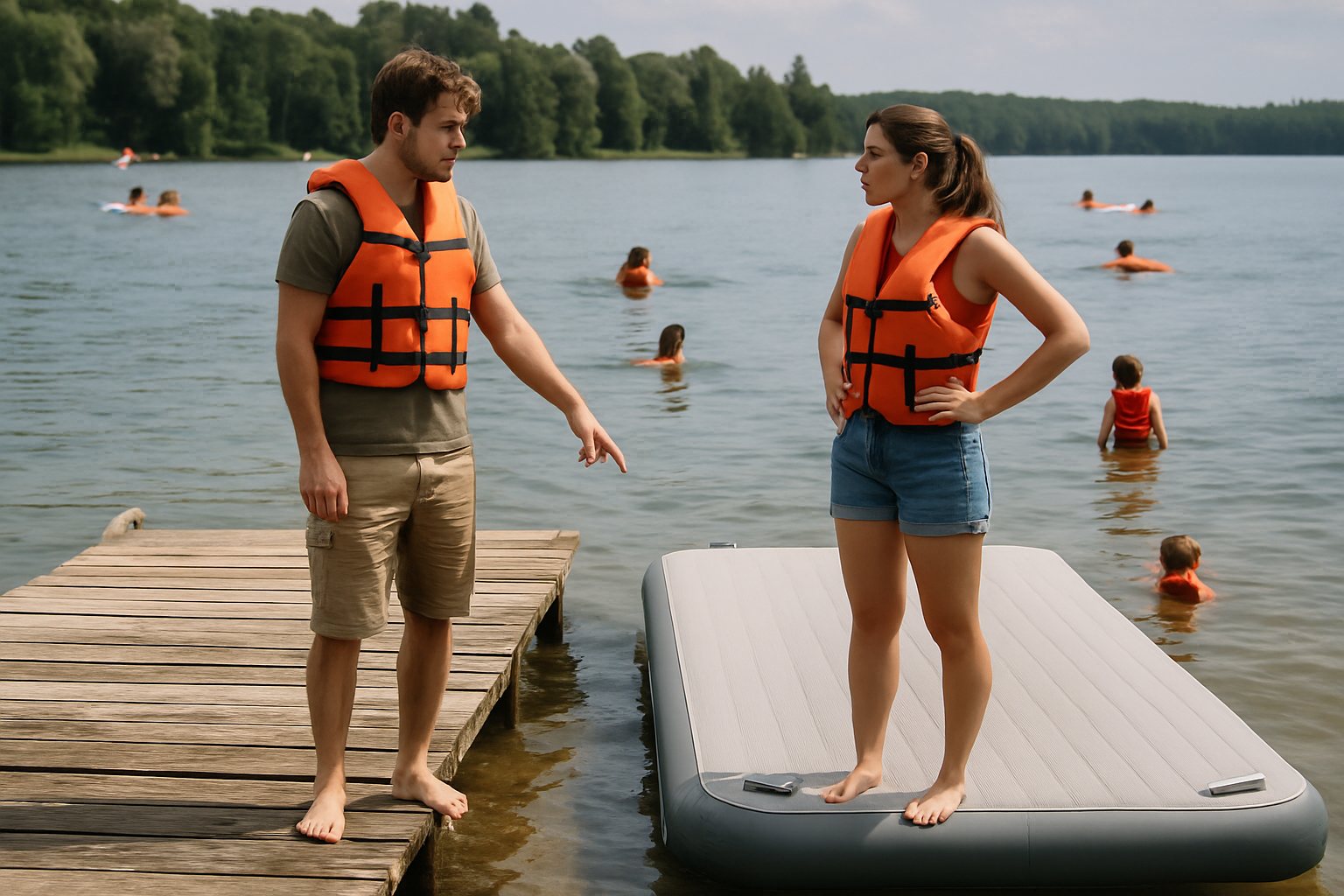
Picture a lazy summer afternoon at the lake: the boat is tied up, the kids are cannonballing off the end of the dock, and someone is already floating with a drink in hand. Whether that dock is wood on pilings or drop-stitch PVC pumped up hard changes a lot about your budget, your weekends and your shoreline. This guide compares inflatable docks vs traditional docks on cost, setup, care, stability, weather and how you actually use the water, so you can pick the one that fits. Strictly speaking an inflatable dock is a floating dock too, just one that uses pressurized air rather than foam, plastic cubes or metal pontoons for buoyancy.
Two very different kinds of dock
Inflatable docks and dock floats
A modern inflatable dock is made of drop-stitch PVC, the same construction as inflatable paddle boards. Thousands of threads tie the top and bottom together, so when you pump it to 5 to 15 psi it stays flat and firm enough to stand, sit and jump on. Most are 6 to 8 in thick and roughly 10 ft long, with D-rings and handles for tying off and climbing aboard.
You can clip one to your boat’s stern at anchor, float it in front of a lake house, or anchor it as a swim platform. At the end of the day it deflates and rolls into a bag.
Traditional docks
Traditional docks are built from wood, aluminum or composite decking. Some stand on posts or pilings driven into the bottom; others float on sealed foam or plastic floats and are anchored or hinged to shore. They are built to stay put for years, to hold a boat alongside, and to carry foot traffic every day of the season.
Inflatable docks vs traditional docks, side by side
- Purpose. Inflatable: a swim deck, lounge and launch pad. Traditional: a permanent place to tie up, load and walk on every day.
- Setup. Inflatable: unroll, pump, tie off, often in well under half an hour. Traditional: planning, materials and often a contractor.
- Portability. Inflatable: goes with you on the boat or to a rental cabin. Traditional: stays where it’s built.
- Feel underfoot. Inflatable: firm but with a gentle sway. Traditional: solid, especially on pilings.
- Weather. Inflatable: comes in before storms. Traditional: built to ride out a season, with its own upkeep.
- Permits. Inflatable: usually none for a dock you pack up daily. Traditional: often needs approval from your town, lake association or state.
Cost: what you pay up front and over time
Inflatable docks have a clear price tag. When we checked in October 2026, the boat-friendly Island Hopper Yacht Dock (10 x 6 ft) was about $750, the RAVE Aqua Dock (10 x 10 ft) about $800, and the 15 ft Island Hopper Patio Dock about $1,199. Budget a little more for an electric pump if one isn’t included.
A traditional dock has no single price. It depends on length, materials, your bottom and water depth, local labor, and any permits. Get quotes from local dock builders before you compare, and ask what yearly upkeep they expect.
Over time, an inflatable dock’s costs are mostly patches, a pump and eventually a replacement after many seasons. A fixed dock’s are sealing or replacing boards, hardware and seasonal work such as pulling sections out before ice.
Setup, care and the weather
Living with an inflatable dock
Island Hopper says its 10 x 6 Yacht Dock inflates in about 8 minutes with the included hand pump. Bigger, higher-pressure decks go faster with an electric pump; the Island Hopper Patio Dock includes a 12-volt one. Care is simple: rinse it, let it dry before you roll it up, keep it out of the sun when you’re not using it, and patch small holes early. Our inflatable dock maintenance guide covers the details.
Bring it in before storms and strong wind. If you leave one out, anchor it well and check the pressure, since heat makes the air expand.
Living with a traditional dock
A fixed dock is ready every morning with no pumping. In return, it needs regular checks of boards, fasteners and floats, cleaning and sealing, and in cold climates a plan for ice. On tidal water, piling docks don’t rise and fall, so many owners use floating sections with a ramp.
Which is right for you?
Choose an inflatable dock if you want a swim platform that goes with the boat, you rent or have only a short stretch of shoreline, you can’t build a fixed structure, or you want a place to lounge and launch paddle boards and kayaks at anchor.
Choose a traditional dock if you own waterfront, keep a boat in the water all season, need a solid place to load gear and passengers every day, or want something that stays put.
Or both. Plenty of lake houses keep a fixed dock for the boat and float an inflatable swim platform off the end for the kids. Add a dock slide and the afternoon takes care of itself.
Inflatable docks we like
If an inflatable dock fits your plans, these three cover most needs. For all seven picks, sizes and prices, see our best inflatable docks and swim platforms guide.
Island Hopper Yacht Dock 10 x 6
- 1,500 lb
- Corner bumpers
- EVA foam top
RAVE Aqua Dock 10 x 10
- 100 sq ft
- 1,800 lb
- Hand pump included
- Island Hopper Yacht Dock 10 x 6: designed to sit beside a boat, with rubber corner bumpers to protect your gelcoat and an EVA foam top. It holds 1,500 lb, weighs 53 lb and rolls up small.
- RAVE Aqua Dock 10 x 10: a full 100 sq ft for about 10 adults (1,800 lb), with handles all around and two anchor points. It needs at least 4 ft of water.
- Island Hopper Patio Dock 15: a 15 x 6 ft floating patio for big groups, rated over 2,000 lb, with a 12V electric pump and a soft ladder in the box.
Check the Island Hopper Yacht Dock price on Amazon
Still deciding on the type of float? Our guide to choosing the right inflatable dock float goes deeper on size, thickness and pumps. Browse all inflatable dock guides.
Inflatable vs traditional dock questions
Is an inflatable dock as stable as a wooden dock?
Not quite. A good drop-stitch dock is firm enough to stand, sit and jump on, but it floats, so it moves a little with waves and when people gather on one edge. Thicker docks flex less. A dock on pilings is the most solid underfoot.
Can an inflatable dock replace a permanent dock?
For swimming, lounging and launching paddle boards, often yes. For mooring a boat all season and loading people and gear every day, a traditional dock is the better tool. Some platforms, like the Aquaglide C Lounge, are made to stay anchored all summer, but they are still swim platforms rather than boat docks.
How much weight can an inflatable dock hold?
It depends on the model. Among the docks we compared, limits run from 1,100 lb to over 2,000 lb. Always check the maker’s rating and count people plus coolers and gear.
Do inflatable docks handle rough water?
They’re made for calm water. Use them at anchor in protected spots, keep them away from boat traffic, and bring them in when wind, waves or storms pick up.
Which is better for the lake or river bottom?
An inflatable dock tied to a boat touches the bottom only through the boat’s anchor, and it leaves with you. A fixed dock is a lasting structure, which is one reason many areas ask for a permit. If you go inflatable, make it last: keep it out of the sun when not in use, repair rather than replace, and recycle old PVC where your town accepts it.
Leave a Reply