Author: Inflatable Docks Experts

  • Floating Dock Ramps, Gangways and Hardware: How It All Connects

    Floating Dock Ramps, Gangways and Hardware: How It All Connects

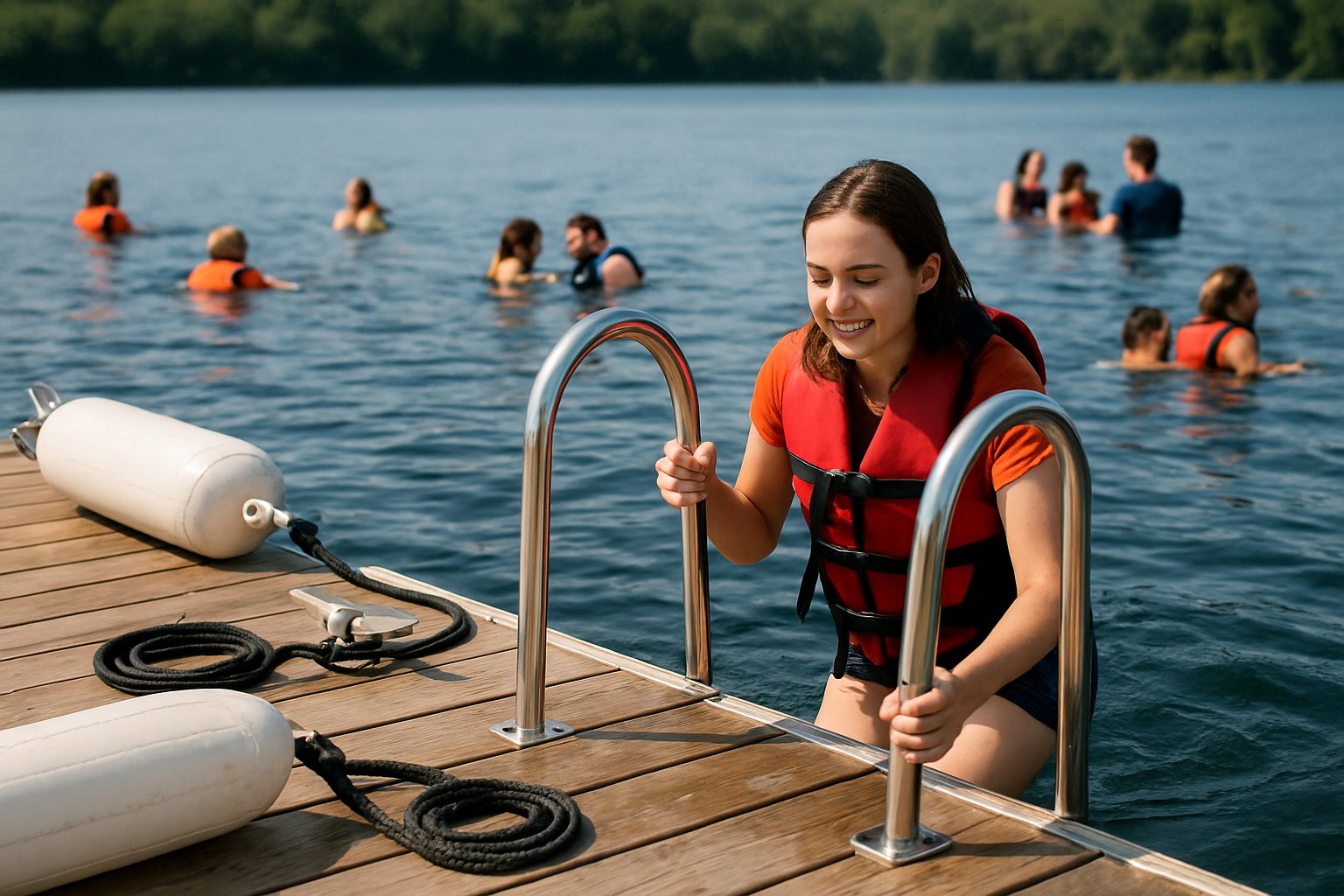
    Late August on a reservoir, and the water is two feet lower than it was on Memorial Day. The dock still floats perfectly level, but the walk down to it has turned into a steep little slide, and someone carrying a cooler is taking it very slowly. That walk is the floating dock ramp, and together with the brackets, hinges and pins that hold the sections together, it decides whether a floating dock feels solid or sketchy. This guide covers how a floating dock connects to shore and how its sections connect to each other, using the figures makers and retailers actually publish.
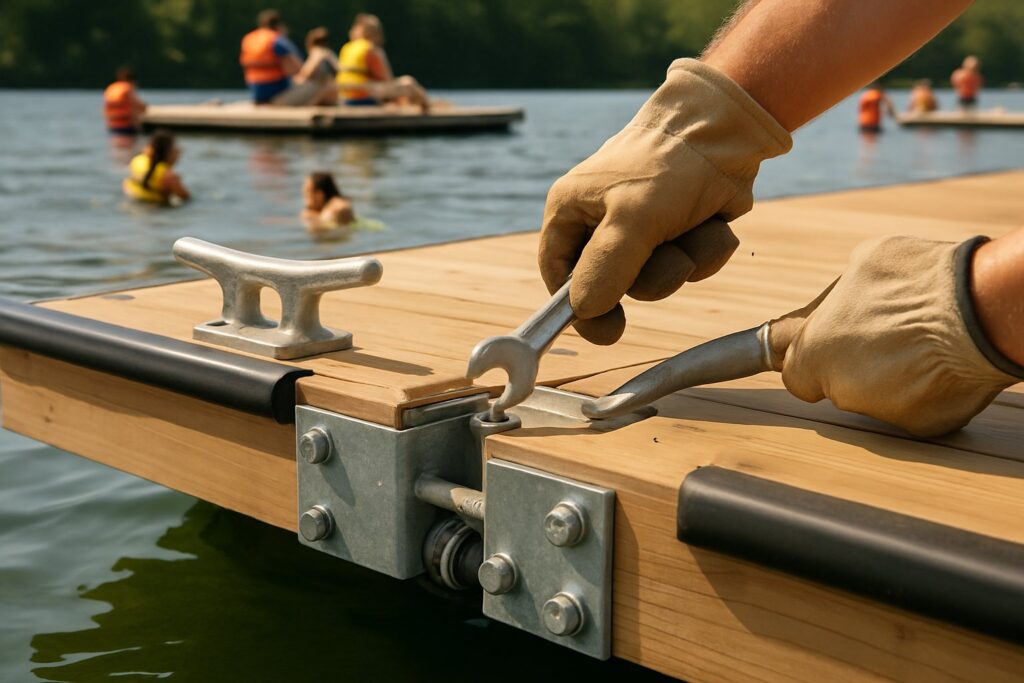
    Close view of galvanized corner brackets and a cleat joining two floating dock sections

    In short: a floating dock ramp (or gangway) is hinged at the shore end and rests on rollers or a slider on the dock, so it can change angle as the water rises and falls. The longer the ramp, the gentler the slope for the same change in water level. The U.S. Access Board’s guidance for covered public boating facilities sets a 1:12 maximum slope for gangways, with exceptions; private docks are not bound by it, but it is a useful benchmark. Floating dock hardware (corner brackets, hinge connectors, pipe holders, stiff arms) is usually hot-dip galvanized steel for fresh water, with stainless or aluminum options for salt.

    What a floating dock ramp actually does

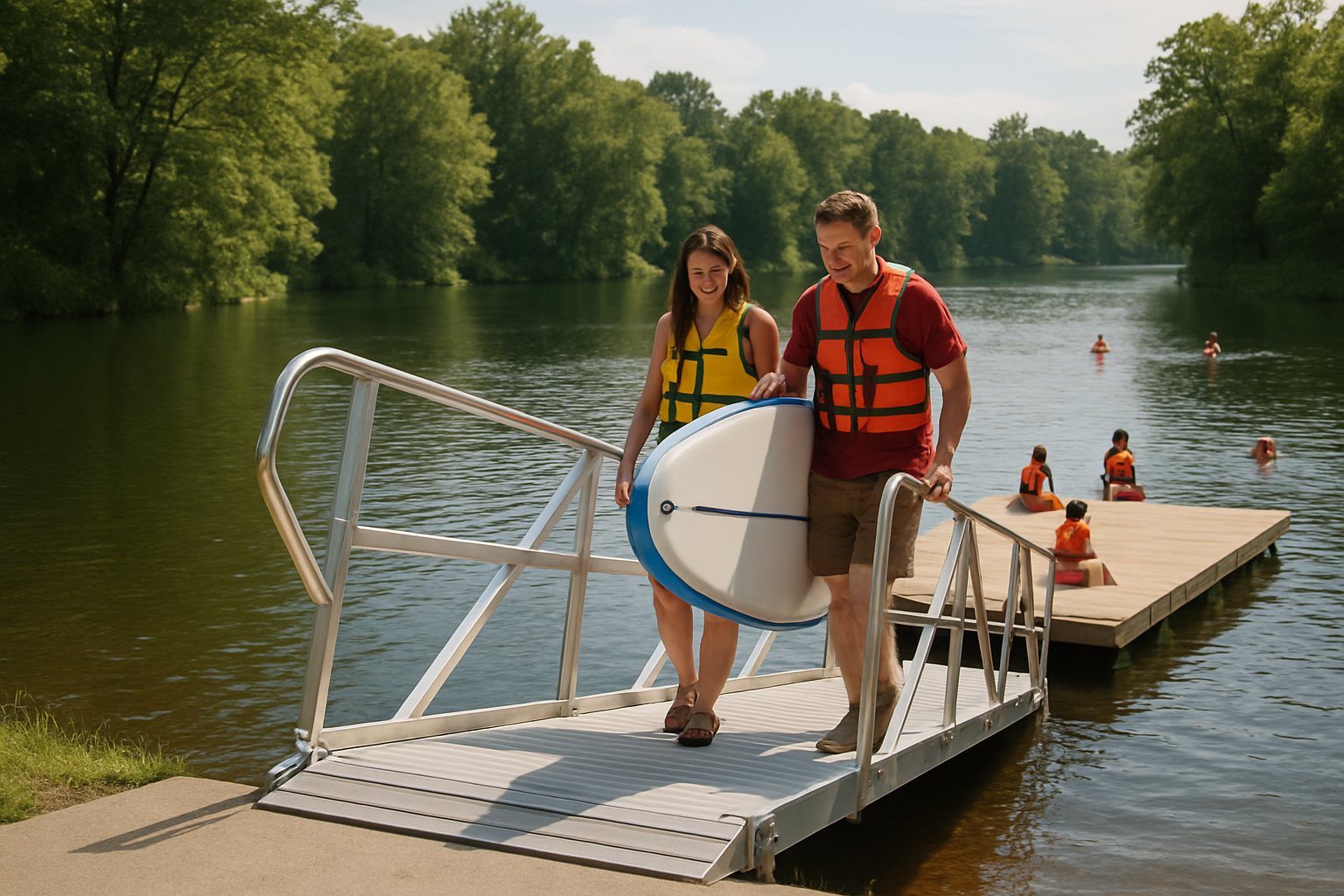
    A floating dock moves; the shore does not. The ramp bridges the two, so it has to allow movement at both ends. The usual arrangement in floating dock systems is a hinge at the shore end, bolted to a seawall, a concrete pad, a deck or posts, and rollers or wheels on the dock end, which roll back and forth across the deck as the angle changes. Wahoo, for example, describes its aluminum gangways as equipped with a bulkhead hinge mount and deck rollers, with rollers on the dock end. Dock Hardware’s DH-RRA4 ramp roller assembly is sold for exactly this job, to support floating dock ramps as water levels rise and fall.

    A floating dock gangway and a floating dock ramp are much the same thing on a residential dock; makers tend to say gangway for the longer, railed versions. Both differ from a transition plate, the short hinged plate at the end of a gangway that smooths the step onto the dock. Some systems skip the separate ramp altogether: Multinautic’s semi-floating dock kit has one end linked to the shore and the other on floats, and the maker says it adjusts automatically to water level changes of up to 1 m (3 ft).

    EZ Dock says the best docks for lakes with fluctuating water are those with a gangway, which lets the dock sit over deeper water. For bigger swings, see our guide to a floating dock on a river.

    Ramp length, water level and slope: the simple geometry

    The ramp is the long side of a right triangle. The height of that triangle is the difference between the shore hinge and the dock deck, and it changes with the water. To size a ramp, you need the lowest water level you expect, because that is usually when the drop is greatest and the ramp is steepest (if the dock can rise above the shore hinge at high water, check that end too). Slope is the rise divided by the horizontal run.

    A worked example (illustrative numbers, not a recommendation): say the dock deck sits 3 ft (0.9 m) below the shore hinge at your lowest water. Here is what different ramp lengths give you:

    Ramp lengthDrop at low waterHorizontal runSlopeAngle
    16 ft (4.9 m)3 ftabout 15.7 ftabout 1:5.2 (19%)about 10.8°
    24 ft (7.3 m)3 ftabout 23.8 ftabout 1:7.9 (12.6%)about 7.2°
    about 36 ft (11 m)3 ft36 ft1:12 (8.3%)about 4.8°
    16 ft, water 2 ft higher1 ftabout 16 ftabout 1:16 (6.3%)about 3.6°

    The pattern is what matters: doubling the drop doubles the slope, and only a longer ramp brings it back down. The same 16 ft ramp that is a gentle walk at summer pool level can feel steep after a drawdown. That is why makers sell ramps in a range of lengths. ShoreMaster’s residential gangway comes 4 ft wide in 16, 20 and 24 ft lengths; Wahoo lists widths from 32 to 72 in and lengths up to 80 ft; Tommy Docks sells modular aluminum gangways in 4, 8 and 12 ft sections. Ask your dealer for their own slope guidance, and give them your real high and low water numbers.

    What the ADA guidance says about gangway slope

    The U.S. Access Board’s guide to the ADA standards for recreational boating facilities is the clearest published benchmark. It says gangways must be designed to provide for a maximum 1:12 (8.33%) slope, but are not required to be longer than 80 ft. In smaller facilities with fewer than 25 boat slips, the slope may exceed 1:12 if the gangway is at least 30 ft long. Landings are not required at the ends of gangways if transition plates are provided, and a transition plate steeper than 1:20 (5%) needs a landing.

    Two cautions. First, these rules apply where gangways are part of the accessible route to accessible boat slips at newly built or altered recreational boating facilities covered by the ADA (marinas, public launches, piers); a private dock behind your house is not the target. Second, local building codes, lake associations and permits may still set their own rules, so check our permits and local rules guide before you build.

    Ramp materials and features

    • Aluminum frames are the norm for bought gangways: light enough to handle, and they don’t rot. Tommy Docks says its marine-grade aluminum frames will not rust or rot. Candock’s 4 x 16 ft welded aluminum gangway lists a maximum load of 1,750 lb; Wahoo lists load capacities up to 100 lb per sq ft. Many makers publish no load rating at all; Tommy Docks only says its frames are rated for foot traffic, gear and the occasional loaded hand cart.
    • Decking can be cedar, composite, polypropylene panels or aluminum. Tommy Docks offers cedar, composite and thermoformed decking on the same frame; ShoreMaster and Candock sell the frame with decking sold separately.
    • Handrails. ShoreMaster says handrails are necessary for the longer distances its gangways span. Candock’s 16 ft gangway has 42 in bolt-on railings on both sides; Wahoo’s dual handrails are standard, with a no-handrail option only under 20 ft.
    • Transition plates cover the step between the end of the ramp and the dock deck. Candock’s welded gangways include a 16 in transition plate; Wahoo sells them as an accessory.
    • Non-slip surface. A wet ramp at an angle is where people fall. Choose textured decking or anti-slip treads (Wahoo lists anti-slip cleats as an accessory), and keep the surface clear of algae.

    Prices vary a lot, from a short modular section to a long railed gangway. When checked in October 2026: Tommy Docks listed its aluminum gangway with Titan decking at $775 (4 ft), $1,575 (8 ft) and $2,375 (12 ft); boatliftanddock.com listed ShoreMaster’s residential gangway at $3,595 (length not stated on the page) and Candock’s 4 x 16 ft railed gangway at $4,855. All three ship as freight or require pickup for longer sizes.

    Floating dock hardware, piece by piece

    Wood-frame and many aluminum floating docks are held together by a small set of steel parts. If you are building your own frame or repairing an old one, these are the names you’ll see:

    PartWhat it doesPublished example
    Inside corner bracketSquares and stiffens the frame from inside each cornerExtreme Max inside corner kit: 3.2 mm galvanized steel, 2 corners and 4 backer plates
    Outside corner (male / female)Wraps the outside corner; paired male and female corners make a hinge point between sectionsDock Hardware DH-M and DH-F: 1/4 in hot-dip galvanized, 10-1/4 x 5 in legs
    Corner bracket for small framesJoins frame boards at the cornerTommy Docks CB5: 3/16 in hot-dip galvanized, for 2 x 6 frames, 1/2 in carriage bolts sold separately
    Hinge / link connector (T-style)Joins two dock sections along a face so they can flexExtreme Max link kit: two 5 in square hinge-link assemblies with backer plates
    Backer plateSpreads the bolt load on the inside face of the boardIncluded in most kits; Extreme Max says they reduce pull-through and worn holes
    Pipe holder / collarHolds a vertical pipe the dock slides up and downTommy Docks pipe guide kit: auger, pipe, sleeve bracket and cap, $96
    Stiff armRigid arm from shore that stops side-to-side drift while the dock rises and fallsShoreMaster heavy-duty stiff arm: to a seawall, deck or post; pipe sold separately
    Float bracketBolts the floats under the framePatriot Docks sections include float mounting bracket sets
    Bumpers and edgingProtect boats from the dock edgeDock Edge Full Face profile: flexible marine-grade PVC, 4-1/2 in high, three 8 ft pieces

    Read the bolt sizes before you order: many brackets take 1/2 in carriage bolts, some take 3/8 in, and mounting bolts are often sold separately (Tommy Docks and Extreme Max both say so on the parts above). Cleats are a separate purchase; bolt them through the frame with a backer, not just into decking. For tying up, see safe boarding and tying up, and for ladders, cleats and bumpers, our dock ladders and accessories guide.

    Stiff arms and pipes are also part of how the dock stays in place, which is covered in more depth in how to anchor a floating dock. ShoreMaster notes that a stiff arm is a good choice where augering into the lake bottom, river bed or seafloor is restricted or prohibited.

    Joins two sections

    Extreme Max 3005.5588 Floating Dock Link Connector Kit

    • Two 5 in hinge-link sets
    • Backer plates included
    • Galvanized, about $81
    Check price on Amazon
    Corner hinge, made in USA

    Dock Hardware DH-CLK Floating Dock Corner Link Kit

    • 1/4 in hot-dip galvanized
    • Male + female corners, pin
    • 16 bolt sets, about $100
    Check price on Amazon
    For aluminum frames

    Patriot Docks Low-Profile Floating Hinge Kit

    • Marine-grade aluminum
    • 4 ft x 1 in hinge pipe
    • About $107
    Check price on Amazon
    Frame corners

    Extreme Max 3005.5516 Dock Inside Corner Bracket Kit

    • 3.2 mm galvanized steel
    • 2 corners, 4 backer plates
    • Freshwater, about $29
    Check price on Amazon

    Galvanized, stainless or aluminum: fresh vs saltwater

    Most floating dock hardware sold in the US is hot-dip galvanized steel: strong, affordable and well suited to fresh water. Makers are fairly honest about its limits. Extreme Max says its galvanized inside corner kit protects against rust in freshwater marine environments; Tommy Docks says its galvanized pipe guide kit is not recommended for salt or brackish water. On the other side, Dock Hardware describes its 1/4 in hot-dip galvanized corners as corrosion resistant in fresh or salt water, and also sells a 316 stainless steel line for saltwater docks, which it says lasts up to 5 times longer in fresh water and up to 10 times longer in salt than its galvanized connectors.

    Aluminum is common for frames, gangways and some hinges; Patriot Docks’ hinge kit is marine-grade aluminum, and the maker describes it for freshwater use. If you dock in salt or brackish water, ask the maker directly which hardware line they recommend, use one metal family where parts touch, and rinse and inspect bolts every season. For EZ Dock systems, the maker says hardware is available for both fresh and salt water.

    How floating dock sections connect

    There are two basic ideas. A rigid connection bolts sections into one stiff platform; it feels solid underfoot but passes every wave load through the joints. A hinged connection lets sections flex at the joint, so each piece can follow the water. Most wood and aluminum floating dock sections use hinged links: Extreme Max’s kit mounts through the faceboards of two opposing sections, and Patriot Docks says its hinge kit is designed to flex with changing water levels, with a hinge set used every 16 ft of floating dock.

    Modular plastic docks use their own connectors. Candock cubes are joined by a polyethylene connecting pin that passes through the tabs of neighboring cubes and threads into a sliding nut, tightened with a G2 key. EZ Dock sections are linked with its coupler system, which the maker says gives stability and shock absorption; the same couplers attach EZ Dock to gangways, stiff arms and other docks. If you are mixing brands, ask about adapters before you buy. Our modular docks page compares these systems, and floating dock designs and layouts shows how sections are usually arranged (straight, L, T and U shapes).

    Inflatable docks are a different case: they are usually anchored as stand-alone platforms rather than linked to a ramp, and makers such as RAVE say not to connect them directly to piers or other hard objects. See inflatable docks for how those work.

    Putting it together

    1. Measure the water. Note high and low levels for the season, and the height of your shore abutment.
    2. Choose the ramp length from the drop at low water, using the geometry above and your maker’s guidance.
    3. Build or set a solid shore abutment for the hinge: a seawall, concrete pad or set posts.
    4. Put rollers on the dock end, with enough deck length for them to travel, and a transition plate if the step is high.
    5. Connect the sections with the maker’s hinges or couplers, backer plates on every bolt through wood.
    6. Hold the dock in place with pipes, stiff arms or anchors, then check every bolt after the first storm.

    The full sequence, from site check to first season, is in our floating dock installation guide, and the Setup and Care hub has the rest.

    Floating dock ramp and hardware questions

    How long should a floating dock ramp be?

    Long enough that the slope is comfortable at your lowest water. Find the drop from shore hinge to dock deck at low water and work out the slope for each length you are considering; a 3 ft drop is about 1:5 on a 16 ft ramp and about 1:8 on a 24 ft ramp. Public facilities covered by the ADA aim for 1:12, which would take about 36 ft for that same drop.

    Which end of the gangway gets the hinge?

    Usually the shore end is hinged and the dock end rolls on wheels or a slider, because the dock moves and the shore does not. Makers sell both ends as options: Wahoo, for instance, lists a bulkhead hinge and a roller assembly as separate end options for its aluminum gangways.

    Can I use galvanized floating dock hardware in salt water?

    Some makers say yes and some say no, product by product. Tommy Docks says its galvanized pipe guide kit is not recommended for salt or brackish water, while Dock Hardware describes its hot-dip galvanized corners as corrosion resistant in fresh or salt water and sells a 316 stainless line for saltwater docks. Follow the maker of the part you buy.

    How do floating dock connectors work?

    On framed docks, a male and female plate (T-style or corner) bolt to facing sections and a steel pin drops through their ears, making a hinge. On modular plastic docks, pins or couplers lock the sections together. Either way, the joint is meant to flex a little; check pins and bolts every season.

  • Dock Floats: Types, Buoyancy and How Many Your Dock Needs

    Dock Floats: Types, Buoyancy and How Many Your Dock Needs

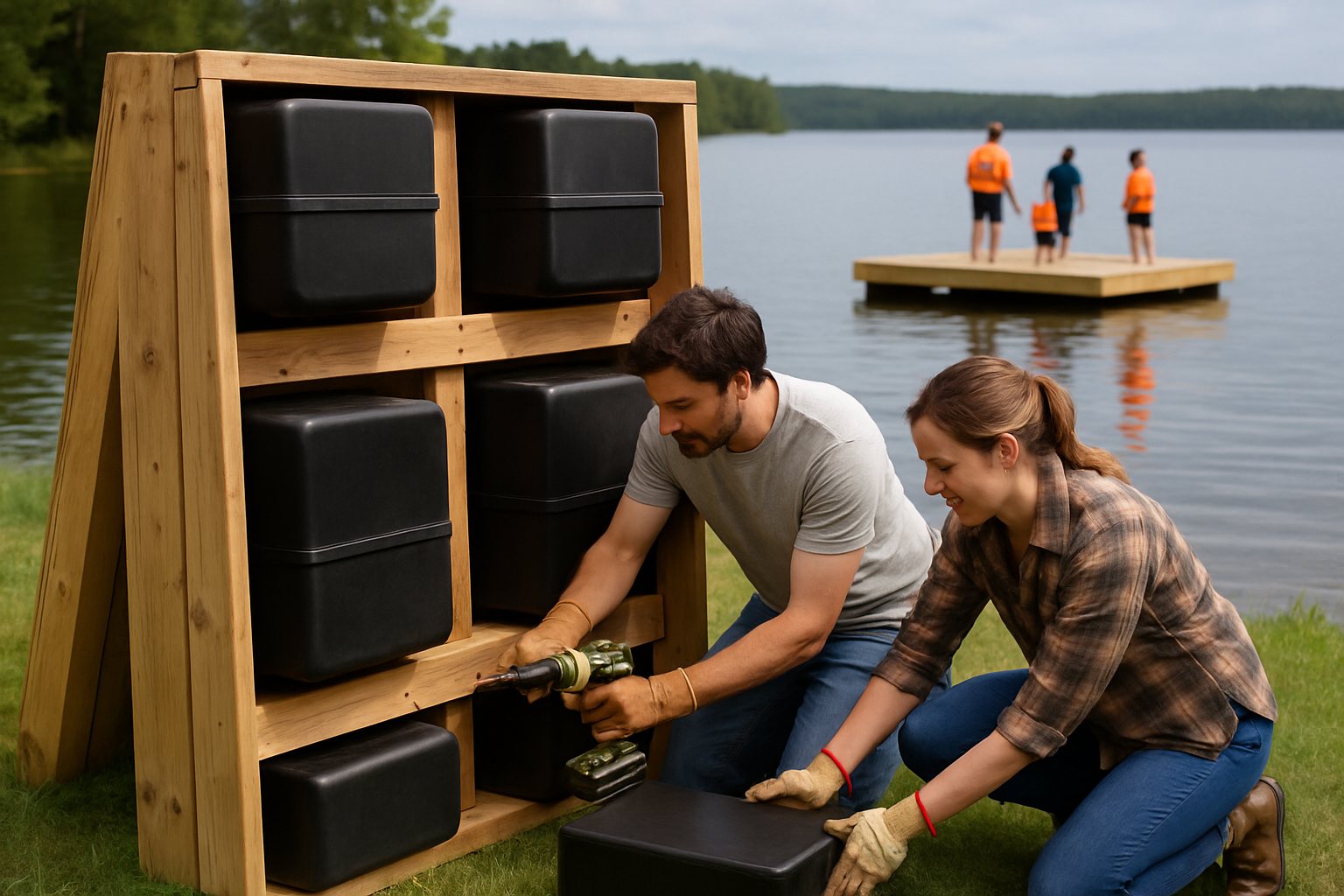
    Late in the season, a lake neighbor walks out to the end of his floating dock with a cooler and two grandkids, and the far corner dips until water runs over the boards. Nothing broke. One of the dock floats underneath has slowly lost its lift, and the dock is telling him. Dock floats are the plain black boxes that hold up almost every non-inflatable floating dock in the US, and choosing, sizing and replacing them is mostly a matter of reading the right numbers. This guide covers the types, the buoyancy figures makers actually publish, how to work out how many you need, and the rules on bare foam that many lakes now enforce.

    Side view of a floating dock at the waterline showing the black floats and the deck height above water

    In short: most floating dock floats today are encapsulated: a rotomolded polyethylene shell filled with EPS foam, rated by the maker in pounds of buoyancy (for example 600 lb for a Taylor Made 24 x 48 x 16 in float, 2,475 lb for a Barr Plastics 48 x 96 x 16 in float). Add up the dock’s dead load and the live load you expect, divide by the float rating, and leave a healthy margin, because those ratings assume the float is fully under water. Bare foam and used drums are banned or restricted on many US waters, so check local rules first.

    What dock floats do, and what freeboard means

    A float holds up a dock the same way a boat hull does: it pushes water aside, and the water pushes back with a force equal to the weight of the water displaced. Fresh water weighs about 62.4 lb per cubic foot (USGS), so every cubic foot of float pushed under can carry roughly that much, minus the float’s own weight. That is why makers quote buoyancy, and why the numbers track the size of the float so closely. Barr Plastics, a float maker, notes that its ratings assume the float is fully submerged, and adds that dock floats are not designed to be fully submerged. Treat the rating as a ceiling, not a working load.

    Freeboard is the height of the deck above the water. Bellingham Marine, a marina builder, gives a handy rule: in salt water, 5 lb of load on one square foot of a floating object sinks it about 1 inch. Barr recommends 12 to 14 in of freeboard for most residential docks, counting the frame and decking. Low docks are easier for kayaks, but every inch of float you sink to get there is lift you no longer have for people.

    Types of floating dock floats

    TypeWhat it isGood to know
    Encapsulated foam floatsSeamless polyethylene shell filled with EPS foam, with a flat top and mounting slotsThe standard choice today; the foam keeps the float up if the shell is holed (Taylor Made)
    Bare (unencapsulated) foamBlocks of polystyrene bolted under the frame with no shellBreaks into beads and litter; banned or being phased out on many waters (see below)
    Air-filled plastic floatsHollow rotomolded polyethylene drums with no foam insideNo foam to shed; a hole can let water in, so they depend on the shell staying sound
    Barrels and drumsRe-used plastic or metal drums strapped to a frameCheap but restricted: TVA prohibits previously used drums for flotation
    Modular cubes and sectionsThe float is the deck: plastic cubes or sections that lock togetherNo separate floats to size; see modular docks

    Encapsulated dock floats

    Encapsulated dock floats are what you will find at marine dealers and on Amazon. Taylor Made describes a seamless, UV-resistant black polyethylene shell filled with EPS foam, which protects the foam from salt water, gasoline and most chemicals, plus a thick mounting flange you drill for fasteners. Barr Plastics describes a one-piece rotomolded shell of virgin polyethylene with UV inhibitors around EPS foam, and Eagle Float a seamless one-piece virgin polyethylene shell with a 0.15 in nominal wall and a solid EPS core; both have mounting slots molded into the flat top. Because the foam fills the shell, a puncture does not sink the float the way it can an empty one.

    Foam dock floats without a shell

    Older docks often sit on bare white foam billets. They float well when new, but sun, waves, boats, ice and animals break the surface into beads that end up in the water. That is the reason many authorities now restrict them:

    • Tennessee Valley Authority (TVA) lakes. Federal rule 18 CFR 1304.400 prohibits using or reusing unencased flotation for repairs, replacement or new construction, and requires existing unencased flotation to be removed and replaced by December 31, 2031. Flotation must be commercially manufactured for marine use and must not crack, peel, fragment, become waterlogged or lose beads.
    • Vermont. Since July 1, 2024, polystyrene foam used as flotation in Vermont waters must be encapsulated, with a covering expected to last at least 10 years. The state’s Department of Environmental Conservation says garbage bags, shrink wrap, hardware cloth and plywood do not count.
    • Lake of the Ozarks, Missouri. Ameren, which manages the lake, banned new non-encapsulated foam in 1995 and set December 31, 2008 as the final deadline to replace it, calling broken foam the largest source of man-made debris in the lake.

    Rules differ by state, lake authority and reservoir operator, and these are only the ones we confirmed. Before you buy or rebuild, check our permits and local rules guide and ask whoever manages your water.

    Plastic air-filled floats

    Some makers sell the same rotomolded shell empty. Dock Edge+, for example, lists its 2 x 4 ft x 8 in float in both a foamed and an empty version, each with a stated flotation of 260 lb. Vermont’s environmental agency calls air flotation the more environmentally friendly option, since there is no foam to shed if the shell is breached. The trade-off is that the shell is the only thing keeping water out. Plastic dock systems such as EZ Dock skip separate floats entirely: their polyethylene sections have open pylons underneath, are 15 in high and draw about 1 1/2 to 2 in of water, according to EZ Dock’s FAQ.

    Barrels and drums

    Plastic drums on a wooden frame are the classic budget dock. They work, but used drums carry real risks. TVA’s rule prohibits plastic, metal or other previously used drums or containers for flotation, citing the possible release of toxic or polluting substances and the navigation hazard of metal drums that partly fill with water and break loose. Illinois’s statewide permit for minor docks allows metal drums only if they are foam-filled. If you are set on drums, use new, clean, purpose-made floats where your rules allow them, and never a container that held chemicals or fuel.

    Modular cube docks

    With cube docks the floats are the dock. Candock’s G2 cube is 19 x 19 in and 14 in high, air-filled HDPE, with a stated buoyancy of about 150 lb per cube, or about 60 lb per square foot. You add cubes rather than floats to carry more. More on these in our modular docks guide.

    Dock float sizes and buoyancy, as makers state them

    Floats come in a handful of standard footprints (24 x 36, 24 x 48, 36 x 48, 48 x 48 and 48 x 96 in are common) and heights from about 8 to 32 in. Taller floats give more lift on the same footprint. These are the published figures we found:

    Maker and floatSize (W x L x H)Stated buoyancy
    Dock Edge+ (foamed or empty)24 x 48 x 8 in260 lb
    Eagle Float2 ft x 4 ft x 12 in390 lb
    Taylor Made 4611824 x 36 x 12 in335 lb (approx.)
    Taylor Made 4611624 x 48 x 12 in450 lb (approx.)
    Taylor Made 4611724 x 48 x 16 in600 lb (approx.)
    Barr Plastics BD2448-1624 x 48 x 16 in598 lb
    Taylor Made 48481648 x 48 x 16 in1,200 lb (approx.)
    Barr Plastics BD4848-1648 x 48 x 16 in1,220 lb
    Barr Plastics BD4896-1648 x 96 x 16 in2,475 lb
    Barr Plastics BD4896-3248 x 96 x 32 in4,804 lb

    Notice how two makers’ 24 x 48 x 16 in floats land within a couple of pounds of each other. That is physics, not marketing: the same volume displaces the same water. A float’s own weight matters too; Barr lists 37 lb for its 24 x 48 x 16 in float, and that weight is part of your dead load.

    How many dock floats do you need?

    The basic sum is the same everywhere: dead load + live load = buoyancy you need, then divide by the rating of one float and round up.

    • Dead load is the dock itself: frame, decking, hardware, ladders and the floats. Dock Builders Supply, a Florida dock supplier, says most residential lumber docks weigh typically 10 to 15 lb per square foot.
    • Live load is what comes and goes: people, coolers, gear. It is never spread evenly; everyone ends up at the ladder end.
    • Margin. Dock Builders Supply designs for about 40% submergence under the dead load and says floats should never be more than 50% submerged in normal use, leaving the rest for people.

    Worked example (published by Dock Builders Supply, shown here as an illustration only). For a typical uncovered wooden residential dock, Dock Builders Supply multiplies the deck area by a factor of 28, 31 or 35 lb per square foot, depending on framing and decking. For an 8 x 16 ft dock with 2 x 6 pressure-treated decking it uses 31:

    1. Deck area: 8 x 16 = 128 sq ft.
    2. Buoyancy needed: 128 x 31 = 3,968 lb.
    3. Floats: six 36 x 48 x 12 in floats rated 691 lb each = 4,146 lb, just over the target.

    Barr Plastics publishes a similar rule of thumb: 3 to 6 floats per residential dock section, depending on size, weight and the freeboard you want. Both companies say these are guidelines; Dock Builders Supply takes no responsibility for the figures and recommends a structural engineer for specific designs. We don’t calculate safe loads for your dock. Use the method to understand the order of magnitude, then confirm the count with your float maker or a local dock builder, especially for a covered dock, a boat lift, a gangway resting on one side, or rough water.

    Attaching floats to a dock frame

    • Use the mounting slots or flange. Taylor Made’s minimum recommended hardware is a 3/8 x 3 in lag screw with a 3/8 in and a 5/8 in flat washer. Barr says its molded slots and holes suit wood, steel or aluminum frames.
    • Bear on the frame, not the decking. Dock Builders Supply says each float must contact at least two cross-members.
    • Spread them out. Put floats in every corner with no more than 8 ft between them (Dock Builders Supply). Barr suggests at least one float at each end of a walkway with more in the middle, and on a platform four corners plus two between them lengthwise.
    • Don’t join floats to each other. Taylor Made says its floats are not designed to attach to each other; they attach to the dock.
    • Secure them for the long haul. TVA requires every float to be firmly fixed to its structure with materials that can stand prolonged wave wash and weather. Use corrosion-resistant hardware.

    Then anchor the finished dock properly: see how to anchor a floating dock and our step-by-step floating dock installation guide.

    Dock floats you can buy online

    These encapsulated floats were in stock on Amazon when checked in October 2026. Hardware is not included with any of them. Prices change often.

    Most lift per float

    Taylor Made Dock Float 24 x 48 x 16 in

    • 600 lb stated buoyancy
    • PE shell, EPS foam, made in USA
    • About $198, seen October 2026
    Check price on Amazon
    15-year warranty

    Eagle Float Dock Float 2 x 4 ft x 12 in

    • 390 lb stated buoyancy
    • One-piece HDPE shell, EPS core
    • About $223, seen October 2026
    Check price on Amazon
    Low profile

    Dock Edge+ Float 2 x 4 ft x 8 in, Foamed

    • 260 lb flotation capacity
    • 10-year warranty
    • About $129, seen October 2026
    Check price on Amazon

    Bigger sizes, such as 48 x 96 in floats, are usually bought from marine distributors by the pallet. Barr Plastics, for example, lists its 48 x 96 x 16 in float at $703.36 CAD (Canadian dollars) when checked in October 2026, with shipping extra. We did not find a published US retail price for that size that we could confirm. For the total cost of a dock, see floating dock cost.

    How long dock floats last, and when to replace them

    No maker we checked publishes an expected service life in years, but warranties give a hint: Taylor Made offers an 8-year flotation warranty, Dock Edge+ 10 years on the float above, and Barr Plastics and Eagle Float 15 years. Vermont expects any foam covering to last at least 10 years. TVA’s rule puts the test simply: replace flotation when it no longer does its job, or when it cracks, fragments, sheds beads or becomes waterlogged. In practice, walk the dock each spring: a corner that sits lower than the rest, a cracked shell or foam showing through are your cues. Replace like with like so the dock floats level, and dispose of old foam properly; Vermont, for one, sends old unencapsulated floats to approved facilities such as transfer stations.

    Where inflatable docks fit

    An inflatable dock needs no separate floats at all: the air chamber is the float, and it packs away in a bag. It suits swimming, lounging and seasonal use rather than a permanent walkway to a boat. If you are weighing the two routes, read building a floating dock vs buying inflatable, floating dock kits vs inflatable docks and inflatable vs rigid floating docks.

    Dock float questions

    What are encapsulated dock floats?

    Floats whose foam core is sealed inside a hard shell, usually rotomolded polyethylene over EPS foam. The shell keeps the foam from breaking apart in the water, and the foam keeps the float up if the shell is holed. Many lakes now require them.

    How much weight does a dock float hold?

    Whatever the maker states for that size, and that figure assumes the float is pushed fully under water. Published examples run from 260 lb (Dock Edge+ 24 x 48 x 8 in) to 600 lb (Taylor Made 24 x 48 x 16 in) and 2,475 lb (Barr Plastics 48 x 96 x 16 in). Part of it goes to holding up the dock itself.

    How many floats does an 8 x 16 ft dock need?

    In Dock Builders Supply’s published example, an 8 x 16 ft wooden dock needs about 3,968 lb of buoyancy, met by six 691 lb floats. Your number depends on your materials, your loads and the freeboard you want, so confirm with your float maker or dock builder.

    Can I use plastic barrels as floating dock floats?

    Check your rules first. TVA prohibits previously used drums or containers for flotation on its lakes, and Illinois allows metal drums only if foam-filled. Where drums are allowed, never use one that held chemicals or fuel.

    Are foam dock floats bad for the lake?

    Bare foam can break into beads and litter, which is why TVA, Vermont and Ameren at Lake of the Ozarks restrict it. Encapsulated foam floats and air-filled floats are the accepted alternatives.

    Can I replace just one float?

    Usually, yes: floats are bolted on individually. Match the size and rating of the others so the dock stays level, and if several are failing at once, plan to replace the set.

  • Dock Ladders and Floating Dock Accessories: What You Need

    Dock Ladders and Floating Dock Accessories: What You Need

    The dock is out, the water is perfect, and the first swimmer back finds the snag: there’s no easy way up. Hands on the edge, a knee on the deck, a scramble. A good dock ladder fixes that in an afternoon, and the right anchor, lines and pump turn a floating deck from a weekend experiment into something you can count on all summer. This guide covers the floating dock accessories that matter (ladders, anchors, lines, pumps, cleats and fenders), which ones suit inflatable docks and which only fit rigid ones, with products that were in stock when we checked.

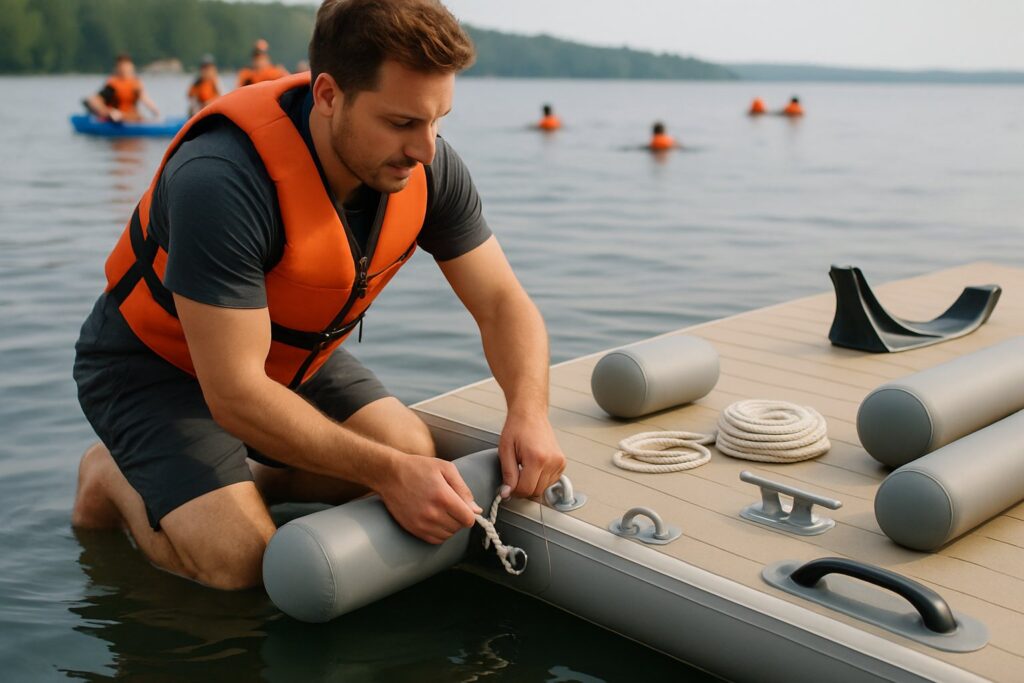
    Man fitting fenders and mooring lines to an inflatable dock

    In short: on a rigid or wooden dock, a bolt-on stainless ladder is the standard. On an inflatable dock, use a ladder only where the maker provides ladder connectors or includes a soft ladder; never screw into the deck. Anchor to the maker’s anchor points with the anchor weight it specifies, use lines rated by working load, and get a pump that reaches your dock’s pressure with the right valve adapter.

    Prices change often. The prices below are what we saw on Amazon in October 2026; check the current price before you buy.

    Our accessory picks

    Rigid docks

    4-Step Stainless Telescoping Dock Ladder

    • 316 stainless, 600 lb (listing)
    • 62.5 in tall, flip-up
    • Quick-release brackets
    Check price on Amazon
    Boat swim platforms

    Amarine Made 4-Step Telescoping Ladder

    • 304 stainless, telescopic
    • Vinyl treads
    • Hinged bracket
    Check price on Amazon
    Soft bottoms

    SeaSense Mushroom Anchor

    • Vinyl-coated cast iron
    • Sandy, muddy, weedy bottoms
    • For small craft
    Check price on Amazon
    Anchor line

    Better Boat 3/8 in Nylon Anchor Line, 100 ft

    • 820 lb working load
    • 4,035 lb breaking load
    • Spliced stainless thimble
    Check price on Amazon
    Patch kit

    JLF Repair Kit with HH-66 Vinyl Cement

    • 5 PVC patches
    • HH-66 vinyl cement
    • 6-prong valve wrench
    Check price on Amazon

    Floating dock accessories compared

    AccessoryRigid or wood dockInflatable dockAbout (Oct 2026)
    4-step stainless dock ladderBolts to the deck edgeNo (needs a rigid mount)$160
    Amarine Made telescoping ladderSmall decks and boat platformsNo$60
    Maker’s own ladder or soft ladder–Yes, where the maker provides connectorsVaries
    SeaSense mushroom anchor–Light use only; check your maker’s anchor weight$32
    Better Boat 3/8 in anchor lineYesYes$46
    JLF PVC repair kit–Yes (PVC docks)$40

    Dock ladders

    For rigid, wood and modular docks

    A fixed dock or a rigid floating dock takes a bolt-on ladder. The 4-step telescoping dock ladder above is 316 stainless with a mirror finish, has 2 in wide anti-slip steps spaced 10 in apart, stands 62.5 in tall and 15.8 in wide, folds up against the dock, and is rated for 600 lb in its listing. It mounts with quick-release brackets. Amarine Made’s 4-step ladder is a smaller 304 stainless telescoping ladder with vinyl treads and a hinged bracket that folds over a platform, the kind used on boat swim platforms and small decks. Before buying, measure from the deck to the water and the thickness of the edge you’ll bolt to, and follow the ladder’s mounting hardware instructions. Modular dock makers sell their own ladders that fit their sections; Wave Armor’s sections have perimeter slots for accessories.

    For inflatable docks

    An inflatable dock has no rigid edge to bolt into, and drilling it would be the end of it. Use what the maker designed instead: Jobe includes two ladder connectors with its Infinity Island, Solstice sells a 10 x 8 Luxe Dock that comes with a ladder, and Island Hopper’s Patio Dock comes with a six-step soft ladder. Many swim-out docks are made to be climbed straight from the water, with handles all round (RAVE’s Aqua Dock has ten neoprene-covered handles for that). If your dock has neither connectors nor an included ladder, ask the maker what it approves before hanging anything off its D-rings.

    Anchors and anchor lines

    The anchor is the accessory people under-buy. Inflatable dock makers ask for far more anchor weight than a single small anchor: Aquaglide calls for at least 1,100 lb of anchor weight on its Docking Station, and RAVE’s FAQ suggests 150 to 200 lb for its dock, depending on the lake and bottom. A vinyl-coated mushroom anchor like the SeaSense, which its listing recommends for sandy, muddy or weedy bottoms, is fine for a kayak or for holding a light deck off a boat for an afternoon in calm water; for a dock that stays out, follow your maker’s figure, and for permanent moorings ask a dock or mooring specialist.

    For lines, look at the working load, not just the breaking strength. Better Boat’s 3/8 in double-braided nylon line lists an 820 lb working load and a 4,035 lb breaking load, with a spliced stainless thimble at one end. For anchoring a boat, the Boat-Ed boating course suggests 7 to 8 ft of chain between anchor and line to lower the angle of pull, and a line at least 7 to 10 times the water depth; for a dock, follow the maker’s mooring instructions. Tie only to the maker’s anchor points: RAVE’s dock has two, one at each end on the bottom. Our setup and installation guide walks through anchoring.

    Pumps

    Most docks come with a hand pump, and makers sell electric ones separately because hand-pumping a big deck to pressure is hard work: RAVE recommends its Dual Stage Rapid Pump ($69.98), and Island Hopper sells a PSI 15 Auto-Set electric inflator ($129) for its docks. A BOTE reviewer recommends BOTE’s auto pump for its dock. Whatever you buy, check three things: it reaches your dock’s stated pressure (from 5 psi on RAVE’s dock to 15 psi on Island Hopper’s), it has the right adapter for your valve (many docks use H3-style valves), and it has an auto-stop so it can’t overshoot the maker’s maximum.

    Cleats, bumpers and fenders

    Cleats belong on rigid and wooden docks, through-bolted where the dock maker says. On an inflatable dock, the stainless D-rings are the tie-off points; don’t add hardware. Bumpers protect both dock and hull: Island Hopper’s Yacht Dock has rubber bumpers on all four corners for tying alongside a boat, and rigid dock makers such as Wave Armor sell dock bumpers. Fenders hang from the boat. Taylor Made’s Hull Gard chart starts at 4-1/2 x 16 in fenders for 10 to 15 ft boats, recommends 2 psi, and calls its chart a minimum, adding that you should check with your marina and neighbors about local conditions.

    Gangways, walkways and the rest

    • Gangways: rigid makers sell ramps and walkways to the shore (EZ Dock and Wave Armor both list them); Jobe sells an inflatable Infinity Gangway to link a yacht and its platform.
    • Repair kit: keep your maker’s kit, or a PVC kit like JLF’s, in the dock bag; see inflatable dock repair.
    • Pressure gauge: many pumps have one built in; check pressure morning and afternoon, since sun raises it.
    • Life jackets: the most important accessory for kids and weak swimmers. RAVE’s manual asks users to wear a USCG-approved Type III / Level 70N life jacket on its dock.

    How to choose floating dock accessories

    • Start with the manual. Anchor weight, anchor points, pressure and approved add-ons all come from the dock maker.
    • Rigid or inflatable? Bolt-on ladders and cleats are for rigid decks only.
    • Marine-grade materials. Look for 316 stainless hardware for salt water and marine-grade nylon line, which has some stretch.
    • Buy for the water you have. Bottom type decides the anchor; depth decides line length; boat traffic decides fenders.

    Still choosing the dock itself? See best inflatable docks, compare brands in Solstice vs BOTE vs VEVOR, browse the dock types hub, or check sizes and ratings in inflatable dock capacity explained.

    Dock ladder and accessory questions

    Can you put a ladder on an inflatable dock?

    Only one the maker designed for it. Jobe includes ladder connectors with its Infinity Island, Solstice’s Luxe Dock comes with a ladder, and Island Hopper’s Patio Dock has a soft ladder. Never drill or screw into an inflatable deck.

    What size dock ladder do I need?

    Measure from the deck to the water and add enough steps to reach comfortably below the surface. The ladder in our picks is 62.5 in tall with 10 in step spacing; check the mounting fits your deck edge.

    How heavy an anchor does an inflatable dock need?

    Use your maker’s figure. They vary widely: RAVE suggests 150 to 200 lb for its dock; Aquaglide asks for at least 1,100 lb on its Docking Station.

    What rope should I use to anchor a floating dock?

    Many boaters use double-braided nylon for its stretch. Choose by working load, not breaking strength, and use stainless or galvanized hardware.

    Do I need an electric pump for an inflatable dock?

    Not strictly, but makers recommend one: RAVE and Island Hopper both sell electric pumps for their docks. Make sure it reaches your dock’s pressure and fits its valve.

  • How to Store an Inflatable Dock (and Winterize a Floating Dock)

    How to Store an Inflatable Dock (and Winterize a Floating Dock)

    Labor Day weekend: the last swim off the dock, the last sunset with your feet in the water, and then the job nobody looks forward to. How you put an inflatable dock away decides whether it comes out next June firm and clean or musty, sticky and chewed. Good inflatable dock storage takes an afternoon and a dry spot in the garage. This guide follows the makers’ own manuals for cleaning, drying, folding and storing, covers overnight and mid-season storage, and explains how winterizing a rigid floating dock differs.

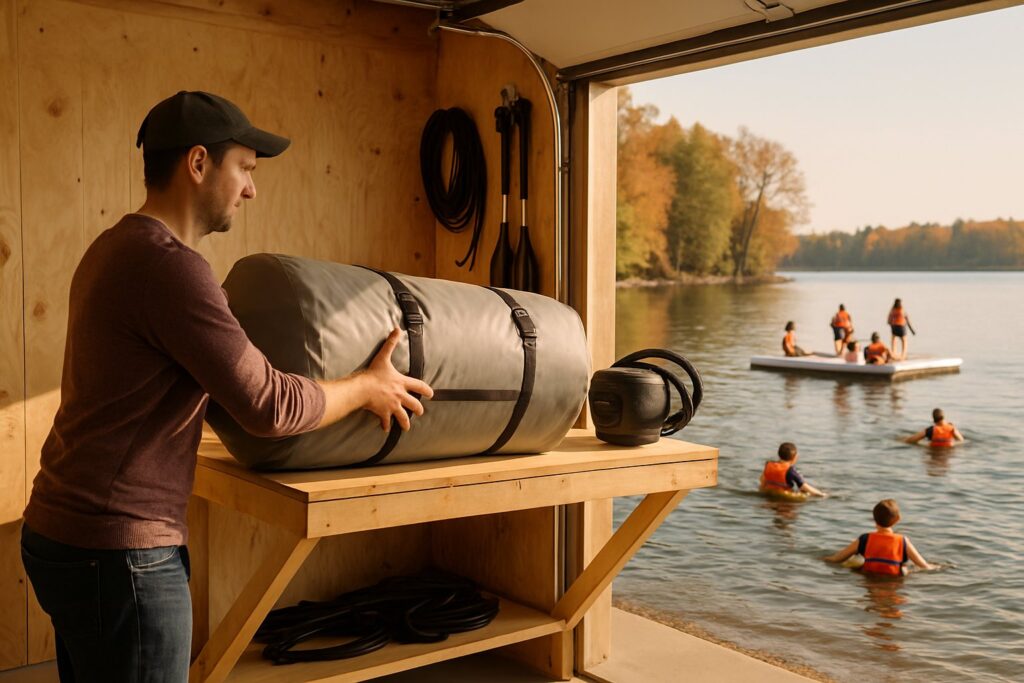
    Deflated inflatable dock rolled up in its bag on a garage shelf

    In short: bring the dock ashore without dragging it, wash it with mild soap and fresh water, dry both sides completely, deflate fully, fold it in thirds and roll it loosely toward the valve, then store it out of the sun in a clean, dry, rodent-proof place. Aquaglide says never to store its products damp or below 40 °F (4 °C). Rigid floating docks are a different job: makers suggest removing them where ice shifts.

    Inflatable dock storage, step by step

    1. Bring it ashore the right way. RAVE’s manual says to carry the dock to land, or deflate it carefully on a flat surface on your boat, and to be “extremely careful not to drag the product.” Unclip anchors and lines first.
    2. Clean it. Use mild soap and fresh water with a soft brush or sponge. Aquaglide says not to use petroleum-based cleaners and to avoid high-pressure washing, which can damage the product; RAVE’s manual also rules out petroleum products and solvents.
    3. Protect it. Aquaglide recommends regularly applying a UV protectant to exposed surfaces and doing so before storage.
    4. Dry it completely. RAVE suggests letting the dock dry for 15 minutes or longer in the sun, flipping it to dry the other side, and towelling off anything still damp. Aquaglide: confirm it is completely dry before folding.
    5. Deflate fully. Aquaglide suggests an electric pump in deflate mode to get the last air out; RAVE’s own rapid inflator has a deflate side.
    6. Fold and roll. RAVE: fold the dock into thirds with the EVA pad sections folded in, then roll it like a sleeping bag starting from the end opposite the valve, and secure it with the straps. Aquaglide: fold in thirds, then roll loosely toward the valve.
    7. Store it well. Out of direct sunlight, in a clean, dry place such as a sealed closet, crate or container that keeps rodents out (Aquaglide), and never damp or below 40 °F.

    Rolling toward the valve lets air left inside escape as you go. A rolled dock is compact, so plan a shelf or closet rather than a corner of the boathouse. Folded sizes that makers and dealers publish:

    DockInflatedFolded or rolledWeight
    BOTE Inflatable Dock 77 x 7 ft, 8 in44 x 19 x 10 inAbout 35 lb
    BOTE Inflatable Dock 1010 x 10 ft, 8 in63 x 22 x 10 inAbout 83 lb
    Solstice 10 x 1010 x 10 ft, 6 in29 x 18 x 11 in54 lb
    Island Hopper Yacht Dock10 x 6 ft, 6 in40 x 16 x 14 in53 lb

    Where to store it: what the makers say

    ConcernRAVE (Aqua Dock manual)Aquaglide (C-Deck manual)
    SunStore in a covered, shaded area to protect against UVOut of direct sunlight; apply UV protectant
    MoistureDry fully before foldingNever store in a damp location
    ColdNot statedNever store below 40 °F (4 °C)
    RodentsMuskrats may chew the PVC; on the water, keep full pressure or take it out at nightStore in a sealed closet, crate or container against rodent damage
    FoldingThirds, EVA pads in, roll from the end opposite the valveThirds, roll loosely toward the valve(s)

    Aquaglide’s 40 °F rule matters for anyone who planned to leave the dock in an unheated shed through a northern winter. If your garage drops below that, store the dock indoors in a basement or closet. Other makers may publish different figures; check your own manual.

    Overnight and mid-season storage

    You don’t have to pack the dock away every evening, but RAVE’s manual does say that after use it is best to deflate and fold it for storage to prevent damage and extend its life. If you leave it out between weekends, keep it at full pressure and well anchored, and check the pressure in the morning and the afternoon: air expands in the sun and contracts at night. RAVE notes that full pressure discourages muskrats, and taking the dock out of the water at night removes the temptation. Before a forecast storm, bring it in; RAVE says never to use its dock in high winds, waves or storms, and no consumer dock maker we checked publishes a wind limit. Some lakes also have rules on what may stay in the water overnight; ask your local agency.

    Winterizing a floating dock that isn’t inflatable

    If you also own a rigid floating dock, winterizing it is a different decision: leave it in or take it out. The makers we checked put the risk on moving ice rather than cold:

    • Connect-A-Dock says freezing temperatures won’t harm its polyethylene docks, but “with shifting ice, we recommend removal for the winter months.”
    • EZ Dock says ice can be very detrimental and floating ice carried by currents can damage docks and gangways. It calls removal the best protection in severe winters, says sectional floating docks generally don’t need removal in normal winters, and recommends removing the dock and pilings where ice flow is severe.

    Whichever you choose, ask your dealer about the anchoring in winter, since water levels change and fasteners can work loose through freeze and thaw. For more on rigid docks, see EZ Dock vs inflatable docks, Wave Armor vs inflatable docks and inflatable vs rigid floating docks.

    Spring: getting the dock back out

    • Unroll on a clean, flat surface free of rocks and sticks, and look over the deck, seams, handles, D-rings and valve.
    • Inflate to the maker’s pressure with a gauge, leave it for a few hours, and check it again before you float it.
    • If it loses air, run the soapy-water test; our inflatable dock repair guide has the patch steps.
    • Check anchor lines, shackles and the anchor itself before it goes back down; RAVE’s manual asks owners to inspect for worn, defective or missing parts.
    • Re-attach anchors only to the anchor points the maker provides. RAVE’s dock has two, one at each end on the bottom, so wind can’t swing it around.

    Handy for storage day

    An electric pump with a deflate setting gets the last air out, and a repair kit stored in the dock bag means a pinhole found in spring is a ten-minute fix. These were in stock on Amazon when we checked:

    Keep in the dock bag

    JLF Repair Kit with HH-66 Vinyl Cement

    • 5 PVC patches
    • HH-66 vinyl cement
    • Valve wrench
    Check price on Amazon
    Small and light

    Stormsure SUP Repair Kit

    • TUFF Tape patches
    • Polyurethane adhesive
    • For small punctures
    Check price on Amazon

    For pumps, lines and ladders, see dock ladders and accessories. Every care guide is on our Setup and Care hub, along with inflating and installing your dock and the FAQ.

    Storage and winterizing questions

    Can I store an inflatable dock inflated?

    For the off-season, the makers we checked say to deflate it: Aquaglide says to deflate completely before folding, and RAVE says it is best to deflate and fold the dock for storage after use.

    Can an inflatable dock stay in a cold garage over winter?

    Check your manual. Aquaglide says never to store its products below 40 °F (4 °C) or in a damp place, so an unheated garage in a cold climate may not qualify.

    How do I keep mice and muskrats away from my dock?

    On the water, RAVE suggests keeping full pressure and taking the dock out at night. In storage, Aquaglide suggests a sealed closet, crate or container.

    Do I need to winterize a floating dock?

    An inflatable dock should simply come out, be cleaned and dried, and be stored indoors. For rigid floating docks, Connect-A-Dock recommends removal where ice shifts, and EZ Dock recommends removal in severe ice conditions.

    Should I use a protectant before storing?

    Aquaglide recommends cleaning the product and considering a UV protectant before storage, and applying one regularly through the season. Avoid petroleum-based cleaners.

  • Inflatable Dock Repair: Find and Fix a Leak the Right Way

    Inflatable Dock Repair: Find and Fix a Leak the Right Way

    You tied the dock off last night firm as a tabletop, and this morning one corner is sitting low in the water while the coffee goes cold. A soft dock is usually a small fix: a pinhole from a sharp rock, a fishing hook, or a valve that needs a quarter turn. This guide covers inflatable dock repair the way the makers describe it in their manuals: how to find the leak, how to patch PVC, why Hypalon needs a different glue, and when to stop and call the maker instead. An inflatable dock is a floating dock held up by air, so most floating dock repair on it means finding and sealing leaks in its air chambers.

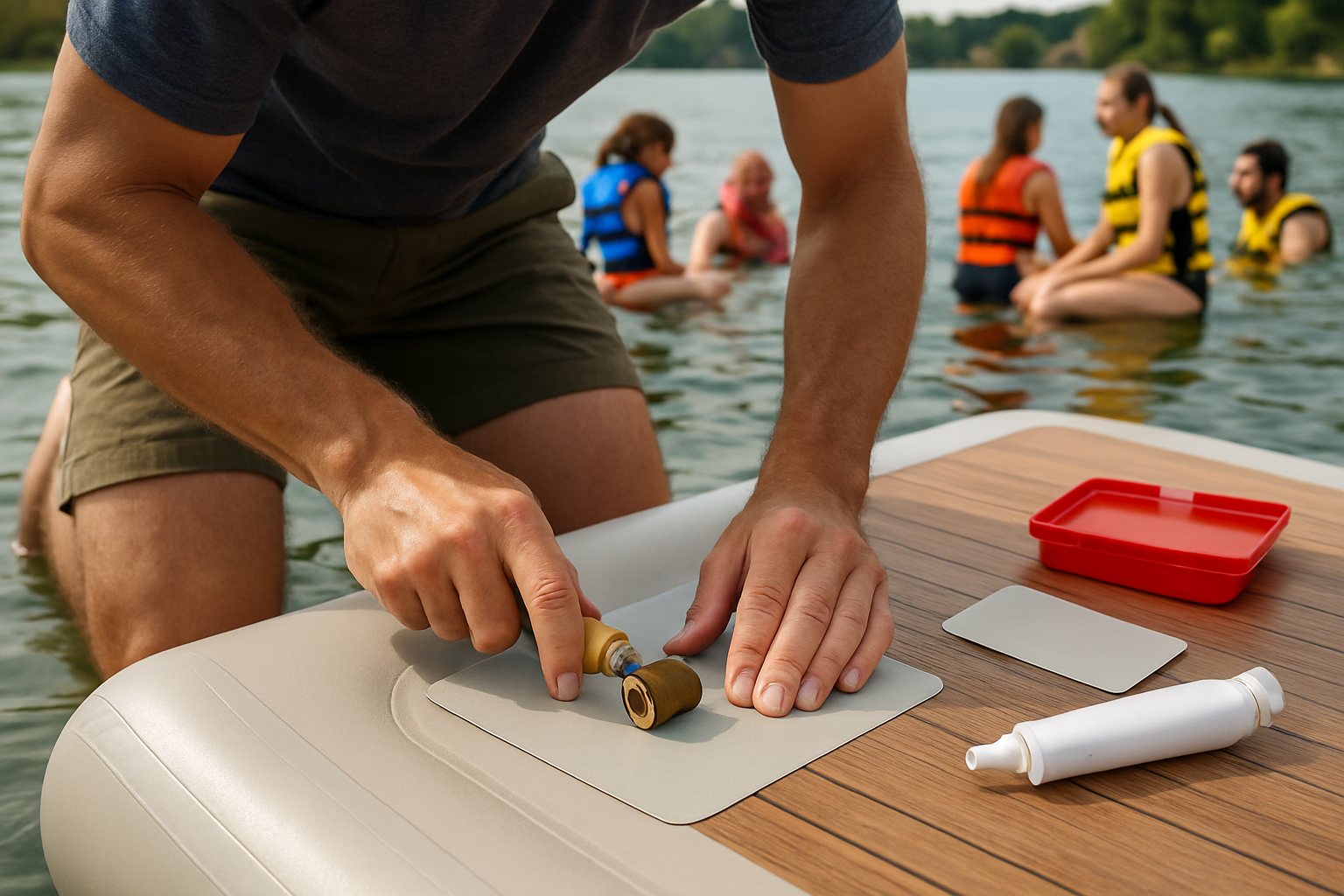
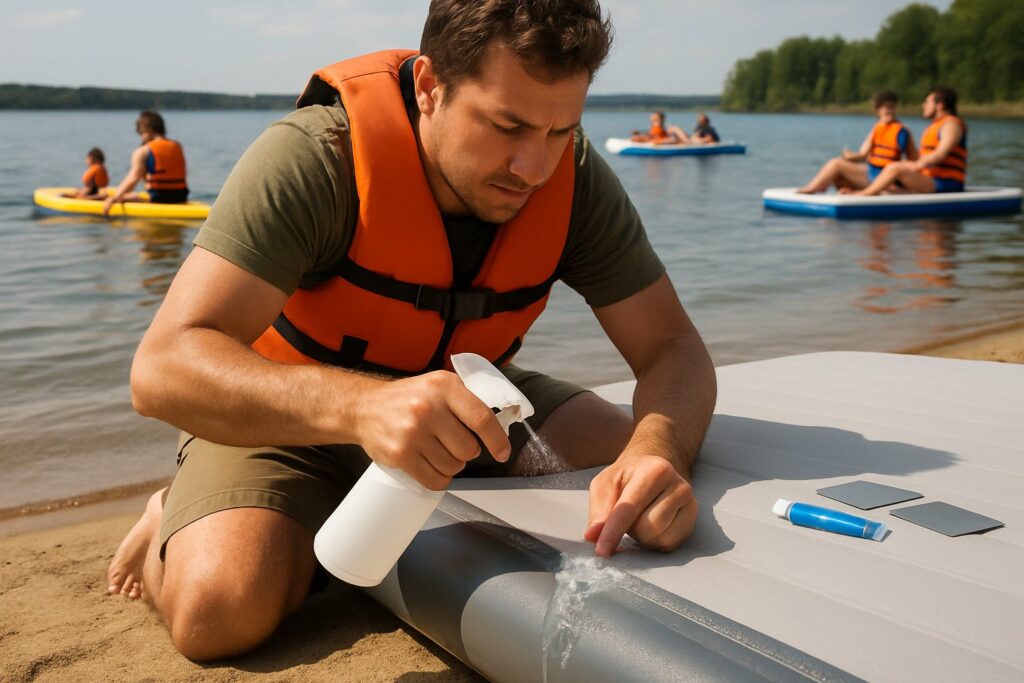
    Man spraying soapy water on an inflatable dock seam to find a leak

    In short: inflate the dock, find the leak with soapy water, deflate, clean the area with rubbing alcohol, glue on a round-cornered patch that overlaps the hole by about an inch, and let it cure for a full day before you pump it up. Use the adhesive made for your dock’s fabric: PVC glue for PVC docks (most consumer docks), Hypalon adhesive for Hypalon. Large tears, seam failures and anything that might be a defect go to the maker first.

    Before you patch: warranty and seams

    Two checks save trouble. First, warranty: Aquaglide’s repair instructions say that if you believe the product has a manufacturing defect, you should submit a warranty claim before making repairs, and a DIY patch may complicate a claim with any maker. Second, the kind of damage: RAVE’s Aqua Dock manual tells owners to contact RAVE for large holes, tears or seam failures, and to handle only minor holes and tears themselves. Seams on many docks are welded (Island Hopper says its docks have no glued edges or corners), which is factory work, not a kitchen-table repair.

    Step 1: find the leak

    1. Inflate the dock to its normal pressure on a clean, flat surface away from sharp objects.
    2. Mix mild soap in water and spray or sponge it over the deck, sides, seams and valve, a section at a time. RAVE suggests mild soapy water; Aquaglide says Windex or soapy water and a sponge.
    3. Watch for a stream of small bubbles. Check the valve and the area around D-rings and handles as well as the flat surfaces.
    4. Mark the spot with a grease pencil or tape, and note how big the hole is.

    If you find nothing and the dock still goes soft, remember that air pressure falls as the deck cools in the evening and rises in the sun. Re-check it at the same time of day before you decide it is leaking.

    Step 2: patch a PVC inflatable dock

    Most consumer docks (RAVE, Solstice, BOTE, Island Hopper, VEVOR and others) are PVC drop-stitch. RAVE’s manual gives these steps for minor holes and tears, using the patch kit that comes in the box:

    1. Cut a patch 1 to 2 in (3 to 5 cm) wider than the hole, with all corners rounded. (Aquaglide’s instructions are similar: cover 1 in beyond the leak in every direction, corners rounded to about 1/4 in.)
    2. Deflate the dock.
    3. Clean the patch and the area around the hole with rubbing alcohol, and let both dry completely.
    4. Read and follow the warnings on the glue, and work somewhere ventilated.
    5. Apply glue to the patch and the area around the hole, and let it dry until tacky to the touch (RAVE: about 30 seconds; Aquaglide: 30 to 60 seconds, until the surface glazes slightly).
    6. Lay the dock on a flat, hard surface, place the patch, and rub out air bubbles working from the center to the edges.
    7. Let the patch dry for 24 hours before inflating.

    Then inflate to pressure and run the soapy-water test again over the patch. If bubbles still appear, peel and redo it rather than stacking a second patch on top.

    PVC vs Hypalon: use the right adhesive

    Some docks, mostly on yachts, use Hypalon (CSM rubber) instead of PVC. Henshaw’s superyacht jet ski docks, for instance, have a Hypalon tube base under a drop-stitch top. The two fabrics need different glues. Polymarine, a UK maker of inflatable boat adhesives, says it is “very important to use the correct adhesive” for PVC or Hypalon, and its Hypalon adhesive guide states that the Hypalon glue is not for plasticised PVC.

    PVC dockHypalon dock or tube
    How to tell (Polymarine)Same color both sides; stays glossy when sanded; feels tacky after a light solvent wipeDark grey or black on the inside (look through the valve); sands to a matte, suede-like nap
    AdhesivePVC adhesive (for example the vinyl cement in a PVC patch kit)Hypalon adhesive; Polymarine uses a two-part glue for permanent repairs and calls its one-part tube an emergency fix
    Surface prepClean; Polymarine says don’t sand PVCSand lightly until it looks like suede, then clean with Hypalon solvent
    CureRAVE: 24 hours before inflatingPolymarine: at least six hours to dry; full cure 48 hours per its product sheet

    Polymarine’s two-part Hypalon method is more involved: mix the adhesive with its curative at 25 to 1 and use it within four hours, don’t glue in humid air (it “blooms,” turning slightly white, and must be removed), paint a thin first coat and let it dry at least 30 minutes, add a second coat to both surfaces and wait until tacky (5 to 15 minutes), then press the patch down hard from the middle out. Damage over 75 mm in any direction needs an inside patch as well as an outside one. The solvents involved are very flammable, so work outdoors or with good ventilation and no flames.

    Valve leaks

    If the bubbles come from the valve, it may only need cleaning and tightening. Many docks use H3-style high-pressure valves like those on paddle boards. Check that the stem is in the closed position (on RAVE’s dock you depress the stem and rotate a quarter turn to lock it open or closed), clear any sand from the seal, and if the valve body itself is loose, tighten it with the valve wrench your maker specifies. Replacement valves and parts come from the maker or its distributor; Aquaglide’s manual sends owners to its distributor or website for valves, handles and rings.

    Repair kits worth keeping in the dock bag

    Your dock’s own kit is the first choice because it matches the fabric. As spares for PVC docks, these were in stock on Amazon when we checked:

    PVC patches and glue

    JLF Repair Kit with HH-66 Vinyl Cement

    • 5 PVC patches, 3 x 6 in
    • 1 oz HH-66 vinyl cement
    • 6-prong valve wrench
    Check price on Amazon
    Small field repairs

    Stormsure SUP Repair Kit

    • TUFF Tape strip and patches
    • Polyurethane adhesive tubes
    • Sold for paddle boards
    Check price on Amazon

    The JLF kit’s patches are thick PVC raft material and the listing says its wrench fits 6-prong valves (check yours before relying on it). Stormsure’s kit is a quick, flexible fix sized for small punctures. Neither is Hypalon adhesive; for a Hypalon dock, follow your maker or a Hypalon-specific product.

    Avoiding the next leak

    • Carry, don’t drag. RAVE’s manual repeats it: always carry the dock to the water.
    • Inflate on a clean surface, free of rocks and sticks.
    • Keep it firm on the water. RAVE warns that muskrats may chew PVC; keeping full pressure or taking the dock out at night helps.
    • Don’t over-inflate. Stay within the maker’s pressure (RAVE: never beyond 5 psi on its dock).
    • Store it well. Clean, dry and out of the sun; see how to store an inflatable dock.

    More care guides live on our Setup and Care hub, including inflation and maintenance tips. To understand the fabric you’re patching, read drop-stitch docks explained; for spare pumps, lines and ladders, see dock ladders and accessories.

    Inflatable dock repair questions

    How do I find a slow leak in an inflatable dock?

    Inflate it fully and go over every surface, seam and the valve with soapy water, watching for bubbles. Re-check pressure at the same time of day, since temperature alone changes it.

    What glue do I use on an inflatable dock?

    The adhesive for its fabric. Most consumer docks are PVC and take PVC adhesive, usually supplied in the dock’s repair kit. Hypalon needs Hypalon adhesive; Polymarine says its Hypalon glue is not for plasticised PVC.

    How long before I can inflate after patching?

    RAVE says 24 hours for a PVC patch on its dock. Polymarine gives at least six hours to dry for a two-part Hypalon patch and 48 hours for a full cure.

    Can I fix a leaking seam myself?

    Makers generally say no. RAVE asks owners to contact it for seam failures, large holes and tears, and Aquaglide asks for a warranty claim before repairs if you suspect a defect.

    Can I patch a dock while it’s in the water?

    Not properly. The steps in RAVE’s manual call for a deflated dock, a clean and fully dry surface, and a flat, hard work surface, followed by a day of curing.

  • Drop Stitch Docks Explained: How an Air Dock Stays Flat

    Drop Stitch Docks Explained: How an Air Dock Stays Flat

    Stand on a good inflatable dock for the first time and it surprises you. You expect a bouncy-castle wobble; instead the deck is flat and firm, and you can walk to the edge and dive in the way you would off wood. Pull the valve at the end of the day and the same deck folds into a bag you can carry to the car. The trick is the fabric inside. This guide explains how a drop stitch dock is built, why pressure and thickness matter, how the main makers specify theirs, and where drop-stitch makes sense compared with rigid docks.

    In short: drop-stitch is two layers of airtight coated fabric tied together by thousands of fine threads. Pumped to pressure, the threads pull tight and hold the top and bottom flat and parallel, so the dock behaves like a firm deck instead of a balloon. Consumer drop-stitch docks are usually 6 to 8 in thick at roughly 5 to 15 psi, depending on the maker; yacht docks run to about 20 cm (8 in).

    What is a drop stitch dock?

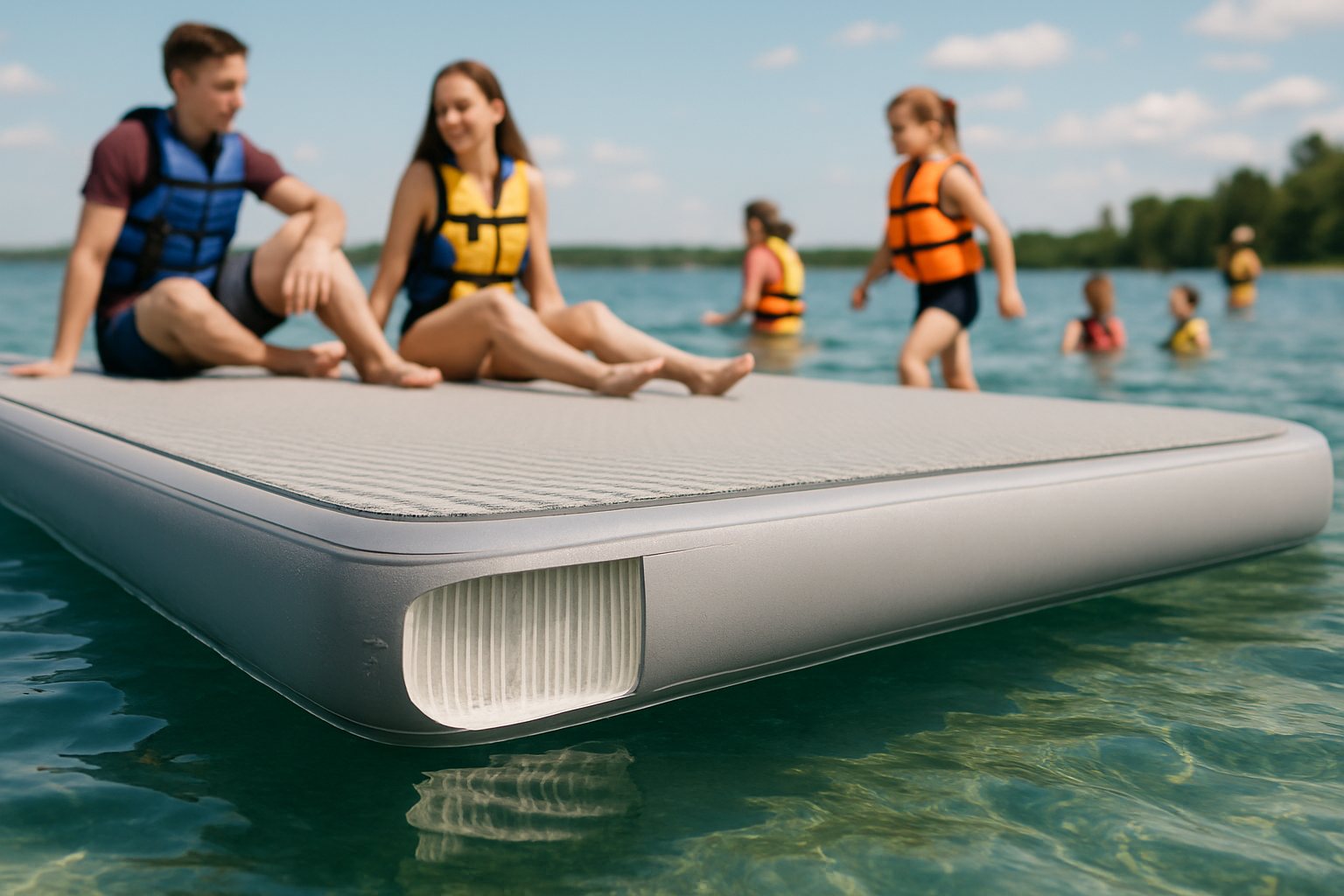
    Drop-stitch fabric is made of two woven layers joined by “drop yarns.” Both outer surfaces are coated with an airtight material, usually PVC or TPU. When the space between them is filled with air, the yarns stop the layers from bulging apart, so the panel holds its shape. The idea is older than paddle boards: Goodyear developed a similar fabric in the 1950s, called it Airmat, and used it in inflatable airplanes. The weaving machines use hundreds of needles, sometimes more than 400, and the finished panels are joined by gluing or welding.

    A drop stitch dock is that fabric made into a large flat chamber, with handles, D-rings and usually a textured foam top so wet feet don’t slip. It is the same construction as an inflatable paddle board, scaled up into a deck. That is why retailers often call it an inflatable dock platform: a platform-like floating deck, used as a dock for swimming, boarding and tying up small craft.

    How a drop stitch dock is built, layer by layer

    LayerWhat it doesExamples makers publish
    Deck padGrip and comfort underfootEVA foam top (Island Hopper, Jobe, VEVOR)
    Outer skinAbrasion, UV and puncture resistance1000-denier reinforced fabric (Island Hopper); 0.80 mm, 28 oz Duratex (Aquaglide); 1.2 mm PVC (VEVOR)
    Drop-stitch coreHolds the deck flat under pressure6 in on most consumer docks; 8 in (BOTE); 20 cm (Jobe, Yachtbeach)
    SeamsKeep the chamber airtightHeat-welded with no glued edges (Island Hopper); welded three-layer seams (Aquaglide)
    ValveInflation and deflationH3 high-pressure valves on several docks (Solstice, Overton’s)
    FittingsAnchoring, tie-off, climbing outStainless D-rings, anchor points, handles, corner bumpers

    Some docks mix materials. Henshaw’s superyacht jet ski docks, for example, have a Hypalon tube base with a double-wall drop-stitch top about 100 mm thick. Northern Diver’s FloatDeck is an 8 cm drop-stitch deck with an EVA surface rated to 0.7 bar (10 psi), sold in lengths from 1 to 10 m that link together.

    Single layer, fusion and double layer

    Paddle board makers describe three ways of finishing drop-stitch, and the same words show up in dock listings. Earth River SUP, which sells boards in the stiffer builds, explains that single-layer drop-stitch (the core with a PVC coating) is the lightest and cheapest but bouncier and easier to puncture; fusion bonds a woven fabric layer to the core for more rigidity; and double layer laminates an extra PVC-coated sheet on top for the most stiffness and puncture resistance, adding a few pounds. It also warns that “triple” or “quad” layer claims are mostly marketing. Few dock makers say which build they use, so if a listing doesn’t, ask, or compare the published fabric weight, seams and warranty instead.

    Thickness and pressure: why they matter

    The two numbers work together. Thickness sets how deep the deck is; pressure sets how tight the threads pull. Makers specify very different pressures for their own products, so there is no universal right number:

    DockThicknessPressure the maker states
    RAVE Aqua Dock 106 in5 psi; do not inflate beyond 5 psi
    BOTE Inflatable Dock 7 / 108 in6-8 psi / 8-10 psi
    Island Hopper Yacht Dock 10 x 66 in8-15 psi
    Solstice 10 x 106 in10 psi recommended (a dealer listing)
    Aquaglide Half Deck 7.510 cm (about 4 in)3.5-5 psi
    Northern Diver FloatDeck8 cm0.7 bar (10 psi)

    For comparison, inflatable paddle boards, which are much narrower, usually run at 12 psi and up. The rule is simple: inflate to the figure printed for your dock, check it with a gauge, and check again after the dock has sat in the sun, because warm air expands. RAVE ties its capacity rating to its 5 psi figure; see inflatable dock capacity explained.

    Drop stitch docks vs other floating docks

    Drop stitch dockRigid polyethylene dockFoam water mat
    FeelFirm, flat, slight giveHard and solidSoft; bends with the water
    WeightAbout 30 to 85 lb (consumer)Hundreds of lb per section (Wave Armor: 380 lb for 60 x 120 in)Light; rolls up
    Packs downYes, into a bagNoRolls
    DamageCan be punctured and patchedFoam-filled floats; maker says punctures shouldn’t sink it (Wave Armor)Can tear
    Best forSeasonal swim and boarding decks, docks carried on boatsDocks that stay in all season, drive-on portsFloating play and lounging

    For more on the rigid side, read inflatable vs rigid floating docks or our EZ Dock and Wave Armor comparisons. If a soft mat is what you want for the kids, our sister site explains drop-stitch for platforms and mats.

    Strengths and limits of drop-stitch

    • Good: light enough for two people to carry, ships by parcel, inflates in minutes (Island Hopper says about 8 minutes for its 10 x 6 ft dock with a hand pump), and stores in a closet.
    • Good: rides high and firm; with bumpers it can sit beside a boat without marking the hull.
    • Watch out: it can be punctured. Most docks come with a patch kit; large tears and seam failures go back to the maker (see inflatable dock repair).
    • Watch out: UV and rodents. RAVE warns that muskrats may chew PVC and suggests keeping full pressure on the water or taking the dock out at night; Aquaglide recommends a UV protectant.
    • Watch out: a light deck needs proper anchoring, and no consumer maker we checked publishes a wind limit.

    Drop stitch docks you can buy now

    6 in drop-stitch

    RAVE Aqua Dock 10 x 10

    • 5 psi
    • 1,800 lb or 10 adults (maker)
    • EVA foam corners
    Check price on Amazon
    Heat-welded

    Island Hopper Yacht Dock 10 x 6

    • 6 in, 8-15 psi
    • 1000-denier outer layer
    • 1,500 lb (maker)
    Check price on Amazon

    And some of the drop-stitch docks in our catalog, from family decks to yacht and dive systems:

    BOTE Inflatable Dock 10 Classic

    by BOTE

    • Size (as stated): 10 x 10 ft x 8 in
    • Stated capacity: 2,100 lb on BOTE's site (1,500 lb at some retailers)
    • Thickness: 8 in

    Full specs and sources

    See it at BOTE

    Jobe Infinity Dock

    by Jobe

    • Size (as stated): 250 x 233 cm
    • Stated capacity: 300 kg maximum user weight
    • Thickness: 20 cm

    Full specs and sources

    See it at Nootica

    Northern Diver FloatDeck

    by Northern Diver

    • Size (as stated): 1 to 10 m lengths
    • Thickness: 8 cm drop-stitch

    Full specs and sources

    See it at Northern Diver
    Custom built: request information

    Henshaw Jet Ski Dock (single and twin)

    by Henshaw Inflatables

    • Thickness: About 100 mm double-wall drop-stitch top

    Full specs and sources

    Request more information

    Browse all styles on the dock types hub, see family decks on lake docks and yacht systems on yacht docks, or look up terms like denier and H3 valve in the glossary.

    Drop stitch dock questions

    What does drop stitch mean on an inflatable dock?

    It means the dock’s air chamber is made of two coated fabric layers held together by thousands of threads. Under pressure the threads keep the deck flat and firm, which is what lets you stand and walk on it.

    How thick should a drop stitch dock be?

    Most consumer docks are 6 in; BOTE’s are 8 in, and yacht docks from Jobe and Yachtbeach are 20 cm. Thicker decks tend to feel stiffer, but the maker’s stated capacity and pressure tell you more than thickness alone.

    What psi should I inflate my drop stitch dock to?

    The figure your maker prints for that model. They vary: RAVE 5 psi, BOTE 6-10 psi by size, Island Hopper 8-15 psi. Don’t go above the maker’s maximum; RAVE warns that over-inflating can damage its dock.

    Is a drop stitch dock the same as an inflatable dock platform?

    Usually, yes: retailers use both names for the same flat drop-stitch deck. Check the listing for thickness, pressure and a stated capacity; a thin, low-pressure pool float sold as a “platform” is a different product.

    Can a drop stitch dock be repaired?

    Small holes, yes, with the maker’s patch kit and the right adhesive for the fabric. RAVE asks owners to contact it for large holes, tears or seam failures, and to let a patch dry for 24 hours before inflating. Our repair guide walks through the steps.

  • Inflatable Dock Weight Capacity Explained: What the Numbers Mean

    Inflatable Dock Weight Capacity Explained: What the Numbers Mean

    Late afternoon, the whole crew swims over to the dock at once: four adults, three kids and a dog, everyone climbing up the same side. The deck dips at that corner and someone asks the obvious question: how many of us can this thing actually hold? The answer is on the label, but it isn’t always one number. This guide explains inflatable dock weight capacity: the three kinds of figures makers publish, why they disagree, what “heavy duty” really means, and how to use them without guessing. Like any floating dock, an inflatable dock’s rated capacity depends on how much water it can displace before the deck sits too low.

    In short: makers state capacity in one of three ways: a weight in pounds (sometimes called a load rating), a people count, or both tied to a specific pressure. They are not interchangeable, and a figure for static load is not a figure for people moving around or for a jet ski. Use the lowest figure your maker publishes for your exact model, inflated to the pressure it names, and if two sources disagree, ask the maker.

    The three ways makers state capacity

    How it’s statedExample (maker’s own figure)What it tells you
    Weight in poundsIsland Hopper: 1,000 / 1,500 / 2,000 lb load ratings for its 10 x 3, 10 x 6 and 10 x 10 ft docksA total weight; it doesn’t say how many people
    People countSolstice: 3-5 people (6 x 5 ft) up to 8-10 people (10 x 10 ft)How many people the maker expects on it, not their weight
    Both, at a set pressureRAVE: 1,800 lb, 14 users maximum; 5 psi recommended for up to 10 adults or 14 childrenThe most useful form: people, weight and the pressure that goes with them
    People and pounds togetherAquaglide Docking Station: 600 lb (3 adults + 3 children)A conservative people rating on a big deck
    Per userJobe Infinity Dock: 300 kg maximum user weightThe maker’s maximum user weight for that module

    Look at how far apart the numbers sit. Aquaglide’s Docking Station is almost 15 ft long, yet Aquaglide rates it for 600 lb, while RAVE rates its 10 x 10 ft Aqua Dock for 1,800 lb. That is not proof that one is stronger. The makers are measuring different things, with different assumptions about how people move, where they stand and how much the deck may sink or flex.

    Inflatable dock weight capacity vs people count

    A pound figure on its own invites a bad shortcut: dividing it by an average body weight. Don’t. People jump, crowd one edge and climb on from the water, and a dock that floats a static load evenly can tip or fold at one corner. That is why the best ratings come with a people count. RAVE’s manual for the Aqua Dock lists a maximum capacity of 14 users and a maximum weight of 1,800 lb, and then says that 5 psi is “a recommended inflation pressure for up to 10 adults or 14 children.” Island Hopper’s figures, by contrast, appear in listings as load ratings in pounds with no people count, so ask the maker how many people a given dock is meant to carry.

    We never work out a “safe load” from a dock’s size, and we suggest you don’t either. A larger deck doesn’t come with a proportionally higher rating (Aquaglide’s case above shows that), and nothing in the area of a deck tells you how its seams, valves or drop-stitch threads were tested. The figure that counts is the one printed on your dock and in its manual.

    Pressure is part of the rating

    A drop-stitch dock is only as stiff as the air in it. Makers state very different pressures: RAVE 5 psi for its Aqua Dock (and not to inflate beyond it), BOTE 6-8 psi for its 7 ft and 8-10 psi for its 10 ft dock, Island Hopper 8-15 psi for its Yacht Dock, and Solstice 10 psi on a dealer listing. A dock run soft will sag under the load it is rated for; one over-pressured can be damaged. Check with a gauge before people climb on, and again in the afternoon, since air expands as the deck warms in the sun. Our drop-stitch docks explained guide covers why pressure matters so much.

    When the numbers conflict

    It happens more than you’d think. BOTE’s own page lists its 10 ft Inflatable Dock at 2,100 lb, while some retailers list the same model at 1,500 lb. Solstice rates its 10 x 10 by people (8-10), while Overton’s lists it at 1,650 lb. When sources disagree, plan around the lower figure and ask the maker in writing which one applies to people on the deck. Our Solstice vs BOTE vs VEVOR comparison lays out these conflicts brand by brand.

    Docks don’t have a capacity plate

    Boaters know the capacity plate: the BoatUS Foundation explains that powered boats under 20 ft built after November 1, 1972 must display one, showing maximum persons and maximum weight, and that those limits apply in good to moderate weather (keep well below them in rough water). Inflatable boats are exempt, and inflatable docks aren’t boats, so there is no federal plate or common test standard behind their ratings. Each maker sets its own. The same caution applies, though: no consumer dock maker we checked publishes a wind or wave limit, and RAVE’s manual says never to use its dock in high winds, waves, strong currents or storms.

    What “heavy duty inflatable dock” really means

    “Heavy duty” and “military grade” appear all over listings, but neither is a defined spec; on consumer docks they are seller copy. What you can compare are the things makers actually publish:

    • Thickness: most consumer docks are 6 in; BOTE’s are 8 in; yacht docks from Jobe and Yachtbeach are 20 cm (about 8 in).
    • Fabric: Island Hopper lists a 1000-denier outer layer; Aquaglide 0.80 mm, 28 oz Duratex on its Docking Station.
    • Seams: heat-welded (Island Hopper) or welded three-layer seams (Aquaglide) versus glued.
    • Warranty and use: RAVE’s lifetime warranty is for personal use; Aquaglide gives 3 years residential but 1 year light commercial on its Half Deck.

    Heavy duty for a family is not the same as rated for work. Recreational docks are not sold for passenger boarding, rental fleets or crews with equipment, and in some places passenger landing pontoons must be certified (a 1998 circular from Singapore’s maritime authority requires it). For commercial or rescue use, see the purpose-built products on our dock types hub and use Request more information.

    Jet skis need a jet ski rating

    A people count is not a jet ski rating. A flat swim dock is not sold for parking a personal watercraft, whatever its pound figure. Purpose-built docks such as Jobe’s Infinity PWC Dock or the yacht jet ski docks in our jet ski docks guide are the ones to look at, and even then, confirm with the maker which craft and weights a dock is rated for.

    How to use a capacity rating

    • Find the rating for your exact model and size in the manual or on the label, not a listing for a similar dock.
    • Inflate to the pressure the maker ties to that rating, and check it with a gauge.
    • Use the lowest figure when sources disagree, and the people count when both are given.
    • Spread people out, climb on from different sides, and keep the deck clear of coolers that load one corner.
    • Check the water depth the maker asks for (RAVE: at least 4 ft) and keep life jackets on non-swimmers and kids.

    Two docks that publish clear ratings and were in stock when we checked:

    People and pounds

    RAVE Aqua Dock 10 x 10

    • 1,800 lb, 14 users max
    • 10 adults or 14 children at 5 psi
    • 10 x 10 ft, 6 in
    Check price on Amazon
    Load rating

    Island Hopper Yacht Dock 10 x 6

    • 1,500 lb (maker)
    • 8-15 psi
    • 10 x 6 ft, 6 in
    Check price on Amazon
    SpecRAVE Aqua Dock 10Island Hopper Mega Yacht Dock 10 x 10Aquaglide Docking Station
    Size (as stated)10 x 10 ft x 6 in10 x 10 ft14 ft 9 in x 10 ft 5 in x 6 in
    Thickness6 in drop-stitch6 in6 in (15 cm) welded drop-stitch
    Stated capacity1,800 lb / 10 adults2,000 lb load rating600 lb (3 adults + 3 children)
    Minimum water depth4 ftnot published4 ft; at least 10 ft from shore
    ConstructionDrop-stitch PVCHeat-welded PVC with EVA top0.80 mm 28 oz Duratex, 3-layer seams
    Inflation pressure5 psinot publishednot published
    Weight68 lb75 lb rollednot published
    Anchoring / attachment2 anchor pointsnot published5 anchor rings; at least 1,100 lb anchor weight; anchors, bridle and pump not included
    WarrantyLimited lifetimenot published3-year limited
    Price signalnot publishednot publishedAbout $2,530 to $2,640 at dealers
    See it at Bart'sSee it at Overton'sSee it at Bart's

    Figures as each maker states them; makers measure capacity differently. Check the product page for sources and dates.

    More reading: our Setup and Care hub, best inflatable docks, lake docks, and the terms in our glossary and FAQ.

    Capacity questions

    How much weight can an inflatable dock hold?

    It depends entirely on the model. Stated figures we found run from 265 lb (VEVOR 6 x 5 ft) and 600 lb (Aquaglide Docking Station) to 1,800 lb (RAVE 10 x 10 ft) and 2,100 lb (BOTE 10 ft, per BOTE). Use your dock’s own rating.

    Is a load rating the same as a people limit?

    No. A load rating is a total weight, often for a static, evenly spread load. A people limit accounts for how people move and gather. When a maker gives both, follow both.

    Does a bigger dock always hold more?

    No. Aquaglide’s nearly 15 ft Docking Station is rated 600 lb; RAVE’s 10 x 10 ft dock 1,800 lb. Ratings reflect each maker’s own testing and assumptions, not just area.

    What is the most heavy duty inflatable dock?

    There is no standard for “heavy duty.” Compare the published thickness, fabric, seams, stated capacity and warranty terms instead; among consumer docks, BOTE’s are thickest at 8 in, and yacht docks such as Jobe’s run 20 cm.

    Does underinflating reduce capacity?

    Makers tie their ratings to a pressure. RAVE, for example, gives 5 psi as the recommended pressure for up to 10 adults or 14 children. Below the stated pressure the deck is softer and the rating no longer reflects how it will behave, so pump to spec.

  • Solstice vs BOTE vs VEVOR Inflatable Docks Compared

    Solstice vs BOTE vs VEVOR Inflatable Docks Compared

    Saturday at the cove: boats rafted up, music low, and a white inflatable dock tied off behind the pontoon where everyone climbs out to sit with their feet in the water. Ask whose dock it is and you’ll hear one of three names more than any other: Solstice, BOTE or VEVOR. This guide puts the Solstice inflatable dock side by side with BOTE’s and VEVOR’s, using each maker’s own published sizes, ratings and prices, and flags where the numbers don’t agree.

    In short: Solstice (a Swimline brand) sells mid-priced 6 in drop-stitch docks from 6 x 5 to 10 x 10 ft, rated by people count on its own site. BOTE’s docks are the thickest at 8 in and the most expensive, with a 2-year warranty, but its 10 ft capacity is listed as 2,100 lb by BOTE and 1,500 lb by some retailers. VEVOR is the budget pick, with an electric pump in the box and much lower stated capacities for its size. All three are recreational swim and lounge docks.

    Prices change often. The prices below are what we saw at the maker or a major retailer in October 2026; check the current price before you buy.

    Solstice, BOTE and VEVOR at a glance

    Solstice Inflatable Floating DockBOTE Inflatable Dock (Classic)VEVOR Inflatable Floating Dock
    Sizes6 x 5, 8 x 5, 10 x 8, 10 x 10 ft7 x 7 and 10 x 10 ftSeveral, from 6 x 5 ft to 10 x 6.5 ft and larger on Amazon
    Thickness6 in8 in6 in
    Maker’s stated capacity3-5 to 8-10 people by size7 ft: 1,050 lb; 10 ft: 2,100 lb (1,500 lb at some retailers)6 x 5 ft: 265 lb, 1-3 people; 10 x 6.5 ft: 661 lb, 5-6 adults
    Pressure10 psi recommended (retailers: 10-12 psi)7 ft: 6-8 psi; 10 ft: 8-10 psiNot in the specs
    Weight22 to 54 lb by sizeAbout 35 lb (7 ft) and 83 lb (10 ft)About 28 lb (6 x 5 ft, per VEVOR’s answer to a question)
    PumpDual-action hand pump with gaugeHand pumpElectric pump and hand pump
    Warranty1-year (site-wide)2 years, plus a 30-day guaranteeNot stated; 30-day returns
    Price seen$349.99 on Solstice’s site (sold out); 10 x 10 at $555.39 at a dealer (sold out)$999 (7 ft) and $1,549 (10 ft) at BOTE (sold out)$166.99 (6 x 5 ft) and $337.19 (10 x 6.5 ft) at VEVOR

    Solstice inflatable dock: the mid-priced classic

    Solstice Watersports is a Swimline brand, and its Inflatable Floating Dock is the one you’ll see at Overton’s, Walmart and Lowe’s. Solstice’s own page lists four sizes, all with six stainless D-rings and a dual-action hand pump with a gauge: 6 x 5 ft (3-5 people, 22 lb), 8 x 5 ft (4-6 people, 26 lb), 10 x 8 ft (6-8 people, 48 lb) and 10 x 10 ft (8-10 people, 54 lb). A dealer listing for the 10 x 10 gives a recommended pressure of 10 psi; another retailer says 10 to 12 psi for a firmer deck.

    Solstice rates its docks by people, while retailers add pound figures: Overton’s lists 1,650 lb for the 10 x 10 and 1,320 lb for the 10 x 8. Solstice also sells a 10 x 8 Luxe Dock with a traction pad and ladder, and a mesh-center Rec Mesh dock, which are different products. When we checked in October 2026, every size was marked sold out on Solstice’s site, and dealer stock was patchy, so check availability before you plan around one.

    BOTE dock: thickest, priciest, with a capacity question

    BOTE, the paddle board brand, builds its Inflatable Dock (sold as the Hangout Dock) with its AeroBOTE inflatable construction, 8 in thick. BOTE’s page lists the 7 x 7 ft dock at 1,050 lb, 6-8 psi and about 35 lb, and the 10 x 10 ft at 2,100 lb, 8-10 psi and about 83 lb, each with a carry sling and hand pump and a 2-year warranty. BOTE showed $999 for the 7 ft and $1,549 for the 10 ft in October 2026, both sold out with a notify-me button.

    The 2,100 vs 1,500 lb conflict. BOTE’s own page lists the 10 ft dock at 2,100 lb, while some retailers selling model 10IBD20CL list 1,500 lb (and 6-8 psi instead of 8-10). We can’t tell from the listings which figure covers people standing on the deck. Until BOTE clarifies, plan around the lower number and ask BOTE which one applies to your dock. Our inflatable dock capacity explained guide shows why these figures differ.

    VEVOR floating dock: the budget option

    VEVOR sells a long list of inflatable floating docks, on its own site and on Amazon, in square, rectangular and round shapes. Its listings describe layered drop-stitch PVC with an EVA non-slip pad, 6 in thick, and include both an electric pump and a dual-action hand pump. The figures VEVOR states are much lower than the other brands for a similar size: the 6 x 5 ft dock is rated 265 lb (120 kg) for 1-3 people, and the 10 x 6.5 ft dock 661 lb (300 kg) for 5-6 adults. VEVOR’s specs don’t give a pressure; in its answer to a buyer’s question it says 3 psi. No warranty is listed, only 30-day free returns.

    The low price is real ($166.99 for the 6 x 5 ft and $337.19 for the 10 x 6.5 ft on VEVOR’s site), but so is the gap in stated capacity. A VEVOR dock is a good fit for a pool, a pond or two people on a lake. For a crowd, a higher-rated dock is the safer buy.

    Where to buy

    Mid-priced classic

    Solstice Inflatable Floating Dock

    • 6 x 5 to 10 x 10 ft, 6 in
    • 3-5 to 8-10 people (maker)
    • Hand pump with gauge
    See it at the store
    Thickest deck

    BOTE Inflatable Dock 10 Classic

    • 10 x 10 ft, 8 in
    • 2,100 lb on BOTE's site
    • 2-year warranty
    See it at the store
    Budget

    VEVOR Inflatable Dock 10 x 6.5 ft

    • 661 lb, 5-6 adults (maker)
    • Electric and hand pump
    • 30-day returns
    See it at the store

    If those are out of stock, two docks with higher stated ratings were in stock on Amazon when we checked:

    Also consider

    RAVE Aqua Dock 10 x 10

    • 10 x 10 ft, 6 in
    • 1,800 lb or 10 adults (maker)
    • Limited lifetime warranty, personal use
    Check price on Amazon
    For boaters

    Island Hopper Yacht Dock 10 x 6

    • 10 x 6 ft, 6 in
    • 1,500 lb (maker)
    • Corner bumpers
    Check price on Amazon

    Setup and care are the same for all three

    Whichever brand you pick, the routine is similar. Inflate on a clear, flat spot (RAVE’s manual for its own dock says flat ground or the boat deck with the motor off), carry it rather than drag it, and pump to the pressure printed for your model, not to a number from another brand. A gauge helps: Solstice includes one on its pump. Tie off or anchor through the D-rings so wind can’t swing the dock, and keep it away from engines and propellers. Air expands as the sun warms the deck, so check pressure again in the afternoon.

    At the end of the day or season, rinse with mild soap and fresh water, dry both sides completely, and roll it loosely for storage somewhere shaded and dry. Our guides on how to store an inflatable dock and inflatable dock repair cover the details from the makers’ manuals.

    How to choose between them

    • Count people, then check the label. For a family of four on a lake, the Solstice 10 x 8 (6-8 people) or BOTE 7 ft (1,050 lb) fit; the VEVOR 6 x 5 (1-3 people) does not.
    • Thicker is firmer. BOTE’s 8 in deck flexes less underfoot than 6 in decks, at a price.
    • Budget for a pump. Only VEVOR includes an electric pump. Hand-pumping a 10 x 10 to 8-10 psi takes a while; see dock ladders and accessories for pumps.
    • Plan anchoring. Solstice gives you six D-rings; anchors and lines are usually extra on all three.
    • Warranty matters on PVC. BOTE gives 2 years, Solstice 1 year; VEVOR lists returns only.

    See every model with its sources in our product directory or try the dock finder. For more picks, read best inflatable docks; for how these decks are built, drop-stitch docks explained; and for the whole range, the lake docks page.

    SpecSolstice Inflatable Dock 10 x 10BOTE Inflatable Dock 10 ClassicRAVE Aqua Dock 10
    Size (as stated)10 x 10 ft x 6 in10 x 10 ft x 8 in10 x 10 ft x 6 in
    Thickness6 in drop-stitch8 in6 in drop-stitch
    Stated capacity1,650 lb2,100 lb on BOTE's site (1,500 lb at some retailers)1,800 lb / 10 adults
    Minimum water depthnot publishednot published4 ft
    Constructionnot publishedAeroBOTE drop-stitchDrop-stitch PVC
    Inflation pressure7 to 12 psi8 to 10 psi5 psi
    Weight70 lbnot published68 lb
    Anchoring / attachment6 stainless steel D-ringsnot published2 anchor points
    InflationH3 valvenot publishednot published
    Warrantynot publishednot publishedLimited lifetime
    Price signalnot published$1,549 direct (when checked)not published
    See it at Overton'sSee it at BOTESee it at Bart's

    Figures as each maker states them; makers measure capacity differently. Check the product page for sources and dates.

    Solstice, BOTE and VEVOR dock questions

    How much weight can a Solstice inflatable dock hold?

    Solstice rates its docks by people: 3-5 for the 6 x 5 ft up to 8-10 for the 10 x 10 ft. Overton’s lists 1,650 lb for the 10 x 10 and 1,320 lb for the 10 x 8. Go by the label on your dock.

    Is the BOTE 10 ft dock rated 2,100 or 1,500 lb?

    BOTE’s site says 2,100 lb; some retailers list 1,500 lb for the same model. The sources conflict, so use the lower figure until BOTE confirms which applies to people on the deck.

    Is a VEVOR inflatable dock any good?

    It is a low-cost drop-stitch dock with both pumps included. Its stated capacities are much lower than Solstice, BOTE or RAVE for a similar size, and no warranty is listed, so it suits light use by a few people.

    Can I park a jet ski on these docks?

    None of the three is sold as a jet ski dock. For that, see purpose-built models in our jet ski docks guide.

  • Wave Armor Floating Dock vs Inflatable Docks Compared

    Wave Armor Floating Dock vs Inflatable Docks Compared

    Early morning on the lake, the water still glassy. One neighbor rolls a jet ski off a grey plastic port and is gone in a puff of spray; another is still pumping up a white inflatable deck for the kids’ swim later. Both are floating docks, and if you’re shopping for a Wave Armor floating dock, you’ve probably wondered whether an inflatable could do the job for less. We checked what Wave Armor actually sells on its own site, with its published prices, and set it next to the inflatable docks on the market.

    In short: Wave Armor makes rigid, rotationally molded polyethylene docks with foam-filled floats, plus drive-on ports for jet skis and boats. Its dock sections list from $250 for a small corner to $2,950 for an 80 x 120 in section, and its PWC ports from $1,725 to $5,199 (October 2026). Inflatable docks are lighter, portable and cheaper per deck, but they are seasonal swim and boarding decks; only purpose-built inflatable jet ski docks are sold for parking a jet ski.

    What Wave Armor sells

    Wave Armor’s website groups its range like this: floating docks (dock sections, bumpers, accessories, ramps, walkways and gangways, H-beam connections and mooring kits), PWC ports (Pro, Pro Maxx, Pro Inline, SLX and Sport), boat ports (PRO 170 and 220, PRO 8, Extreme X24), pontoon lifts, canopies, a power launch assist, and extras such as a kayak launch and a swim raft. None of it is inflatable.

    The dock sections are a two-piece design: a molded top deck with a flagstone texture on a closed, foam-filled bottom float. Wave Armor says the floats have suction pockets that help the section sit steady on the water, and that because the float is foam-filled, a puncture should not cause a leak or a sinking section. Its 60 x 120 in section, for example, is listed at 60 in wide, 120 in long and 17 in high (16 in elsewhere on the same page), weighs 380 lb, and needs a forklift for delivery. Wave Armor’s site mentions a standard ten-year warranty for its floating dock systems.

    Wave Armor floating dock prices

    Unlike some rigid dock makers, Wave Armor publishes list prices. These are from its site in October 2026, for one section or port, before connectors, anchoring, freight and installation.

    Wave Armor itemSizePrice listed
    Dock section30 x 60 in$950
    Dock section60 x 60 in$1,350
    Dock section40 x 120 in$1,795
    Dock section60 x 120 in$2,295
    Dock section80 x 120 in$2,950
    Corners, wedges, half-rounds30 to 60 in$250 to $1,275
    Sport PWC port59 in wide, 11 ft long; 700 lb weight capacity$1,725
    SLX5 / SLX6 PWC ports–$2,100 / $2,199
    Pro and Pro Maxx PWC ports–$2,299 to $2,699
    Pro Inline Port–$5,199
    Kayak launch with 2 rails–$2,100
    Otter Island Swim Raft10 x 8 ft; 3,000 lb capacityQuote

    Wave Armor’s online section listings don’t show a load rating for each dock section, so ask a dealer for the figure on the sections you buy. A dash means the size or rating was not shown on the listing page.

    Planning a Wave Armor dock

    A rigid dock is a small construction job, even when it comes in sections. Wave Armor’s rectangular panels run 2.5 to 5 ft wide and 5 or 10 ft long, with wedge, half-round and corner pieces, joined by H-beam connectors in 24, 31 and 50 in lengths. Its site has an online Dock Builder for sketching a layout, and the shop sells mooring kits, ramps, gangways and bumpers separately. Before you order, measure the water depth along the planned dock, note the bottom type and how much the level changes through the season, and ask the dealer which mooring kit suits it. Delivery is by freight; the 60 x 120 in section page says a forklift is required. If you want a shape, our floating dock designs and layouts guide explains straight, L, T and U layouts.

    Inflatable docks: what you get for the money

    An inflatable dock is a drop-stitch PVC deck pumped to the maker’s pressure. It weighs a fraction of a rigid section (RAVE’s 10 x 10 ft Aqua Dock is listed at 68 to 69 lb; Island Hopper’s 10 x 6 ft Yacht Dock at 53 lb), so two people can carry it and it ships by parcel. Prices are published and lower per square foot of deck: RAVE lists its Aqua Dock at $799.99 for 100 sq ft, rated by RAVE for 1,800 lb or 10 adults, and Island Hopper lists its Yacht Dock at $749, rated for 1,500 lb.

    Swim deck

    RAVE Aqua Dock 10 x 10

    • 100 sq ft, 6 in thick
    • 1,800 lb or 10 adults (maker)
    • Needs at least 4 ft of water
    Check price on Amazon
    Boat side

    Island Hopper Yacht Dock 10 x 6

    • 1,500 lb (maker)
    • Rubber corner bumpers
    • Stainless D-rings
    Check price on Amazon

    Prices change often. The prices here are what we saw at the maker or a major retailer in October 2026; check the current price before you buy.

    Wave Armor vs inflatable docks, side by side

    Wave Armor (rigid)Inflatable dock
    BuildRotomolded UV-protected polyethylene, foam-filled floatDrop-stitch PVC, often with an EVA foam top
    Weight380 lb for a 60 x 120 in section; forklift deliveryAbout 30 to 85 lb for consumer docks
    Height16 to 17 in tall section6 to 8 in thick deck
    If puncturedFoam-filled; maker says it should not sinkLoses air; patch it (see inflatable dock repair)
    Jet skiDrive-on PWC portsOnly purpose-built inflatable jet ski docks
    LayoutsStraight, L, T, U with corners, wedges and H-beam connectorsMostly a single deck
    SeasonInstalled for the seasonPumped up when needed; stored dry in winter
    PricePublished per section and portPublished per dock

    Which is right for you?

    Choose a Wave Armor floating dock if you own the waterfront, keep a jet ski or small boat at home all summer and want it out of the water on a drive-on port, or want a dock you can extend into an L, T or U over time. Plan for anchoring, delivery by truck and forklift, and a winter plan if your lake ices up.

    Choose an inflatable dock if you mostly want a swim and lounge deck, a step beside the boat at anchor, or something you can take to a rental or a second lake. It is also the easy choice on small ponds (see floating docks for ponds and lakes). Budget for anchors, an electric pump and a ladder; our dock ladders and accessories guide covers them.

    Many families end up with both: a rigid dock and port at the shore, and an inflatable deck anchored a little way out for swimming. If you do mix them, follow each maker’s own instructions. RAVE’s manual, for example, warns that tying its dock to docks, piers or other hard objects raises the risk of injury and tells owners not to connect it directly to them.

    Inflatable jet ski docks, for comparison

    If the jet ski is the reason you’re looking at Wave Armor, know that inflatable jet ski docks exist, mostly for yachts: Jobe’s U-shaped Infinity PWC Dock, Henshaw’s single and twin docks, NautiBuoy’s double-bay drive-in dock and FunAir’s Toy Island. Most are quote-only. Here is what’s in our catalog:

    Custom built: request information

    FunAir Toy Island

    by FunAir

    • Stated capacity: Up to 4 jet skis or dinghies, or 2 Seabobs plus guests (maker)

    Full specs and sources

    Request more information
    Custom built: request information

    Henshaw Jet Ski Dock (single and twin)

    by Henshaw Inflatables

    • Thickness: About 100 mm double-wall drop-stitch top

    Full specs and sources

    Request more information

    Jobe Infinity PWC Dock

    by Jobe

    • Size (as stated): 345 x 250 cm
    • Thickness: 20 cm

    Full specs and sources

    See it at Nootica
    Custom built: request information

    NautiBuoy Jet-Ski Dock

    by NautiBuoy Marine

    Full specs and sources

    Request more information

    Read more in jet ski docks and floating dock for a jet ski. Comparing rigid brands? See EZ Dock vs inflatable docks and the general inflatable vs rigid floating docks guide, or browse every style on the dock types hub.

    Wave Armor floating dock questions

    Is a Wave Armor dock inflatable?

    No. Wave Armor docks and ports are rotationally molded, UV-protected polyethylene. The dock sections pair a top deck with a foam-filled bottom float; nothing is pumped up.

    How much does a Wave Armor floating dock cost?

    Wave Armor listed sections from $950 (30 x 60 in) to $2,950 (80 x 120 in) on its site in October 2026, with corners and wedges from $250. A full dock adds connectors, mooring kits, freight and installation, so ask a dealer for a complete quote.

    How much weight does a Wave Armor PWC port hold?

    Wave Armor lists its Sport port, made for smaller, lightweight PWCs, with a 700 lb weight capacity. Check the stated capacity of the exact port against your jet ski’s weight from its owner’s manual.

    What warranty does Wave Armor offer?

    Wave Armor’s site refers to a standard ten-year warranty for its floating dock systems but doesn’t spell out the terms on the pages we checked, and some retailers list a different term for PWC ports. Ask the dealer for the written warranty for your items.

    Can I add an inflatable dock to a Wave Armor dock?

    Neither maker documents a connection between the two. Keep an inflatable deck anchored on its own, following its maker’s manual; RAVE, for one, says not to connect its dock directly to docks or piers.

  • EZ Dock Cost vs Inflatable Docks: An Honest Comparison

    EZ Dock Cost vs Inflatable Docks: An Honest Comparison

    Walk the shoreline of almost any busy lake in summer and you’ll see both kinds: a grey or beige plastic dock with a jet ski sitting high and dry in its port, and a few doors down, a big white inflatable deck with kids cannonballing off the corner. Both float, both are called floating docks, and both get shortlisted by the same buyers. This guide compares EZ Dock cost and construction with inflatable docks, using only what EZ Dock and the inflatable makers publish, so you can tell which one fits your water and budget.

    Modular plastic cube dock next to an inflatable dock on a lake

    In short: EZ Dock is a rigid modular dock made of polyethylene sections. It does not publish prices; you get a quote from a local dealer, and the cost depends on your layout, location and accessories. Inflatable docks are drop-stitch PVC decks with list prices from under $200 for small generic models to about $800 for a 10 x 10 ft RAVE dock and over $2,500 for Aquaglide’s largest dock. EZ Dock is built to stay in for the season and expand; an inflatable is portable and seasonal.

    What EZ Dock is (and isn’t)

    EZ Dock is a US company that says it has been around since 1991 and is now part of PlayPower, Inc. Its docks are not inflatable. A standard 60 x 60 in section (SKU 206060) is molded from 100% virgin linear low-density polyethylene, measures 58-1/2 x 58-1/2 x 14-5/8 in, has patented hollow chambers underneath for stability, and is rated by EZ Dock for 1,500 lb. The range includes straight sections of several lengths, corner gussets, finger docks, a low-profile dock, half-hex and tri shapes, plus PWC ports, boat ports and lifts, the EZ Launch kayak launch, gangways, railings and benches.

    Because it is a system of sections, EZ Dock can be laid out as a straight dock, an L, a T or a U, and changed later. EZ Dock sells pre-configured kits too, such as a 20 x 20 ft U made of five 60 in x 10 ft sections. Our floating dock designs and layouts guide shows what each shape is for.

    EZ Dock pricing: how the cost is set

    We looked for an official EZ Dock price list and did not find one. EZ Dock’s own pricing page has no dollar figures; it says to “find a local distributor or get a custom quote,” and its kit pages say the same. The company lists what drives the price:

    • Location: environmental conditions, shipping costs and local regulations.
    • Your needs: accessories, features and the weight of your personal watercraft.
    • Configuration and size: the dimensions and any custom layout.

    For a sense of scale, another rigid polyethylene maker, Wave Armor, does publish list prices: $1,350 for a 60 x 60 in section and $2,295 for a 60 x 120 in section on its site in October 2026, with connectors, anchoring, delivery and installation on top. That is a different brand with a different design, so treat it only as a signal of what rigid sections cost, not as an EZ Dock price. A 2026 HomeAdvisor cost guide puts floating docks in general at $15 to $35 per sq ft for materials and labor. To get a real EZ Dock number, use its online Dock Designer and request a dealer quote with your water depth, bottom type and the craft you want to dock.

    Inflatable dock cost, with published prices

    Inflatable dockSizeMaker’s stated capacityPrice seen, Oct 2026
    VEVOR 6 x 5 ft6 x 5 ft, 6 in265 lb, 1-3 people$166.99 at VEVOR
    Island Hopper Yacht Dock10 x 6 ft, 6 in1,500 lb$749 at the maker
    RAVE Aqua Dock 1010 x 10 ft, 6 in1,800 lb or 10 adults$799.99 at the maker
    BOTE Inflatable Dock 10 Classic10 x 10 ft, 8 in2,100 lb on BOTE’s site (1,500 lb at some retailers)$1,549 at BOTE (sold out)
    Aquaglide Docking Station14 ft 9 in x 10 ft 5 in, 6 in600 lb (3 adults + 3 children)About $2,530 to $2,640 at dealers

    Notice how loosely size and capacity line up: Aquaglide’s big Docking Station carries the lowest stated capacity in the table, because makers rate different things (people on the deck, or a static load). Our inflatable dock capacity explained guide unpacks that. Budget too for anchors (often not included), a pump and lines.

    EZ Dock vs inflatable docks, side by side

    EZ Dock (rigid polyethylene)Inflatable dock (drop-stitch PVC)
    PriceDealer quote; not publishedPublished list prices, about $170 to $2,640 for the models above
    Feel underfootHard, stable deck about 14-5/8 in tall (60 x 60 in section)Firm but slightly springy, 6 to 8 in thick
    CraftPWC ports, boat ports and lifts, kayak launchSwimming and boarding; jet ski use only on purpose-built inflatable jet ski docks
    InstallationSections coupled together and anchored, often by a dealerPump up on shore or a boat deck, float out, anchor or tie off
    SeasonStays in for the seasonOften taken out after use; stored dry over winter
    ExpandableYes, add sections laterMostly no; only systems built to link
    Warranty10-year limited on sections and ports; 1 year on hardware and accessories (register within 30 days)From about 1 year to RAVE’s limited lifetime for personal use; Island Hopper 5 years with registration
    Weak pointsCost, weight, delivery and winter ice where it shiftsPunctures, UV, rodents, and anchoring a light deck in wind

    What to ask for in an EZ Dock quote

    • A parts list with every section, gusset and coupler set, so you can compare it with a kit from another brand.
    • The stated weight capacity of each section and port, and the make and weight of the jet ski or boat it is quoted for.
    • What anchoring is included (pipes, chains, anchors) and whether it suits your depth, bottom and water-level changes.
    • Delivery, installation, and winter removal or storage, priced separately.
    • Who handles permits, and the warranty registration steps.

    When EZ Dock makes more sense

    • You own the shoreline and want a dock that stays in all season.
    • You want a drive-on berth for a jet ski or small boat. EZ Dock and others sell rigid PWC ports; a flat inflatable swim dock is not rated for that.
    • You plan to grow the dock in stages, or you need an accessible kayak launch (EZ Dock makes an Accessible Transfer System).
    • You’d like a dealer to plan, deliver and anchor it.

    When an inflatable dock makes more sense

    • You want a swim and lounge deck this summer for a fraction of a dealer-installed dock.
    • You rent, move between lakes, or boat out to a sandbar and want the dock to come with you.
    • You need to tie a deck alongside a boat; Island Hopper’s Yacht Dock has rubber corner bumpers for that.
    • Your lake freezes hard and you’d rather store the dock in the garage than plan a winter removal.
    Big family deck

    RAVE Aqua Dock 10 x 10

    • 10 x 10 ft, 6 in thick
    • 1,800 lb or 10 adults (maker)
    • About $800, Oct 2026
    Check price on Amazon
    Ties alongside a boat

    Island Hopper Yacht Dock 10 x 6

    • 10 x 6 ft, 6 in thick
    • 1,500 lb (maker)
    • About $749, Oct 2026
    Check price on Amazon

    Prices change often. The prices here are what we saw at the maker or a major retailer in October 2026; check the current price before you buy.

    Compare three inflatable docks with their sources:

    SpecRAVE Aqua Dock 10Island Hopper Mega Yacht Dock 10 x 10BOTE Inflatable Dock 10 Classic
    Size (as stated)10 x 10 ft x 6 in10 x 10 ft10 x 10 ft x 8 in
    Thickness6 in drop-stitch6 in8 in
    Stated capacity1,800 lb / 10 adults2,000 lb load rating2,100 lb on BOTE's site (1,500 lb at some retailers)
    Minimum water depth4 ftnot publishednot published
    ConstructionDrop-stitch PVCHeat-welded PVC with EVA topAeroBOTE drop-stitch
    Inflation pressure5 psinot published8 to 10 psi
    Weight68 lb75 lb rollednot published
    Anchoring / attachment2 anchor pointsnot publishednot published
    WarrantyLimited lifetimenot publishednot published
    Price signalnot publishednot published$1,549 direct (when checked)
    See it at Bart'sSee it at Overton'sSee it at BOTE

    Figures as each maker states them; makers measure capacity differently. Check the product page for sources and dates.

    Weighing other rigid brands? See Wave Armor vs inflatable docks and the broader inflatable vs rigid floating docks. Thinking of building one? Read building a floating dock vs buying inflatable. Every style, rigid and inflatable, is on the dock types hub, with modular systems on the modular docks page.

    EZ Dock cost questions

    How much does an EZ Dock cost?

    EZ Dock does not publish prices. Its pricing page says cost depends on location, accessories, the weight of your watercraft, and the size and configuration, and it sends buyers to a local dealer for a quote. Be wary of unofficial “price lists” online.

    Is EZ Dock an inflatable dock?

    No. EZ Dock sections are molded polyethylene (LLDPE) with hollow chambers underneath. They float like a dock float, not like an air-filled deck, and they don’t need a pump.

    What warranty does EZ Dock give?

    EZ Dock states a ten-year limited warranty on floating dock sections and boat, PWC and kayak ports against cracks, breakage, leaks and UV deterioration from defects, and one year on hardware and accessories. It asks owners to register within 30 days.

    How much weight does an EZ Dock section hold?

    EZ Dock rates its standard 60 x 60 in section for 1,500 lb. Other sections have their own figures; ask the dealer for the rating of the exact sections in your quote.

    Can I put a jet ski on an inflatable dock instead?

    Only on a dock sold for it, such as Jobe’s Infinity PWC Dock or the yacht jet ski docks covered in our jet ski docks guide. A flat swim dock’s stated capacity is not a jet ski rating.