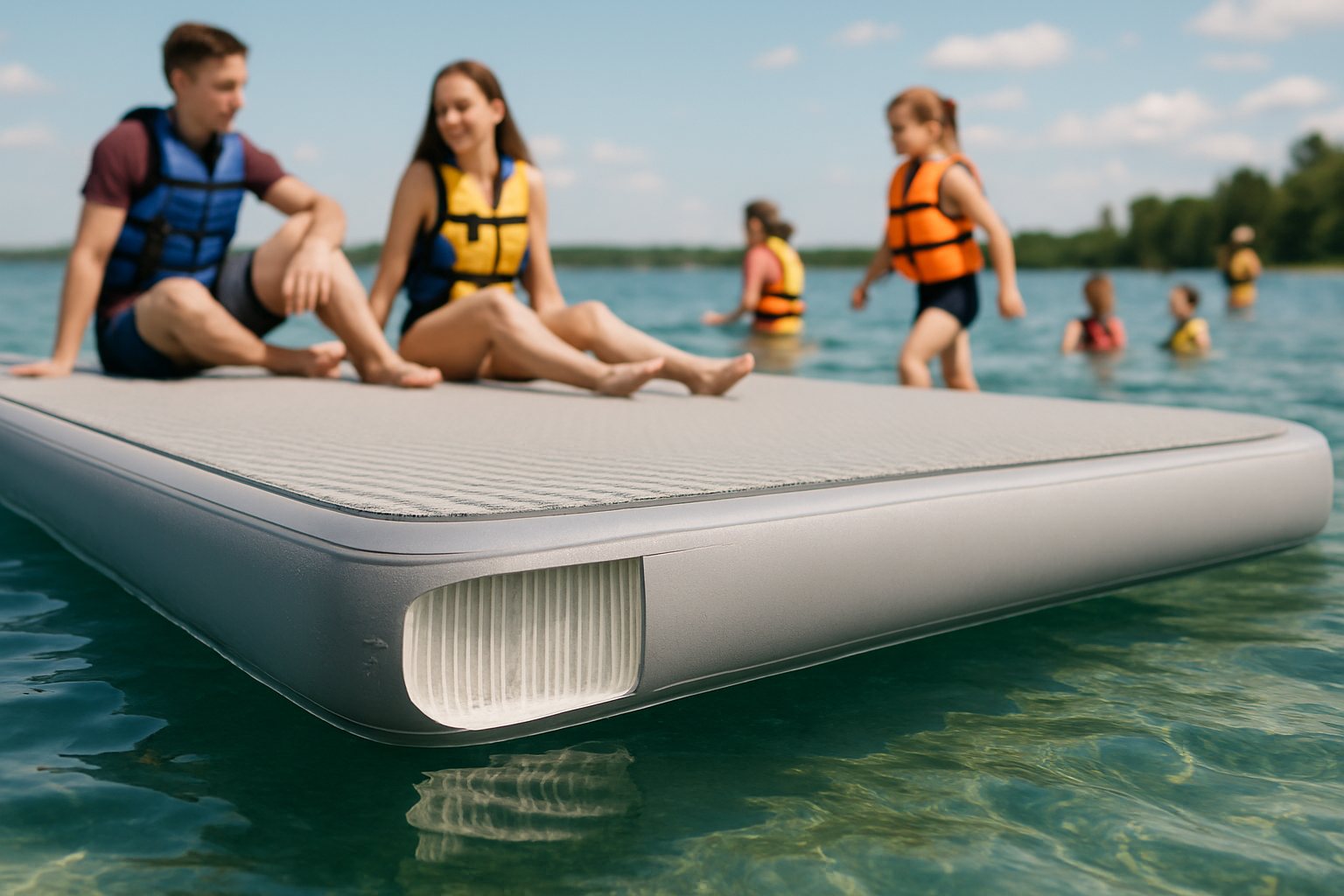
Stand on a good inflatable dock for the first time and it surprises you. You expect a bouncy-castle wobble; instead the deck is flat and firm, and you can walk to the edge and dive in the way you would off wood. Pull the valve at the end of the day and the same deck folds into a bag you can carry to the car. The trick is the fabric inside. This guide explains how a drop stitch dock is built, why pressure and thickness matter, how the main makers specify theirs, and where drop-stitch makes sense compared with rigid docks.
In short: drop-stitch is two layers of airtight coated fabric tied together by thousands of fine threads. Pumped to pressure, the threads pull tight and hold the top and bottom flat and parallel, so the dock behaves like a firm deck instead of a balloon. Consumer drop-stitch docks are usually 6 to 8 in thick at roughly 5 to 15 psi, depending on the maker; yacht docks run to about 20 cm (8 in).
What is a drop stitch dock?
Drop-stitch fabric is made of two woven layers joined by “drop yarns.” Both outer surfaces are coated with an airtight material, usually PVC or TPU. When the space between them is filled with air, the yarns stop the layers from bulging apart, so the panel holds its shape. The idea is older than paddle boards: Goodyear developed a similar fabric in the 1950s, called it Airmat, and used it in inflatable airplanes. The weaving machines use hundreds of needles, sometimes more than 400, and the finished panels are joined by gluing or welding.
A drop stitch dock is that fabric made into a large flat chamber, with handles, D-rings and usually a textured foam top so wet feet don’t slip. It is the same construction as an inflatable paddle board, scaled up into a deck. That is why retailers often call it an inflatable dock platform: a platform-like floating deck, used as a dock for swimming, boarding and tying up small craft.
How a drop stitch dock is built, layer by layer
| Layer | What it does | Examples makers publish |
|---|---|---|
| Deck pad | Grip and comfort underfoot | EVA foam top (Island Hopper, Jobe, VEVOR) |
| Outer skin | Abrasion, UV and puncture resistance | 1000-denier reinforced fabric (Island Hopper); 0.80 mm, 28 oz Duratex (Aquaglide); 1.2 mm PVC (VEVOR) |
| Drop-stitch core | Holds the deck flat under pressure | 6 in on most consumer docks; 8 in (BOTE); 20 cm (Jobe, Yachtbeach) |
| Seams | Keep the chamber airtight | Heat-welded with no glued edges (Island Hopper); welded three-layer seams (Aquaglide) |
| Valve | Inflation and deflation | H3 high-pressure valves on several docks (Solstice, Overton’s) |
| Fittings | Anchoring, tie-off, climbing out | Stainless D-rings, anchor points, handles, corner bumpers |
Some docks mix materials. Henshaw’s superyacht jet ski docks, for example, have a Hypalon tube base with a double-wall drop-stitch top about 100 mm thick. Northern Diver’s FloatDeck is an 8 cm drop-stitch deck with an EVA surface rated to 0.7 bar (10 psi), sold in lengths from 1 to 10 m that link together.
Single layer, fusion and double layer
Paddle board makers describe three ways of finishing drop-stitch, and the same words show up in dock listings. Earth River SUP, which sells boards in the stiffer builds, explains that single-layer drop-stitch (the core with a PVC coating) is the lightest and cheapest but bouncier and easier to puncture; fusion bonds a woven fabric layer to the core for more rigidity; and double layer laminates an extra PVC-coated sheet on top for the most stiffness and puncture resistance, adding a few pounds. It also warns that “triple” or “quad” layer claims are mostly marketing. Few dock makers say which build they use, so if a listing doesn’t, ask, or compare the published fabric weight, seams and warranty instead.
Thickness and pressure: why they matter
The two numbers work together. Thickness sets how deep the deck is; pressure sets how tight the threads pull. Makers specify very different pressures for their own products, so there is no universal right number:
| Dock | Thickness | Pressure the maker states |
|---|---|---|
| RAVE Aqua Dock 10 | 6 in | 5 psi; do not inflate beyond 5 psi |
| BOTE Inflatable Dock 7 / 10 | 8 in | 6-8 psi / 8-10 psi |
| Island Hopper Yacht Dock 10 x 6 | 6 in | 8-15 psi |
| Solstice 10 x 10 | 6 in | 10 psi recommended (a dealer listing) |
| Aquaglide Half Deck 7.5 | 10 cm (about 4 in) | 3.5-5 psi |
| Northern Diver FloatDeck | 8 cm | 0.7 bar (10 psi) |
For comparison, inflatable paddle boards, which are much narrower, usually run at 12 psi and up. The rule is simple: inflate to the figure printed for your dock, check it with a gauge, and check again after the dock has sat in the sun, because warm air expands. RAVE ties its capacity rating to its 5 psi figure; see inflatable dock capacity explained.
Drop stitch docks vs other floating docks
| Drop stitch dock | Rigid polyethylene dock | Foam water mat | |
|---|---|---|---|
| Feel | Firm, flat, slight give | Hard and solid | Soft; bends with the water |
| Weight | About 30 to 85 lb (consumer) | Hundreds of lb per section (Wave Armor: 380 lb for 60 x 120 in) | Light; rolls up |
| Packs down | Yes, into a bag | No | Rolls |
| Damage | Can be punctured and patched | Foam-filled floats; maker says punctures shouldn’t sink it (Wave Armor) | Can tear |
| Best for | Seasonal swim and boarding decks, docks carried on boats | Docks that stay in all season, drive-on ports | Floating play and lounging |
For more on the rigid side, read inflatable vs rigid floating docks or our EZ Dock and Wave Armor comparisons. If a soft mat is what you want for the kids, our sister site explains drop-stitch for platforms and mats.
Strengths and limits of drop-stitch
- Good: light enough for two people to carry, ships by parcel, inflates in minutes (Island Hopper says about 8 minutes for its 10 x 6 ft dock with a hand pump), and stores in a closet.
- Good: rides high and firm; with bumpers it can sit beside a boat without marking the hull.
- Watch out: it can be punctured. Most docks come with a patch kit; large tears and seam failures go back to the maker (see inflatable dock repair).
- Watch out: UV and rodents. RAVE warns that muskrats may chew PVC and suggests keeping full pressure on the water or taking the dock out at night; Aquaglide recommends a UV protectant.
- Watch out: a light deck needs proper anchoring, and no consumer maker we checked publishes a wind limit.
Drop stitch docks you can buy now
RAVE Aqua Dock 10 x 10
- 5 psi
- 1,800 lb or 10 adults (maker)
- EVA foam corners
Island Hopper Yacht Dock 10 x 6
- 6 in, 8-15 psi
- 1000-denier outer layer
- 1,500 lb (maker)
And some of the drop-stitch docks in our catalog, from family decks to yacht and dive systems:
BOTE Inflatable Dock 10 Classic
by BOTE
- Size (as stated): 10 x 10 ft x 8 in
- Stated capacity: 2,100 lb on BOTE's site (1,500 lb at some retailers)
- Thickness: 8 in
Jobe Infinity Dock
by Jobe
- Size (as stated): 250 x 233 cm
- Stated capacity: 300 kg maximum user weight
- Thickness: 20 cm
Northern Diver FloatDeck
by Northern Diver
- Size (as stated): 1 to 10 m lengths
- Thickness: 8 cm drop-stitch
Henshaw Jet Ski Dock (single and twin)
by Henshaw Inflatables
- Thickness: About 100 mm double-wall drop-stitch top
Browse all styles on the dock types hub, see family decks on lake docks and yacht systems on yacht docks, or look up terms like denier and H3 valve in the glossary.
Drop stitch dock questions
What does drop stitch mean on an inflatable dock?
It means the dock’s air chamber is made of two coated fabric layers held together by thousands of threads. Under pressure the threads keep the deck flat and firm, which is what lets you stand and walk on it.
How thick should a drop stitch dock be?
Most consumer docks are 6 in; BOTE’s are 8 in, and yacht docks from Jobe and Yachtbeach are 20 cm. Thicker decks tend to feel stiffer, but the maker’s stated capacity and pressure tell you more than thickness alone.
What psi should I inflate my drop stitch dock to?
The figure your maker prints for that model. They vary: RAVE 5 psi, BOTE 6-10 psi by size, Island Hopper 8-15 psi. Don’t go above the maker’s maximum; RAVE warns that over-inflating can damage its dock.
Is a drop stitch dock the same as an inflatable dock platform?
Usually, yes: retailers use both names for the same flat drop-stitch deck. Check the listing for thickness, pressure and a stated capacity; a thin, low-pressure pool float sold as a “platform” is a different product.
Can a drop stitch dock be repaired?
Small holes, yes, with the maker’s patch kit and the right adhesive for the fabric. RAVE asks owners to contact it for large holes, tears or seam failures, and to let a patch dry for 24 hours before inflating. Our repair guide walks through the steps.