Tag: Floating Docks

  • Floating Dock Ramps, Gangways and Hardware: How It All Connects

    Floating Dock Ramps, Gangways and Hardware: How It All Connects

    Late August on a reservoir, and the water is two feet lower than it was on Memorial Day. The dock still floats perfectly level, but the walk down to it has turned into a steep little slide, and someone carrying a cooler is taking it very slowly. That walk is the floating dock ramp, and together with the brackets, hinges and pins that hold the sections together, it decides whether a floating dock feels solid or sketchy. This guide covers how a floating dock connects to shore and how its sections connect to each other, using the figures makers and retailers actually publish.
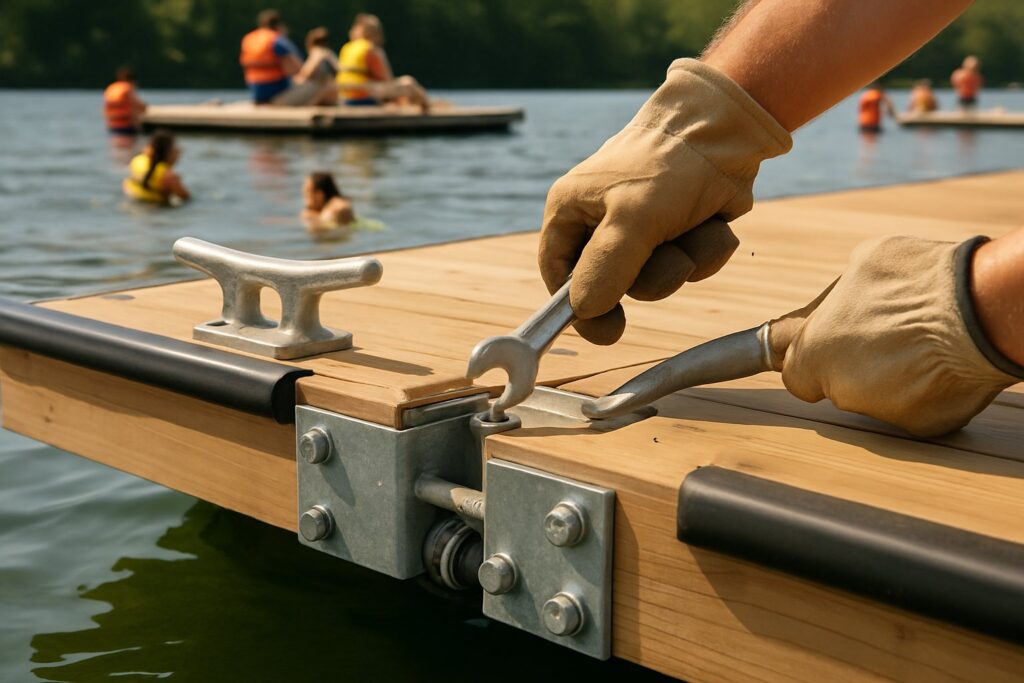
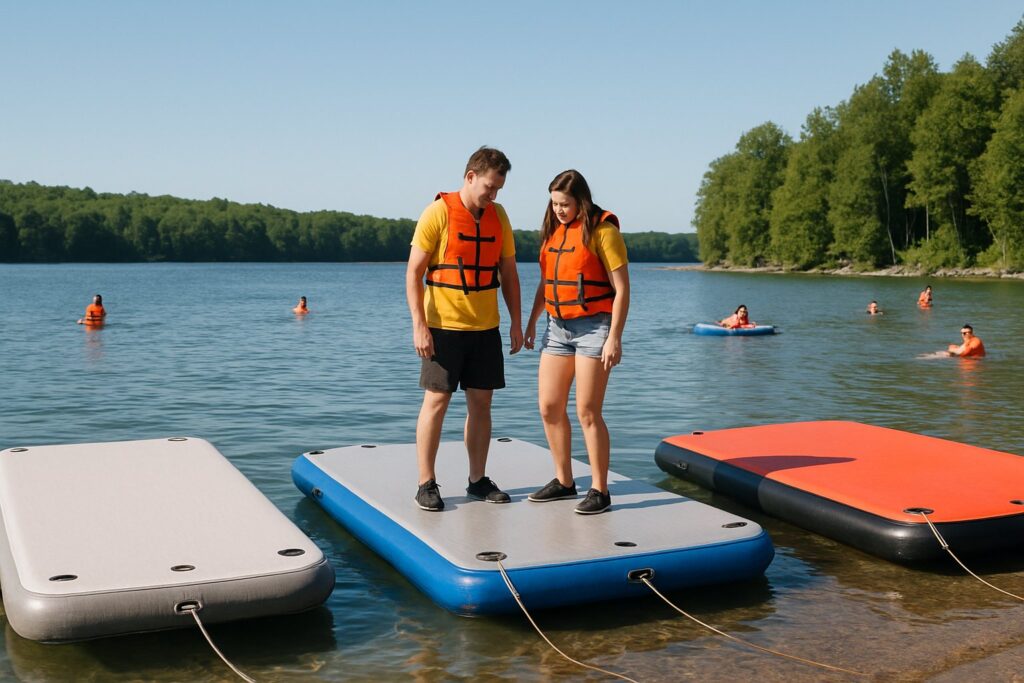
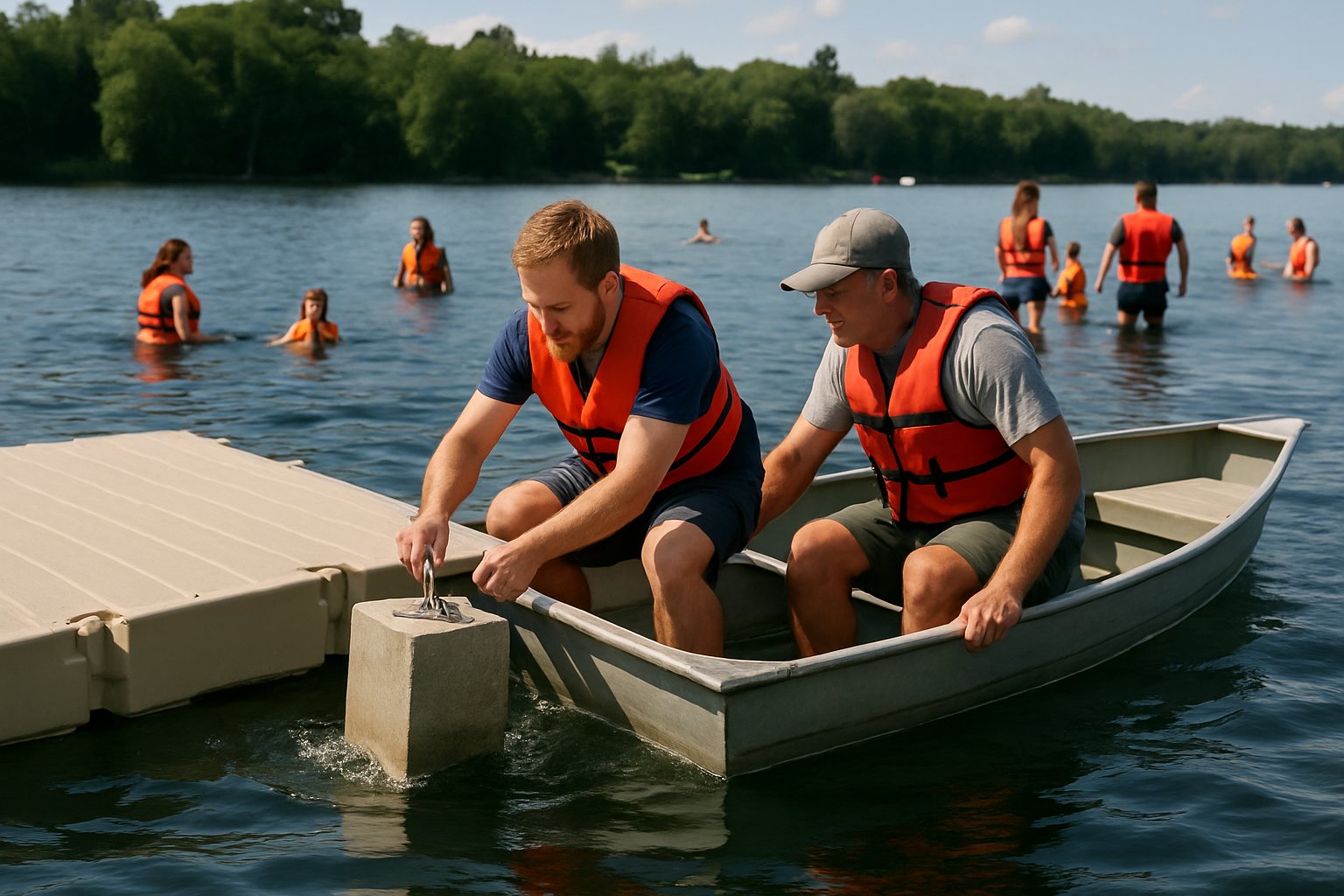
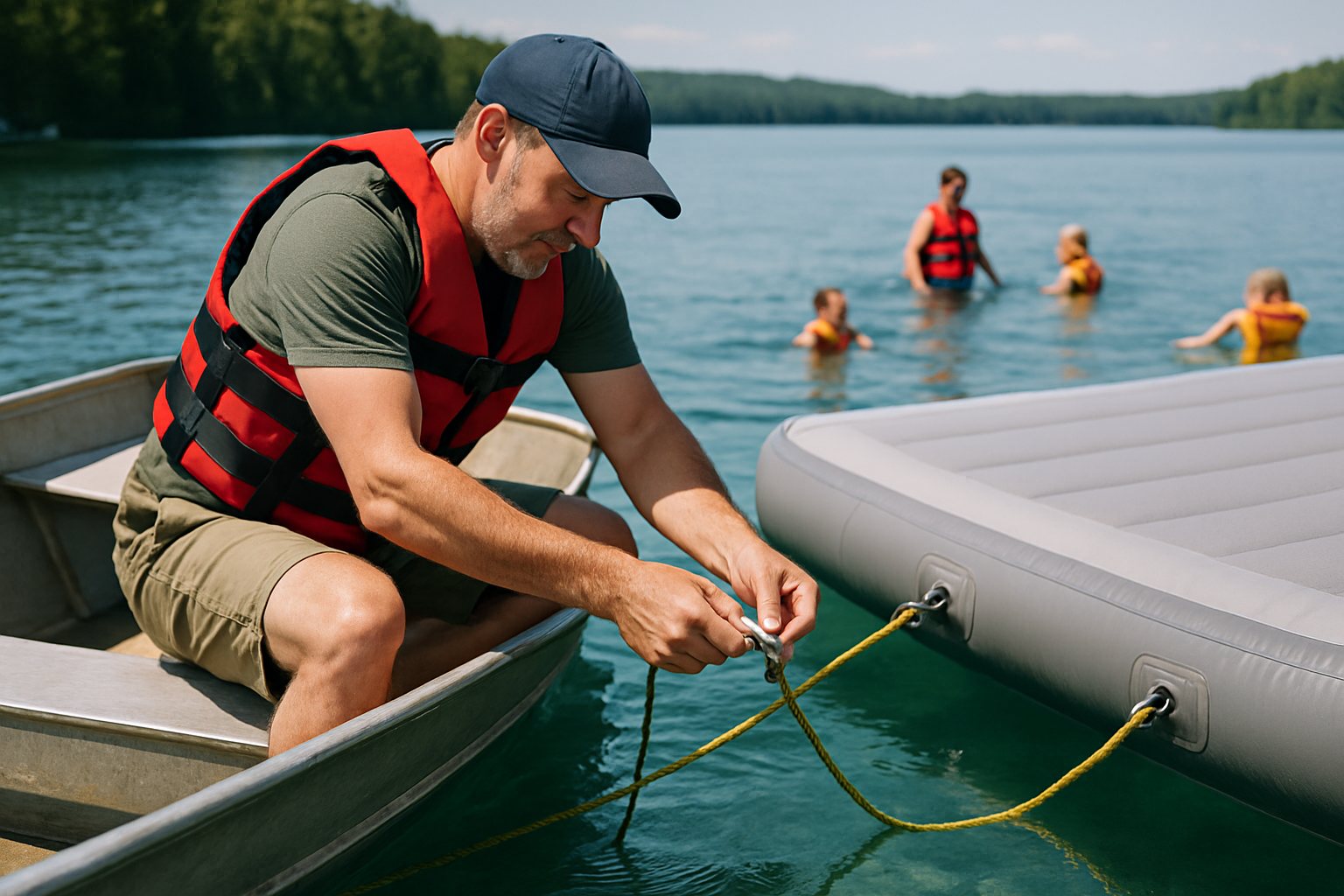
    Close view of galvanized corner brackets and a cleat joining two floating dock sections

    In short: a floating dock ramp (or gangway) is hinged at the shore end and rests on rollers or a slider on the dock, so it can change angle as the water rises and falls. The longer the ramp, the gentler the slope for the same change in water level. The U.S. Access Board’s guidance for covered public boating facilities sets a 1:12 maximum slope for gangways, with exceptions; private docks are not bound by it, but it is a useful benchmark. Floating dock hardware (corner brackets, hinge connectors, pipe holders, stiff arms) is usually hot-dip galvanized steel for fresh water, with stainless or aluminum options for salt.

    What a floating dock ramp actually does

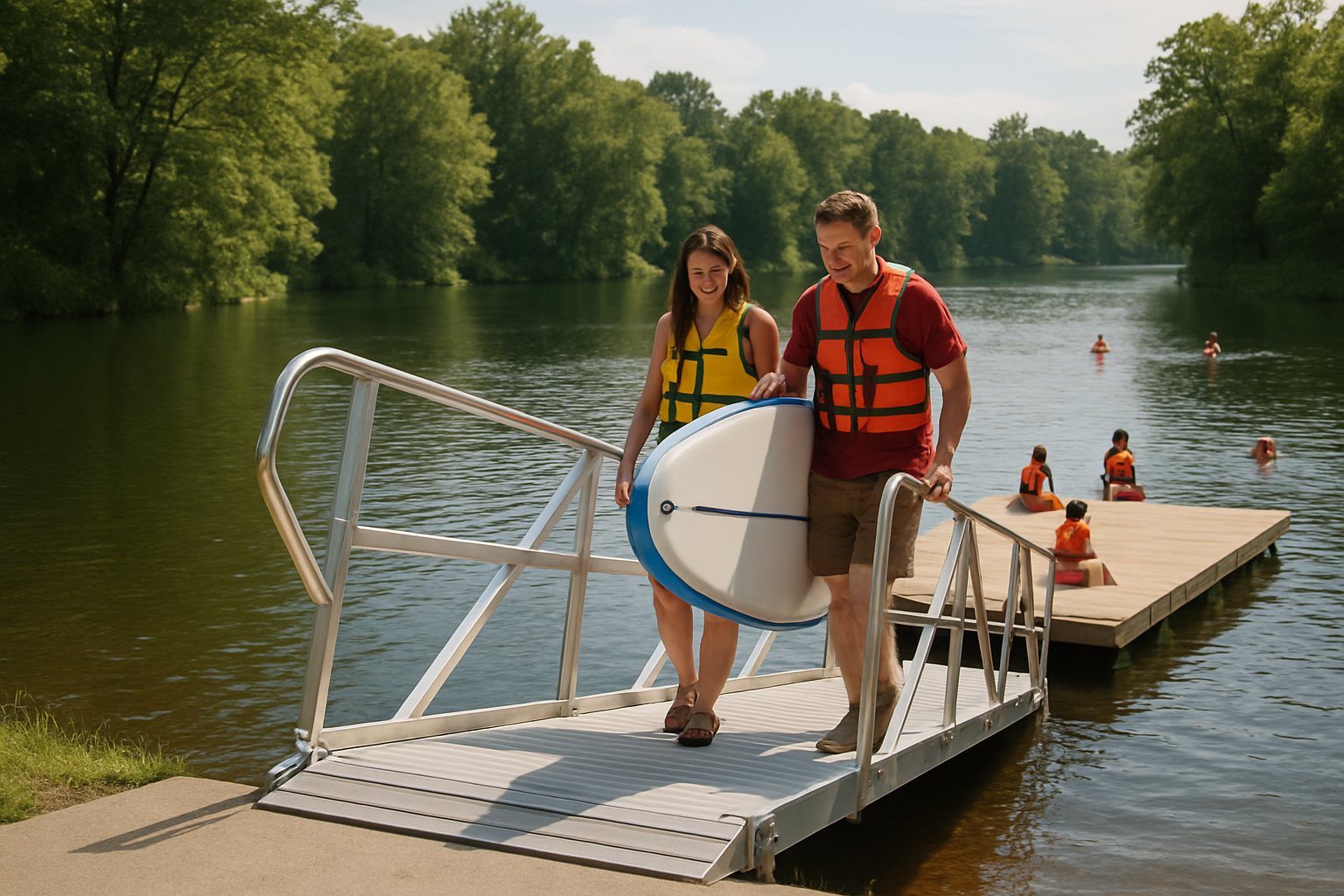
    A floating dock moves; the shore does not. The ramp bridges the two, so it has to allow movement at both ends. The usual arrangement in floating dock systems is a hinge at the shore end, bolted to a seawall, a concrete pad, a deck or posts, and rollers or wheels on the dock end, which roll back and forth across the deck as the angle changes. Wahoo, for example, describes its aluminum gangways as equipped with a bulkhead hinge mount and deck rollers, with rollers on the dock end. Dock Hardware’s DH-RRA4 ramp roller assembly is sold for exactly this job, to support floating dock ramps as water levels rise and fall.

    A floating dock gangway and a floating dock ramp are much the same thing on a residential dock; makers tend to say gangway for the longer, railed versions. Both differ from a transition plate, the short hinged plate at the end of a gangway that smooths the step onto the dock. Some systems skip the separate ramp altogether: Multinautic’s semi-floating dock kit has one end linked to the shore and the other on floats, and the maker says it adjusts automatically to water level changes of up to 1 m (3 ft).

    EZ Dock says the best docks for lakes with fluctuating water are those with a gangway, which lets the dock sit over deeper water. For bigger swings, see our guide to a floating dock on a river.

    Ramp length, water level and slope: the simple geometry

    The ramp is the long side of a right triangle. The height of that triangle is the difference between the shore hinge and the dock deck, and it changes with the water. To size a ramp, you need the lowest water level you expect, because that is usually when the drop is greatest and the ramp is steepest (if the dock can rise above the shore hinge at high water, check that end too). Slope is the rise divided by the horizontal run.

    A worked example (illustrative numbers, not a recommendation): say the dock deck sits 3 ft (0.9 m) below the shore hinge at your lowest water. Here is what different ramp lengths give you:

    Ramp lengthDrop at low waterHorizontal runSlopeAngle
    16 ft (4.9 m)3 ftabout 15.7 ftabout 1:5.2 (19%)about 10.8°
    24 ft (7.3 m)3 ftabout 23.8 ftabout 1:7.9 (12.6%)about 7.2°
    about 36 ft (11 m)3 ft36 ft1:12 (8.3%)about 4.8°
    16 ft, water 2 ft higher1 ftabout 16 ftabout 1:16 (6.3%)about 3.6°

    The pattern is what matters: doubling the drop doubles the slope, and only a longer ramp brings it back down. The same 16 ft ramp that is a gentle walk at summer pool level can feel steep after a drawdown. That is why makers sell ramps in a range of lengths. ShoreMaster’s residential gangway comes 4 ft wide in 16, 20 and 24 ft lengths; Wahoo lists widths from 32 to 72 in and lengths up to 80 ft; Tommy Docks sells modular aluminum gangways in 4, 8 and 12 ft sections. Ask your dealer for their own slope guidance, and give them your real high and low water numbers.

    What the ADA guidance says about gangway slope

    The U.S. Access Board’s guide to the ADA standards for recreational boating facilities is the clearest published benchmark. It says gangways must be designed to provide for a maximum 1:12 (8.33%) slope, but are not required to be longer than 80 ft. In smaller facilities with fewer than 25 boat slips, the slope may exceed 1:12 if the gangway is at least 30 ft long. Landings are not required at the ends of gangways if transition plates are provided, and a transition plate steeper than 1:20 (5%) needs a landing.

    Two cautions. First, these rules apply where gangways are part of the accessible route to accessible boat slips at newly built or altered recreational boating facilities covered by the ADA (marinas, public launches, piers); a private dock behind your house is not the target. Second, local building codes, lake associations and permits may still set their own rules, so check our permits and local rules guide before you build.

    Ramp materials and features

    • Aluminum frames are the norm for bought gangways: light enough to handle, and they don’t rot. Tommy Docks says its marine-grade aluminum frames will not rust or rot. Candock’s 4 x 16 ft welded aluminum gangway lists a maximum load of 1,750 lb; Wahoo lists load capacities up to 100 lb per sq ft. Many makers publish no load rating at all; Tommy Docks only says its frames are rated for foot traffic, gear and the occasional loaded hand cart.
    • Decking can be cedar, composite, polypropylene panels or aluminum. Tommy Docks offers cedar, composite and thermoformed decking on the same frame; ShoreMaster and Candock sell the frame with decking sold separately.
    • Handrails. ShoreMaster says handrails are necessary for the longer distances its gangways span. Candock’s 16 ft gangway has 42 in bolt-on railings on both sides; Wahoo’s dual handrails are standard, with a no-handrail option only under 20 ft.
    • Transition plates cover the step between the end of the ramp and the dock deck. Candock’s welded gangways include a 16 in transition plate; Wahoo sells them as an accessory.
    • Non-slip surface. A wet ramp at an angle is where people fall. Choose textured decking or anti-slip treads (Wahoo lists anti-slip cleats as an accessory), and keep the surface clear of algae.

    Prices vary a lot, from a short modular section to a long railed gangway. When checked in October 2026: Tommy Docks listed its aluminum gangway with Titan decking at $775 (4 ft), $1,575 (8 ft) and $2,375 (12 ft); boatliftanddock.com listed ShoreMaster’s residential gangway at $3,595 (length not stated on the page) and Candock’s 4 x 16 ft railed gangway at $4,855. All three ship as freight or require pickup for longer sizes.

    Floating dock hardware, piece by piece

    Wood-frame and many aluminum floating docks are held together by a small set of steel parts. If you are building your own frame or repairing an old one, these are the names you’ll see:

    PartWhat it doesPublished example
    Inside corner bracketSquares and stiffens the frame from inside each cornerExtreme Max inside corner kit: 3.2 mm galvanized steel, 2 corners and 4 backer plates
    Outside corner (male / female)Wraps the outside corner; paired male and female corners make a hinge point between sectionsDock Hardware DH-M and DH-F: 1/4 in hot-dip galvanized, 10-1/4 x 5 in legs
    Corner bracket for small framesJoins frame boards at the cornerTommy Docks CB5: 3/16 in hot-dip galvanized, for 2 x 6 frames, 1/2 in carriage bolts sold separately
    Hinge / link connector (T-style)Joins two dock sections along a face so they can flexExtreme Max link kit: two 5 in square hinge-link assemblies with backer plates
    Backer plateSpreads the bolt load on the inside face of the boardIncluded in most kits; Extreme Max says they reduce pull-through and worn holes
    Pipe holder / collarHolds a vertical pipe the dock slides up and downTommy Docks pipe guide kit: auger, pipe, sleeve bracket and cap, $96
    Stiff armRigid arm from shore that stops side-to-side drift while the dock rises and fallsShoreMaster heavy-duty stiff arm: to a seawall, deck or post; pipe sold separately
    Float bracketBolts the floats under the framePatriot Docks sections include float mounting bracket sets
    Bumpers and edgingProtect boats from the dock edgeDock Edge Full Face profile: flexible marine-grade PVC, 4-1/2 in high, three 8 ft pieces

    Read the bolt sizes before you order: many brackets take 1/2 in carriage bolts, some take 3/8 in, and mounting bolts are often sold separately (Tommy Docks and Extreme Max both say so on the parts above). Cleats are a separate purchase; bolt them through the frame with a backer, not just into decking. For tying up, see safe boarding and tying up, and for ladders, cleats and bumpers, our dock ladders and accessories guide.

    Stiff arms and pipes are also part of how the dock stays in place, which is covered in more depth in how to anchor a floating dock. ShoreMaster notes that a stiff arm is a good choice where augering into the lake bottom, river bed or seafloor is restricted or prohibited.

    Joins two sections

    Extreme Max 3005.5588 Floating Dock Link Connector Kit

    • Two 5 in hinge-link sets
    • Backer plates included
    • Galvanized, about $81
    Check price on Amazon
    Corner hinge, made in USA

    Dock Hardware DH-CLK Floating Dock Corner Link Kit

    • 1/4 in hot-dip galvanized
    • Male + female corners, pin
    • 16 bolt sets, about $100
    Check price on Amazon
    For aluminum frames

    Patriot Docks Low-Profile Floating Hinge Kit

    • Marine-grade aluminum
    • 4 ft x 1 in hinge pipe
    • About $107
    Check price on Amazon
    Frame corners

    Extreme Max 3005.5516 Dock Inside Corner Bracket Kit

    • 3.2 mm galvanized steel
    • 2 corners, 4 backer plates
    • Freshwater, about $29
    Check price on Amazon

    Galvanized, stainless or aluminum: fresh vs saltwater

    Most floating dock hardware sold in the US is hot-dip galvanized steel: strong, affordable and well suited to fresh water. Makers are fairly honest about its limits. Extreme Max says its galvanized inside corner kit protects against rust in freshwater marine environments; Tommy Docks says its galvanized pipe guide kit is not recommended for salt or brackish water. On the other side, Dock Hardware describes its 1/4 in hot-dip galvanized corners as corrosion resistant in fresh or salt water, and also sells a 316 stainless steel line for saltwater docks, which it says lasts up to 5 times longer in fresh water and up to 10 times longer in salt than its galvanized connectors.

    Aluminum is common for frames, gangways and some hinges; Patriot Docks’ hinge kit is marine-grade aluminum, and the maker describes it for freshwater use. If you dock in salt or brackish water, ask the maker directly which hardware line they recommend, use one metal family where parts touch, and rinse and inspect bolts every season. For EZ Dock systems, the maker says hardware is available for both fresh and salt water.

    How floating dock sections connect

    There are two basic ideas. A rigid connection bolts sections into one stiff platform; it feels solid underfoot but passes every wave load through the joints. A hinged connection lets sections flex at the joint, so each piece can follow the water. Most wood and aluminum floating dock sections use hinged links: Extreme Max’s kit mounts through the faceboards of two opposing sections, and Patriot Docks says its hinge kit is designed to flex with changing water levels, with a hinge set used every 16 ft of floating dock.

    Modular plastic docks use their own connectors. Candock cubes are joined by a polyethylene connecting pin that passes through the tabs of neighboring cubes and threads into a sliding nut, tightened with a G2 key. EZ Dock sections are linked with its coupler system, which the maker says gives stability and shock absorption; the same couplers attach EZ Dock to gangways, stiff arms and other docks. If you are mixing brands, ask about adapters before you buy. Our modular docks page compares these systems, and floating dock designs and layouts shows how sections are usually arranged (straight, L, T and U shapes).

    Inflatable docks are a different case: they are usually anchored as stand-alone platforms rather than linked to a ramp, and makers such as RAVE say not to connect them directly to piers or other hard objects. See inflatable docks for how those work.

    Putting it together

    1. Measure the water. Note high and low levels for the season, and the height of your shore abutment.
    2. Choose the ramp length from the drop at low water, using the geometry above and your maker’s guidance.
    3. Build or set a solid shore abutment for the hinge: a seawall, concrete pad or set posts.
    4. Put rollers on the dock end, with enough deck length for them to travel, and a transition plate if the step is high.
    5. Connect the sections with the maker’s hinges or couplers, backer plates on every bolt through wood.
    6. Hold the dock in place with pipes, stiff arms or anchors, then check every bolt after the first storm.

    The full sequence, from site check to first season, is in our floating dock installation guide, and the Setup and Care hub has the rest.

    Floating dock ramp and hardware questions

    How long should a floating dock ramp be?

    Long enough that the slope is comfortable at your lowest water. Find the drop from shore hinge to dock deck at low water and work out the slope for each length you are considering; a 3 ft drop is about 1:5 on a 16 ft ramp and about 1:8 on a 24 ft ramp. Public facilities covered by the ADA aim for 1:12, which would take about 36 ft for that same drop.

    Which end of the gangway gets the hinge?

    Usually the shore end is hinged and the dock end rolls on wheels or a slider, because the dock moves and the shore does not. Makers sell both ends as options: Wahoo, for instance, lists a bulkhead hinge and a roller assembly as separate end options for its aluminum gangways.

    Can I use galvanized floating dock hardware in salt water?

    Some makers say yes and some say no, product by product. Tommy Docks says its galvanized pipe guide kit is not recommended for salt or brackish water, while Dock Hardware describes its hot-dip galvanized corners as corrosion resistant in fresh or salt water and sells a 316 stainless line for saltwater docks. Follow the maker of the part you buy.

    How do floating dock connectors work?

    On framed docks, a male and female plate (T-style or corner) bolt to facing sections and a steel pin drops through their ears, making a hinge. On modular plastic docks, pins or couplers lock the sections together. Either way, the joint is meant to flex a little; check pins and bolts every season.
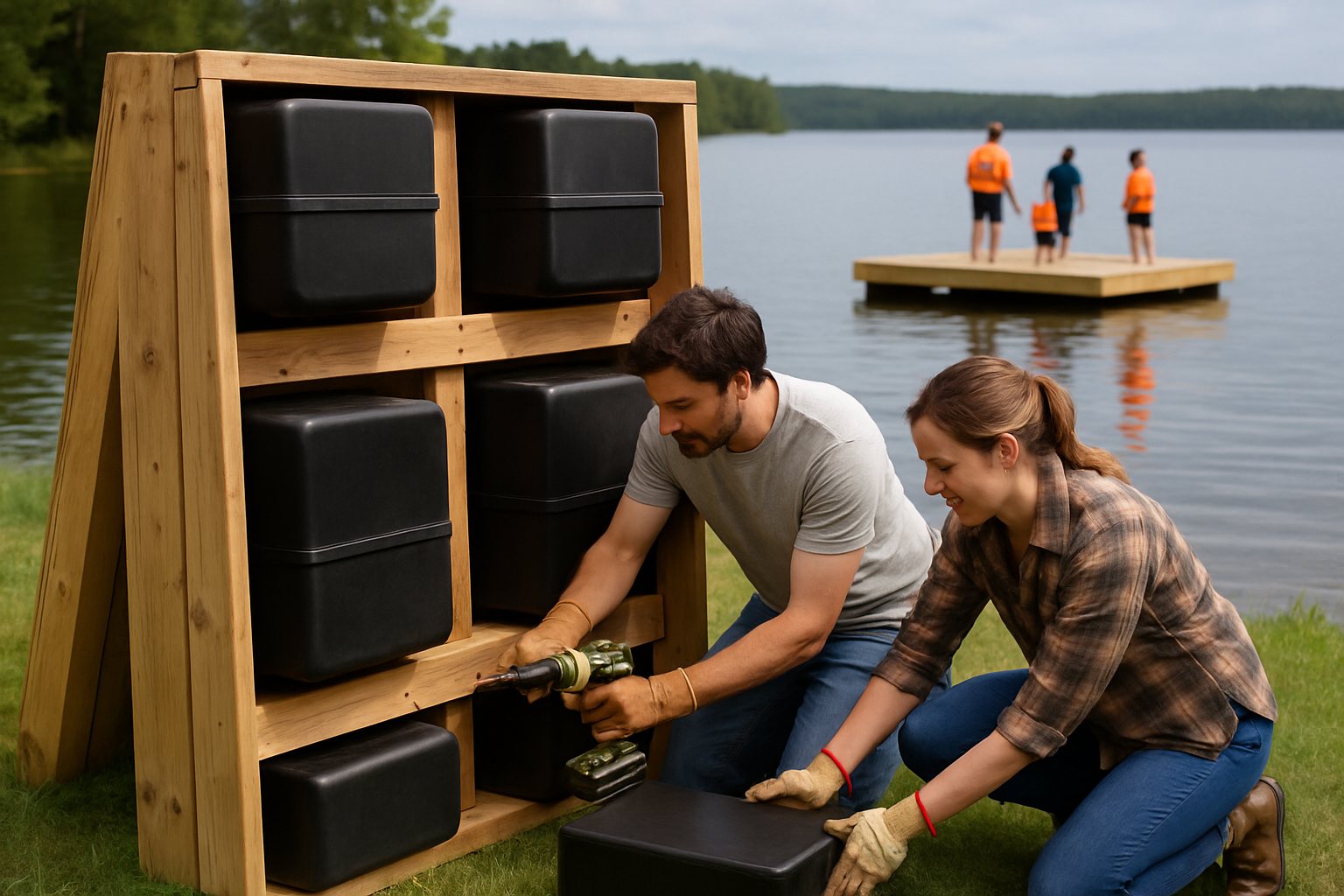

  • Dock Floats: Types, Buoyancy and How Many Your Dock Needs

    Dock Floats: Types, Buoyancy and How Many Your Dock Needs

    Late in the season, a lake neighbor walks out to the end of his floating dock with a cooler and two grandkids, and the far corner dips until water runs over the boards. Nothing broke. One of the dock floats underneath has slowly lost its lift, and the dock is telling him. Dock floats are the plain black boxes that hold up almost every non-inflatable floating dock in the US, and choosing, sizing and replacing them is mostly a matter of reading the right numbers. This guide covers the types, the buoyancy figures makers actually publish, how to work out how many you need, and the rules on bare foam that many lakes now enforce.

    Side view of a floating dock at the waterline showing the black floats and the deck height above water

    In short: most floating dock floats today are encapsulated: a rotomolded polyethylene shell filled with EPS foam, rated by the maker in pounds of buoyancy (for example 600 lb for a Taylor Made 24 x 48 x 16 in float, 2,475 lb for a Barr Plastics 48 x 96 x 16 in float). Add up the dock’s dead load and the live load you expect, divide by the float rating, and leave a healthy margin, because those ratings assume the float is fully under water. Bare foam and used drums are banned or restricted on many US waters, so check local rules first.

    What dock floats do, and what freeboard means

    A float holds up a dock the same way a boat hull does: it pushes water aside, and the water pushes back with a force equal to the weight of the water displaced. Fresh water weighs about 62.4 lb per cubic foot (USGS), so every cubic foot of float pushed under can carry roughly that much, minus the float’s own weight. That is why makers quote buoyancy, and why the numbers track the size of the float so closely. Barr Plastics, a float maker, notes that its ratings assume the float is fully submerged, and adds that dock floats are not designed to be fully submerged. Treat the rating as a ceiling, not a working load.

    Freeboard is the height of the deck above the water. Bellingham Marine, a marina builder, gives a handy rule: in salt water, 5 lb of load on one square foot of a floating object sinks it about 1 inch. Barr recommends 12 to 14 in of freeboard for most residential docks, counting the frame and decking. Low docks are easier for kayaks, but every inch of float you sink to get there is lift you no longer have for people.

    Types of floating dock floats

    TypeWhat it isGood to know
    Encapsulated foam floatsSeamless polyethylene shell filled with EPS foam, with a flat top and mounting slotsThe standard choice today; the foam keeps the float up if the shell is holed (Taylor Made)
    Bare (unencapsulated) foamBlocks of polystyrene bolted under the frame with no shellBreaks into beads and litter; banned or being phased out on many waters (see below)
    Air-filled plastic floatsHollow rotomolded polyethylene drums with no foam insideNo foam to shed; a hole can let water in, so they depend on the shell staying sound
    Barrels and drumsRe-used plastic or metal drums strapped to a frameCheap but restricted: TVA prohibits previously used drums for flotation
    Modular cubes and sectionsThe float is the deck: plastic cubes or sections that lock togetherNo separate floats to size; see modular docks

    Encapsulated dock floats

    Encapsulated dock floats are what you will find at marine dealers and on Amazon. Taylor Made describes a seamless, UV-resistant black polyethylene shell filled with EPS foam, which protects the foam from salt water, gasoline and most chemicals, plus a thick mounting flange you drill for fasteners. Barr Plastics describes a one-piece rotomolded shell of virgin polyethylene with UV inhibitors around EPS foam, and Eagle Float a seamless one-piece virgin polyethylene shell with a 0.15 in nominal wall and a solid EPS core; both have mounting slots molded into the flat top. Because the foam fills the shell, a puncture does not sink the float the way it can an empty one.

    Foam dock floats without a shell

    Older docks often sit on bare white foam billets. They float well when new, but sun, waves, boats, ice and animals break the surface into beads that end up in the water. That is the reason many authorities now restrict them:

    • Tennessee Valley Authority (TVA) lakes. Federal rule 18 CFR 1304.400 prohibits using or reusing unencased flotation for repairs, replacement or new construction, and requires existing unencased flotation to be removed and replaced by December 31, 2031. Flotation must be commercially manufactured for marine use and must not crack, peel, fragment, become waterlogged or lose beads.
    • Vermont. Since July 1, 2024, polystyrene foam used as flotation in Vermont waters must be encapsulated, with a covering expected to last at least 10 years. The state’s Department of Environmental Conservation says garbage bags, shrink wrap, hardware cloth and plywood do not count.
    • Lake of the Ozarks, Missouri. Ameren, which manages the lake, banned new non-encapsulated foam in 1995 and set December 31, 2008 as the final deadline to replace it, calling broken foam the largest source of man-made debris in the lake.

    Rules differ by state, lake authority and reservoir operator, and these are only the ones we confirmed. Before you buy or rebuild, check our permits and local rules guide and ask whoever manages your water.

    Plastic air-filled floats

    Some makers sell the same rotomolded shell empty. Dock Edge+, for example, lists its 2 x 4 ft x 8 in float in both a foamed and an empty version, each with a stated flotation of 260 lb. Vermont’s environmental agency calls air flotation the more environmentally friendly option, since there is no foam to shed if the shell is breached. The trade-off is that the shell is the only thing keeping water out. Plastic dock systems such as EZ Dock skip separate floats entirely: their polyethylene sections have open pylons underneath, are 15 in high and draw about 1 1/2 to 2 in of water, according to EZ Dock’s FAQ.

    Barrels and drums

    Plastic drums on a wooden frame are the classic budget dock. They work, but used drums carry real risks. TVA’s rule prohibits plastic, metal or other previously used drums or containers for flotation, citing the possible release of toxic or polluting substances and the navigation hazard of metal drums that partly fill with water and break loose. Illinois’s statewide permit for minor docks allows metal drums only if they are foam-filled. If you are set on drums, use new, clean, purpose-made floats where your rules allow them, and never a container that held chemicals or fuel.

    Modular cube docks

    With cube docks the floats are the dock. Candock’s G2 cube is 19 x 19 in and 14 in high, air-filled HDPE, with a stated buoyancy of about 150 lb per cube, or about 60 lb per square foot. You add cubes rather than floats to carry more. More on these in our modular docks guide.

    Dock float sizes and buoyancy, as makers state them

    Floats come in a handful of standard footprints (24 x 36, 24 x 48, 36 x 48, 48 x 48 and 48 x 96 in are common) and heights from about 8 to 32 in. Taller floats give more lift on the same footprint. These are the published figures we found:

    Maker and floatSize (W x L x H)Stated buoyancy
    Dock Edge+ (foamed or empty)24 x 48 x 8 in260 lb
    Eagle Float2 ft x 4 ft x 12 in390 lb
    Taylor Made 4611824 x 36 x 12 in335 lb (approx.)
    Taylor Made 4611624 x 48 x 12 in450 lb (approx.)
    Taylor Made 4611724 x 48 x 16 in600 lb (approx.)
    Barr Plastics BD2448-1624 x 48 x 16 in598 lb
    Taylor Made 48481648 x 48 x 16 in1,200 lb (approx.)
    Barr Plastics BD4848-1648 x 48 x 16 in1,220 lb
    Barr Plastics BD4896-1648 x 96 x 16 in2,475 lb
    Barr Plastics BD4896-3248 x 96 x 32 in4,804 lb

    Notice how two makers’ 24 x 48 x 16 in floats land within a couple of pounds of each other. That is physics, not marketing: the same volume displaces the same water. A float’s own weight matters too; Barr lists 37 lb for its 24 x 48 x 16 in float, and that weight is part of your dead load.

    How many dock floats do you need?

    The basic sum is the same everywhere: dead load + live load = buoyancy you need, then divide by the rating of one float and round up.

    • Dead load is the dock itself: frame, decking, hardware, ladders and the floats. Dock Builders Supply, a Florida dock supplier, says most residential lumber docks weigh typically 10 to 15 lb per square foot.
    • Live load is what comes and goes: people, coolers, gear. It is never spread evenly; everyone ends up at the ladder end.
    • Margin. Dock Builders Supply designs for about 40% submergence under the dead load and says floats should never be more than 50% submerged in normal use, leaving the rest for people.

    Worked example (published by Dock Builders Supply, shown here as an illustration only). For a typical uncovered wooden residential dock, Dock Builders Supply multiplies the deck area by a factor of 28, 31 or 35 lb per square foot, depending on framing and decking. For an 8 x 16 ft dock with 2 x 6 pressure-treated decking it uses 31:

    1. Deck area: 8 x 16 = 128 sq ft.
    2. Buoyancy needed: 128 x 31 = 3,968 lb.
    3. Floats: six 36 x 48 x 12 in floats rated 691 lb each = 4,146 lb, just over the target.

    Barr Plastics publishes a similar rule of thumb: 3 to 6 floats per residential dock section, depending on size, weight and the freeboard you want. Both companies say these are guidelines; Dock Builders Supply takes no responsibility for the figures and recommends a structural engineer for specific designs. We don’t calculate safe loads for your dock. Use the method to understand the order of magnitude, then confirm the count with your float maker or a local dock builder, especially for a covered dock, a boat lift, a gangway resting on one side, or rough water.

    Attaching floats to a dock frame

    • Use the mounting slots or flange. Taylor Made’s minimum recommended hardware is a 3/8 x 3 in lag screw with a 3/8 in and a 5/8 in flat washer. Barr says its molded slots and holes suit wood, steel or aluminum frames.
    • Bear on the frame, not the decking. Dock Builders Supply says each float must contact at least two cross-members.
    • Spread them out. Put floats in every corner with no more than 8 ft between them (Dock Builders Supply). Barr suggests at least one float at each end of a walkway with more in the middle, and on a platform four corners plus two between them lengthwise.
    • Don’t join floats to each other. Taylor Made says its floats are not designed to attach to each other; they attach to the dock.
    • Secure them for the long haul. TVA requires every float to be firmly fixed to its structure with materials that can stand prolonged wave wash and weather. Use corrosion-resistant hardware.

    Then anchor the finished dock properly: see how to anchor a floating dock and our step-by-step floating dock installation guide.

    Dock floats you can buy online

    These encapsulated floats were in stock on Amazon when checked in October 2026. Hardware is not included with any of them. Prices change often.

    Most lift per float

    Taylor Made Dock Float 24 x 48 x 16 in

    • 600 lb stated buoyancy
    • PE shell, EPS foam, made in USA
    • About $198, seen October 2026
    Check price on Amazon
    15-year warranty

    Eagle Float Dock Float 2 x 4 ft x 12 in

    • 390 lb stated buoyancy
    • One-piece HDPE shell, EPS core
    • About $223, seen October 2026
    Check price on Amazon
    Low profile

    Dock Edge+ Float 2 x 4 ft x 8 in, Foamed

    • 260 lb flotation capacity
    • 10-year warranty
    • About $129, seen October 2026
    Check price on Amazon

    Bigger sizes, such as 48 x 96 in floats, are usually bought from marine distributors by the pallet. Barr Plastics, for example, lists its 48 x 96 x 16 in float at $703.36 CAD (Canadian dollars) when checked in October 2026, with shipping extra. We did not find a published US retail price for that size that we could confirm. For the total cost of a dock, see floating dock cost.

    How long dock floats last, and when to replace them

    No maker we checked publishes an expected service life in years, but warranties give a hint: Taylor Made offers an 8-year flotation warranty, Dock Edge+ 10 years on the float above, and Barr Plastics and Eagle Float 15 years. Vermont expects any foam covering to last at least 10 years. TVA’s rule puts the test simply: replace flotation when it no longer does its job, or when it cracks, fragments, sheds beads or becomes waterlogged. In practice, walk the dock each spring: a corner that sits lower than the rest, a cracked shell or foam showing through are your cues. Replace like with like so the dock floats level, and dispose of old foam properly; Vermont, for one, sends old unencapsulated floats to approved facilities such as transfer stations.

    Where inflatable docks fit

    An inflatable dock needs no separate floats at all: the air chamber is the float, and it packs away in a bag. It suits swimming, lounging and seasonal use rather than a permanent walkway to a boat. If you are weighing the two routes, read building a floating dock vs buying inflatable, floating dock kits vs inflatable docks and inflatable vs rigid floating docks.

    Dock float questions

    What are encapsulated dock floats?

    Floats whose foam core is sealed inside a hard shell, usually rotomolded polyethylene over EPS foam. The shell keeps the foam from breaking apart in the water, and the foam keeps the float up if the shell is holed. Many lakes now require them.

    How much weight does a dock float hold?

    Whatever the maker states for that size, and that figure assumes the float is pushed fully under water. Published examples run from 260 lb (Dock Edge+ 24 x 48 x 8 in) to 600 lb (Taylor Made 24 x 48 x 16 in) and 2,475 lb (Barr Plastics 48 x 96 x 16 in). Part of it goes to holding up the dock itself.

    How many floats does an 8 x 16 ft dock need?

    In Dock Builders Supply’s published example, an 8 x 16 ft wooden dock needs about 3,968 lb of buoyancy, met by six 691 lb floats. Your number depends on your materials, your loads and the freeboard you want, so confirm with your float maker or dock builder.

    Can I use plastic barrels as floating dock floats?

    Check your rules first. TVA prohibits previously used drums or containers for flotation on its lakes, and Illinois allows metal drums only if foam-filled. Where drums are allowed, never use one that held chemicals or fuel.

    Are foam dock floats bad for the lake?

    Bare foam can break into beads and litter, which is why TVA, Vermont and Ameren at Lake of the Ozarks restrict it. Encapsulated foam floats and air-filled floats are the accepted alternatives.

    Can I replace just one float?

    Usually, yes: floats are bolted on individually. Match the size and rating of the others so the dock stays level, and if several are failing at once, plan to replace the set.

  • Best Floating Docks 2026: Inflatable Floating Boat Docks Compared

    Best Floating Docks 2026: Inflatable Floating Boat Docks Compared

    Late afternoon at the lake: the boat swings gently on its anchor, someone steps off the stern onto a wide, firm deck, the kids cannonball off the far edge, and a cooler sits in the shade of the bimini. A good floating dock turns a patch of water into the best seat in the house. This guide compares the best floating boat docks and lake docks you can buy in 2026, with a focus on inflatable drop-stitch docks that pack away, and one honest section on rigid docks for when an inflatable is not the right answer.

    Three different inflatable docks moored along a lake shore

    In short: for most lake houses, RAVE’s 10 x 10 ft Aqua Dock (1,800 lb or 10 adults, about $800) is the best all-rounder; for tying off a boat, Island Hopper’s 10 x 6 ft Yacht Dock (1,500 lb, corner bumpers, about $749) fits better; for a small budget, AWSUM’s docks start at about $170. If you need a permanent walkway from shore or daily boat mooring, a rigid modular dock is the better tool.

    Prices change often. The prices below are what we saw at the maker or a major retailer in October 2026; check the current price before you buy.

    Our top picks

    Best overall

    RAVE Aqua Dock 10

    • 10 x 10 ft, 6 in
    • 1,800 lb or 10 adults
    • Limited lifetime (personal use)
    Check price on Amazon
    Best floating boat dock

    Island Hopper Yacht Dock 10 x 6

    • 1,500 lb
    • Rubber corner bumpers
    • 5-year warranty if registered
    Check price on Amazon
    Lowest-priced 10 x 10

    Solstice Drop Stitch Inflatable Dock 10 x 10

    • 10 x 10 ft, 6 in
    • H3 valve, hand pump
    • 6 to 8 people
    Check price on Amazon
    Links to more stations

    WOW Vacation Station 8 x 8

    • 8 x 8 ft, 53 lb
    • 1,200 lb
    • Pump with gauge
    See it at the store
    Best budget

    AWSUM Inflatable Floating Dock

    • 6 x 5 to 15 x 6 ft
    • 455 to 2,000 lb by size (seller)
    • Soft ladder included
    Check price on Amazon

    Floating docks compared

    DockSizeStated capacityWeightWarrantyAbout (Oct 2026)
    RAVE Aqua Dock 1010 x 10 ft, 6 in1,800 lb or 10 adults68 to 69 lbLimited lifetime, personal use$800
    Island Hopper Yacht Dock10 x 6 ft, 6 in1,500 lb53 lb5 years with registration$749
    Solstice 10 x 1010 x 10 ft, 6 in1,323 lb on Amazon; 1,650 lb at Overton’sAbout 70 to 73 lb30 days (Amazon listing)$703
    WOW Vacation Station 8 x 88 x 8 ft, 6 in1,200 lb53 lbNot stated on the page we read$720
    AWSUM6 x 5 ft (other sizes to 15 x 6 ft)455 lb for 6 x 5 ft (seller)18.8 lb (6 x 5 ft)Not stated$170 (6 x 5 ft)

    The best floating boat docks

    1. RAVE Aqua Dock 10: best overall

    RAVE’s Aqua Dock is a 10 x 10 ft, 6 in thick drop-stitch PVC deck inflated to 5 psi, rated by RAVE for 1,800 lb or 10 adults. It has 10 neoprene-covered handles for climbing on from the water, 8 D-rings and two anchor points, one at each end underneath, and comes with a hand pump. RAVE asks for at least 4 ft of water and gives a limited lifetime warranty for personal use. It is a stand-alone dock: RAVE says it does not connect to its trampolines or other products. About $800 on Amazon.

    • Good: highest stated rating of the 10 x 10 docks here; long warranty; a published owner’s manual.
    • Watch out: 68 to 69 lb, so two people to carry; RAVE says not to tie it directly to docks or piers.
    • Best for: a summer swim and sun dock anchored off a lake house.

    Check the RAVE Aqua Dock price on Amazon

    2. Island Hopper Yacht Dock 10 x 6: best floating boat dock

    Island Hopper built this one to sit beside a boat. It is 10 x 6 ft and 6 in thick, heat-welded PVC with a 1000-denier outer fabric and “no glued edges or corners,” an EVA top, stainless side D-rings and rubber bumpers on all four corners to absorb knocks from hulls, dock posts and shorelines. It runs at 8 to 15 psi, weighs 53 lb, and Island Hopper says it inflates in about 8 minutes with the double-action hand pump. The 6 ft beam lets it deploy off smaller boats where a 10 ft dock would not fit. Five-year warranty if you register within 30 days. $749 on Amazon.

    • Good: bumpers and welded seams; light enough to carry on a boat.
    • Watch out: 6 ft wide is cozy for a crowd.
    • Best for: pontoons, cruisers and sailboats at anchor.

    Check the Island Hopper Yacht Dock price on Amazon

    3. Solstice Drop Stitch Inflatable Dock 10 x 10: lowest-priced 10 x 10

    Solstice’s 10 x 10 ft dock is 6 in thick drop-stitch with an H3 high-pressure valve and a high-volume hand pump, and the Amazon listing gives a capacity of 6 to 8 people. Figures differ between sellers: the Amazon listing (sold by Swim Central) states 1,323 lb, 73 lb and a 30-day warranty, while Overton’s lists the same size at 1,650 lb and 70 lb with six stainless D-rings and 7 to 12 psi. It was about $703 on Amazon, shipping in 6 to 7 days.

    • Good: full 10 x 10 ft deck for less.
    • Watch out: conflicting ratings and a short warranty on the Amazon listing; ask the seller which applies.
    • Best for: families who want maximum deck on a tighter budget.

    Check the Solstice dock price on Amazon

    4. WOW Vacation Station 8 x 8: links to more stations

    WOW’s Vacation Station is 8 x 8 ft and 6 in thick, rated 1,200 lb and weighing about 53 lb, with several reinforced D-rings for anchoring, tying to a boat or linking to other Vacation Stations. A hand pump with a pressure gauge is included. Overton’s had it in stock at $719.99.

    See it at Overton's

    5. AWSUM Inflatable Floating Dock: best budget

    AWSUM sells its 6 in drop-stitch dock in seven sizes, from 6 x 5 ft (3 to 5 people, 455 lb, per the seller) to 15 x 6 ft (2,000 lb), inflated to 5 to 8 psi. Each has an EVA top, six stainless D-rings, six handles and a detachable 3-step soft ladder, plus a hand pump, 10 ft rope, carry bag and repair kit (adhesive not included). The 6 x 5 ft size weighs 18.8 lb and was about $170 on Amazon.

    • Good: low price, many sizes, ladder in the box.
    • Watch out: ratings are the seller’s; “military-grade” is marketing language, not a standard.
    • Best for: a first dock, a pond or a trip.

    Check the AWSUM floating dock price on Amazon

    Also checked: BOTE’s 8 in thick Inflatable Dock (10 x 10 ft, 2,100 lb, $1,549) was sold out at BOTE, and Aquaglide’s large Docking Station (600 lb, at least 1,100 lb of anchor weight, $2,640) was backordered at Bart’s when we looked. Both are worth a look when back in stock.

    When a rigid floating dock is the better choice

    Inflatables are wonderful for swimming and lounging, and handy for stepping on and off a boat at anchor. They are not the best tool for every job. If you want to walk from the bank to a boat every day, moor boats against it all season, or bolt on a jet ski port or kayak launch, rigid polyethylene sections are built for that. Connect-A-Dock’s 20 ft straight kit was $4,878 on Amazon (690 lb per section, pipe not included); EZ Dock rates its 5 x 10 ft section at 3,000 lb and sells by dealer quote; Candock builds from 150 lb cubes. They cost much more and take a day to install, but they stay in all season and connect to shore with a gangway. Compare the two in floating dock kits vs inflatable docks.

    Rigid alternative

    Connect-A-Dock 20 ft Straight Floating Dock Kit

    • Four 3.75 x 5 ft sections
    • 690 lb per section
    • Gangway hinge included
    Check price on Amazon

    How to choose the best floating dock

    • Boat or shore? Beside a boat, choose a narrower, lighter dock with bumpers. Off a beach, a square 10 x 10 ft gives the most room.
    • Compare stated ratings, not sizes. The same 10 x 10 ft footprint was rated from 1,323 to 2,100 lb by different makers and sellers.
    • Check the depth. RAVE and Aquaglide ask for at least 4 ft of water.
    • Budget for anchoring and a pump. See how to anchor a floating dock and floating dock cost.
    • Read the warranty. Terms ran from 30 days to a limited lifetime on the docks above.

    Aquaglide Docking Station

    by Aquaglide

    • Size (as stated): 14 ft 9 in x 10 ft 5 in x 6 in
    • Stated capacity: 600 lb (3 adults + 3 children)
    • Thickness: 6 in (15 cm) welded drop-stitch

    Full specs and sources

    See it at Bart's

    BOTE Inflatable Dock 10 Classic

    by BOTE

    • Size (as stated): 10 x 10 ft x 8 in
    • Stated capacity: 2,100 lb on BOTE's site (1,500 lb at some retailers)
    • Thickness: 8 in

    Full specs and sources

    See it at BOTE

    BOTE Inflatable Dock 7 Classic

    by BOTE

    • Size (as stated): 7 x 7 ft x 8 in
    • Stated capacity: 1,050 lb
    • Thickness: 8 in

    Full specs and sources

    See it at BOTE

    Island Hopper Mega Yacht Dock 10 x 10

    by Island Hopper

    • Size (as stated): 10 x 10 ft
    • Stated capacity: 2,000 lb load rating
    • Thickness: 6 in

    Full specs and sources

    See it at Overton's

    RAVE Aqua Dock 10

    by RAVE Sports

    • Size (as stated): 10 x 10 ft x 6 in
    • Stated capacity: 1,800 lb / 10 adults
    • Thickness: 6 in drop-stitch

    Full specs and sources

    See it at Bart's

    Solstice Inflatable Dock 10 x 10

    by Solstice Watersports

    • Size (as stated): 10 x 10 ft x 6 in
    • Stated capacity: 1,650 lb
    • Thickness: 6 in drop-stitch

    Full specs and sources

    See it at Overton's

    Keep going: the best inflatable docks, the best jet ski docks, portable docks, and the boat docks and lake docks hubs. Want a slide off the end? BoatSlide covers dock slides.

    Floating dock questions

    What is the best floating dock for a boat?

    For tying off at anchor, a narrower inflatable with bumpers, like Island Hopper’s 10 x 6 ft Yacht Dock, fits beside most boats and protects the hull. For a boat that lives at your shore all season, a rigid floating dock with cleats is the better long-term answer.

    How many people can stand on a floating dock?

    Only as many as the maker states. RAVE rates its 10 x 10 ft dock for 10 adults; the Solstice Amazon listing says 6 to 8 people. Never estimate capacity from size.

    Can I park a jet ski on an inflatable floating dock?

    Not on a swim dock. Use a jet ski dock made for it; see the best jet ski docks.

    How long do inflatable floating docks last?

    Makers do not publish lifespans, but warranties hint at confidence: RAVE gives a limited lifetime for personal use and Island Hopper five years with registration. Clean, dry and store the dock out of the sun when it is not in use, as RAVE’s manual describes.

  • Floating Dock on a River: Current, Debris and Changing Water

    Floating Dock on a River: Current, Debris and Changing Water

    A river house in June is hard to beat: the boat tied up out front, kids fishing off the end, the water sliding past all day. Then the spring rains come upstream, the river rises a few feet overnight, and a log the size of a canoe drifts down and lodges against the dock. A floating dock on a river lives with three things a lake dock rarely sees: constant current, floating debris and big changes in water level. This guide explains what each one means for the dock you choose, how it is held in place, the rules that apply on rivers, and when an inflatable dock is the wrong tool.

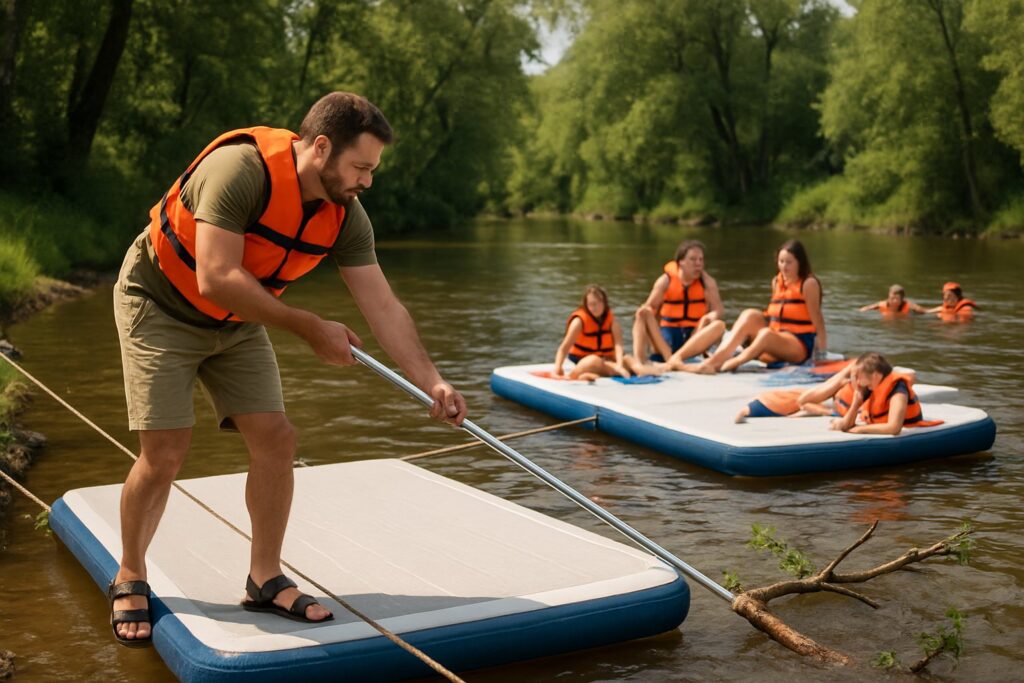
    Man clearing a floating branch from an inflatable dock on a river

    In short: on a river, use a rigid floating dock held by hardware that lets it rise and fall but not drift (pipes in collars, piling brackets or stiff arms), with a hinged gangway for level changes. Consumer inflatable docks are a poor fit for current: RAVE tells owners not to use its dock in currents, and Aquaglide says sites with strong currents should consider up to 50% more anchor weight. States such as Iowa and Illinois require river docks to be securely anchored so they do not become floating hazards in high water. Check federal, state and local rules before you install.

    Why a floating dock on a river is different

    • Current never stops. On a lake, wind loads a dock now and then. On a river, the water pushes on it all the time, and harder when the river is high.
    • Debris arrives with the current. Branches, logs and trash catch on the upstream edge, add load and can puncture or scrape.
    • The level moves. Rivers can rise and fall several feet with rain upstream or dam releases, so lines and gangways that fit in the morning can be too short or too long by evening.
    • Ice moves too. Where rivers freeze, ice shifting in the thaw is what damages docks; Candock says most ice damage happens then.

    Inflatable docks and river current

    We like inflatable docks on lakes and at anchor, but we are cautious about them on moving water, and the makers are too. RAVE’s owner’s manual for its Aqua Dock tells users never to use it in high winds, waves or currents, and not to connect it directly to docks, piers or other hard objects. Aquaglide, writing about its anchored lakefront products, says sites with strong tides, currents, winds or swell should consider up to 50% more weight or holding power. None of the consumer dock makers we checked publishes a current, wind or wave limit, so there is no number to work to.

    If you use an inflatable on a river at all, keep it to slack water: a backwater, a still side channel or a cove where the current is barely moving, on a calm day, attended, and out of the water when the river is up. For a dock that lives on the river all season, look at rigid docks.

    Holding a river dock in place

    River docks are usually held by hardware that controls sideways movement while letting the dock float up and down. EZ Dock lists pipes, deadweight anchors, piling brackets and stiff arms as its anchoring options, with hardware for fresh and salt water.

    MethodHow it worksRiver notes
    Pipes in collarsPipes set in the bottom pass through collars on the dock (Connect-A-Dock kits have pole anchoring connectors for Schedule 40 pipe)Pipe length must cover the high-water mark; best in shallower water
    Piling bracketsBrackets slide on fixed pilingsPilings are a construction job and often need a permit
    Stiff armsRigid arms hinge between shore and dockHold the dock off the bank as the level changes
    Deadweights and linesHeavy weights on the bottom with lines or chainLines must be long enough for high water without letting the dock swing into the bank or channel

    Rigid modular docks are designed with wave loads in mind: EZ Dock says its couplers are designed to break before the dock section in strong wave action, so the repair is a coupler, not a section. Ask the dealer to size the anchoring for your river, depth and current, and get it in writing.

    Planning for rising and falling water

    • Know your range. Find the nearest US Geological Survey streamgage and look at its history. USGS WaterAlert sends email or text notifications when water conditions cross thresholds you choose, which is a simple way to know when to check the dock.
    • Hinge the gangway. A gangway hinged at both ends follows the dock up and down; EZ Dock offers wood, polyethylene (up to 18 ft) and aluminum gangways.
    • Check low water too. Make sure the dock still floats at the lowest level you expect and does not settle onto rocks.
    • Have a high-water plan. Know in advance whether you will pull the dock, swing it in to the bank or leave it; Iowa makes riparian owners responsible for retrieving a dock that becomes a navigation hazard.

    Debris and inspections

    After every rise, walk the dock: clear branches from the upstream side, look at lines, chain and shackles for chafe, and check couplers, cleats and nuts. Candock, for example, asks owners to check the nuts on cleats, ladders and connecting pins occasionally. Keep a repair kit for anything soft on the dock, such as an inflatable swim pad or fenders. Never go out on a dock in flood: the National Weather Service warns that 6 in of fast-moving flood water can knock over an adult.

    Long line for high water

    Better Boat 3/8 in Nylon Anchor Line, 100 ft

    • 820 lb working load
    • 4,035 lb breaking load
    • Stainless thimble
    Check price on Amazon
    Shock cord and chain

    RAVE Sports Anchor Connector Kit

    • 6 ft shock cord
    • 15 ft nylon rope
    • Galvanized chain, float
    Check price on Amazon
    Patch kit

    JLF Inflatable Repair Kit with HH-66 Cement

    • Five PVC patches
    • 1 oz vinyl cement
    • Valve wrench
    Check price on Amazon

    River dock permits and rules

    Rivers are more likely than ponds to be navigable waters. In US navigable waters, the Army Corps of Engineers treats piers and boat docks as structures that need a Department of the Army permit unless they are exempt or covered by a general permit. States add their own rules, and some are written with rivers in mind:

    • Iowa: “All river docks must be securely anchored to prevent them from becoming floating hazards during times of high river flows,” and the riparian owner is responsible for retrieving and removing a dock when needed to prevent or remove a navigation hazard.
    • Illinois: its statewide permit for minor private docks requires a dock to be securely anchored against high water or winds, to project no more than 50 ft and never more than a quarter of the waterway’s width, to stay within navigation limits, and to be no more than 10 ft wide.

    These are examples, not your rules. Check with your state natural resources agency, county, any river authority or water management district, and the Corps district office before you buy.

    Choosing a dock for a river

    • Tell the dealer it is for a river, with the depth range and how fast the current runs at your bank.
    • Prefer rigid modular sections with river-rated anchoring over a single inflatable deck.
    • Keep it short and close to the bank; the rules above limit how far you may reach into the channel.
    • Plan to remove it before ice moves, as Connect-A-Dock recommends where ice shifts.
    Custom built: request information

    FunAir Toy Island

    by FunAir

    • Stated capacity: Up to 4 jet skis or dinghies, or 2 Seabobs plus guests (maker)

    Full specs and sources

    Request more information

    Jobe Infinity Dock

    by Jobe

    • Size (as stated): 250 x 233 cm
    • Stated capacity: 300 kg maximum user weight
    • Thickness: 20 cm

    Full specs and sources

    See it at Nootica

    Jobe Infinity PWC Dock

    by Jobe

    • Size (as stated): 345 x 250 cm
    • Thickness: 20 cm

    Full specs and sources

    See it at Nootica
    Custom built: request information

    NautiBuoy Jet-Ski Dock

    by NautiBuoy Marine

    Full specs and sources

    Request more information

    Northern Diver FloatDeck

    by Northern Diver

    • Size (as stated): 1 to 10 m lengths
    • Thickness: 8 cm drop-stitch

    Full specs and sources

    See it at Northern Diver

    Related: how to anchor a floating dock, floating dock installation, floating dock kits vs inflatable docks, the modular docks hub and the Setup and Care guide.

    River dock questions

    Can I put an inflatable dock on a river?

    Only in slack water, and check your manual first. RAVE says not to use its inflatable dock in currents, and no consumer maker we checked publishes a current limit.

    How do floating docks handle river level changes?

    They float up and down, so the anchoring has to slide or flex with them: pipes through collars, brackets on pilings, stiff arms, or lines with enough length. A hinged gangway connects the moving dock to the fixed bank.

    Should I take my river dock out before a flood?

    If you can do it safely before the water rises, it is often the simplest way to protect the dock and keep it from becoming a hazard downstream. Once the water is up and fast, stay off it.

    Do I need a permit for a floating dock on a river?

    Often. Many rivers are navigable waters under federal rules, and states such as Iowa and Illinois set conditions for river docks. Check before you install.

  • Portable Docks: Floating Docks You Can Pack Up and Move

    Portable Docks: Floating Docks You Can Pack Up and Move

    A rented cabin for two weeks in July, a sandbar you anchor at every Saturday, a pond you are not sure you will keep: none of these wants a dock bolted into the lake bed. Portable docks are the answer people look for, floating docks you can carry down to the water, set up in an afternoon and take home again. This guide sorts the options by how portable they really are, with the weights and sizes makers publish: inflatable docks that roll into a bag, modular sections you can carry one at a time, and small docks made to ride along on a boat.

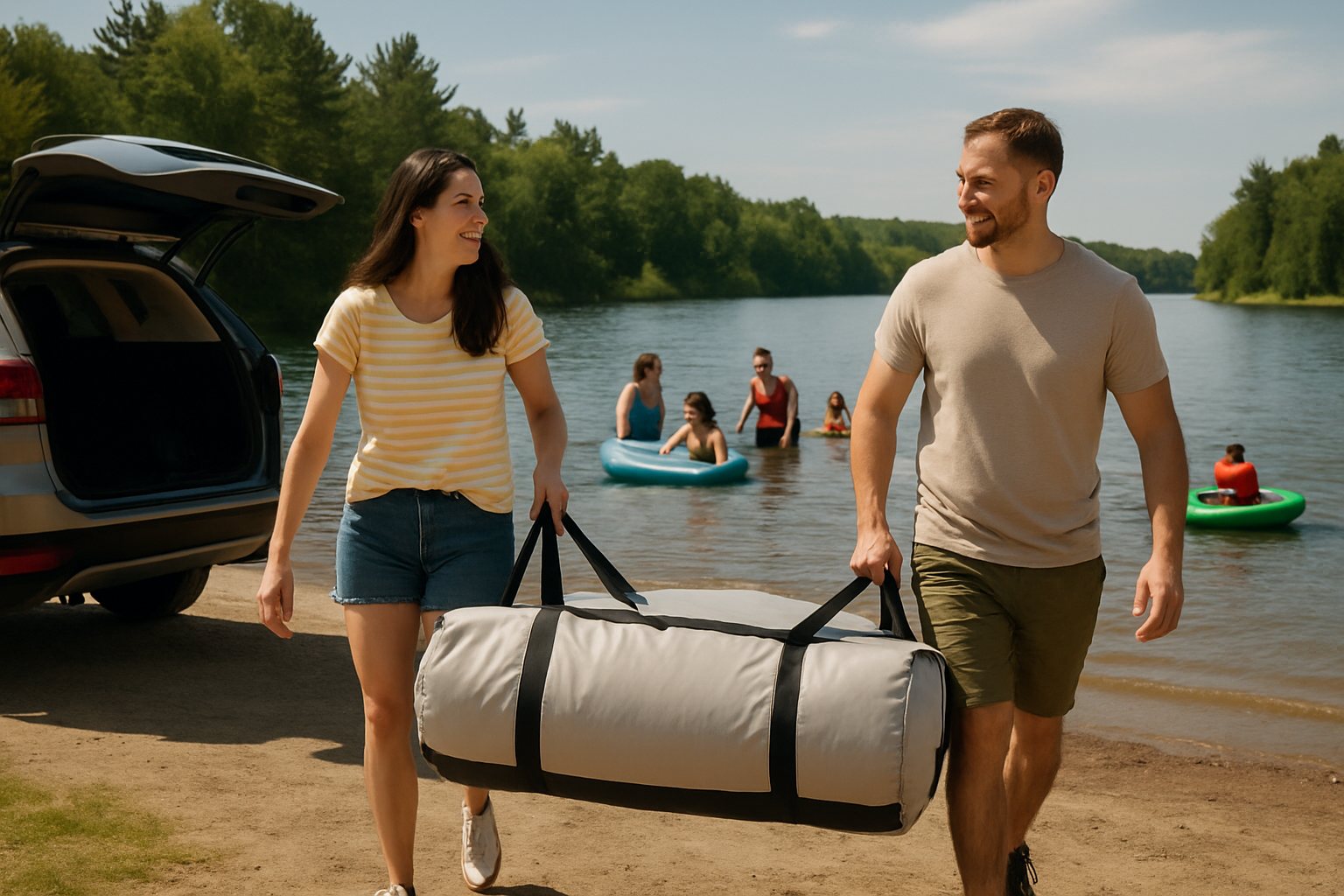
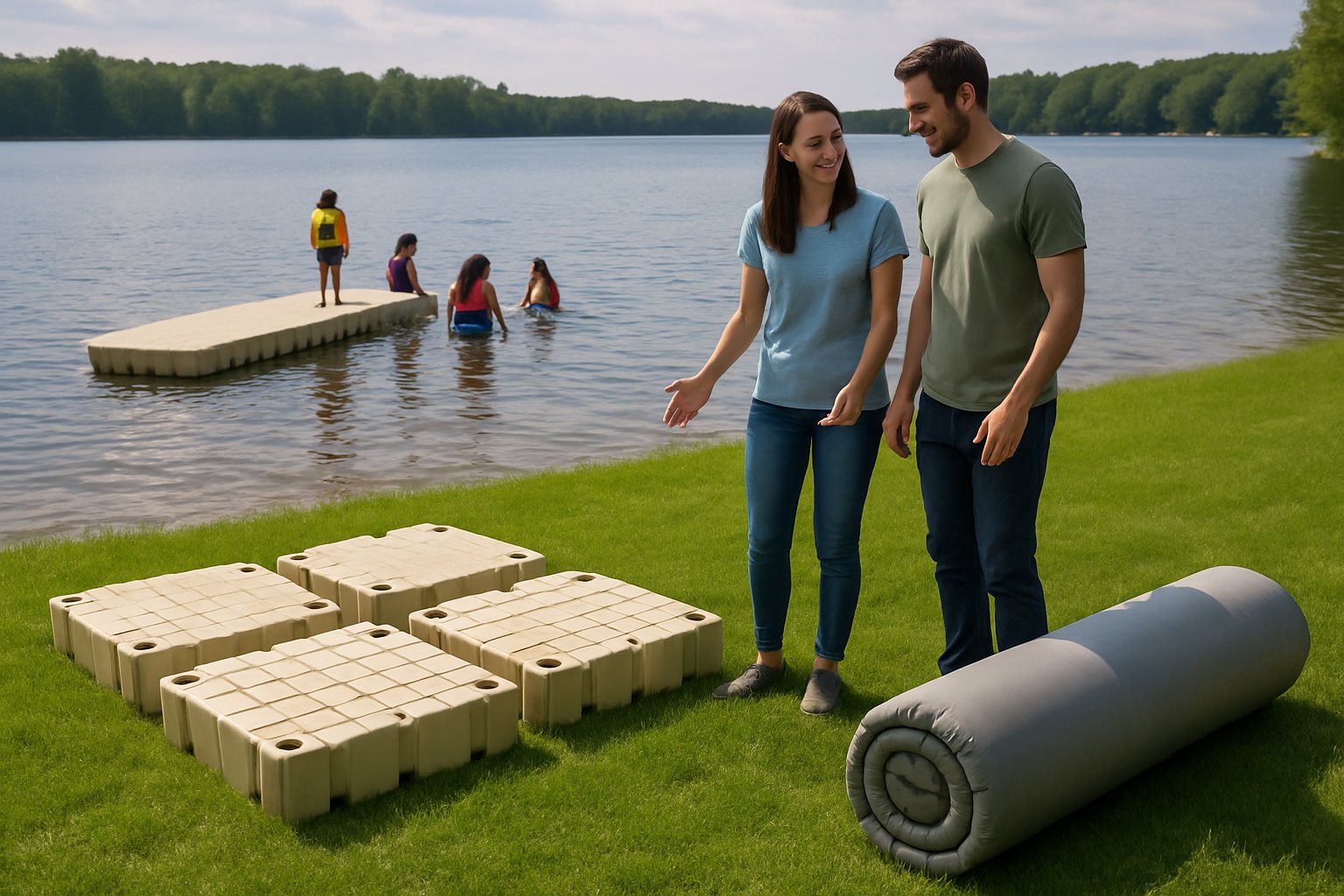
    Couple unloading a packed inflatable dock from their car at a lake

    In short: the most portable docks are inflatable: drop-stitch decks from about 19 lb (AWSUM 6 x 5 ft) to 83 lb (BOTE 10 x 10 ft) that pack into a bag and cost about $170 to $1,550 in October 2026. Modular plastic docks are portable in pieces (a Candock cube weighs 12 lb, a Connect-A-Dock section 110 lb) but take longer to set up and anchor. Whatever you choose, portable still means anchored: bring weights or anchor bags you can fill on site.

    What makes a dock portable?

    • Weight you can carry. Lighter is easier: the docks below run from about 19 to 110 lb per piece, and RAVE asks for two or more people to carry its inflated 68 to 69 lb dock.
    • Packed size. Island Hopper’s 10 x 6 ft Yacht Dock rolls to about 40 x 16 x 14 in.
    • Setup time. Island Hopper says about 8 minutes with a hand pump for that dock; EZ Dock says most rigid docks take a day with two people.
    • Anchoring that leaves with you. Weights and bags, not pipes driven into the bottom.

    Portable docks by weight

    DockTypeSizeWeight (maker or seller)Stated capacity
    AWSUM 6 x 5 ftInflatable6 x 5 ft, 6 in18.8 lb455 lb
    Island Hopper Mini Mate Yacht DockInflatable10 x 3 ft, 6 in32 lb rolled1,000 lb load rating
    BOTE Inflatable Dock 7Inflatable7 x 7 ft, 8 in35 lb1,050 lb
    LOSKIA U jet ski dockInflatable8.5 x 8 ft, 6 in39 lbNot published
    Island Hopper Yacht DockInflatable10 x 6 ft, 6 in53 lb1,500 lb
    WOW Vacation Station 8 x 8Inflatable8 x 8 ft, 6 in53 lb1,200 lb
    RAVE Aqua Dock 10Inflatable10 x 10 ft, 6 in68 to 69 lb1,800 lb or 10 adults
    BOTE Inflatable Dock 10Inflatable10 x 10 ft, 8 in83 lb2,100 lb
    Candock G2 cubeRigid modular19 x 19 x 14 in per cube12 lb per cube150 lb per cube
    Connect-A-Dock 1000 sectionRigid modular60 x 45 x 10 in110 lb per section690 lb per section

    Inflatable portable docks

    An inflatable dock is the most portable dock there is. It is a drop-stitch PVC deck, 6 to 8 in thick when pumped to the maker’s pressure, that deflates and rolls up; Island Hopper gives about 40 x 16 x 14 in for its rolled 10 x 6 ft dock. Small ones, like the AWSUM 6 x 5 ft at 18.8 lb, fit in a car trunk with room to spare. The 10 ft class from known brands (RAVE, Island Hopper, Solstice, WOW, BOTE) weighs about 50 to 85 lb and is stated by its makers at about 1,200 to 2,100 lb. Most come with a hand pump; an electric pump makes moving from lake to lake much easier.

    Lightest to carry

    AWSUM Inflatable Floating Dock

    • 6 x 5 ft, 18.8 lb
    • Seven sizes to 15 x 6 ft
    • Pump, rope, soft ladder
    Check price on Amazon
    Rides along on a boat

    Island Hopper Yacht Dock 10 x 6

    • 53 lb
    • 1,500 lb
    • Corner bumpers
    Check price on Amazon
    Most deck to pack away

    RAVE Aqua Dock 10

    • 10 x 10 ft
    • 1,800 lb or 10 adults
    • 68 to 69 lb
    Check price on Amazon
    Square mid-size

    WOW Vacation Station 8 x 8

    • 8 x 8 ft, 53 lb
    • 1,200 lb
    • Hand pump with gauge
    See it at the store

    Prices seen in October 2026: AWSUM 6 x 5 ft about $170, Island Hopper Yacht Dock $749 and RAVE Aqua Dock $800 on Amazon, WOW Vacation Station $720 at Overton’s. More picks are in the best floating docks.

    Portable docks that ride along on a boat

    Some portable docks are made to travel with the boat rather than the car. Island Hopper says its Yacht Dock’s 6 ft beam lets it deploy off smaller vessels “where a 10-foot platform would be impossible,” with rubber corner bumpers to protect the hull, and its narrow 10 x 3 ft Mini Mate is sold to sit beside a boat, including in a marina slip. Tie them off at anchor with the engine off, keep them clear of the propeller and exhaust, and stay at least 20 ft from boats running an engine or generator, as the CDC advises because of carbon monoxide. Inflatable jet ski docks are portable too; see the best jet ski docks.

    Modular docks: portable in pieces

    Rigid modular docks are portable in a different sense: you can take them apart, move them and rebuild them in a new shape. Candock says you can change the configuration of its 12 lb cubes “as often as you like,” EZ Dock says its sections can be reconfigured or expanded at any time, and Jet Dock calls its drive-on PWC dock “completely modular, expandable and portable.” The trade-off is time and weight per piece (110 lb for a Connect-A-Dock 1000 section) and anchoring with pipes, brackets or stiff arms. They suit a seasonal dock that comes out every fall rather than one that moves every weekend. See floating dock kits vs inflatable docks.

    Which portable dock for which trip

    • A week at a rented cabin: a 10 ft class inflatable with an electric pump. It gives the kids a swim deck and you a place to tie the paddle boards, and it goes home in the trunk.
    • Saturdays at the sandbar: a narrow boat-side dock such as the Island Hopper Yacht Dock or Mini Mate, tied off the stern at anchor.
    • A jet ski that travels with you: an inflatable U or L jet ski dock that packs down to under 40 lb.
    • A summer place you own, out every fall: modular sections you assemble in spring and stack in the barn in October.
    • Daily boat access all season: portable is probably the wrong goal. Look at rigid floating docks in the modular docks section.

    Anchoring a portable dock

    Portable does not mean loose. Makers state anchor weights for their docks: RAVE suggests about 150 to 200 lb for its Aqua Dock, depending on the lake and bottom, and Aquaglide asks for at least 1,100 lb on its large Docking Station. Weights that pack flat are the portable answer: Aquaglide’s Lakefront Anchor Bag holds about 110 lb when filled with sand, so you carry an empty bag and fill it at the beach. Use every anchor point, keep the dock off piers and boats, and check it after the first breeze. Full details in how to anchor a floating dock.

    Packing up and storing

    RAVE’s manual gives a good routine for any inflatable: dry each side in the sun for at least 15 minutes, towel off, fold in thirds and roll loosely, then store somewhere covered, shaded, cool and dry, off concrete and safe from rodents. Clean with mild soap and fresh water, never solvents or a power washer. Carry inflated docks with two or more people and never drag them over sand or rocks.

    Rules for docks that move

    A portable dock can still fall under local rules. Minnesota, for example, says swimming rafts and other structures not attached to shore may not stay in the water from sunset to sunrise without a county sheriff’s permit and a light or reflectors. If you take the dock in every evening, that is easy; if you leave it out, check first.

    Aquaglide Docking Station

    by Aquaglide

    • Size (as stated): 14 ft 9 in x 10 ft 5 in x 6 in
    • Stated capacity: 600 lb (3 adults + 3 children)
    • Thickness: 6 in (15 cm) welded drop-stitch

    Full specs and sources

    See it at Bart's

    BOTE Inflatable Dock 10 Classic

    by BOTE

    • Size (as stated): 10 x 10 ft x 8 in
    • Stated capacity: 2,100 lb on BOTE's site (1,500 lb at some retailers)
    • Thickness: 8 in

    Full specs and sources

    See it at BOTE

    BOTE Inflatable Dock 7 Classic

    by BOTE

    • Size (as stated): 7 x 7 ft x 8 in
    • Stated capacity: 1,050 lb
    • Thickness: 8 in

    Full specs and sources

    See it at BOTE

    Island Hopper Mega Yacht Dock 10 x 10

    by Island Hopper

    • Size (as stated): 10 x 10 ft
    • Stated capacity: 2,000 lb load rating
    • Thickness: 6 in

    Full specs and sources

    See it at Overton's

    RAVE Aqua Dock 10

    by RAVE Sports

    • Size (as stated): 10 x 10 ft x 6 in
    • Stated capacity: 1,800 lb / 10 adults
    • Thickness: 6 in drop-stitch

    Full specs and sources

    See it at Bart's

    Solstice Inflatable Dock 10 x 10

    by Solstice Watersports

    • Size (as stated): 10 x 10 ft x 6 in
    • Stated capacity: 1,650 lb
    • Thickness: 6 in drop-stitch

    Full specs and sources

    See it at Overton's

    Explore more: the lake docks hub, boat docks, floating dock cost, our inflatable docks guide and kayak launch docks. Looking for a floating patio to lounge on rather than a dock? Our sister site covers floating lounges.

    Portable dock questions

    What is the lightest portable dock?

    Of the docks we checked, the AWSUM 6 x 5 ft inflatable at 18.8 lb, per the seller. Lighter usually means smaller and a lower rating.

    Can one person set up a portable dock?

    One person can inflate one, but RAVE says two or more people should carry an inflated dock, and anchoring from a boat is easier with a helper.

    Can I leave a portable dock in the water all summer?

    Some makers expect it to come in. RAVE’s manual says to deflate and store its dock when not in use. Larger docks, like Aquaglide’s Docking Station, are built around heavy anchoring (at least 1,100 lb) and a fixed spot. Check your manual and local rules.

    Are portable docks good for a pond?

    Yes, if it is deep enough: RAVE and Aquaglide ask for at least 4 ft of water under their docks. Shallow farm ponds may suit a small rigid dock better. See floating docks for ponds and lakes.

    Do portable docks work on rivers?

    Current changes the picture; RAVE’s manual says not to use its dock in currents. Read floating docks on a river first.

  • Floating Dock Installation: Step by Step, Inflatable and Rigid

    Floating Dock Installation: Step by Step, Inflatable and Rigid

    Memorial Day weekend, the water still cold, and the new dock is on the lawn in boxes. By Sunday evening you want to be sitting on the end of it with your feet in the lake. Good floating dock installation is mostly planning: knowing your depth, bottom and rules before the first piece touches the water, then following the maker’s order of work. This guide walks through installing an inflatable dock and a rigid modular dock kit, the tools each needs, connecting to shore, the first-week checks and taking it out in the fall.

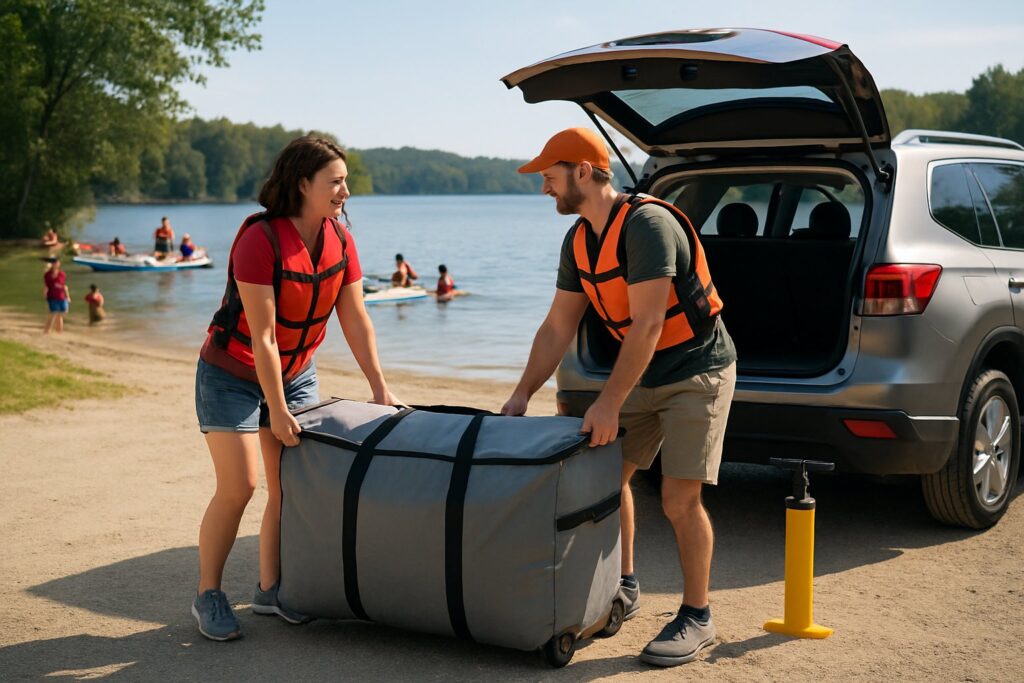
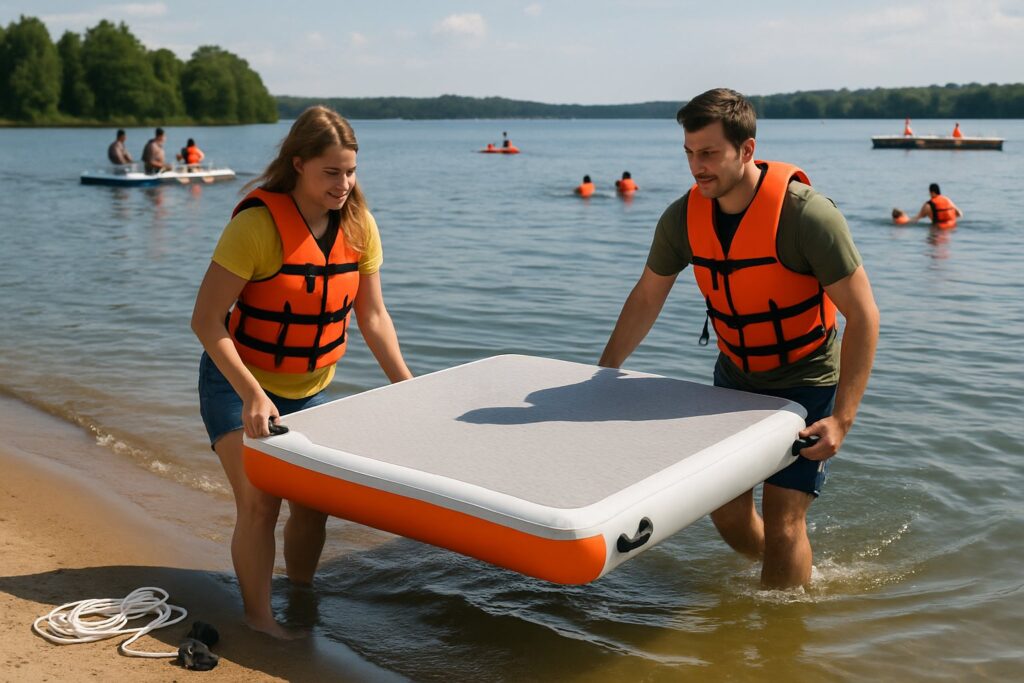
    Two people guiding a freshly inflated dock into shallow water

    In short: check permits, depth and bottom first. An inflatable dock is inflated on a clean, flat surface to the maker’s pressure, carried (not dragged) to the water and anchored at every anchor point, away from piers and boats. A rigid kit is assembled section by section with couplers or connectors, pinned with pipes or anchored with weights, piling brackets or stiff arms, and joined to shore with a gangway. EZ Dock says most of its docks go in within a day with two people; Aquaglide recommends a dock and mooring specialist for its large anchored docks.

    Before installation: rules, depth and bottom

    • Rules. In US navigable waters, the Army Corps of Engineers counts boat docks and piers as structures that need a Department of the Army permit unless exempt or covered by a general permit. States add their own: Minnesota’s DNR lets many docks go in without a state permit if they meet conditions such as width and use, and leaves more to local rules; Illinois covers small private docks with a statewide permit that limits length, width and setbacks. Utility and reservoir lakes often have their own shoreline permits.
    • Depth. Measure at the lowest water you expect, not today’s. RAVE and Aquaglide ask for at least 4 ft under their inflatable docks.
    • Distance. Aquaglide’s Docking Station must sit at least 10 ft from shore. Leave room for the dock to swing on its lines.
    • Bottom. Sand, mud, weed or rock decides the anchor; see how to anchor a floating dock.
    • Neighbors and traffic. Keep clear of channels, swim areas and the property line.

    Tools and parts

    Inflatable dockRigid dock kit
    Pump with a gauge (hand pump usually included; electric saves time)EZ Dock: in-water coupler tool, coupler nut tool, hammer, ratchet, 15/16 in wrench or socket, Phillips screwdriver
    Anchors to the maker’s total weight, lines, shackles or carabiners, a bridle if the dock has several ringsAnchoring pipe (Connect-A-Dock’s kit leaves out the Schedule 40 pipe), or weights, piling brackets or stiff arms
    Repair kit, ground sheet or tarpGangway or gangway hinge, cleats, bumpers
    Two or more people to carryA helper (two or more people recommended), a boat or waders

    Installing an inflatable dock

    1. Set the anchors first. Aquaglide’s manuals say to install anchors and mooring lines before inflating. Lower weights into place from a boat and mark them with a float.
    2. Unroll on a clean, flat surface. RAVE says to inflate on flat ground clear of sharp objects, or on the flat deck of a boat with the motor off.
    3. Inflate to the stated pressure and no more. RAVE’s Aqua Dock is 5 psi (“do not inflate beyond 5 psi”); BOTE gives 6 to 8 psi for its 7 ft dock and 8 to 10 psi for the 10 ft; other docks run up to about 15 psi. Island Hopper says its 10 x 6 ft dock takes about 8 minutes with the hand pump. An electric pump with auto-stop takes the effort out.
    4. Carry it to the water. RAVE says two or more people should carry an inflated dock and that you should not drag it.
    5. Attach to every anchor point and set the line length so the dock floats flat with a little slack.
    6. Keep it off hard objects. RAVE’s manual says not to connect its dock directly to docks, piers or other hard objects. Anchor it on its own, a swim away from the pier.
    Electric pump

    AIRBANK Puffer Pro Electric Pump

    • Up to 20 psi
    • Auto-off at set pressure
    • 7 nozzles
    Check price on Amazon
    Repair kit

    JLF Inflatable Repair Kit with HH-66 Cement

    • Five 3 x 6 in PVC patches
    • 1 oz vinyl cement
    • Valve wrench
    Check price on Amazon
    Lines

    Better Boat 3/8 in Nylon Anchor Line, 100 ft

    • 820 lb working load
    • Double-braided nylon
    • Stainless thimble
    Check price on Amazon

    Before you buy a pump, check that one of its nozzles fits your dock’s valve. Several docks we looked at use an H3 high-pressure valve (Solstice and Overton’s), and the JLF kit’s wrench fits 6-prong valves only, so check yours.

    Installing a rigid floating dock kit

    1. Lay out the sections near the water in the order they will go, with the gangway end nearest shore.
    2. Join sections in the water. EZ Dock uses rubber couplers set with its in-water coupler tool; Connect-A-Dock’s kit has float connectors; Candock cubes screw together. Work outward from shore.
    3. Anchor as you go. Drive pipe through the pole anchoring connectors in shallow water, or fit deadweights, piling brackets or stiff arms as the dealer advises. The dock must still rise and fall.
    4. Connect to shore. Fit the gangway hinge and gangway. EZ Dock offers a hardware kit for a wooden gangway built from 2 x 12 boards, polyethylene gangways up to 18 ft, and aluminum ones.
    5. Add accessories such as cleats, bumpers, a ladder, a PWC port or a kayak launch, using the maker’s connectors.

    EZ Dock says most docks can be installed in a day with you and a helper, or its dealers can deliver and install. Connect-A-Dock’s seller says its kit installs with simple hand tools and that one person can do it, though two or more are recommended. Heavy add-ons ship by freight; Wave Armor says its Sport jet ski port needs a forklift for delivery.

    DIY or hire a pro?

    A 10 ft inflatable and a short straight kit are reasonable DIY jobs for two people. Call a professional when the anchoring is heavy or the site is hard: Aquaglide advises a dock and mooring specialist for its Docking Station (1,100 lb minimum anchor weight) and C Lounge (4,400 lb). Get dealer quotes itemized, because prices are not always all-in; one dealer we checked listed its price as excluding installation, anchoring equipment and shipping. See floating dock cost for typical prices.

    The first week

    • Check position after the first hour and the first windy afternoon; add weight if it moved.
    • Check inflatable pressure in the morning and in the afternoon sun; warm air expands.
    • Tighten couplers, nuts and cleats on rigid docks; Candock tells owners to check nuts on cleats, ladders and pins occasionally.
    • Walk the lines for chafe where they pass edges.

    Taking it out for the season

    For inflatables, RAVE’s manual says to bring the dock to land or deflate it on a boat deck, dry each side in the sun for at least 15 minutes, towel it dry, fold it in thirds and roll it loosely, then store it in a covered, shaded, cool, dry place off concrete and safe from rodents. Clean it with mild soap and fresh water, never solvents or a power washer. For rigid docks, Connect-A-Dock recommends removal for winter where ice shifts, and Candock says ice damage usually comes from ice moving in the spring thaw. Mark where your anchors are so next spring goes faster.

    Aquaglide Docking Station

    by Aquaglide

    • Size (as stated): 14 ft 9 in x 10 ft 5 in x 6 in
    • Stated capacity: 600 lb (3 adults + 3 children)
    • Thickness: 6 in (15 cm) welded drop-stitch

    Full specs and sources

    See it at Bart's

    BOTE Inflatable Dock 10 Classic

    by BOTE

    • Size (as stated): 10 x 10 ft x 8 in
    • Stated capacity: 2,100 lb on BOTE's site (1,500 lb at some retailers)
    • Thickness: 8 in

    Full specs and sources

    See it at BOTE

    BOTE Inflatable Dock 7 Classic

    by BOTE

    • Size (as stated): 7 x 7 ft x 8 in
    • Stated capacity: 1,050 lb
    • Thickness: 8 in

    Full specs and sources

    See it at BOTE

    Island Hopper Mega Yacht Dock 10 x 10

    by Island Hopper

    • Size (as stated): 10 x 10 ft
    • Stated capacity: 2,000 lb load rating
    • Thickness: 6 in

    Full specs and sources

    See it at Overton's

    RAVE Aqua Dock 10

    by RAVE Sports

    • Size (as stated): 10 x 10 ft x 6 in
    • Stated capacity: 1,800 lb / 10 adults
    • Thickness: 6 in drop-stitch

    Full specs and sources

    See it at Bart's

    Solstice Inflatable Dock 10 x 10

    by Solstice Watersports

    • Size (as stated): 10 x 10 ft x 6 in
    • Stated capacity: 1,650 lb
    • Thickness: 6 in drop-stitch

    Full specs and sources

    See it at Overton's

    More in Setup and Care: how to anchor a floating dock, floating docks on rivers, floating dock kits vs inflatable docks and our older guide to inflating and installing a boat dock. Common questions are in the FAQ.

    Installation questions

    How long does floating dock installation take?

    An inflatable takes minutes to inflate (about 8 minutes by hand for Island Hopper’s 10 x 6 ft dock, by the maker’s figure) plus the time to set anchors. EZ Dock says most of its rigid docks go in within a day with two people.

    Can I install a floating dock by myself?

    Plan on two people. RAVE says two or more should carry an inflated dock, and Connect-A-Dock’s seller recommends two or more for its kit even though one person can do it.

    Can I attach an inflatable dock to my existing dock?

    RAVE says not to connect its dock directly to docks, piers or other hard objects, and Aquaglide says never to tie its lakefront products to a dock. Anchor the inflatable separately.

    What water depth do I need?

    At least what the maker states, measured at low water: 4 ft for the RAVE and Aquaglide docks we checked. Rigid docks vary by system; ask the dealer.

    Do I need a permit to install a floating dock?

    Sometimes. Federal rules apply in navigable waters, and states, counties and lake authorities have their own. Call before you buy, not after it is in the water.

  • How to Anchor a Floating Dock: Anchors, Weights, Lines, Bridles

    How to Anchor a Floating Dock: Anchors, Weights, Lines, Bridles

    The first afternoon breeze on a lake is the test. A dock that was sitting nicely off the beach at breakfast starts to swing, drags a little, and by three o’clock it is nosing into the neighbor’s lift. Many floating dock problems come back to the same thing: anchoring a floating dock properly, with enough weight, the right lines and the right spot. This guide covers how to anchor a floating dock, inflatable or rigid, using the figures makers actually publish, and it tells you where they publish nothing.

    In short: follow your maker’s numbers first. Aquaglide asks for at least 1,100 lb of total anchor weight on its Docking Station and 4,400 lb on its C Lounge; RAVE suggests about 150 to 200 lb for its 10 x 10 ft Aqua Dock, depending on the lake and bottom. Use anchors suited to your bottom, lines with enough scope (boating guides use 5:1 to 7:1 for boats), a bridle where the dock has several anchor rings, and keep the dock away from piers, boats and other hard objects. Rigid docks are pinned with pipes, deadweights, piling brackets or stiff arms.

    Start with what your dock maker says

    Makers publish very different anchoring figures, because their docks are very different. These are the ones we found, as the makers state them:

    DockAnchor pointsAnchor weightDepth and distance
    Aquaglide Docking Station (14 ft 9 in x 10 ft 5 in)5 anchor ringsAt least 1,100 lb (500 kg) totalAt least 4 ft deep, 10 ft from shore
    Aquaglide C Lounge (14.7 ft)4 anchor ringsAt least 4,400 lb (2,000 kg) totalAt least 4.8 ft deep, 3.3 ft from shore
    RAVE Aqua Dock 10 (10 x 10 ft)2, one at each end on the bottomAbout 150 to 200 lb, depends on lake and bottom (RAVE FAQ)At least 4 ft deep
    Rigid sections (EZ Dock, Connect-A-Dock)Pipe collars, pole connectors, bracketsSet by dealer for the siteSite specific

    Two things stand out. First, Aquaglide’s figures are far higher than most owners expect, and Aquaglide says its weight recommendations are for anchoring in extreme weather, waves or other abnormal conditions, and advises a dock and mooring specialist for the install. Second, no consumer dock maker we checked publishes a wind or wave limit. That is why the maker’s anchor weight is the number to respect, and why you should bring the dock in, or stay off it, when weather turns.

    Floating dock anchors: the main types

    • Deadweight anchors. Anything heavy that sits on the bottom: concrete blocks, filled anchor bags or purpose-made weights. Aquaglide’s Lakefront Anchor Bag holds about 110 lb (50 kg) when filled with sand, and several bags can share one line to reach a large total.
    • Mushroom anchors. Cast bowls that settle into soft bottoms. A 10 lb SeaSense mushroom is sold for sandy, muddy or weedy bottoms and small boats; on its own it is far below the totals above, so it suits small, light setups or as one of several anchors.
    • Pipes and poles. For rigid kits in shallow water: Connect-A-Dock’s kit has pole anchoring connectors for Schedule 40 pipe (not included), and the dock slides up and down the pipe as the water changes.
    • Stiff arms and piling brackets. Rigid arms from the shore or brackets on pilings that hold the dock in place while letting it rise and fall. EZ Dock lists pipes, deadweight anchors, piling brackets and stiff arms as its options, with fresh and saltwater hardware.

    Match the anchor to the bottom. The BoatUS Foundation notes that lightweight fluke anchors hold best in hard sand or mud, not in very soft mud or grass, and that plow anchors work in sand, rock, weeds and grass but poorly in soft bottoms. For a dock that stays put for weeks, deadweight is the usual answer, because it does not depend on digging in.

    Lines, scope and chain

    Scope is the length of line compared with the depth of water. For anchoring boats, the BoatUS Foundation teaches 7:1, or 5:1 for a small boat with a light anchor in good weather, and a state boating course adds 7 to 8 ft of galvanized chain at the anchor end to lower the angle of pull. Docks are moored rather than anchored like boats, and makers set their own line arrangements, but the idea holds: a short, steep line lifts the anchor; a longer line with some chain keeps it on the bottom. Allow for the dock swinging in a circle and keep that circle clear of swimmers’ routes, boats and other docks.

    Use marine line rated well above the load. Better Boat’s 3/8 in double-braided nylon, for example, lists an 820 lb working load and a 4,035 lb breaking load. The working load is the figure to plan with. A shock cord near the dock absorbs movement and stress; RAVE sells an anchor connector kit with a 6 ft shock cord, 15 ft of nylon rope, galvanized chain and a foam float.

    Small extra anchor

    SeaSense Mushroom Anchor 10 lb

    • Vinyl-coated cast iron
    • Sandy, muddy, weedy bottoms
    • About $32
    Check price on Amazon
    Anchor line

    Better Boat 3/8 in Nylon Anchor Line, 100 ft

    • 820 lb working load
    • 4,035 lb breaking load
    • Stainless thimble
    Check price on Amazon
    Shock-absorbing connector

    RAVE Sports Anchor Connector Kit

    • 6 ft shock cord
    • 15 ft nylon rope, chain
    • Foam marker float
    Check price on Amazon

    What a bridle does

    A bridle is a set of short lines that run from several anchor rings on the dock to one point, often a swivel, where the main anchor line attaches. It spreads the pull across the dock instead of yanking one corner, and the swivel lets the dock turn with the wind without twisting the line. In one of its lakefront manuals, Aquaglide describes a single vertical mooring line to the center swivel of a 4-way bridle with an appropriate weight, and tells owners to secure the swivel and connections so they cannot loosen in rough weather. Aquaglide’s Docking Station has five anchor rings and ships without a bridle, so buy or make one rated for the job.

    How to anchor a floating dock, step by step

    1. Read the manual. Note the anchor weight, anchor points, minimum depth and distance from shore.
    2. Pick the spot. Check depth with a weighted line at the lowest water you expect, and leave room for the dock to swing clear of piers, lifts, boats and swim lanes.
    3. Place anchors first. Aquaglide’s instructions say to install anchors and mooring lines before inflating its product. Lower weights from a boat; never throw them.
    4. Attach the bridle or lines to every anchor point the maker provides, using shackles or locking carabiners.
    5. Set the length so the dock floats flat at today’s level with some slack for waves and level changes.
    6. Check after an hour and after the first wind. If it has moved, add weight. For sites with strong wind, current or swell, Aquaglide suggests up to 50% more weight or holding power.

    Keep it away from hard objects

    It is tempting to tie an inflatable dock to the end of a pier. RAVE’s manual says not to connect its Aqua Dock directly to docks, piers or other hard objects, and Aquaglide says never to tie its lakefront product to a dock. Anchor it on its own instead. If you tie a dock off a boat for the afternoon, do it at anchor with the engine off, and remember the CDC’s advice to stay at least 20 ft from boats running an engine or generator because of carbon monoxide.

    Local rules

    Anchoring is also a legal matter in many places. Illinois’s statewide dock permit requires docks to be securely anchored so they do not break loose and become a floating hazard in high water or wind. Minnesota’s boating guide says swimming rafts and similar structures not attached to shore may not stay in the water between sunset and sunrise without a county sheriff’s permit, with a light or reflectors. Check your state and lake rules before you leave a dock out overnight.

    Next steps: floating dock installation, a floating dock on a river (current changes everything), portable docks, floating docks for ponds and lakes, the Setup and Care guide, and the lake docks hub. Words like scope, bridle and freeboard are in the glossary.

    Anchoring questions

    How much weight do I need to anchor a floating dock?

    Whatever your maker states. The figures we found range from about 150 to 200 lb (RAVE, 10 x 10 ft inflatable) to 1,100 lb (Aquaglide Docking Station) and 4,400 lb (Aquaglide C Lounge). We do not calculate anchor weight from size; if your maker publishes nothing, ask them, or a local dock and mooring installer.

    One anchor or two?

    Use every anchor point the maker provides. RAVE’s dock has two, one at each end; Aquaglide’s Docking Station has five. Two or more anchors stop the dock spinning and spread the load.

    Can I use cinder blocks as floating dock anchors?

    People do, but no dock maker we checked specifies them. Makers sell purpose-made weights instead; Aquaglide says its sand-filled anchor bag is unlikely to damage boats or inflatables. Whatever you use, reach the maker’s total weight.

    How deep should the water be?

    RAVE and Aquaglide ask for at least 4 ft under the docks above, and 4.8 ft for the C Lounge. If people will jump, look for more.

    How do I anchor a dock where the water level changes?

    Leave slack, check often, or use hardware that slides: pipes through collars, piling brackets or stiff arms on rigid docks. For big swings, see our river guide.

  • Floating Dock Kits vs Inflatable Docks: Which Should You Buy?

    Floating Dock Kits vs Inflatable Docks: Which Should You Buy?

    Spring at the pond: two pallets of gray plastic sections arrive on a truck, and by evening there is a 20 ft walkway out to deep water with cleats for the jon boat. Down the road, a family carries a rolled-up bag to the beach, pumps it for ten minutes, and has a 10 x 10 ft swim deck by lunch. Both are floating docks. One is a floating dock kit, a set of rigid modular sections that bolt together; the other is an inflatable dock. This guide compares them on what you get in the box, height above the water, stated loads, anchoring, winter, set-up time and price, so you can tell which one you need.

    Assembled floating dock kit and an inflatable dock seen from the water

    In short: floating dock kits are rigid polyethylene sections that connect into a permanent walkway or platform, sit about 8 to 17 in above the water, carry a stated load per section and cost thousands of dollars. Inflatable docks are single 6 to 8 in thick drop-stitch decks that cost hundreds, pack into a bag and are built for swimming, lounging and light boarding. Choose a kit for daily access from shore and boat mooring; choose an inflatable for summer fun and easy storage.

    What is in a floating dock kit?

    A kit is a bundle of rigid sections plus the hardware to join and anchor them. Connect-A-Dock’s 20 ft straight kit, for example, has four 3.75 x 5 ft float sections, nine float connectors, four pole anchoring connectors, four 8 in cleats and a gangway hinge, with all connection hardware. The Schedule 40 pipe that pins it to the bottom is not included. Each section is rated at 690 lb and the walking surface sits about 8 in above the water. The seller says one person can install the sections but recommends two or more.

    Other systems work the same way at different sizes. Connect-A-Dock’s heavier 2000 Series is rated 2,500 lb per section and rides about 17 in above the water. EZ Dock’s 60 in x 10 ft section is rated 3,000 lb, with couplers that EZ Dock says are designed to break before the section in severe waves, so a repair means replacing a coupler. Candock builds from 19 x 19 x 14 in HDPE cubes, each rated 150 lb, screwed together in any layout, with a twenty-year guarantee.

    What an inflatable dock is

    An inflatable dock is one deck of drop-stitch PVC, usually 6 in thick (BOTE makes 8 in), pumped to the maker’s pressure so it feels firm. RAVE’s Aqua Dock 10 is 10 x 10 ft at 5 psi, rated 1,800 lb or 10 adults, and weighs about 68 to 69 lb. Island Hopper’s Yacht Dock is 10 x 6 ft, rated 1,500 lb, with rubber corner bumpers for boats. They come with a hand pump, roll up at the end of the day or season, and float low, close to swimmers. Some link together and some do not: BOTE invites owners to lash several together, Aquaglide allows its lounges to interlock on up to two sides, while RAVE says the Aqua Dock does not connect to its other products.

    Modular floating dock kit vs inflatable, compared

    Floating dock kit (rigid, modular)Inflatable dock
    MaterialPolyethylene sections or cubes, air or foam insideDrop-stitch PVC, air inside
    Height above waterAbout 8 in (Connect-A-Dock 1000) to 17 in (2000 Series); EZ Dock about 13 inLow; the deck is 6 to 8 in thick and sits close to the surface
    Stated loadPer section: 690 lb (Connect-A-Dock 1000), 2,500 lb (2000 Series), 3,000 lb (EZ Dock 5 x 10 ft); 150 lb per Candock cubePer dock: 1,200 lb (WOW 8 x 8) to 1,800 lb (RAVE 10 x 10) on the ones we checked
    Grows by adding piecesYes, by designSome models link; many do not
    AnchoringPipes, deadweight anchors, piling brackets or stiff armsAnchor weights and lines to D-rings or anchor points
    SeasonStays in all season; remove where ice shiftsOut when not in use, per RAVE’s manual
    Price seen, Oct 2026$4,878 for a 20 ft kit (Connect-A-Dock, pipe extra); EZ Dock by quoteAbout $170 to $1,550

    Where floating dock kits win

    • Daily access. A kit connects to shore with a gangway hinge, so you walk out every morning without wading. EZ Dock offers wood, polyethylene (up to 18 ft) and aluminum gangways.
    • Boats and jet skis. Cleats, bumpers and add-on PWC ports and kayak launches bolt to the same system.
    • Layout. Straight, L, T and U shapes are all made from the same pieces; Candock’s kit menu lists linear, L, T and U layouts.
    • Low upkeep. No splinters or sealing; Connect-A-Dock’s seller says a hose and broom keep it clean.

    Where inflatable docks win

    • Price. A well-known 10 ft class inflatable is about $700 to $800; a rigid 20 ft kit is about six times that.
    • Storage and travel. It deflates into a bag that goes in the car, the boat locker or the garage.
    • Swimming. The low deck is easy to climb onto from deep water, and soft edges are kind to shins and hulls.
    • Rentals and changing plans. No hardware stays in the lake bed, so it suits a rented cabin or a shoreline you are not sure about yet.
    Rigid kit

    Connect-A-Dock 20 ft Straight Floating Dock Kit

    • Four 3.75 x 5 ft sections
    • 690 lb per section
    • Pipe not included
    Check price on Amazon
    Float for a DIY frame

    Taylor Made Dock Float 24 x 48 x 16 in

    • About 600 lb flotation
    • PE shell, EPS foam
    • Not meant to join each other
    Check price on Amazon
    Inflatable swim dock

    RAVE Aqua Dock 10

    • 10 x 10 ft, 6 in
    • 1,800 lb or 10 adults
    • Hand pump included
    Check price on Amazon
    Inflatable boat-side dock

    Island Hopper Yacht Dock 10 x 6

    • 1,500 lb
    • Corner bumpers
    • Rolls up
    Check price on Amazon

    What about building your own on dock floats?

    Single floats are the third route. Taylor Made sells polyethylene-shelled, foam-filled floats from about 335 to 1,200 lb of flotation by size, made to bolt under a stay-in dock frame, and its own page says they are “not designed to attach to each other.” Dock Edge’s 2 x 4 ft float is rated 260 lb. You then build the frame and deck yourself, so it is a carpentry project rather than a kit. If you go this way on a TVA lake, note that TVA rules require flotation to be commercially made for marine use, and unencased foam is being phased out.

    Setting them up

    A kit is a half-day to full-day job. EZ Dock says most of its docks go in within a day with you and a helper, using an in-water coupler tool, a coupler nut tool and ordinary hand tools, or its dealer can do it. Then come the anchors: pipes through the pole connectors, or deadweight anchors, piling brackets or stiff arms, depending on depth and bottom; the maker or dealer will say which. An inflatable takes a pump and some patience; Island Hopper says about 8 minutes for its 10 x 6 ft dock with a hand pump. It still needs anchoring away from hard objects. Our floating dock installation guide walks through both, and how to anchor a floating dock covers weights and lines.

    Winter and lifespan

    Rigid kits can stay out in many places, but moving ice is the enemy. Connect-A-Dock says freezing will not harm its sections but recommends removal with shifting ice, and Candock says most ice damage comes from ice movement in the spring thaw and is not covered by its guarantee. Inflatables come in: RAVE’s manual says to deflate and store the dock when not in use, cleaned with mild soap, dried and rolled loosely somewhere cool and shaded. Warranties differ widely, from 30 days on one Amazon inflatable listing to a limited lifetime on RAVE’s dock and twenty years on Candock cubes.

    Custom built: request information

    FunAir Toy Island

    by FunAir

    • Stated capacity: Up to 4 jet skis or dinghies, or 2 Seabobs plus guests (maker)

    Full specs and sources

    Request more information

    Jobe Infinity Dock

    by Jobe

    • Size (as stated): 250 x 233 cm
    • Stated capacity: 300 kg maximum user weight
    • Thickness: 20 cm

    Full specs and sources

    See it at Nootica

    Jobe Infinity PWC Dock

    by Jobe

    • Size (as stated): 345 x 250 cm
    • Thickness: 20 cm

    Full specs and sources

    See it at Nootica
    Custom built: request information

    NautiBuoy Jet-Ski Dock

    by NautiBuoy Marine

    Full specs and sources

    Request more information

    Northern Diver FloatDeck

    by Northern Diver

    • Size (as stated): 1 to 10 m lengths
    • Thickness: 8 cm drop-stitch

    Full specs and sources

    See it at Northern Diver

    More help: the modular docks hub, floating dock cost, inflatable vs rigid floating docks, floating docks for ponds and lakes and the best floating docks.

    Floating dock kit questions

    Can I connect an inflatable dock to a floating dock kit?

    Check both makers first. RAVE tells owners not to connect its inflatable dock directly to docks, piers or other hard objects, and Aquaglide warns against mixing its products with other brands. Anchoring the inflatable on its own, a short swim from the rigid dock, avoids the problem.

    How many sections do I need for a modular floating dock?

    Divide the length you want by the section length (5 ft for Connect-A-Dock 1000 sections, 10 ft for EZ Dock’s 60 in section), then ask the maker or dealer to confirm the layout, anchoring and load for your water. Do not work out the safe load yourself from the section ratings.

    Is a floating dock kit stable enough to fish from?

    Rigid sections are steadier than an inflatable and are sold for fishing, swimming and boats. Keep within the stated load per section and spread people out.

    Do floating dock kits rise and fall with the water?

    Yes, that is the point of a floating dock: the seller describes the Connect-A-Dock kit as rising and falling with changing water levels. The anchoring has to allow that movement, which is why kits use pipe collars or stiff arms rather than fixed bolts.

  • Floating Docks for Sale: What a Floating Dock Costs in 2026

    Floating Docks for Sale: What a Floating Dock Costs in 2026

    It usually starts on the porch of a lake cabin: coffee in hand, looking at the water, someone says “we really need a dock.” Then the search begins, and the floating docks for sale online run from a $170 inflatable to a quote that has a comma in it. This guide sorts out what a floating dock really costs in 2026, using only prices we saw on maker and retailer pages in October 2026, and it shows where the extra money goes: anchoring, connectors, pumps, delivery and installation.

    Couple setting up chairs on a small inflatable dock by a lake cabin

    In short: inflatable floating docks cost about $170 to $1,550, with a large anchored lake dock at about $2,640. A rigid 20 ft straight dock kit from Connect-A-Dock was $4,878 before the pipe for anchoring. Drive-on jet ski ports run about $1,700 to $2,700 each. EZ Dock publishes no price list and sells by dealer quote. Budget extra for anchors, lines, a pump or connectors, and delivery.

    Prices change often. The prices below are what we saw at the maker or a major retailer in October 2026; check the current price before you buy.

    Floating dock cost at a glance

    What you buyExamples we pricedPrice seen, Oct 2026
    Small inflatable dock (about 6 x 5 ft)AWSUM 6 x 5 ft (Amazon)$170
    Mid-size inflatable dock (8 x 8 to 10 x 10 ft)Solstice 10 x 10 (Amazon), WOW Vacation Station 8 x 8 (Overton’s), Island Hopper Yacht Dock 10 x 6 (Amazon), RAVE Aqua Dock 10 (Amazon)$703 to $800
    Premium inflatable dockBOTE Inflatable Dock 10 (BOTE, sold out when checked)$1,549
    Large anchored inflatable docking stationAquaglide Docking Station (Bart’s, backordered)$2,640
    Inflatable jet ski dockACWYENN L to GIRISHIP E (Amazon)$179 to $665
    Rigid drive-on jet ski portWave Armor Sport to Pro Maxx Wide Body; Candock JetRoll$1,725 to $2,699 single; $5,199 double in-line
    Rigid modular dock kitConnect-A-Dock 20 ft straight kit (Amazon)$4,878, pipe not included
    Single dock float for a DIY frameDock Edge+ 2 x 4 ft; Taylor Made 24 x 48 x 16 in (Amazon)$129 to $198 each
    Kayak launchGolden Kayak Launch, YAKport (Amazon)$2,050 to $2,144
    EZ Dock sections and portsEZ DockDealer quote only

    Inflatable floating docks: about $170 to $2,640

    Inflatable docks are drop-stitch PVC decks, usually 6 in thick, that pack into a bag. Price follows size, thickness and brand. At the bottom, AWSUM sells a 6 x 5 ft dock at about $170 on Amazon, with a hand pump, soft ladder, rope and repair kit in the box; the seller rates that size at 455 lb. In the middle, 10 ft class docks from known US brands cluster tightly: Solstice 10 x 10 at $703, WOW’s 8 x 8 Vacation Station at $720 at Overton’s, Island Hopper’s 10 x 6 Yacht Dock at $749 and RAVE’s 10 x 10 Aqua Dock at $800, with stated ratings from 1,200 lb (WOW) to 1,800 lb (RAVE).

    Above that you pay for thickness, warranty and a system. BOTE’s 8 in thick Inflatable Dock was $1,549 for the 10 ft size (sold out when we looked). Aquaglide’s Docking Station, a 14 ft 9 in x 10 ft 5 in dock built to stay anchored for the season, was $2,640 at Bart’s, and it leaves out the anchors, bridle, mooring lines and pump. Aquaglide asks for at least 1,100 lb of total anchor weight on it, which is a real cost of its own.

    Lowest cost to start

    AWSUM Inflatable Floating Dock

    • 6 x 5 to 15 x 6 ft sizes
    • 455 lb on 6 x 5 ft (seller)
    • Pump, ladder, rope included
    Check price on Amazon
    Mid-size, long warranty

    RAVE Aqua Dock 10

    • 10 x 10 ft, 6 in
    • 1,800 lb or 10 adults
    • Limited lifetime, personal use
    Check price on Amazon
    Rigid kit

    Connect-A-Dock 20 ft Floating Dock Kit

    • 4 sections, 3.75 x 5 ft
    • 690 lb per section
    • Pipe not included
    Check price on Amazon
    For a DIY dock

    Taylor Made Dock Float 24 x 48 x 16 in

    • About 600 lb flotation
    • PE shell, EPS foam
    • Made in USA
    Check price on Amazon

    Rigid floating docks and kits: thousands, not hundreds

    Rigid floating docks are polyethylene sections, cubes or foam floats under a deck. They stay in all season, sit higher, and grow by adding pieces. The clearest public price we found was Connect-A-Dock’s 20 ft straight kit at $4,878 on Amazon: four 3.75 x 5 ft sections, nine connectors, four pole anchoring connectors, four cleats and a gangway hinge. Each section is rated at 690 lb, and the Schedule 40 pipe for anchoring is not included. Canadian cube maker Candock showed an indicative “starting from 44$ sq ft (before transport and installation)” on its site in early October 2026, in Canadian dollars.

    Building your own frame on floats is cheaper per float, but the floats are only part of it. Dock Edge’s 2 x 4 ft float (260 lb flotation, 10-year warranty) was $129, and a Taylor Made 24 x 48 x 16 in float (about 600 lb flotation by the maker’s table) was $198. You still need the frame, decking, hardware and anchoring. For the full comparison see floating dock kits vs inflatable docks.

    EZ Dock pricing: why there is no price list

    Many people search for EZ Dock pricing and find nothing. That is deliberate: EZ Dock says “there’s no one-size-fits-all EZ Dock price list” and sends buyers to a local dealer for a quote. It names what moves the price: location (environmental considerations, shipping and local rules), accessories, the weight of your personal watercraft, and the dock’s size and configuration. Financing is arranged through the dealer. Third-party sites publish “average” EZ Dock prices, but we could not confirm any of them against EZ Dock or a dealer, so we do not repeat them. Ask for an itemized quote that separates sections, couplers, anchoring, delivery and installation.

    Jet ski and kayak docks

    Inflatable PWC docks were $179 to $665 on Amazon. Rigid drive-on ports from Wave Armor ran $1,725 (Sport) to $2,699 (Pro Maxx Wide Body), with a double in-line port at $5,199; Candock’s JetRoll was $2,399 at Boat Lift and Dock. Kayak launches were $2,050 (Golden Kayak Launch) and $2,144 (YAKport) on Amazon. Details are in best jet ski docks and best kayak launch docks.

    The costs that are not in the sticker price

    • Anchoring. A 10 lb mushroom anchor was $32 and 100 ft of 3/8 in nylon anchor line $46 on Amazon. Heavy docks need much more: Aquaglide’s 1,100 lb minimum for its Docking Station is not something one small anchor covers. See how to anchor a floating dock.
    • Pipe and connectors. Rigid kits often leave out the pipe; Wave Armor sells connection kits separately from its ports.
    • A pump. Most inflatables include a hand pump, which works but is slow. A 20 psi electric SUP pump was about $130 on Amazon.
    • Delivery. Rigid ports ship by freight; Wave Armor says a forklift is needed for its Sport port.
    • Installation. EZ Dock says its dealers can install, or you can do it yourself in a day with a helper. One dealer we checked listed its price as excluding installation, anchoring equipment and shipping. See floating dock installation.
    • Permits. Structures in US navigable waters can need an Army Corps permit, and states and counties have their own rules. Fees vary; ask before you buy.

    How to get the most dock for the money

    Start with the job. If you want a swim and sun deck for summer weekends, a 10 ft inflatable around $700 to $800 does it, and it rolls up for winter. If you need to walk from the bank to a boat every day, rigid sections cost more but are built for that. Compare stated ratings, not size: the same 10 x 10 ft footprint was rated 1,800 lb by RAVE, 1,650 lb for Solstice at Overton’s and 1,323 lb on the Solstice Amazon listing. Read the warranty, because terms ran from 30 days (the Solstice Amazon listing) to limited lifetime (RAVE, personal use). For help picking a type, start at dock types or the dock finder.

    Aquaglide Docking Station

    by Aquaglide

    • Size (as stated): 14 ft 9 in x 10 ft 5 in x 6 in
    • Stated capacity: 600 lb (3 adults + 3 children)
    • Thickness: 6 in (15 cm) welded drop-stitch

    Full specs and sources

    See it at Bart's

    BOTE Inflatable Dock 10 Classic

    by BOTE

    • Size (as stated): 10 x 10 ft x 8 in
    • Stated capacity: 2,100 lb on BOTE's site (1,500 lb at some retailers)
    • Thickness: 8 in

    Full specs and sources

    See it at BOTE

    BOTE Inflatable Dock 7 Classic

    by BOTE

    • Size (as stated): 7 x 7 ft x 8 in
    • Stated capacity: 1,050 lb
    • Thickness: 8 in

    Full specs and sources

    See it at BOTE

    Island Hopper Mega Yacht Dock 10 x 10

    by Island Hopper

    • Size (as stated): 10 x 10 ft
    • Stated capacity: 2,000 lb load rating
    • Thickness: 6 in

    Full specs and sources

    See it at Overton's

    RAVE Aqua Dock 10

    by RAVE Sports

    • Size (as stated): 10 x 10 ft x 6 in
    • Stated capacity: 1,800 lb / 10 adults
    • Thickness: 6 in drop-stitch

    Full specs and sources

    See it at Bart's

    Solstice Inflatable Dock 10 x 10

    by Solstice Watersports

    • Size (as stated): 10 x 10 ft x 6 in
    • Stated capacity: 1,650 lb
    • Thickness: 6 in drop-stitch

    Full specs and sources

    See it at Overton's

    Related reading: the best floating docks, inflatable vs rigid floating docks, portable docks and the lake docks hub.

    Floating dock cost questions

    What is the cheapest floating dock?

    An inflatable. The lowest-priced ones we saw were about $170 to $180 (AWSUM 6 x 5 ft, ACWYENN L-shaped jet ski dock). Low price usually means a smaller deck, a seller rating rather than a maker spec sheet, and a shorter warranty.

    How much does a 20 ft floating dock cost?

    The one complete 20 ft kit with a public price we found, Connect-A-Dock’s straight kit, was $4,878 on Amazon in October 2026, without the anchoring pipe, delivery or installation.

    How much is an EZ Dock?

    EZ Dock does not publish prices. Its pricing page says each waterfront is different and asks you to request a quote from a local dealer, who also handles financing.

    Are inflatable docks worth it compared with rigid ones?

    For swimming, lounging and occasional boarding, yes: they cost a fraction of a rigid dock and store in a closet. For a permanent walkway or daily boat access, rigid sections last longer in the water and carry stated loads per section. Many lake homes end up with one of each.

    Do floating docks need a permit?

    Often, for anything that stays in. Minnesota’s DNR, for example, says many docks need no state permit if they meet size and use conditions, while the Army Corps regulates structures in navigable waters. Check your state, county and lake authority.