This article contains affiliate links: if you buy through them we may earn a commission, at no extra cost to you. Read our affiliate disclosure.
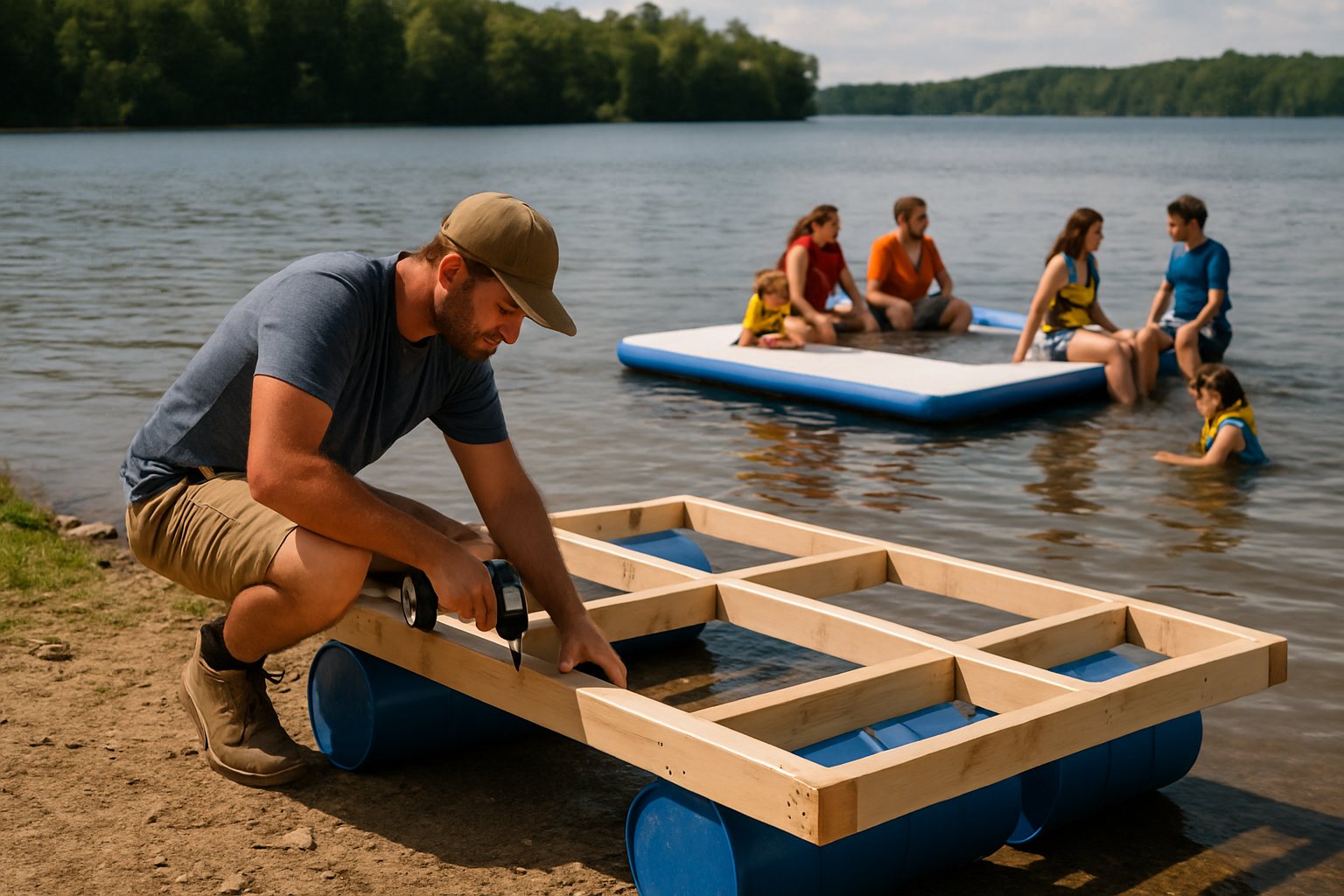
Every lake house has that one weekend project on the list. You picture the frame going together on the lawn, the floats bolted underneath, and the first evening sitting at the end of your own dock with your feet in the water. Then you start pricing lumber, floats, hardware and anchors, and you wonder whether a dock that comes out of a bag would do the same job. This guide compares building a floating dock with buying a rigid kit or an inflatable dock: what each one involves, what the makers and cost guides say they cost, and which one fits which shoreline.
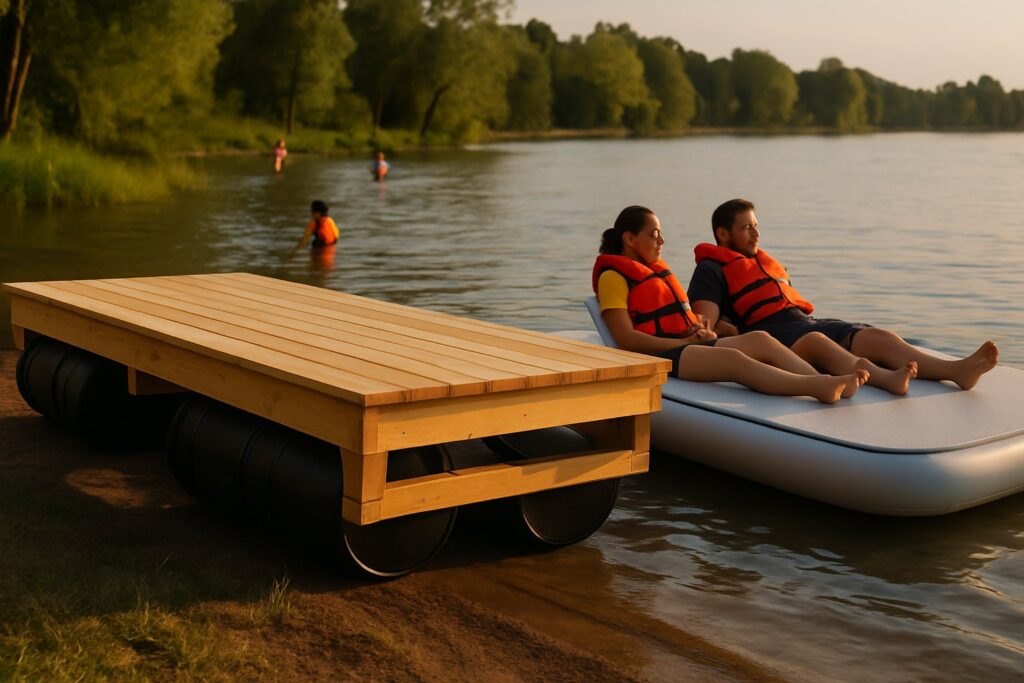
In short: building your own floating dock makes sense when you want a permanent, custom-sized dock, you are handy with tools and your local rules allow it. A rigid modular kit trades some money for speed and a maker’s warranty. An inflatable dock is the quickest and usually the cheapest way to get a floating deck on the water, but it is a seasonal product that you pump up, anchor and bring in again, not a permanent structure.
The three ways to get a floating dock
| Build it yourself | Rigid modular kit | Inflatable dock | |
|---|---|---|---|
| What it is | A wood or metal frame and deck on bought dock floats | Molded polyethylene sections that bolt or pin together | A drop-stitch PVC deck, usually 6 to 8 in thick, pumped to the maker’s pressure |
| Typical cost signal | One 2026 cost guide: $15 to $35 per sq ft for floating docks, materials and labor | Wave Armor lists a 60 x 120 in section at $2,295; EZ Dock quotes through dealers | About $800 for a 10 x 10 ft RAVE dock; about $750 for a 10 x 6 ft Island Hopper dock |
| Time to set up | Days to weeks, plus permits | Hours to a day once delivered (often with a dealer) | Minutes to inflate; Island Hopper says about 8 minutes for its 10 x 6 ft dock with the hand pump |
| Season | Permanent or seasonal, depending on ice | Season-long or longer | Day use or summer use; stored indoors over winter |
| Size and shape | Whatever you design | Straight, L, T, U from standard sections | Fixed rectangle or square, 6 x 5 ft up to about 15 ft long |
| Warranty | Only on the parts you buy (Taylor Made: 8-year flotation warranty on its floats) | EZ Dock: 10-year limited on sections and ports | Varies: RAVE limited lifetime for personal use, Island Hopper 5 years with registration |
Building a floating dock: what it really involves
A home-built floating dock has four parts: the floats, a frame, the decking and the anchoring. The floats are the one part you should not improvise. Taylor Made, a large US marine supplier, sells dock floats with a seamless UV-resistant polyethylene shell filled with EPS foam and publishes an approximate flotation for each size, from 335 lb for a 24 x 36 x 12 in float to 1,200 lb for a 48 x 48 x 16 in float. It says the floats are not designed to attach to each other; they bolt to the dock frame through a mounting flange, and it lists the minimum hardware (3/8 x 3 in lag screws with matching washers).
How many floats you need, where they go and how stiff the frame must be are engineering questions that depend on your deck, your lumber and what you plan to put on it. We don’t size docks from float ratings, and you shouldn’t either from a blog: use the float maker’s figures and installation guidance, and if the dock will carry boats, lifts or many people, have a dock builder size it. The 2026 HomeAdvisor cost guide says a simple floating dock can be a DIY project if you are comfortable with tools and local codes, while pilings, suspension designs and deep-water work should go to a professional.
Use marine flotation, not barrels or bare foam
Some lakes write this into law. On Tennessee Valley Authority reservoirs, flotation for docks must be “commercially manufactured for marine use,” unencased foam may not be used for repairs or new construction, and older unencased foam has to be replaced by December 31, 2031. Check your own lake authority or state agency; many have similar rules.
Permits come before lumber
Federal rules count a boat dock as a “structure,” and structures in US navigable waters can need a permit from the Army Corps of Engineers. States add their own rules: Minnesota, for example, lets a dock go in without a permit only if it is 8 ft wide or less, no longer than needed for access, and not a hazard, among other conditions. HomeAdvisor’s guide adds that most jurisdictions require a permit before you install a permanent dock, and many cap its length. A seasonal inflatable deck may fall under different rules than a permanent dock, so ask the same office about both.
The kit route: rigid modular floating docks
Rigid kits skip the carpentry. Connect-A-Dock, for instance, says each 1000 Series section supports up to 690 lb with the walking surface about 8 in above the water, and each 2000 Series section up to 2,500 lb at about 17 in. Wave Armor’s sections are a two-piece design, a molded top deck on a foam-filled bottom float, priced on its site from $950 for a 30 x 60 in section to $2,950 for an 80 x 120 in section in October 2026, before connectors, anchoring and delivery. EZ Dock gives a 10-year limited warranty on its sections and ports but does not publish prices; you request a quote from a dealer. Our EZ Dock vs inflatable docks and Wave Armor vs inflatable docks comparisons go deeper.
Buying an inflatable dock instead
An inflatable dock is the opposite of a build: it arrives finished, it inflates in minutes and it rolls up at the end of the day or the season. The construction is drop-stitch, two layers of PVC fabric joined by thousands of threads so the deck stays flat under pressure (our drop-stitch docks explained piece has the details). Makers state a capacity for each model, and those figures vary widely, so read the label rather than guessing from size. Two that are on sale now:
RAVE Aqua Dock 10 x 10
- 100 sq ft, 6 in thick
- 1,800 lb or 10 adults (maker)
- Limited lifetime warranty, personal use
Island Hopper Yacht Dock 10 x 6
- 1,500 lb (maker)
- 53 lb, corner bumpers
- 5-year warranty with registration
The RAVE Aqua Dock is 10 x 10 ft, 6 in thick at 5 psi, rated by RAVE for up to 1,800 lb or 10 adults, with two stainless anchor points; it needs at least 4 ft of water and lists at $799.99. Island Hopper’s Yacht Dock is 10 x 6 ft, heat-welded with a 1000-denier outer layer, rated for 1,500 lb, with rubber corner bumpers and stainless D-rings; the maker lists it at $749.
What the inflatable price leaves out
- Anchoring. Many docks ship without anchors. Aquaglide asks for at least 1,100 lb of anchor weight on its Docking Station, and RAVE’s FAQ suggests 150 to 200 lb for its dock, depending on the lake and bottom.
- A better pump. Hand pumps work; an electric pump saves your arms at 5 to 15 psi.
- A ladder and lines. See our dock ladders and accessories guide.
- Care. UV, rodents and winter. RAVE warns that muskrats may chew PVC and suggests keeping full pressure or taking the dock out at night; see how to store an inflatable dock.
Which one fits your shoreline?
- Build when you own the shoreline, want a permanent dock in a custom size or shape, can get the permits, and enjoy the work. Budget for marine floats, stainless or galvanized hardware, a gangway and proper anchoring.
- Buy a rigid kit when you want a dock that stays in all season, may hold a jet ski port later, and you’d rather have a dealer handle delivery and anchoring.
- Buy an inflatable dock when you rent the cabin, change lakes, boat to the swimming spot, or want a floating deck this weekend. It is also the easy pick for a pond (see floating docks for ponds and lakes).
- Ice matters. Connect-A-Dock says freezing alone won’t harm its docks, but with shifting ice it recommends removing them for the winter. Inflatables come out anyway.
Here are the lake and residential docks in our catalog, with the maker’s own figures and sources:
Aquaglide Docking Station
by Aquaglide
- Size (as stated): 14 ft 9 in x 10 ft 5 in x 6 in
- Stated capacity: 600 lb (3 adults + 3 children)
- Thickness: 6 in (15 cm) welded drop-stitch
BOTE Inflatable Dock 10 Classic
by BOTE
- Size (as stated): 10 x 10 ft x 8 in
- Stated capacity: 2,100 lb on BOTE's site (1,500 lb at some retailers)
- Thickness: 8 in
BOTE Inflatable Dock 7 Classic
by BOTE
- Size (as stated): 7 x 7 ft x 8 in
- Stated capacity: 1,050 lb
- Thickness: 8 in
Island Hopper Mega Yacht Dock 10 x 10
by Island Hopper
- Size (as stated): 10 x 10 ft
- Stated capacity: 2,000 lb load rating
- Thickness: 6 in
RAVE Aqua Dock 10
by RAVE Sports
- Size (as stated): 10 x 10 ft x 6 in
- Stated capacity: 1,800 lb / 10 adults
- Thickness: 6 in drop-stitch
Solstice Inflatable Dock 10 x 10
by Solstice Watersports
- Size (as stated): 10 x 10 ft x 6 in
- Stated capacity: 1,650 lb
- Thickness: 6 in drop-stitch
For the bigger picture, start at lake docks or the full dock types hub, compare shapes in floating dock designs and layouts, and see our best inflatable docks picks.
Building a floating dock: questions
Is it cheaper to build a floating dock or buy one?
It depends on size. HomeAdvisor’s 2026 guide puts floating docks at $15 to $35 per sq ft including materials and labor, and rigid modular sections list in the low thousands each. A small inflatable dock is usually the least money up front (RAVE lists its 10 x 10 ft dock at $799.99), but it is seasonal and its life depends on care.
What do you use for flotation when building a floating dock?
Dock floats made for marine use, such as encapsulated foam floats with a polyethylene shell. Some lake authorities require it: TVA says flotation must be commercially manufactured for marine use and bans unencased foam in new work.
How many dock floats do I need?
That depends on your frame, decking and planned load, so use the float maker’s ratings and installation guide, or ask a dock builder. Taylor Made publishes an approximate flotation per float size, but a float rating is not a load rating for the finished dock.
Do I need a permit for a floating dock?
Often, yes, for a permanent dock. Docks in US navigable waters can need an Army Corps of Engineers permit, and states, counties and lake authorities have their own rules. Ask before you buy materials.
Can an inflatable dock replace a permanent dock?
For swimming, lounging and tying up a small boat for the day, many families use one that way. For a boat that stays tied up all season, or for jet skis, look at purpose-built options in our boat docks guide; a flat swim dock is not rated as a boat or jet ski berth.
Leave a Reply