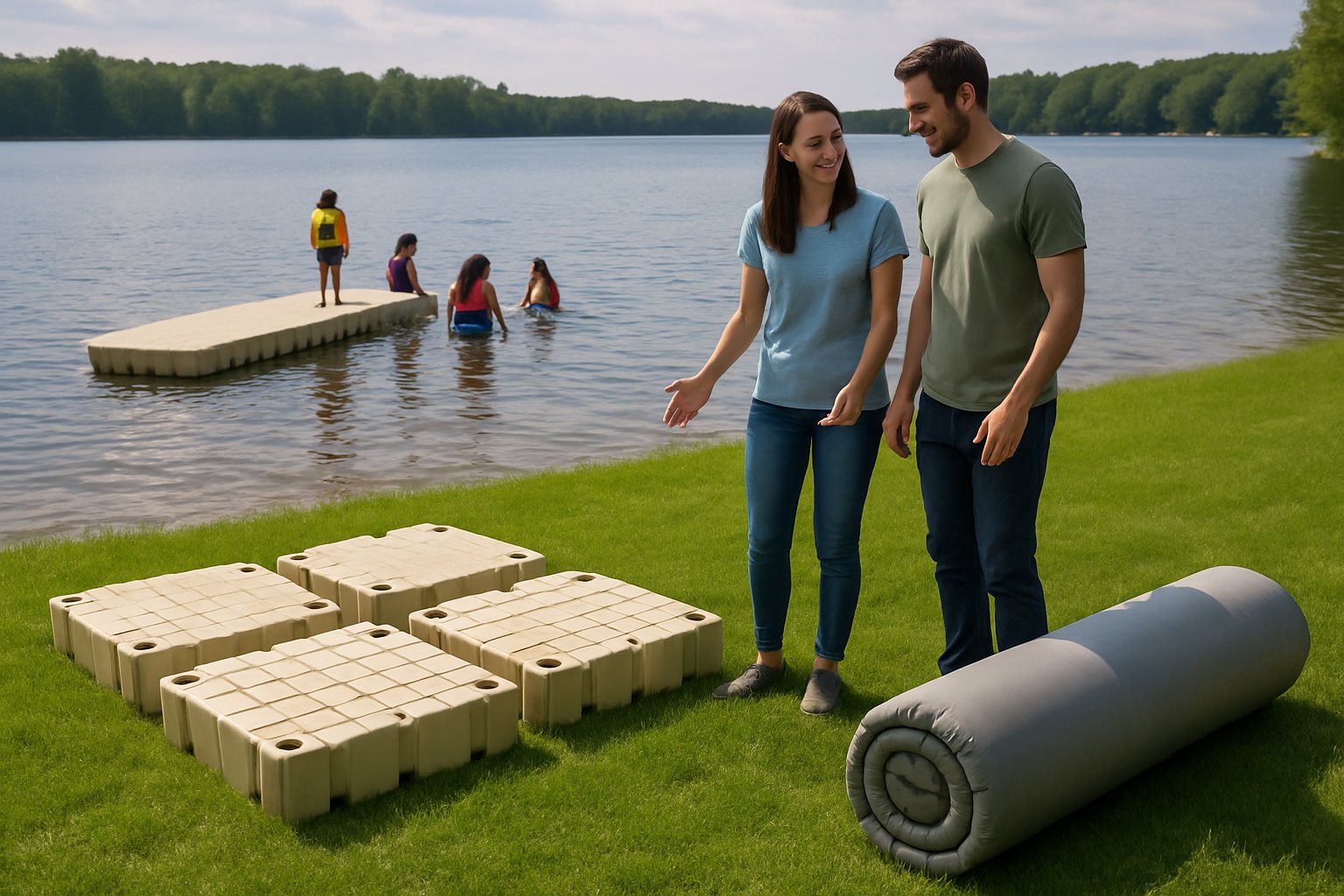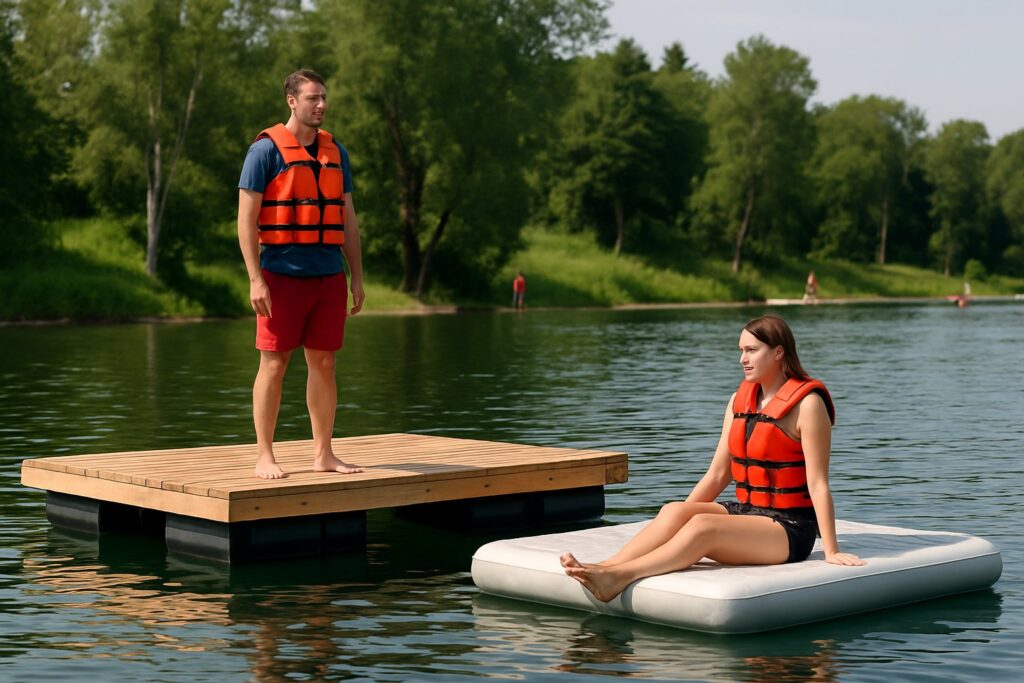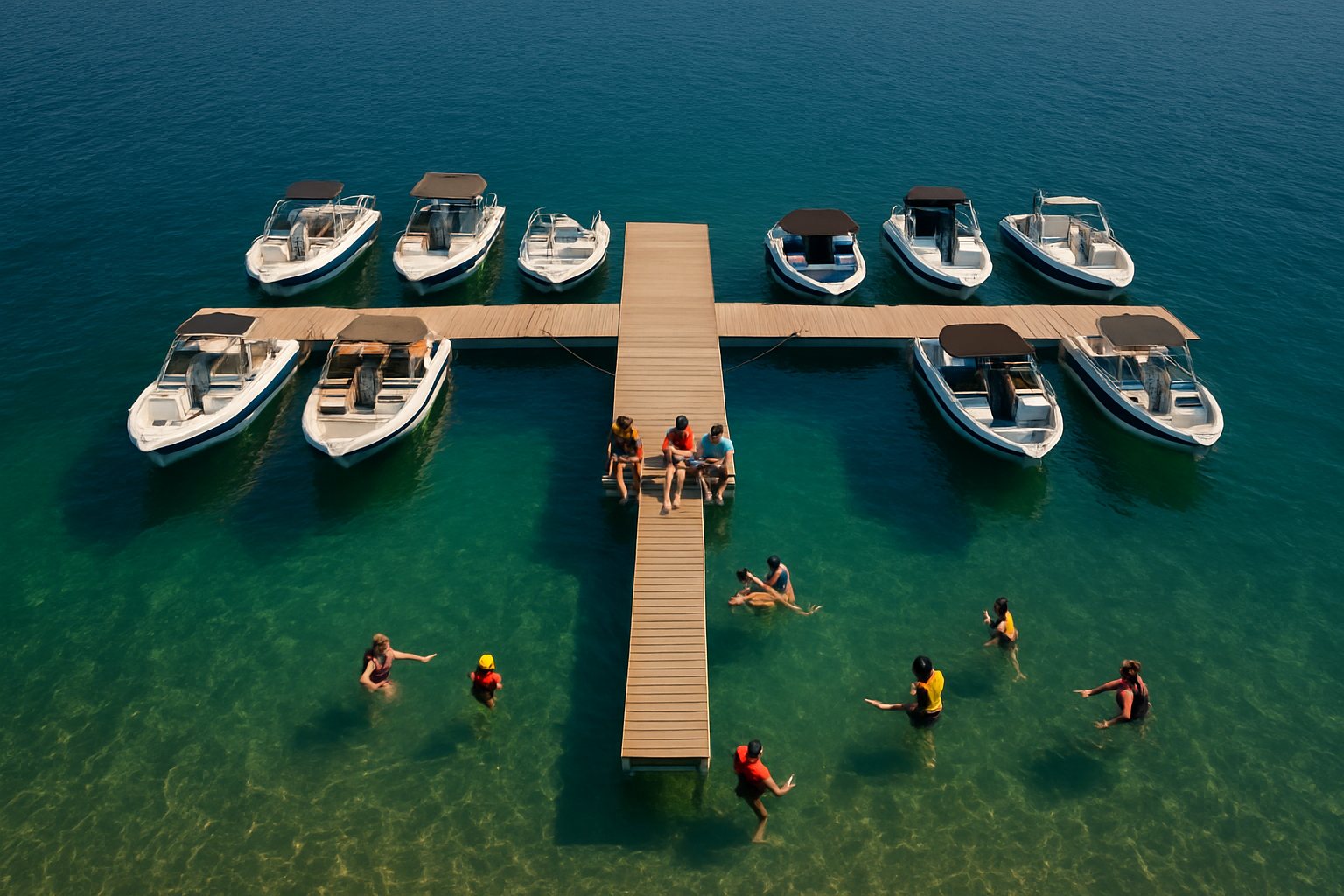
It’s the first warm Saturday at the lake and three things want a spot at the shoreline at once: the family runabout, a jet ski, and two kayaks that nobody wants to drag over the rocks again. Where each one ties up, and how you walk out to it, is decided long before launch day by the shape of the dock. This guide walks through the floating dock designs that makers actually publish (straight, L, T and U layouts, berths and slips, side and stern entry), what each one is good for, and how the inflatable options fit in.
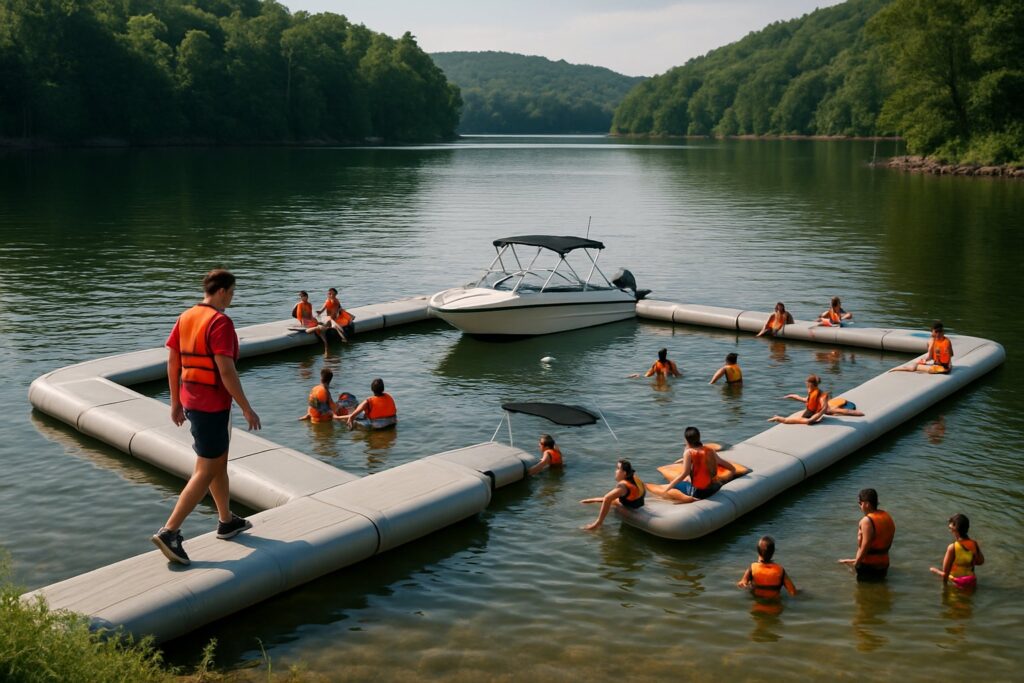
In short: a straight dock is the simplest and usually the cheapest layout; an L adds a second side for another boat; a T gives two berths at the far end; and a U wraps two arms around one boat for the most protection. Rigid modular makers such as EZ Dock and Wave Armor sell these shapes as sections and kits. Inflatable docks are mostly single decks that tie alongside or behind a boat, with a few modular and jet ski systems that link into bigger layouts.
Floating dock designs at a glance
EZ Dock, the US maker of rotomolded polyethylene docks, describes four basic shapes on its own site, and it is a useful starting vocabulary because dealers across the industry use the same letters. The table sums up what the maker says each shape is for.
| Layout | What it looks like | What the maker says it suits |
|---|---|---|
| Straight (I) | One run of sections from shore | The simplest design and usually the least expensive; good for sunbathing and fishing; several boats can moor along it |
| L | A run with one arm turned at the end | Owners with at least two watercraft; a long L can hold about three boats |
| T | A run with a cross piece at the end | Two boats at the head, or one big mooring spot plus room for canoes; quick loading and unloading |
| U | Two arms with the boat parked between them | High-value boats that need more protection and separation from other vessels |
The shapes are not just looks. Each one changes how many boats you can tie up, which side you step aboard from, and how exposed the boat is to passing wakes. Before you pick, count the craft you need to dock (including the toys), note which direction the wind and boat traffic come from, and check how far out you are allowed to build.
Straight docks: the simple layout
A straight dock runs from the shore (or from a gangway) out to water deep enough for your boat. It is the easiest to anchor and to take apart, and because it uses the fewest corner pieces it is usually the least expensive shape for a given length. Boats tie along one or both sides. The weak point is protection: the boat lies against the dock with open water on its other side, so wakes push it into the fenders.
The inflatable equivalent is a long deck such as Island Hopper’s 15 ft Patio Dock, which the listing says can be joined to more units, or Northern Diver’s FloatDeck, a UK drop-stitch deck sold in lengths from 1 to 10 m that links lengthways or sideways. Northern Diver markets FloatDeck for dive prep and as a temporary pontoon; it does not sell it as a permanent dock.
L-shaped and T-shaped docks
Turn the end of a straight run and you have an L. The arm gives a second tie-up side and a sheltered corner, so it is the common choice when a family has a boat plus a jet ski or a pontoon plus kayaks. EZ Dock sells a pre-configured 40 ft x 13 ft L kit made of three 60 in x 10 ft sections, two 80 in x 10 ft sections, one corner gusset and 15 coupler sets.
A T puts a cross piece at the head of the run. EZ Dock lists a T kit that is 15 ft long and 20 ft wide (four 60 in x 10 ft sections, two corner gussets and nine coupler sets) and a much bigger 30 ft x 45 ft T with seven sections and 18 coupler sets. EZ Dock says a longer T can dock two boats, while a shorter one gives one large mooring spot and space for smaller craft. Neither kit page shows a price: EZ Dock sends buyers to a local dealer for a quote.
U-shaped docks and slips
A U wraps two arms around a slip, so the boat sits between them with dock on both sides. EZ Dock aims it at owners of high-end boats who want separation from other vessels, and notes that the extra deck leaves room for racks or benches. Its 20 ft x 20 ft U kit is five 60 in x 10 ft sections, two corner gussets and twelve coupler sets. A U takes the most material and the most anchoring, and it needs room on the water: check that the slip is wide and long enough for your boat with fenders on, using the boat’s beam and length from its manual.
Berths and ports for jet skis and boats
Many layouts are really built around berths. On rigid docks, a berth is often a drive-on port: a molded cradle that the jet ski or boat rides up onto so it sits out of the water. Wave Armor, for example, sells PWC ports from its Sport model (a 59 in wide, 11 ft long port with a stated 700 lb weight capacity, $1,725 on its site) up to its Pro series, plus “port mount corners” from $925 to $1,225 that join a port to its dock sections. Wave Armor’s own site says ports can stand alone or connect to its docks or, with separate kits, to other brands.
Inflatable berths exist too, mostly for yachts. Jobe’s Infinity PWC Dock is a U-shaped 345 x 250 cm module with an opening that the jet ski noses into. Henshaw in the UK makes single and twin jet ski docks with a Hypalon tube base and a drop-stitch top. Yachtbeach sells single and duo jet ski docks, NautiBuoy Marine makes a double-bay drive-in jet ski dock with ballast bags that fill on launch, and FunAir’s custom Toy Island holds up to four jet skis or dinghies, with a V-notch for foiling craft. Most of these are quote-only; our jet ski dock guide covers them in detail, and we have a separate piece on the floating dock for a jet ski.
Henshaw Jet Ski Dock (single and twin)
by Henshaw Inflatables
- Thickness: About 100 mm double-wall drop-stitch top
Northern Diver FloatDeck
by Northern Diver
- Size (as stated): 1 to 10 m lengths
- Thickness: 8 cm drop-stitch
Side entry vs stern entry
With a boat, the layout question is often simply where the dock touches the hull. A side-entry dock lies along the boat’s side, the way a marina finger pier does. Island Hopper sells its narrow 10 x 3 ft Mini Mate Yacht Dock to sit beside a boat, including in a marina slip, and its 10 x 6 ft Yacht Dock has rubber bumpers on all four corners so the edge does not scuff the hull.
A stern-entry dock ties off behind the boat, next to the swim platform. That is how most yacht docks are used: Jobe’s Infinity modules attach to each other or to the boat with D-rings and Velcro straps, and Jobe sells an Infinity Gangway, an inflatable walkway between the boat and the platform. RAVE’s manual for its Aqua Dock adds a caution worth applying to any stern setup: tethering a dock to boats or hard objects raises the risk of injury, so keep it clear of engines and propellers and keep the motor off while people are on it.
Can inflatable docks make L, T or U layouts?
Only the ones built to link. A lot of consumer inflatable docks are designed as stand-alone decks. RAVE’s manual says its Aqua Dock is meant to be used on its own, not attached to other RAVE products, and Aquaglide tells buyers not to combine its products with other brands. If you want a shape, buy into a system whose maker documents the connection, such as Jobe Infinity, NautiBuoy’s connected Voyager series (“linked in multiple configurations”, per the maker) or Northern Diver FloatDeck, and follow the maker’s layout rather than lashing unrelated decks together.
For a single family deck, the practical “layouts” are simpler: a square deck anchored off the shore for swimming, or a long deck tied alongside a boat. These two are on sale and easy to buy:
RAVE Aqua Dock 10 x 10
- 10 x 10 ft, 6 in thick
- 1,800 lb or 10 adults (maker)
- 2 anchor points
Island Hopper Yacht Dock 10 x 6
- 10 x 6 ft, 6 in thick
- 1,500 lb (maker)
- Rubber corner bumpers
Rigid modular vs inflatable layouts compared
| Rigid modular (EZ Dock, Wave Armor) | Inflatable (consumer decks) | Inflatable systems (Jobe, NautiBuoy, FloatDeck) | |
|---|---|---|---|
| Shapes | Straight, L, T, U and custom from sections, wedges, corners and half-rounds | One square or rectangular deck | Linked modules, U-shaped jet ski bays, gangways |
| Berths | Drive-on PWC and boat ports | None; tie alongside | Single, twin and multi jet ski docks |
| Season | Installed for the season or longer | Inflated for the day or the summer | Deployed from a yacht when at anchor |
| How you buy | Dealer quote (EZ Dock); list prices online (Wave Armor) | Retail and Amazon | Mostly dealer or quote |
Wave Armor’s rectangular sections run 2.5 to 5 ft wide and 5 or 10 ft long, with wedges, half-rounds and corner pieces, and H-beam connectors in 24, 31 and 50 in lengths; its site has an online Dock Builder for drawing a layout. For the trade-offs between the two building methods, read inflatable vs rigid floating docks, and for the modular side in depth, see modular docks.
How to plan your layout
- List every craft. Boat, jet ski, kayaks, paddle boards. Each one needs a side, a berth or a launch spot; kayaks often do best on a low launch (see kayak launch docks).
- Measure the water. Depth at the far end at low water, and the bottom type, decide where the berths can go and how the dock is anchored.
- Check the rules first. Docks in US navigable waters can need an Army Corps of Engineers permit, and states and lake authorities add their own limits. Minnesota, for example, lets a dock go in without a permit only if it is 8 ft wide or less, no longer than needed, and not a hazard, among other conditions.
- Plan the anchoring with the shape. Every arm adds anchoring. Inflatable makers state their own needs: Aquaglide asks for at least 1,100 lb of anchor weight on its Docking Station.
- Keep it buildable. Use only the connectors and layouts the maker documents. For a custom yacht or commercial layout, ask the maker; our Request more information form can put you in touch.
Browse every dock style on our dock types hub, compare real products in the product directory, or start with the lake docks page if this is for a cabin or lake house. Terms like gusset, berth and freeboard are in the glossary. Pricing a rigid layout? Read EZ Dock vs inflatable docks and building a floating dock vs buying inflatable.
Floating dock layout questions
What is the most common floating dock design?
The straight dock. EZ Dock calls it the most straightforward option and usually the least expensive. L and T shapes are the next step up when you need more than one tie-up side.
Which dock shape is best for two boats?
EZ Dock suggests an L for owners with at least two watercraft (a long L can hold about three boats) or a longer T with a berth on each side of the head. The right one depends on your shoreline, depth and how boats approach.
Can I connect two inflatable docks?
Only if the maker says so. Some systems are built to link (Jobe Infinity, NautiBuoy Voyager, Northern Diver FloatDeck, Island Hopper Patio Dock). Others are stand-alone: RAVE says its Aqua Dock is not meant to attach to other RAVE products, and Aquaglide says not to mix its products with other brands.
How much does an L- or U-shaped floating dock cost?
EZ Dock does not publish prices for its kits; it quotes through dealers. Wave Armor lists its sections online, for example $2,295 for a 60 x 120 in section and $1,350 for a 60 x 60 in section when we checked in October 2026, before connectors, anchoring, delivery and installation.