This article contains affiliate links: if you buy through them we may earn a commission, at no extra cost to you. Read our affiliate disclosure.
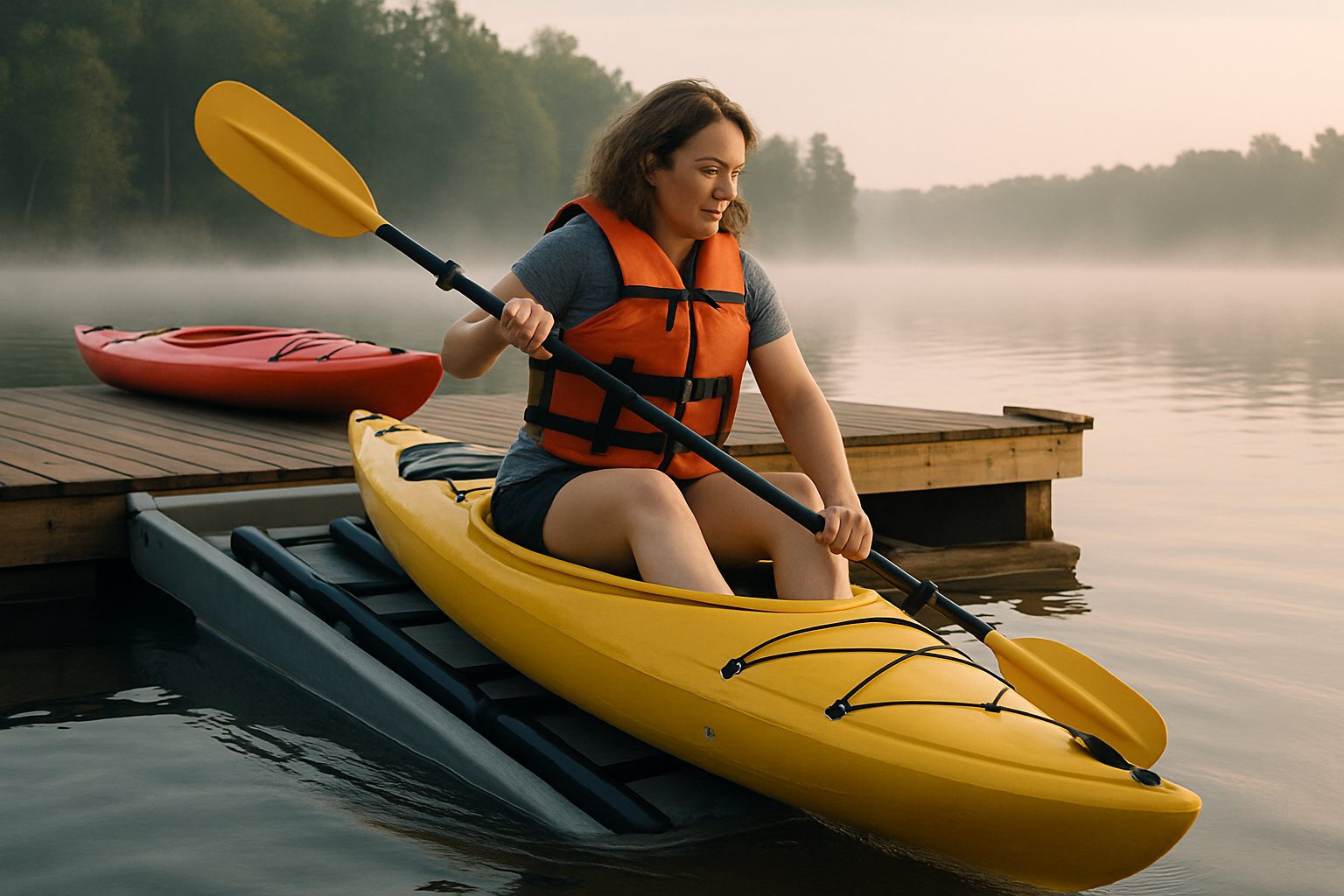
Six in the morning, mist on the lake, and the only sound is a paddle knocking a hull. Anyone who has tried to step from a tall wooden pier down into a kayak knows how that quiet can end: a wobble, a lunge, a splash. A kayak dock built low to the water turns the start of the paddle into the easy part. You sit, slide in, push off, and the lake is yours.
In short: there are two kinds of kayak launch dock. Inflatable docks float with their deck about 6 to 8 in thick and work as a low, soft launch pad that packs into a bag; prices start around $170. Rigid launch units such as EZ Dock’s EZ Launch and YAKport are molded polyethylene with rails, handles or a cradle that hold the kayak while you get in, and they cost about $2,000 and up. Rigid units are not inflatable, even when they are listed as floating kayak launches.
Kayak launch dock types compared
| Inflatable dock as a launch | Rigid floating kayak launch | Dock-mounted aluminum launch | |
|---|---|---|---|
| Examples | AWSUM, RAVE Aqua Dock, BOTE dock, Northern Diver FloatDeck | EZ Launch, YAKport | Golden Kayak Launch |
| Material | Drop-stitch PVC, EVA deck | Rotomolded or UV-protected polyethylene | Welded aluminum, stainless cables |
| Deck thickness or size | 6 in (most), 8 in (BOTE), 8 cm (FloatDeck) | EZ Launch 58.5 x 168 in; YAKport 48 x 60 in | 3, 5 or 7 step versions |
| Holds the kayak for you | No; you steady it yourself | Yes; V-entry and handholds (EZ Launch) or a cradle (YAKport) | Yes; a carriage with a brake winch |
| Packs away | Yes, into a bag | No; stays on the dock for the season | No; mounted to the dock |
| Price seen | About $170 to $1,550 | About $2,144 (YAKport on Amazon); EZ Launch by quote | About $2,050 on Amazon |
Inflatable kayak launch docks
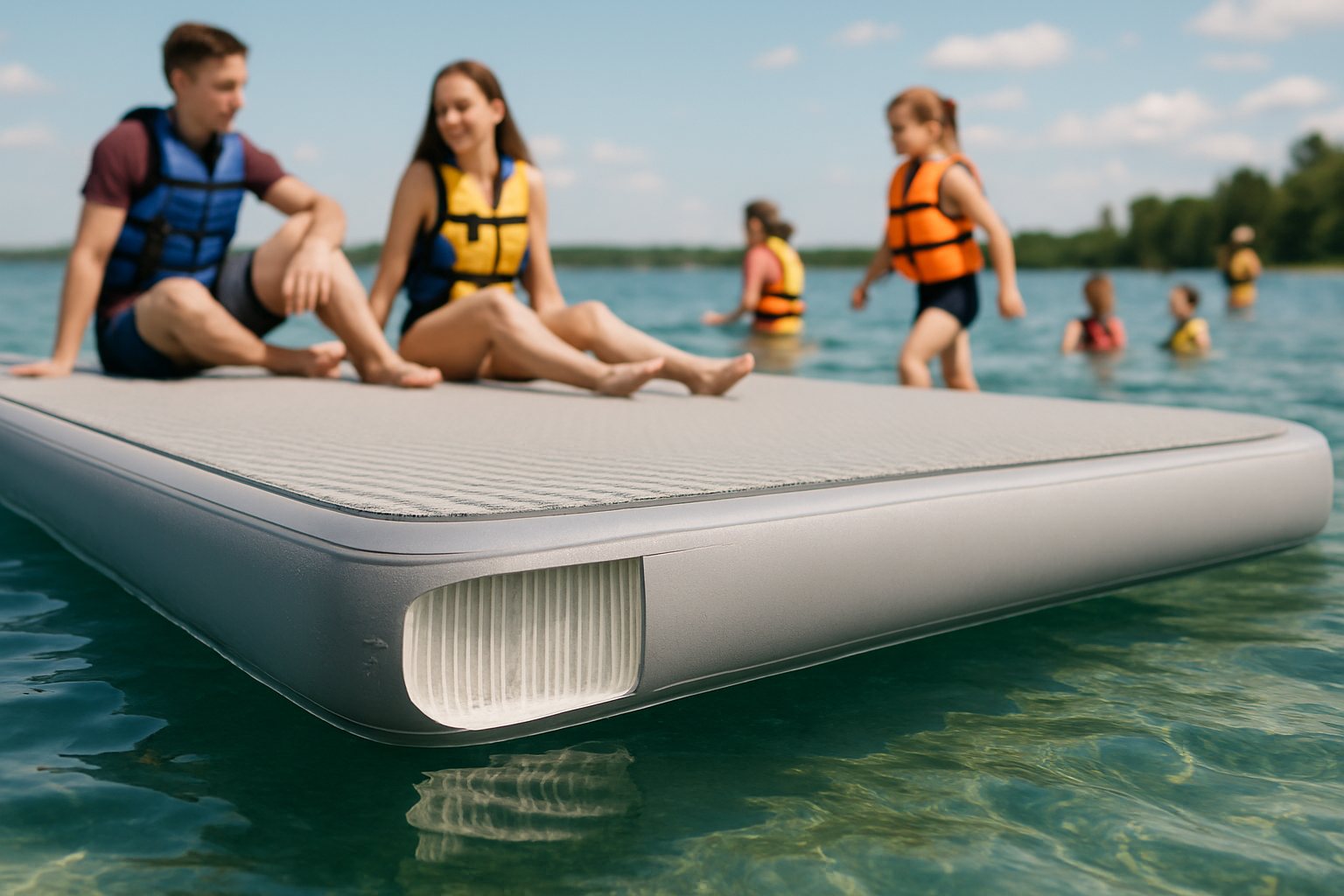
Any firm drop-stitch dock can serve as a launch spot because its deck sits close to the water. BOTE lists launching among the uses for its 7 and 10 ft docks; Northern Diver lists “paddleboard launch” among the uses of its FloatDeck; AWSUM says its dock connects to compatible floating decks, paddle boards, kayaks or water toys. The trade-off is that nothing holds the kayak still. You sit on the edge, put your feet in the cockpit, then lower yourself in, keeping your weight low and centered. On a soft or under-inflated deck the edge sags as you shift, so pump to the maker’s pressure.
Rigid kayak launch docks
EZ Dock’s EZ Launch is a one-piece unit 58.5 in wide, 168 in long and 25 in high, with dual-side entry and exit, a V-shaped entry, built-in handholds and paddle notches. It comes in two heights and attaches to Standard Height or Low Profile EZ Dock with normal couplers, or to other existing docks; pricing goes through EZ Dock distributors. YAKport measures 48 x 60 x 22 in outside, weighs 99 lb, takes kayaks, canoes and SUPs up to 34 in wide, and mounts to floating docks with metal hinges or to fixed docks with pole connectors on 2 in Schedule 40 galvanized pipe (hinges and pipe are not included). Both are rigid floating docks. They suit a household that paddles every day from the same dock.
A third type is not a floating dock at all. The Golden Kayak Launch, as listed on Amazon, is a welded aluminum launch that mounts to a dock, with stainless cables, a brake winch and adjustable travel for changing water levels; the listing rates standard kayaks up to 250 lb and the heavy-duty version up to 350 lb, with clear entry widths of 34 to 56 in.
Floating kayak dock sizes and layouts
| Model | Size | Thickness | Weight | Stated capacity |
|---|---|---|---|---|
| AWSUM Inflatable Floating Dock | 7 sizes, 6 x 5 ft to 15 x 6 ft | 6 in | 18.8 lb (6 x 5 ft) | 455 lb (6 x 5) to 2,000 lb (15 x 6), seller figures |
| BOTE Inflatable Dock 7 Classic | 7 x 7 ft | 8 in | 35 lb | 1,050 lb |
| RAVE Aqua Dock 10 | 10 x 10 ft | 6 in | 68 lb | 1,800 lb / 10 adults |
| Northern Diver FloatDeck | 1, 2, 5, 8 and 10 m long | 8 cm | Not published | Not published |
| YAKport (rigid) | 48 x 60 x 22 in | Rigid | 99 lb | Craft up to 34 in wide |
| EZ Launch (rigid) | 58.5 x 168 x 25 in | Rigid | Not published | Not published |
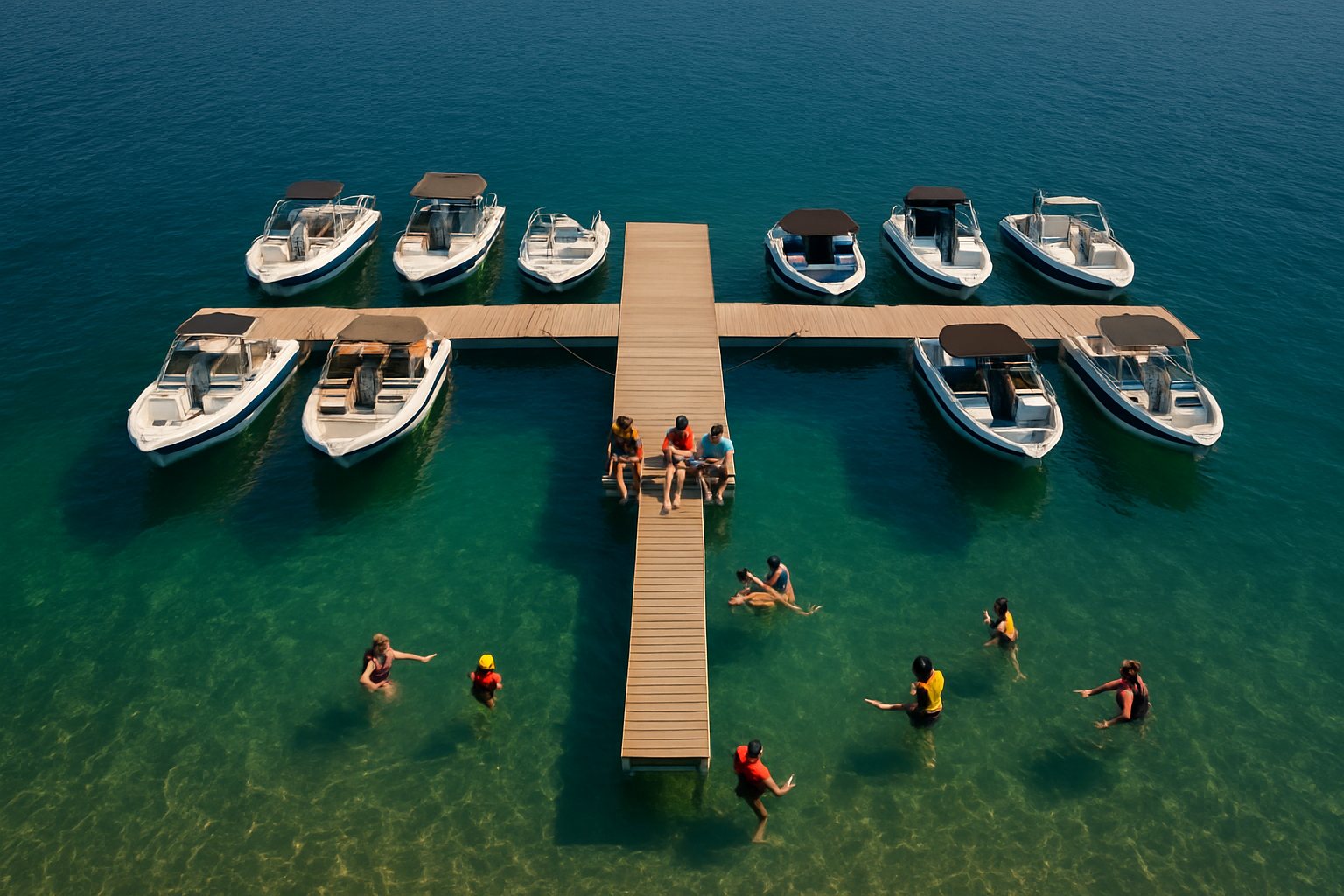
Three layouts cover most waterfronts: a launch unit coupled to the end or side of an existing floating dock; a small inflatable dock anchored off the shore as a stand-alone launch pad; or a long, narrow deck (FloatDeck links lengthways or sideways) running out from a soft bank to water deep enough to float the kayak. See floating dock designs and layouts for more.
Construction and materials
- Drop-stitch PVC (inflatable). Top and bottom skins tied by thousands of threads, inflated to 5 to 8 psi (AWSUM), 6 to 8 psi (BOTE 7) or up to 10 psi (FloatDeck). EVA foam on top for grip. Light, packable, and soft on hulls. See drop-stitch docks explained.
- Rotomolded polyethylene (rigid). Hollow molded sections that float on trapped air. EZ Dock builds in linear low-density polyethylene; YAKport says UV-protected polyethylene.
- Aluminum (dock-mounted). A frame and carriage fixed to the dock rather than floating.
Stated capacities and what they mean
Inflatable dock makers state a total load (1,050 lb for the BOTE 7, 1,800 lb or 10 adults for the RAVE Aqua Dock 10) or a seller figure by size (AWSUM). That number describes the dock with weight spread across it, not one paddler kneeling on the edge with a kayak alongside. Rigid launches state a craft limit instead: YAKport’s 34 in width, Golden’s 250 or 350 lb kayak weight. Use the figure the maker gives for your use, and ask when it isn’t published. More in inflatable dock capacity explained.
Setup and anchoring
- Check the depth. RAVE asks for at least 4 ft under the Aqua Dock; Aquaglide asks for 4 ft and at least 10 ft from shore for its Docking Station.
- Inflate to pressure with the maker’s pump, and check it again once the dock has cooled in the water.
- Anchor it on its own. RAVE’s manual warns against connecting its dock directly to docks, piers or hard objects. RAVE’s FAQ asks for 150 to 200 lb of anchor weight; Aquaglide asks for at least 1,100 lb on its Docking Station.
- Rigid launches couple on. EZ Launch uses EZ Dock couplers; YAKport uses hinges on floating docks and pole connectors on fixed docks.
Full steps: how to anchor a floating dock and floating dock installation.
Advantages and trade-offs
| Advantages | Trade-offs | |
|---|---|---|
| Inflatable | From about $170; packs away; doubles as a swim and lounge dock; soft on hulls | Nothing holds the kayak; needs its own anchors; comes out each fall |
| Rigid floating launch | Holds the kayak; handholds help older paddlers and children; rises and falls with the water | About $2,000 or more; heavy (YAKport 99 lb); stays on the dock |
| Dock-mounted launch | Carriage lowers the kayak for you | About $2,050; fixed to the dock; not a floating dock |
The fun part: first light on the water
A good kayak dock changes how often you go. When getting in is a wobble and a wet foot, the kayak stays on the rack. When it is a sit-and-slide, you go out before breakfast to watch the herons, and again at sunset with a thermos. The kids take the sit-on-top across the cove and come back to a deck where they can haul it out themselves. A grandparent who gave up paddling tries again because the rails take the weight. On an inflatable dock, the same deck becomes the swim platform at noon and the place everyone dries off in the afternoon.
Choosing a kayak dock for your water
- Lake with a fixed pier: the step down is the problem. A rigid launch coupled to a floating section, or a small inflatable dock anchored near the pier, puts you at water level.
- Pond with a soft, shallow edge: a long, narrow deck out to floating depth, or an inflatable dock anchored just off the bank. See floating docks for ponds and lakes.
- River: current pulls on everything, so anchoring matters more; ask the maker whether the dock is meant for moving water. See a floating dock on a river.
- Who paddles: rails, handholds and a cradle help older paddlers and children; confident paddlers do fine from a flat deck.
- Your craft: width and weight against the launch’s limits (YAKport 34 in; Golden 250 or 350 lb).
Getting in from an inflatable launch dock
- Put the kayak in the water parallel to the dock edge, paddle across the deck within reach.
- Sit on the edge beside the cockpit with your life jacket buckled.
- Hold the cockpit rim with the hand nearest the kayak and put both feet in.
- Lower yourself into the seat, keeping your weight low and centered, then take the paddle and push off.
- Coming back, reverse it: paddle across the deck, hands on the deck, and lift your weight onto the edge before standing.
Safety when launching
- Life jacket on before you step in. Kayaks and canoes are vessels under Coast Guard rules, and the Coast Guard treats a paddle board as a vessel outside a swimming or surfing area. In 2024, the Coast Guard counted 77 kayak drowning victims; 60 were not wearing a life jacket.
- Electric shock drowning. If the dock or a neighbor’s dock has power for lights, a lift or a boat, current can leak into the water. Tennessee’s State Fire Marshal advises never swimming within 100 yards of any dock using electrical power, shutting off all shore power to the boat and dock before swimming, and having dock wiring checked by a licensed electrician at least yearly.
- Cold water. The National Weather Service says cold shock can be as dangerous in 50 to 60 °F water as in 35 °F water; dress for the water, not the air, early and late in the season.
- Depth. Launch where the kayak floats freely, and keep swimmers from diving off a low launch deck into shallow water.
- Supervision. The CDC says children need close and constant supervision near water even after swimming lessons, and warns that inflatable toys are not safety devices.
Our dock safety section has the full checklists, including electric shock drowning and Coast Guard requirements.
Floating kayak launch docks you can buy
Prices change often. These are the prices we saw on Amazon in October 2026; check the current price before you buy.
AWSUM Inflatable Floating Dock
- 6 in drop-stitch, 7 sizes
- Pump and 3-step soft ladder included
- From about $170, seen October 2026
RAVE Sports Aqua Dock 10
- 10 x 10 ft x 6 in
- 1,800 lb / 10 adults (maker)
- About $800, seen October 2026
YAKport Kayak Launch
- Craft up to 34 in wide
- Polyethylene, 99 lb
- About $2,144, seen October 2026
Golden Kayak Launch
- Brake winch, stainless cables
- Kayaks up to 250 or 350 lb
- About $2,050, seen October 2026
Check the AWSUM floating dock price on Amazon
Check the YAKport kayak launch price on Amazon
Launch docks in our catalog
Northern Diver FloatDeck
by Northern Diver
- Size (as stated): 1 to 10 m lengths
- Thickness: 8 cm drop-stitch
| Spec | Northern Diver FloatDeck | BOTE Inflatable Dock 7 Classic | RAVE Aqua Dock 10 |
|---|---|---|---|
| Size (as stated) | 1 to 10 m lengths | 7 x 7 ft x 8 in | 10 x 10 ft x 6 in |
| Thickness | 8 cm drop-stitch | 8 in | 6 in drop-stitch |
| Stated capacity | not published | 1,050 lb | 1,800 lb / 10 adults |
| Minimum water depth | not published | not published | 4 ft |
| Construction | Drop-stitch with EVA deck | AeroBOTE drop-stitch | Drop-stitch PVC |
| Inflation pressure | 0.7 bar / 10 psi | 6 to 8 psi | 5 psi |
| Weight | not published | 35 lb | 68 lb |
| Anchoring / attachment | Links lengthways or sideways | not published | 2 anchor points |
| Inflation | Pump; optional cylinder inflation | not published | not published |
| Warranty | not published | not published | Limited lifetime |
| Price signal | From £166 (smallest size, when checked) | $1,049 direct (when checked) | not published |
| See it at Northern Diver | See it at BOTE | See it at Bart's |
Figures as each maker states them; makers measure capacity differently. Check the product page for sources and dates.
Kayak dock gear
SeaSense 10 lb Mushroom Anchor
- 10 lb cast iron, vinyl coated
- Sandy, muddy or weedy bottoms
- About $32, seen October 2026
Intex Excursion Pro K2 Inflatable Kayak
- 12.7 x 3.1 ft, 2 people
- 400 lb capacity
- About $215, seen October 2026
- Anchor for the kayak, not the dock. The SeaSense anchor is sold for boats up to 15 ft. It is far too light to hold an inflatable dock, which needs 150 lb and up as the makers state above.
- Pump: a drop-stitch dock needs a high-pressure pump; most come with a hand pump.
- Ladder: for swimmers climbing back up. See dock ladders and accessories.
- Paddle leash and dry bag, and a rack on shore so kayaks are not stored on the inflatable deck.
What a kayak launch dock costs
| Option | Price seen | Where |
|---|---|---|
| AWSUM inflatable dock (smallest size) | About $170 | Amazon, October 2026 |
| RAVE Aqua Dock 10 | About $800 | Amazon, October 2026 |
| BOTE Inflatable Dock 7 / 10 Classic | $1,049 / $1,549 | BOTE, October 2026 |
| Northern Diver FloatDeck | From £166 | Northern Diver, October 2026 |
| Golden Kayak Launch | About $2,050 | Amazon, October 2026 |
| YAKport | About $2,144 | Amazon, October 2026 |
| EZ Launch | Quote through a distributor | EZ Dock |
Care
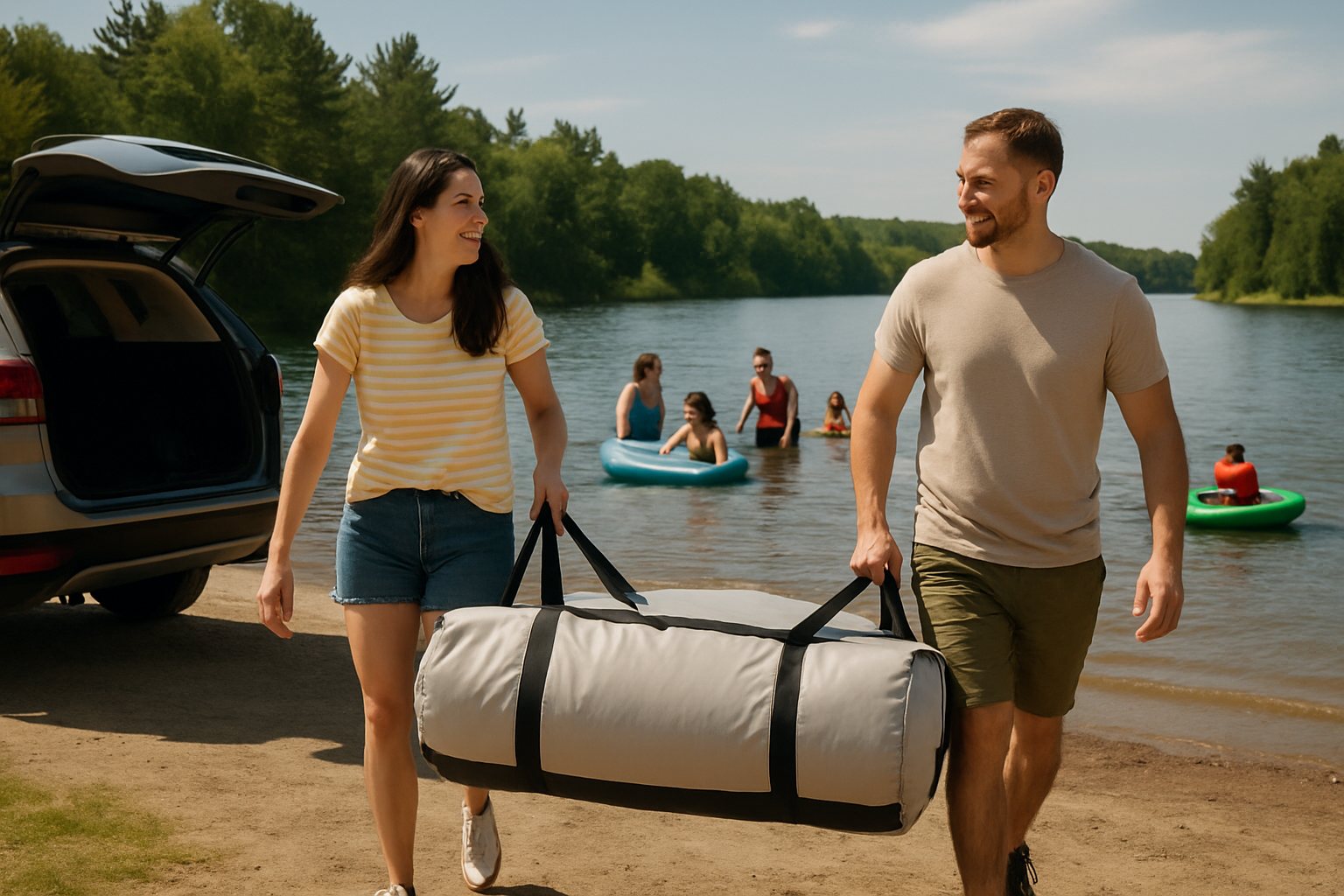
Rinse an inflatable launch dock, let it dry fully, and store it rolled in its bag out of the sun over winter; patch small leaks with the kit and the right PVC glue. Rigid launches need hardware checks each spring and, where ice shifts, removal for winter. See how to store an inflatable dock and inflatable dock repair.
More: best kayak launch docks, launching kayaks and water toys, launch platforms, EZ Dock vs inflatable docks, best inflatable kayaks for boats and lake docks. Back to floating dock types.
Latest guides
Kayak dock questions
Is a floating kayak dock better than a fixed one?
For launching, usually yes: a floating dock rises and falls with the water, so the step into the kayak stays the same height. A fixed pier can leave you high above the water when the level drops.
Can I add a kayak launch to my existing dock?
Rigid launch units are made for that: EZ Launch couples to EZ Dock or other existing docks, and YAKport mounts to floating docks with hinges or fixed docks with pole connectors. Inflatable docks should be anchored on their own; RAVE warns against tying its dock directly to piers or hard objects.
Does a kayak launch dock work for paddle boards?
Yes, within its width limit. YAKport takes SUPs up to 34 in wide, and Northern Diver sells FloatDeck as a paddleboard launch. An inflatable dock works for boards of any width.
What is the difference between a kayak dock and a kayak launch?
People use both words for the same thing. In product listings, “kayak launch” usually means a rigid unit with rails or a cradle (EZ Launch, YAKport), while “kayak dock” also covers any low floating dock you launch from, including inflatables.
Is an inflatable dock good for launching kayaks?
It is a good low, soft launch pad if you are comfortable steadying the kayak yourself. If you need rails or a cradle, a rigid launch is the better fit.
How deep should the water be at a kayak dock?
Deep enough for the loaded kayak to float clear of the bottom beside the dock, and at least what the dock maker asks for its anchoring: RAVE and Aquaglide both state 4 ft for their docks.
What does a kayak launch dock cost?
From about $170 for a small inflatable dock to about $2,050 to $2,144 for rigid or dock-mounted launches on Amazon in October 2026. EZ Launch is priced by distributors.
Can I leave a kayak launch in over winter?
Take an inflatable out. For rigid polyethylene docks, Connect-A-Dock advises removal for winter where ice shifts, and Candock says ice damage mainly comes from ice moving in the spring thaw; ask your launch maker.