This article contains affiliate links: if you buy through them we may earn a commission, at no extra cost to you. Read our affiliate disclosure.
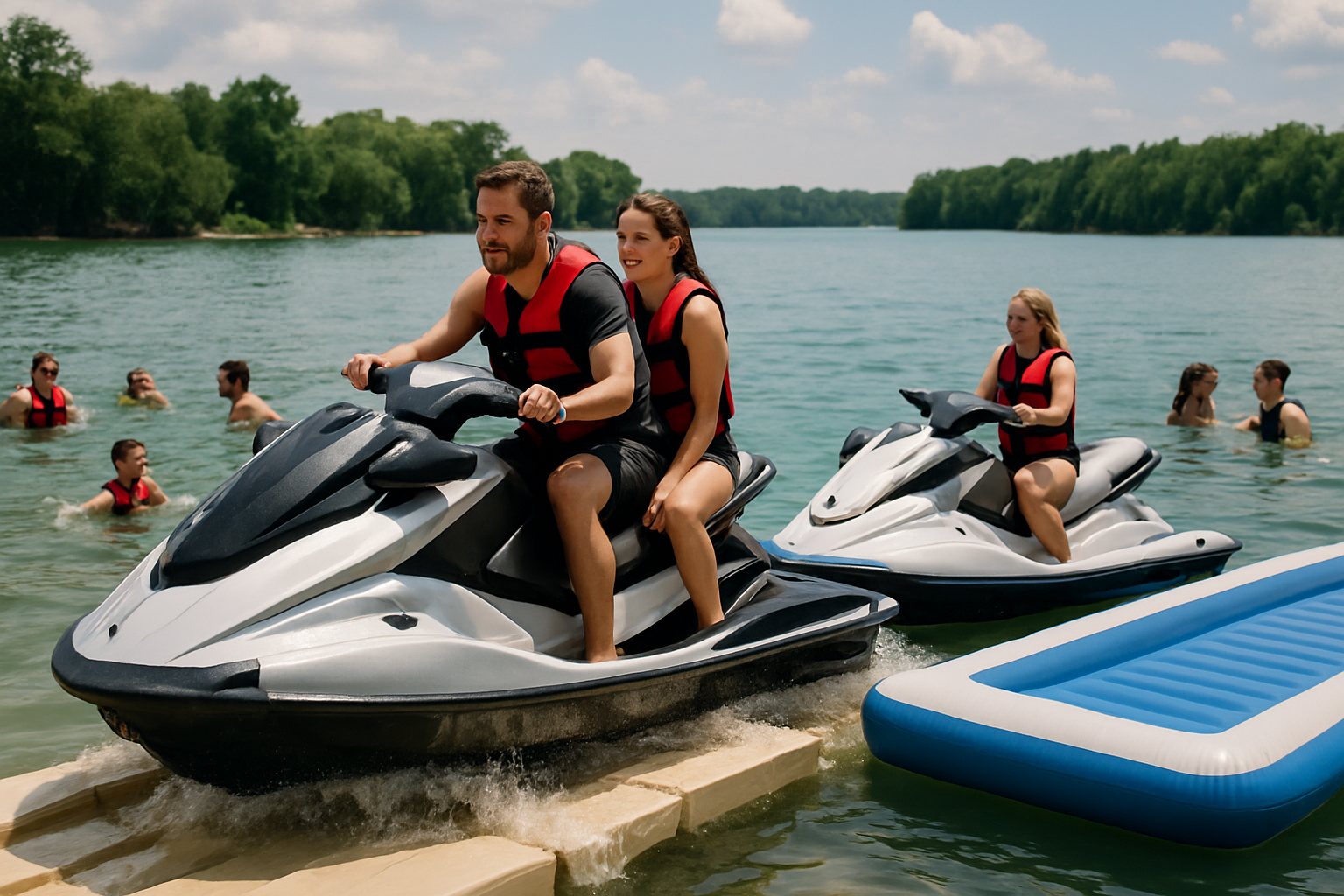
Two neighbors on the same cove, two answers. One idles his ski up a gray plastic ramp at the end of the dock, it rolls up and stops against the bow stop, and he walks off with dry feet. The other pulls hers into the slot of a soft inflatable U, loops two lines through the D-rings and dives off the deck for a swim. Both own a PWC floating dock, but they bought very different things. This guide explains how a drive-on jet ski dock and an inflatable jet ski dock work, what each costs and carries according to its maker, and which one fits the way you use your ski.
In short: a drive-on dock is a rigid polyethylene port with rollers or a ramp that lifts the ski out of the water; makers publish a capacity (700 to 2,000 lb on the ones we checked) and prices start around $1,700. An inflatable jet ski dock is a drop-stitch U, E or L that the ski floats in or beside; it costs about $180 to $670, packs into a bag, but the listings we checked give no rating for a ski on top. Season-long mooring points to drive-on; weekends, travel and small budgets point to inflatable.
How a drive-on jet ski dock works
A drive-on dock, sold as a PWC port, is a shaped float made of rotomolded polyethylene. Some are filled with foam, like the Wave Armor Sport and the Candock JetRoll; others float on sealed air chambers. The top has a cradle with wheels or rollers. You line up, approach at idle, and the momentum carries the hull up the rollers until the bow stop catches it. To launch, you push the ski back or off the side. EZ Dock says the wheels on its EZ Port 2i “move according to how your PWC sits,” which keeps it centered.
Because the hull sits out of the water, there is no growth on the bottom and no slapping against a pier when the wake rolls in. Ports bolt to modular dock sections or to an existing dock with connection kits, which are often sold separately, and they are anchored the same way as any rigid floating dock. They are heavy: Wave Armor lists its Sport at about 180 lb and needs a forklift for delivery, and the Candock JetRoll is about 350 lb.
How an inflatable jet ski dock works
An inflatable jet ski dock is a deck made of drop-stitch PVC: two skins joined by thousands of threads, pumped hard (the ACWYENN asks for 5 to 10 psi) so it stays flat. It is usually 6 in thick with an EVA foam top, cut into a shape that wraps the ski. A U holds one ski in its slot, an E holds two, and a narrow L makes a soft walkway beside the ski or an existing dock. The ski stays afloat, tied to D-rings, while the soft sides keep it off your boat. Deflated, the whole thing goes in a bag; the LOSKIA U weighs 39 lb.
The catch is the load question. None of the inflatable listings we read publishes a weight rating for a ski on the deck, and Paradise Pad calls its own T model “more as a temporary dock and not a long term dock.” So we treat inflatables as slips and bumpers, not lifts.
Drive-on vs inflatable PWC floating dock, side by side
| Drive-on (rigid port) | Inflatable PWC dock | |
|---|---|---|
| Where the ski sits | Out of the water, on rollers | In the water, in a slot or alongside |
| Stated capacity | 700 lb (Wave Armor Sport) to 2,000 lb incl. ski and people (Candock JetRoll) | Not published on the listings we checked |
| Weight of the dock | About 180 to 350 lb (two models checked) | About 39 lb (LOSKIA U); 66 lb package (GIRISHIP E) |
| Price, Oct 2026 | $1,725 to $2,699 per single port; EZ Dock and Jet Dock by quote | $179 to $665 on Amazon |
| Warranty | 7-year limited (Candock JetRoll); lifetime limited (Jet Dock) | Half a year to 1 year |
| Storage | Stays in for the season; out where ice moves | Deflates into a bag |
| Best for | A ski that lives at the dock all summer | Weekends, travel, rentals, tight budgets |
Sizing a drive-on jet ski dock to your ski
Drive-on ports are sized for hull families. Wave Armor builds its Sport “specifically designed for smaller, lightweight PWCs” such as the Sea-Doo Spark and Yamaha EX series, and sells deeper Pro and Pro Maxx ports and a Wide Body version for bigger skis. EZ Dock says the EZ Port 2i suits “today’s larger three-seater models.” Look up your ski’s dry weight on the maker’s site (Sea-Doo lists the Spark Trixx at 443 to 473 lb), add fuel and gear, and ask the dock maker to confirm the fit in writing. Never estimate capacity from the size of the port.
Sizing an inflatable jet ski dock
For a U or E, the slot is what matters. Paradise Pad publishes its opening (4 ft wide and 4 ft deep on a 6.5 x 9 ft dock), which lets you compare it with your ski’s beam. If a listing does not give the slot size, ask before you buy. An L is simpler: it only needs to be about as long as the ski so you have somewhere to step.
Popular picks of each kind
LOSKIA U-Shaped Inflatable Jet Ski Dock
- 8.5 x 8 ft, 6 in
- 39 lb, pump and ropes included
- About $339
ACWYENN L-Shaped Inflatable Jet Ski Dock
- 2 ft wide, 6 in
- 5 to 10 psi
- About $179
Every model, with prices and the facts behind each one, is in our best jet ski docks guide.
Anchoring and setup
Both kinds need to be held in place. A port attached to a dock moves with the dock, so the dock’s anchoring (pipes, deadweight anchors, piling brackets or stiff arms, in EZ Dock’s list of options) has to handle the extra load and the wake. A stand-alone inflatable needs its own anchor and lines; one inflatable dock maker, RAVE, tells owners not to connect its swim dock directly to docks, piers or other hard objects, so read your manual before you tie an inflatable to a pier. Our step-by-step guide on how to anchor a floating dock covers weights, scope and lines, and floating dock installation covers the first day.
Which one should you buy?
- You keep the ski at your own dock from May to September: drive-on. The hull stays clean, and the maker states what it carries.
- You take the ski to different lakes or rent a lake house: inflatable. It fits in the truck with the life jackets.
- You anchor a boat and the ski comes along: inflatable U or L tied off the boat, well clear of the engine and with the boat’s engine off.
- Two skis: an inflatable E with two slots, or two ports joined to a modular dock (see modular docks).
- A yacht carrying skis: neither of these. Look at purpose-built yacht jet ski docks in yacht docks.
FunAir Toy Island
by FunAir
- Stated capacity: Up to 4 jet skis or dinghies, or 2 Seabobs plus guests (maker)
Henshaw Jet Ski Dock (single and twin)
by Henshaw Inflatables
- Thickness: About 100 mm double-wall drop-stitch top
Keep reading: the jet ski docks hub, floating dock cost, inflatable vs rigid floating docks and terms like drop-stitch and bow stop in the glossary.
Drive-on and inflatable jet ski dock questions
Is a drive-on jet ski dock the same as a jet ski lift?
Not quite. A drive-on dock floats and you drive up onto it. A lift raises the ski with a mechanism; some, like the Patriot Docks PWC lift, stand on legs on the lake bed. Jet Dock calls its floating drive-on dock a “jet ski lift,” so check the product type, not just the name.
Can a drive-on port go in salt water?
Many are sold for it. EZ Dock says its products are built to withstand saltwater conditions and offers fresh and saltwater anchoring hardware. Check the specific port and its hardware, and follow the care instructions for wheels and fittings.
Will an inflatable jet ski dock scratch the hull?
It is soft PVC with an EVA top, so sellers market it as a bumper that protects the hull. Keep it clean of sand and grit, which is what usually does the scratching, and use enough lines that the ski cannot ride up over the edge in a wake.
Which lasts longer?
On paper, the rigid port. Candock gives seven years and Jet Dock a lifetime limited warranty, while the inflatable listings we checked give six months to a year. Real life depends on sun, storage and use; deflate, rinse, dry and store an inflatable out of the sun.
Do I still need a life jacket at the dock?
On the ski, yes: state PWC rules, such as Virginia’s, require the operator and every rider to wear a USCG-approved life jacket. At the dock, docks are wet and slippery, and a jacket is a sensible habit for kids and weak swimmers.
Leave a Reply