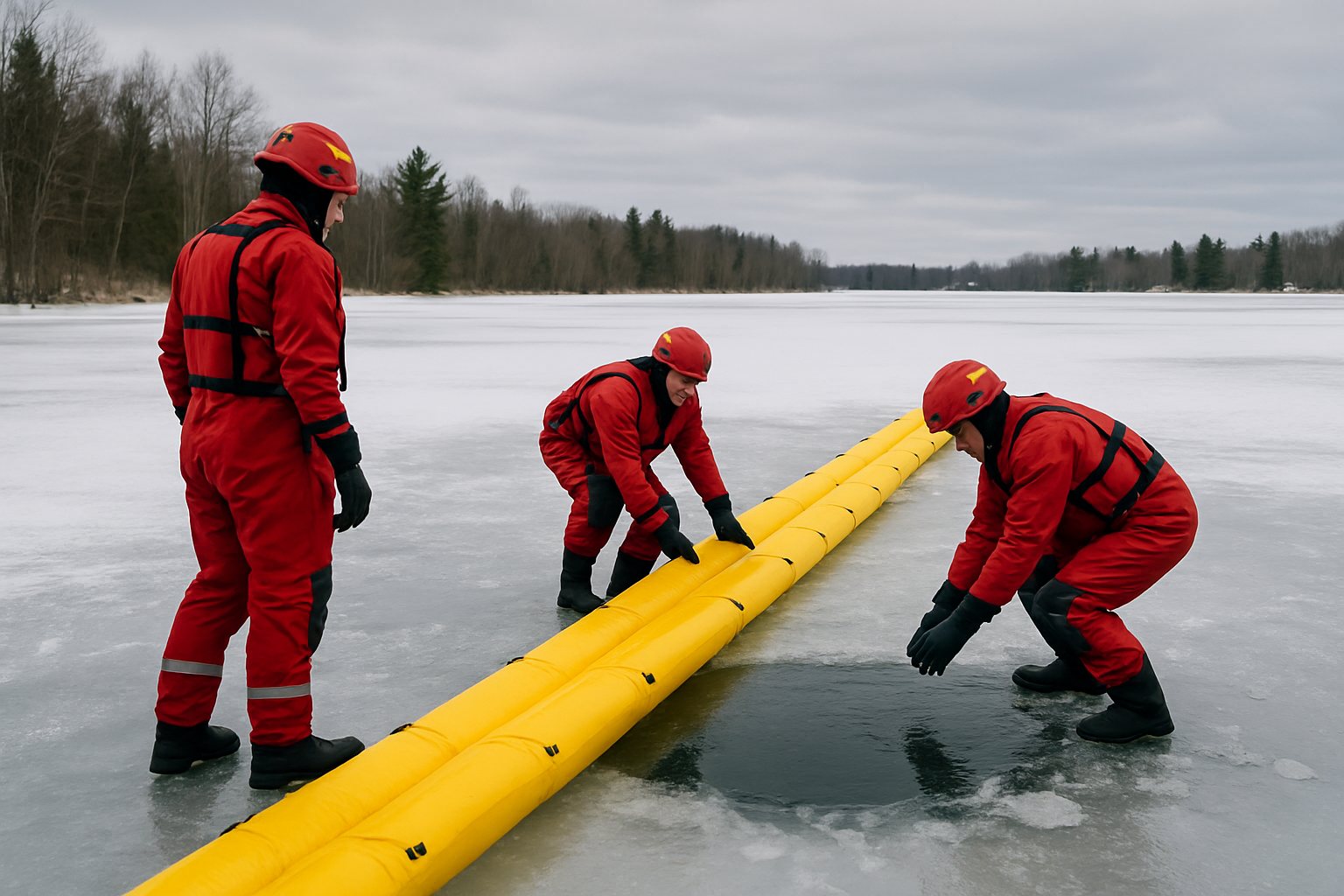
A winter afternoon, a frozen pond at the edge of town, and a call that someone has gone through the ice. The first crew on scene can’t walk out: ice that broke once will break again. So two firefighters pull a long gray roll from the truck, connect it to an air supply, and in a few minutes a floating walkway lies across ice and open water, spreading each rescuer’s weight while they crawl out, reach the person and slide them back. That is the job of an inflatable rescue walkway.
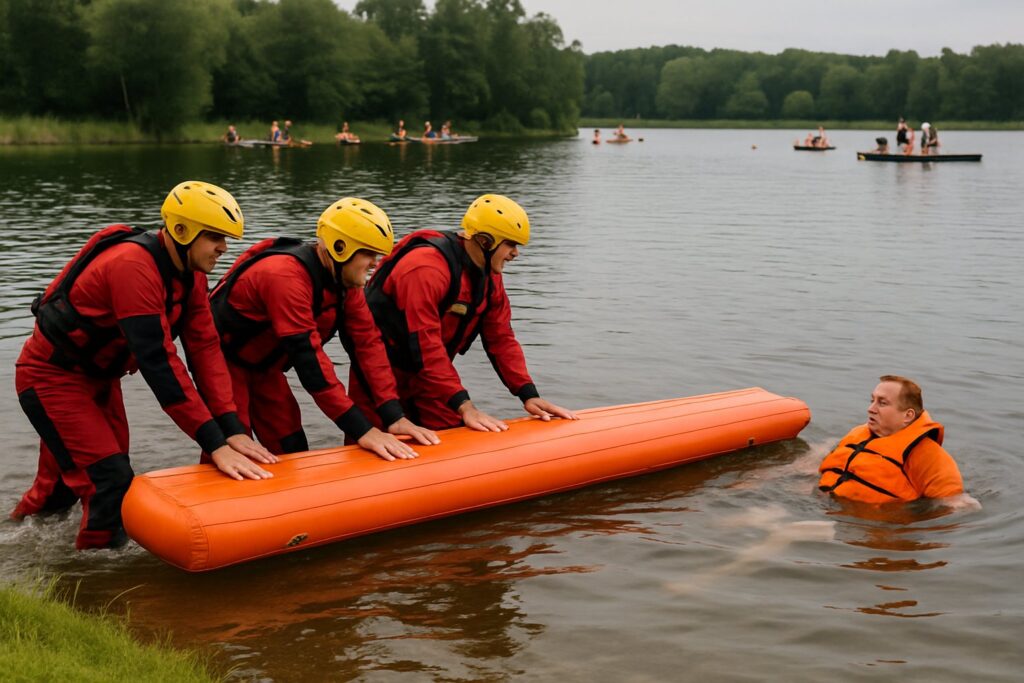
In short: inflatable rescue walkways are professional equipment for fire, police and rescue services: long, narrow, linked inflatable sections filled from apparatus air, a breathing-apparatus cylinder or a pump, used on ice, water, mud and wetlands. Paratech AIRTRACK, I.C. Brindle Fast Path and the Covertex Inflatable Rescue Bridge are examples. This page is information only. Recreational docks are never rescue equipment, and permanent floating walkways for marinas and homes are a different product, covered below.
Inflatable rescue walkways on the market
| Product | Maker | Size | Construction | Inflation |
|---|---|---|---|---|
| AIRTRACK | Paratech (USA) | 5 or 10 m sections that link; 54 in wide x 8 in high | Heavy-duty nylon, anti-slip surface, catamaran-style footprint, 7.8 psi (2007 launch article) | Apparatus-mounted air or other air supplies |
| Fast Path / Rescue Path | I.C. Brindle (UK) | 1.3 m (4.3 ft) wide; 2, 5 and 10 m lengths that join; custom sizes | Drop-stitch base, heavy-duty PVC top, three-chamber catamaran with isolation valves | Electric pump or a standard BA cylinder |
| Inflatable Rescue Bridge | Covertex | Not published | Not published | Not published |
Covertex lists its bridge for emergency access and evacuation over water, wetlands and ice, without figures. A US rescue dealer also sells an “Airtrack Inflatable Path” in a 2 m polyurethane version under the Rescue Tech name, and says units join lengthwise to extend the path or sideways to form a raft. The Paratech figures come from a 2007 launch article, so ask the maker about the current model before writing it into a budget or tender.
Sizes and layouts
Rescue walkways are long and narrow by design: wide enough for a rescuer to kneel or crawl and to lay a casualty on, long enough to reach from solid ground to the hole. The two published systems both build length from linked sections.
- Single run: one 5 m or 10 m AIRTRACK, or a 2, 5 or 10 m Fast Path, laid straight from the bank.
- Linked run: sections joined end to end for a longer reach; both makers say their sections link.
- Raft: sections joined side by side for a wider working platform (Paratech and the Rescue Tech listing describe this).
Handling sets the practical size: Paratech said one person can deploy a 5 m AIRTRACK, while the 10 m needs two because of its weight.
Construction and materials
- Catamaran footprint. Both AIRTRACK and Fast Path use two outer tubes or chambers, which keep the walkway stable and lift the deck off ice and mud.
- Separate chambers. Fast Path has three chambers, each with an isolation valve so a damaged section can be shut off, plus three over-pressure valves; its side sponsons can be inflated separately or left empty using transfer valves.
- Fabrics. Heavy-duty nylon (AIRTRACK, 2007); drop-stitch base with a heavy-duty PVC top (Fast Path); polyurethane on the Rescue Tech 2 m path.
- Working details. Non-slip surfaces, safety lines along the full length (Fast Path), a grab line and ring connectors (AIRTRACK), reflective tape (AIRTRACK), D-rings at both ends (Fast Path), a built-in relief valve (AIRTRACK) and a repair kit (Fast Path).
Stated capacities and what they mean
Neither Paratech nor I.C. Brindle publishes a rated load per length on the pages we checked. A 1999 product note said AIRTRACK “supports heavier loads than any other rescue path”, which is a claim, not a rating. Agencies get load ratings, crew numbers and training requirements from the maker. Never estimate a walkway’s capacity from its size, and never treat a recreational dock’s load rating as a rescue rating.
The job: how crews use a rescue walkway
The idea goes back decades. In 1979 Fire Engineering reported Chicago firefighters demonstrating the Res Q Dek, a rescue platform on two inflatable pontoons at only 5 psi, built for thin ice and for hand-to-hand rescues in the turbulence below low-head dams; the article said two people could handle it and it deployed from a paramedic van in under a minute. Paratech launched AIRTRACK in 2007 as an instant working platform for rescuers on ice, water, mud and wetlands. I.C. Brindle describes Fast Path as a path that lets the rescuer reach and recover a casualty over water, mud or ice.
- Size up from shore. The crew keeps the casualty talking and stays off the ice.
- Unroll and inflate. From apparatus air, a BA cylinder or a pump, depending on the system.
- Push out. The walkway goes out across ice and water toward the casualty, with lines back to shore.
- Reach and recover. A rescuer in a suit works from the walkway, gets the casualty onto it, and the shore team pulls both back.
The same low, stable platform works in floods and soft ground: the 1999 note described AIRTRACK as a flotation device for moving people out of floodwater, with low freeboard that makes it easier to haul people and equipment aboard.
Advantages and trade-offs
| Advantages | Trade-offs |
|---|---|
| Spreads weight on thin ice, mud and wetlands where a boat can’t go and a person can’t walk | Needs trained crews; not a tool for the public |
| Rolls into a case or bag on the truck | Load ratings come from the maker, not published pages |
| Inflates from air the crew already carries | Needs inspection, repair and pressure checks like any inflatable |
| Links into longer runs or a raft | Long sections are heavy: two people for a 10 m AIRTRACK |
Safety: what owners and the public should do
Fire services bring walkways like these. Owners, guests and bystanders should not go onto ice or into the water after someone.
- Ice: the Minnesota DNR says to call 911 first and resist running to the edge of the hole, which usually makes two victims. Reach with a rope, ladder or pole from shore, or throw something that floats; a non-professional should not go onto the ice unless every other option is ruled out.
- Cold water: the National Weather Service warns cold shock can be as dangerous in 50 to 60 °F water as in 35 °F water.
- Electric shock drowning near powered docks: if a swimmer near a dock seems shocked, Tennessee’s State Fire Marshal says to fight the instinct to enter the water, call 911 or use VHF Channel 16, turn off shore power and unplug cords, then get the person out and start CPR if needed.
- Life jackets: the Coast Guard requires an approved wearable life jacket for each person on a boat; in 2024, 87% of boating drowning victims were not wearing one.
- Supervision: the CDC says children need close and constant supervision near water and that inflatable toys are not safety devices.
If you run a lakeside property, marina or resort, the right rescue step is a plan, not equipment: know the emergency number, mark access points for crews, and keep throw lines and life rings where staff can reach them. Our dock safety section has checklists, including electric shock drowning and Coast Guard requirements.
Floating walkways for everyday access
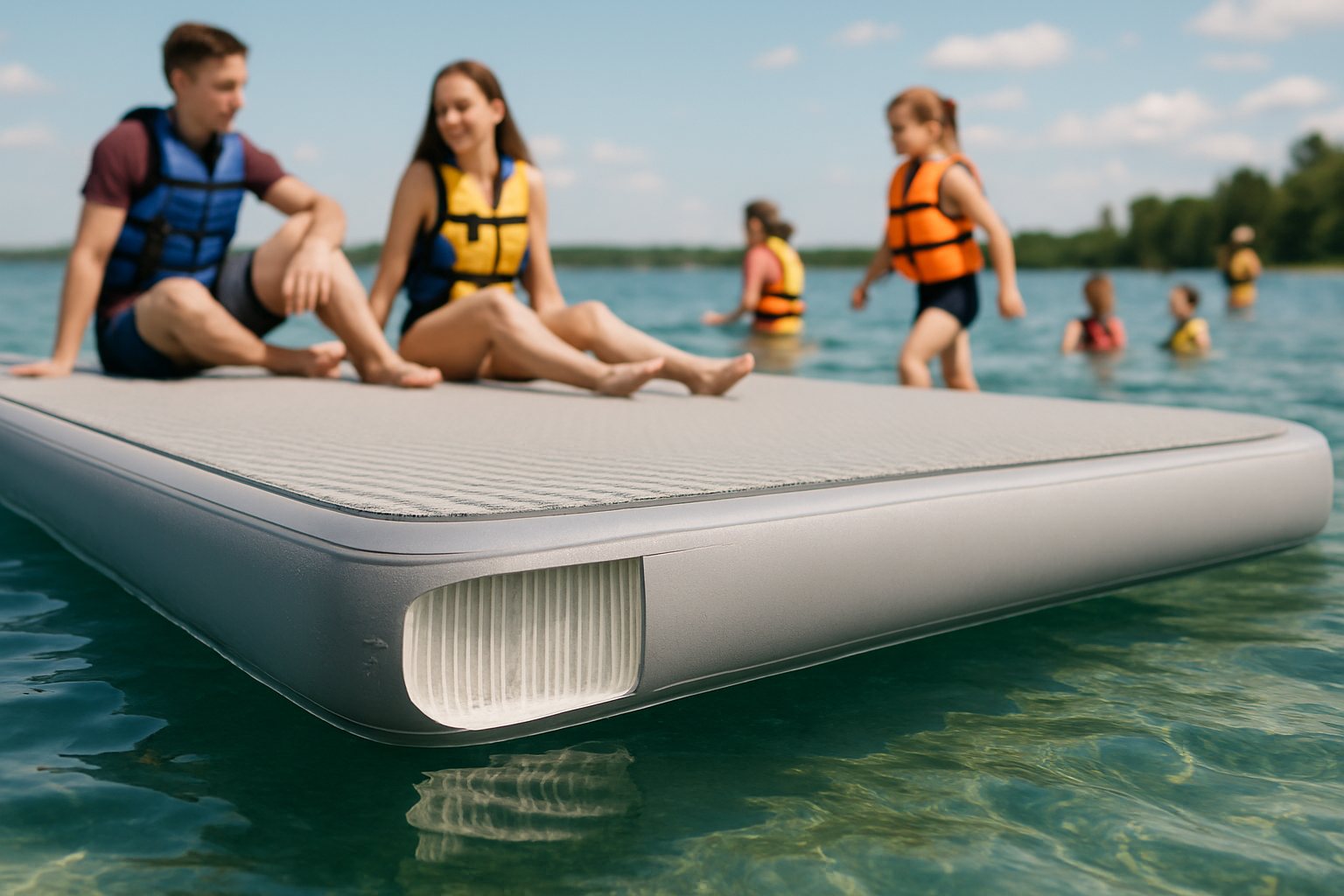
Many people searching “floating walkway” want a permanent path from shore to a dock or along a marina. Those are usually rigid systems: polyethylene sections such as EZ Dock or Connect-A-Dock (whose kit includes a gangway hinge for the shore end), or HDPE cubes such as Candock, which lists pedestrian bridges among its uses. On yachts there is a light inflatable version: Jobe’s Infinity Gangway is an inflatable walkway linking the boat and a platform. None of these is rescue equipment. Our modular docks page covers layouts and kits, and marinas, rentals and charter covers commercial walkways. For public or passenger use, regulators can require certification: Singapore’s port authority, for example, required pontoons used as temporary passenger landing platforms to be certified by a classification society.
If an everyday floating walkway is what you need, three published figures help you compare. Freeboard: Connect-A-Dock’s 1000 Series walks about 8 in above the water and its 2000 Series about 17 in, the second closer to a boat’s deck. Capacity per section: up to 690 lb (Connect-A-Dock 1000), up to 2,500 lb (Connect-A-Dock 2000) and 1,500 lb for a 60 x 60 in EZ Dock section. Width: Connect-A-Dock recommends at least 45 in. A hinge at the shore end lets the walkway rise and fall with the water.
How a rescue walkway differs from a dock
| Rescue walkway | Recreational inflatable dock | |
|---|---|---|
| Users | Trained fire, police and rescue crews | Families, boaters, guests |
| Shape | Long and narrow, linked sections (Fast Path 1.3 m wide; AIRTRACK 54 in) | Square or rectangular deck, about 6 x 5 to 15 ft |
| Inflation | Apparatus air, BA cylinder or pump | Hand or electric pump |
| Surfaces | Ice, water, mud, wetlands | Calm water, anchored |
| How bought | Makers and rescue dealers, with training | Retail and dealers |
What is not a rescue walkway
Three military projects often come up in searches. The US Army’s 2008 Light Weight Modular Causeway System was a prototype with inflatable flotation bladders under rigid aluminum and steel deck sections, a hybrid rather than an inflatable walkway. The CIMNE Air-Bridge tested by Spain’s Military Emergencies Unit is an inflatable bridge about 14 m long, and HDT’s Lightweight Expeditionary Bridge uses inflatable struts to cross a dry gap; neither is a floating dock. Consumer inflatable docks are not rescue gear either: their capacities are for recreation, makers publish no wind or wave limits, and “military-grade” on a listing is marketing, not a specification. Northern Diver says its FloatDeck was developed from rescue-platform expertise, but sells it as a dive, leisure and temporary-pontoon deck.
Rescue walkways in our catalog
I.C. Brindle Fast Path
by I.C. Brindle
- Size (as stated): 1.3 m wide; 2, 5 and 10 m lengths that link
Paratech AIRTRACK
by Paratech
- Size (as stated): 5 or 10 m sections that link; 54 in wide x 8 in high
| Spec | Paratech AIRTRACK | I.C. Brindle Fast Path |
|---|---|---|
| Size (as stated) | 5 or 10 m sections that link; 54 in wide x 8 in high | 1.3 m wide; 2, 5 and 10 m lengths that link |
| Construction | not published | 3-chamber catamaran with isolation valves |
| Inflation pressure | 7.8 psi | not published |
| Inflation | From fire-apparatus air | Breathing-apparatus (BA) cylinder |
| Request more information | Request more information |
Figures as each maker states them; makers measure capacity differently. Check the product page for sources and dates.
Gear that goes with a rescue walkway
- Air source: apparatus air, BA cylinders or a pump. I.C. Brindle lists a 230 V pump, a 12 V pump and air cylinders as suggested items alongside Fast Path.
- Lines: shore lines to haul the walkway back, plus the walkway’s own grab or safety lines.
- Personal gear: the agency’s ice or water rescue suits, life jackets and helmets, set by its training and standards.
- Repair kit and a storage case (AIRTRACK came with one).
Prices and care
| Item | Price seen | Where |
|---|---|---|
| I.C. Brindle Fast Path | £1,650 (listed down from £1,980); despatch in 2 to 3 weeks | I.C. Brindle, October 2026 |
| Rescue Tech Airtrack Inflatable Path, 2 m polyurethane | $2,660 (listed down from $3,800); on backorder | Columbus Supply, October 2026 |
| Paratech AIRTRACK, Covertex Rescue Bridge | Not published | Makers and rescue dealers |
Care follows the maker’s manual: dry before rolling, store out of sun and frost damage, check valves and pressure at each training session, and patch with the supplied kit. Ask the supplier for inspection intervals and how long parts are supported.
Choosing a walkway: notes for agencies
- Match the reach to your water. Ponds and canals near roads need a shorter run than wide lakes or tidal mud. Linking sections lets a crew carry shorter lengths and join them on scene.
- Match the air to your trucks. AIRTRACK was designed around apparatus-mounted air; Fast Path fills from a standard BA cylinder or an electric pump. Use what every crew carries.
- Count the hands. One person for a 5 m AIRTRACK, two for a 10 m, as Paratech stated in 2007. Ask current makers for weights per section.
- Plan for damage. Separate chambers with isolation valves (Fast Path) keep a punctured walkway usable.
- Budget for training. The walkway is one part of an ice and water rescue capability, with suits, lines, procedures and regular drills.
For agencies: what to ask a supplier
- Rated load per section, and how loads change when sections are linked.
- Inflation source and time: apparatus air, BA cylinder or pump, and how many cylinders a full length needs.
- Chamber design: what happens if one chamber is punctured.
- Training, certification and the standards the product is built to.
- Inspection, repair and replacement intervals, and parts support.
Agencies, dealers and makers can contact us through Request more information; makers can also list their products. We are an independent guide and don’t sell rescue equipment.
More: floating dock types, industries, boarding and vessel access, inflatable dock capacity explained and the dock glossary. For inflatable work platforms (not walkways), InflatablePlatforms has a work platforms page.
Latest guides
Rescue walkway questions
What is an inflatable rescue walkway?
A long, narrow inflatable that rescuers lay across ice, water or mud to reach a person, spreading their weight. Sections link to make the length needed.
How is it inflated?
From air the crew already carries: Paratech AIRTRACK from apparatus-mounted air or other supplies, and I.C. Brindle Fast Path from a standard BA cylinder or an electric pump.
What is a floating walkway?
Either a permanent floating path to a dock or along a marina, usually rigid polyethylene sections, or, in rescue work, an inflatable walkway laid out by crews. This page covers both and keeps them apart.
Can I use an inflatable dock for ice rescue?
No. Recreational docks are not made, rated or tested for rescue. Call 911; trained crews carry the right equipment.
Who makes inflatable rescue walkways?
Paratech (AIRTRACK) in the US, I.C. Brindle (Fast Path) in the UK and Covertex (Inflatable Rescue Bridge). A US dealer also sells an Airtrack path under the Rescue Tech name.
How long are rescue walkways?
AIRTRACK came in 5 or 10 m sections and Fast Path in 2, 5 and 10 m lengths, and both link for longer runs.
Can the public buy rescue walkways?
Some are listed with prices by makers and rescue dealers, but they are built for trained crews. Without training, the safe action is to call 911 and help from shore.