This article contains affiliate links: if you buy through them we may earn a commission, at no extra cost to you. Read our affiliate disclosure.
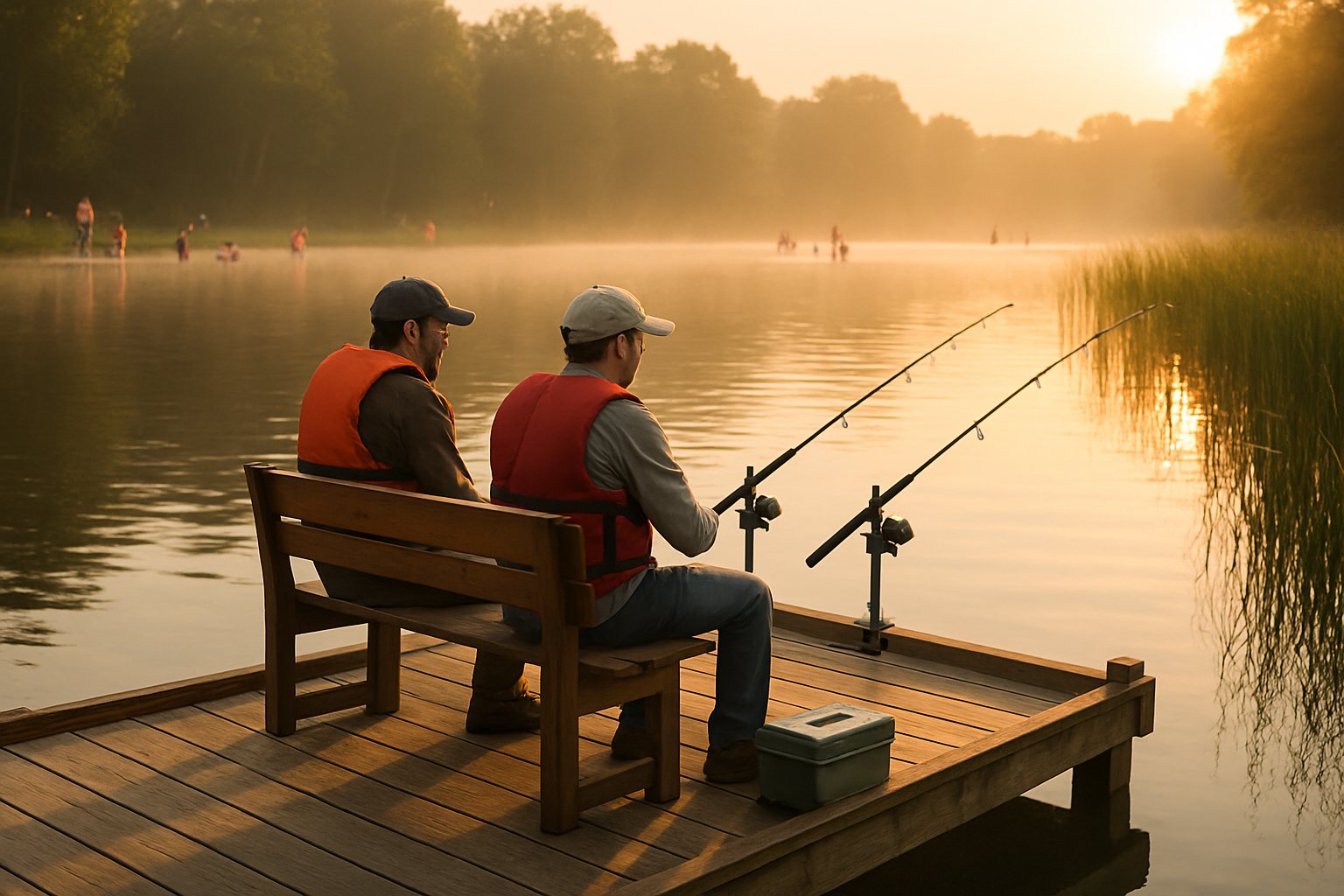
Just after sunrise on a farm pond, a grandfather and a nine-year-old carry two folding chairs, a tackle box and a bucket of crickets down a short ramp to the end of a floating dock. The water out there is deeper than anything they could reach from the muddy bank, the bluegill are sitting on the brush pile someone sank years ago, and nobody has to wade. That is the whole case for a fishing dock: it gets you past the shallows, gives everyone a steady place to stand, and keeps lines out of the cattails. This guide covers floating versus fixed fishing docks, sizing, layouts, the features that matter, accessibility, public fishing docks you can visit, safety and permits.
In short: a floating fishing dock suits ponds and lakes whose water level moves, whose bottom is soft, or where you need to reach deeper water without driving pilings; a fixed piling dock suits steady water and firm, shallow bottoms. Build it to reach water you can actually fish, leave room for chairs and a turning space, add rod holders, a light and a life ring, and check permits before anything goes in the water.
Floating vs fixed: which fishing dock fits your water?
Most residential fishing docks are one of two kinds. A fixed (piling or post) dock stands on legs set into the bottom. A floating dock sits on floats or plastic sections, is held in place by anchors, poles or pilings, and reaches shore by a gangway or ramp. Neither is better everywhere; the water decides.
| Your water | Floating fishing dock | Fixed piling dock |
|---|---|---|
| Level changes through the year | Rides up and down, so the deck stays the same height above the water | Can end up too high above the water at low levels, or awash at high water |
| Very shallow, getting shallower | Has to come out or be moved if it starts to scrape bottom | Works well on shallow, steady water |
| Deep water at the end | Depth matters little to the dock itself; anchoring gets longer | Needs longer pilings as depth grows |
| Soft, mucky bottom | Nothing has to stand on the muck | Pilings need bottom firm enough to hold them |
| Ice in winter | Usually removed or pulled to shore for the winter | Exposed to ice all winter; ask a local builder what survives on your lake |
| Feel underfoot | Moves a little with waves and people | Stays still |
Tommy Docks, a dock retailer, puts the water-level point simply: a floating dock “will simply stay floating above the water,” while stationary docks are best where levels stay fairly steady, and a floating dock has to come out if the water gets low enough for it to scrape bottom. The same retailer says that where ice forms in winter you need to take your dock out for winterization, and that a floating dock is potentially easier to remove. Plastic dock makers say the same about ice: Connect-A-Dock advises removing its docks where ice shifts. For a fuller comparison by lake type, see floating docks for ponds and lakes and our lake docks guide.
How big should a fishing dock for a pond be?
Start with the people, not the lumber. Count how many anglers fish at once, then give each one room to sit, cast and land a fish without hooking a neighbor. A useful yardstick comes from the U.S. Access Board, which writes the federal accessibility guidelines for fishing piers: each accessible fishing spot needs a clear space at least 30 x 48 in (about 76 x 122 cm), and the pier needs at least one 60 in (152 cm) turning space. They are written for public piers, but they show how much deck one seated angler or wheelchair uses.
- Chairs and coolers. A folding chair, a cooler and a tackle box take more deck than the angler does. Plan width for a chair plus a walkway behind it so others can pass.
- Kids. Children wander, so a wider deck and a railing on the deep side help more than extra length.
- A small boat or kayak. If a jon boat or kayak will tie up too, give it its own side or arm so mooring lines and fishing lines don’t cross. See dock ladders and accessories for cleats and launches.
- Weight. On a floating dock, every person, chair and cooler is load the floats must carry. Our dock floats guide shows how makers rate buoyancy and how to count floats; we don’t calculate safe loads for your dock.
Rigid floating dock sections come in set sizes. Wave Armor, for example, sells a 60 x 120 in (5 x 10 ft) polyethylene section for $2,295 and a 60 x 60 in section for $1,350 when checked in October 2026, and EZ Dock builds T, L and U kits from 60 in x 10 ft sections, priced through dealers. HomeAdvisor puts the cost of building a dock at about $15 to $35 per square foot. More on budgets in floating dock cost.
Layouts that help fishing
The shape of a floating dock for fishing matters as much as its size: put people over fishable water, spread them out, and keep the boat side separate.
- Straight dock. EZ Dock calls it the most straightforward and usually least expensive shape, good for sunbathing and fishing. Fine for one or two anglers.
- T-head. A walkway out to a crosspiece gives you two long fishing edges at the deep end, where the fish are. Public agencies use this shape for fishing: Montana Fish, Wildlife and Parks describes an accessible, T-shaped floating dock “specifically for fishing” at Black Sandy State Park.
- L-shape. EZ Dock notes an L leaves room for swimming or fishing off the side while a boat ties up on the other. Good when the dock has two jobs.
- Reach deeper water. A longer walkway or gangway to a floating head lets you fish water you could never reach from the bank. Missouri’s Mozingo Lake dock, dedicated in June 2026, was built with a large fishing platform that, in the Missouri Department of Conservation’s words, lets anglers “fish in deeper waters of the lake without the need of a boat.”
Floating heads usually connect to shore by a hinged gangway that rises and falls with the water. Our floating dock designs and layouts guide shows kit shapes and sizes, and floating dock ramps and hardware covers gangways, hinges and rollers. Then hold it in place properly: see how to anchor a floating dock.
Features that make a better fishing dock
Rod holders
Rod holders keep rods off the deck, out from underfoot and away from a bass that wants to drag them in. Choose by mount: deck-mount holders screw into the boards or frame, rail-clamp holders fit a specific rail diameter (check the size range before you buy), and post adapters fit round dock posts. Several are in the cards below.
Railings and benches
A railing on a fishing dock does two jobs: it keeps people, especially kids, from stepping off the edge, and it gives anglers something to lean on. For public fishing piers, the Access Board requires at least 25% of railings to be no higher than 34 in (86 cm) so a seated angler can fish over them, spread along the pier; other guardrails may be higher where they meet the building code. Where railings are fitted, an edge at least 2 in (5 cm) high helps keep wheels and feet on the deck. Benches give older anglers a place to sit; many dock makers sell them as add-ons, and EZ Dock lists benches and railings among its accessories.
Lighting
Evening and night fishing means walking a dock in the dark. Solar piling caps and deck lights mark the edges without wiring. If you want wired lights or power for an aerator or a boat lift, have a licensed electrician do it and read the electrical safety section below first.
Fish-attracting structure
Fish relate to cover, and a dock is cover. The Missouri Department of Conservation says fish attractors can occur “inadvertently, as when a landowner installs a dock.” You can add to it on your own pond by following state and extension guidance:
- Depth. Missouri says to place cover no deeper than 10 to 12 ft (3 to 3.7 m), because summer oxygen in the deepest water may be too low for fish. Mississippi State University Extension suggests trees in water 4 to 8 ft (1.2 to 2.4 m) deep near creek channels, points or drop-offs.
- Size and number. Missouri says good attractors are about 10 x 15 ft or larger, and one big pile works better than scattered trees. Mississippi State says one brush shelter is enough in a pond under 1 acre, and larger ponds need one or two per acre.
- Within reach. Missouri suggests putting some brush piles within casting distance of bank anglers; from a dock, that means within casting distance of the head.
- Materials. Missouri says natural brush and trees are the most economical, effective attractors. Mississippi State notes that cedars float and need weights, and that washed gravel about 1/2 in across, in 3 to 4 ft of water, makes a spawning bed for bream.
- Keep clear of the spillway. In small ponds Missouri advises about 100 ft (30 m) between attractors and any spillway or overflow pipe.
On public water, don’t sink anything on your own. Missouri tells anglers to contact the proper authority before adding cover to a public fishing spot.
Fishing dock accessories you can buy online
These were in stock on Amazon when checked in October 2026. Prices change often; check before you buy.
Dock-A-Rod 90 Degree Fishing Rod Holder
- Holds rods up to 1 1/2 in
- Reinforced nylon, stainless hardware included
- About $15, seen October 2026
Dock-A-Rod 90 Degree Rod Holder with Round Post Adapter
- Adapter for round dock posts
- 3-year maker warranty, made in USA
- About $19, seen October 2026
Dock Edge+ Solar Pile Cap Light
- Salt and fresh water
- Up to 12 hours run time, replaceable AAA battery
- About $50, seen October 2026
Dock Edge+ Dolphin Life Ring, 24 in
- U.S. and Canadian Coast Guard approval (listing)
- Polyethylene shell, closed-cell foam
- About $98, seen October 2026
Accessible fishing docks for anglers with disabilities
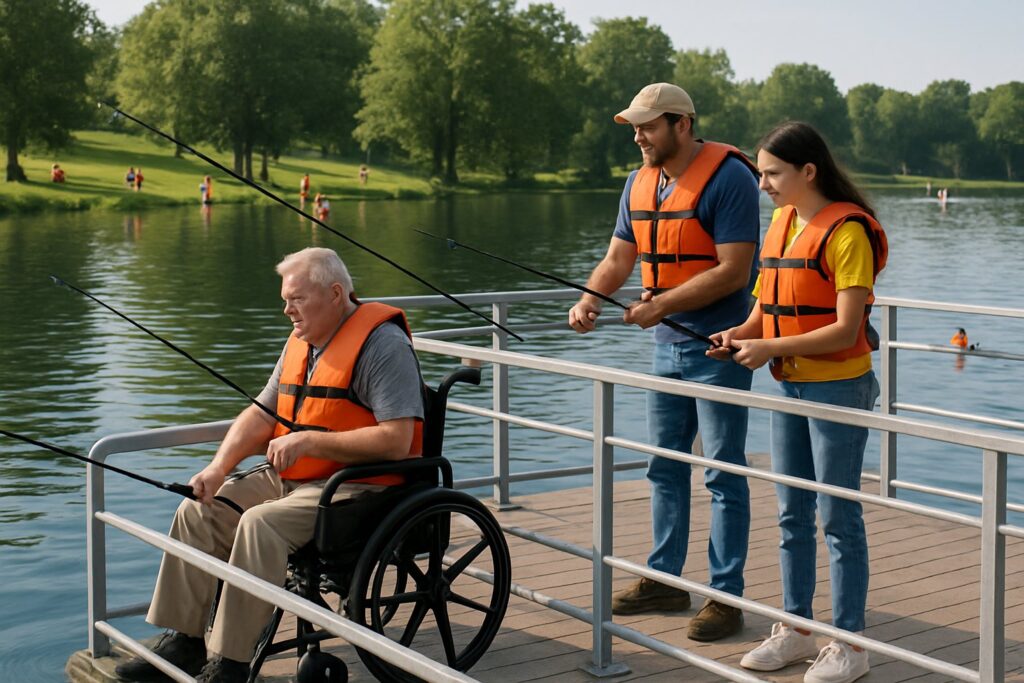
The U.S. Access Board’s ADA guidance on fishing piers and platforms covers facilities specifically designed and built for fishing, new or altered. A private dock behind your house is not the target, but the guidance is the best published reference if you want your own dock to work for a parent in a wheelchair. The main points:
- At least 25% of railings no higher than 34 in, spread along the pier, each with a 30 x 48 in clear space.
- At least one 60 in turning space or T-shaped turning space.
- Edge protection at least 2 in high where railings are fitted, unless the deck runs at least 12 in past the rail with toe clearance.
- Gangways to floating piers: a maximum slope of 1:12, but they need not be longer than 30 ft, and those 30 ft or longer have no maximum slope; transition plates steeper than 1:20 need a landing; cross slope no more than 2% at rest.
The gangway is the hard part on a floating fishing dock, because its slope changes with the water. A longer gangway keeps it gentler at low water.
Public fishing docks: try one before you build
Many state agencies build fishing docks and piers on public lakes, and fishing from one is a good way to learn what size and layout you like. A few examples:
- Montana. Black Sandy State Park has an accessible, T-shaped floating fishing dock that extends roughly 50 ft into the water, with ADA-approved railings and ramps, next to the accessible campsites (Montana Fish, Wildlife and Parks).
- Missouri. At Mozingo Lake Recreation Park in Nodaway County, a new deep-water dock with a large fishing platform was installed in March 2026 and dedicated that June. The park and the Missouri Department of Conservation each paid about $31,500.
- Minnesota. The Minnesota DNR runs a long-standing program of accessible fishing piers with local partners; one state-funded project set out to add 4 to 8 accessible fishing piers for under-served anglers and anglers with disabilities.
Search your state wildlife agency’s site for “fishing piers” or “accessible fishing” to find one near you.
Safety on a fishing dock
- Life jackets for kids. The U.S. Coast Guard notes that adult life jackets will not work for children; buy one sized for the child’s weight. Federal law requires children under 13 to wear one on a moving boat, and state rules vary. On a dock, a child who can’t swim well should wear one too. See life jackets and throwables.
- A throwable within reach. A ring buoy with line, mounted where everyone can see it, is the simplest rescue tool on any dock.
- Electricity and water. If your dock or a neighbor’s has power, electric shock drowning is a real risk. Tennessee’s State Fire Marshal’s Office says never to swim within 100 yards of any dock using electrical power, to have a licensed electrician do the work, and to have it inspected at least once a year. Read electric shock drowning before you wire lights or an aerator.
Permits for a fishing dock
A private pond on your own land may need nothing, but lakes and rivers often do. Federal rules count any pier or boat dock as a “structure,” and docks in navigable waters need U.S. Army Corps of Engineers authorization; on lakes the Corps manages, floating structures are allowed only by permit under the lake’s shoreline management plan. States add their own: Illinois, for example, has a statewide permit for minor docks that limits how far they reach into the waterway (no more than 50 ft, and never more than a quarter of its width) and requires them to be securely anchored. Utilities, lake associations and towns may have rules too. Start with our permits and local rules guide.
Where inflatable docks fit
An inflatable dock can serve as a seasonal place to fish, swim and launch kayaks, and it packs away in a bag. It is not a permanent walkway with rod holders and railings, so for a dedicated fishing dock most owners choose a rigid floating or fixed dock.
Fishing dock questions
Is a floating dock good for fishing?
Yes, especially where the water level changes or the bottom is soft. A floating dock for fishing keeps the same height above the water all season and can reach deeper water by a gangway. It moves a little underfoot, which some anglers notice more than others.
What is the best shape for a fishing dock?
A T-head is the classic: a walkway to a crosspiece puts several anglers side by side over the deepest water. An L works when a boat also ties up. A straight dock is the simplest and usually cheapest.
How do I attract fish to my dock?
On your own pond, follow state guidance: sink brush or trees in water no deeper than 10 to 12 ft (Missouri), within casting distance, and keep them away from the spillway. On public water, ask the managing agency first.
Do I need a permit for a fishing dock on a pond?
It depends on the water. A small private pond often needs none, but lakes, rivers and reservoirs managed by the Corps, a state or a utility usually have rules. Check before you build.
Leave a Reply