Author: Inflatable Docks Experts

  • Drive-On vs Inflatable Jet Ski Docks: Which PWC Floating Dock?

    Drive-On vs Inflatable Jet Ski Docks: Which PWC Floating Dock?

    Two neighbors on the same cove, two answers. One idles his ski up a gray plastic ramp at the end of the dock, it rolls up and stops against the bow stop, and he walks off with dry feet. The other pulls hers into the slot of a soft inflatable U, loops two lines through the D-rings and dives off the deck for a swim. Both own a PWC floating dock, but they bought very different things. This guide explains how a drive-on jet ski dock and an inflatable jet ski dock work, what each costs and carries according to its maker, and which one fits the way you use your ski.

    In short: a drive-on dock is a rigid polyethylene port with rollers or a ramp that lifts the ski out of the water; makers publish a capacity (700 to 2,000 lb on the ones we checked) and prices start around $1,700. An inflatable jet ski dock is a drop-stitch U, E or L that the ski floats in or beside; it costs about $180 to $670, packs into a bag, but the listings we checked give no rating for a ski on top. Season-long mooring points to drive-on; weekends, travel and small budgets point to inflatable.

    How a drive-on jet ski dock works

    A drive-on dock, sold as a PWC port, is a shaped float made of rotomolded polyethylene. Some are filled with foam, like the Wave Armor Sport and the Candock JetRoll; others float on sealed air chambers. The top has a cradle with wheels or rollers. You line up, approach at idle, and the momentum carries the hull up the rollers until the bow stop catches it. To launch, you push the ski back or off the side. EZ Dock says the wheels on its EZ Port 2i “move according to how your PWC sits,” which keeps it centered.

    Because the hull sits out of the water, there is no growth on the bottom and no slapping against a pier when the wake rolls in. Ports bolt to modular dock sections or to an existing dock with connection kits, which are often sold separately, and they are anchored the same way as any rigid floating dock. They are heavy: Wave Armor lists its Sport at about 180 lb and needs a forklift for delivery, and the Candock JetRoll is about 350 lb.

    How an inflatable jet ski dock works

    An inflatable jet ski dock is a deck made of drop-stitch PVC: two skins joined by thousands of threads, pumped hard (the ACWYENN asks for 5 to 10 psi) so it stays flat. It is usually 6 in thick with an EVA foam top, cut into a shape that wraps the ski. A U holds one ski in its slot, an E holds two, and a narrow L makes a soft walkway beside the ski or an existing dock. The ski stays afloat, tied to D-rings, while the soft sides keep it off your boat. Deflated, the whole thing goes in a bag; the LOSKIA U weighs 39 lb.

    The catch is the load question. None of the inflatable listings we read publishes a weight rating for a ski on the deck, and Paradise Pad calls its own T model “more as a temporary dock and not a long term dock.” So we treat inflatables as slips and bumpers, not lifts.

    Drive-on vs inflatable PWC floating dock, side by side

    Drive-on (rigid port)Inflatable PWC dock
    Where the ski sitsOut of the water, on rollersIn the water, in a slot or alongside
    Stated capacity700 lb (Wave Armor Sport) to 2,000 lb incl. ski and people (Candock JetRoll)Not published on the listings we checked
    Weight of the dockAbout 180 to 350 lb (two models checked)About 39 lb (LOSKIA U); 66 lb package (GIRISHIP E)
    Price, Oct 2026$1,725 to $2,699 per single port; EZ Dock and Jet Dock by quote$179 to $665 on Amazon
    Warranty7-year limited (Candock JetRoll); lifetime limited (Jet Dock)Half a year to 1 year
    StorageStays in for the season; out where ice movesDeflates into a bag
    Best forA ski that lives at the dock all summerWeekends, travel, rentals, tight budgets

    Sizing a drive-on jet ski dock to your ski

    Drive-on ports are sized for hull families. Wave Armor builds its Sport “specifically designed for smaller, lightweight PWCs” such as the Sea-Doo Spark and Yamaha EX series, and sells deeper Pro and Pro Maxx ports and a Wide Body version for bigger skis. EZ Dock says the EZ Port 2i suits “today’s larger three-seater models.” Look up your ski’s dry weight on the maker’s site (Sea-Doo lists the Spark Trixx at 443 to 473 lb), add fuel and gear, and ask the dock maker to confirm the fit in writing. Never estimate capacity from the size of the port.

    Sizing an inflatable jet ski dock

    For a U or E, the slot is what matters. Paradise Pad publishes its opening (4 ft wide and 4 ft deep on a 6.5 x 9 ft dock), which lets you compare it with your ski’s beam. If a listing does not give the slot size, ask before you buy. An L is simpler: it only needs to be about as long as the ski so you have somewhere to step.

    Popular picks of each kind

    Inflatable U

    LOSKIA U-Shaped Inflatable Jet Ski Dock

    • 8.5 x 8 ft, 6 in
    • 39 lb, pump and ropes included
    • About $339
    Check price on Amazon
    Inflatable L

    ACWYENN L-Shaped Inflatable Jet Ski Dock

    • 2 ft wide, 6 in
    • 5 to 10 psi
    • About $179
    Check price on Amazon
    Rigid drive-on

    Wave Armor Sport PWC Port

    • 59 in x 11 ft
    • 700 lb capacity
    • $1,725
    See it at the store

    Every model, with prices and the facts behind each one, is in our best jet ski docks guide.

    Anchoring and setup

    Both kinds need to be held in place. A port attached to a dock moves with the dock, so the dock’s anchoring (pipes, deadweight anchors, piling brackets or stiff arms, in EZ Dock’s list of options) has to handle the extra load and the wake. A stand-alone inflatable needs its own anchor and lines; one inflatable dock maker, RAVE, tells owners not to connect its swim dock directly to docks, piers or other hard objects, so read your manual before you tie an inflatable to a pier. Our step-by-step guide on how to anchor a floating dock covers weights, scope and lines, and floating dock installation covers the first day.

    Which one should you buy?

    • You keep the ski at your own dock from May to September: drive-on. The hull stays clean, and the maker states what it carries.
    • You take the ski to different lakes or rent a lake house: inflatable. It fits in the truck with the life jackets.
    • You anchor a boat and the ski comes along: inflatable U or L tied off the boat, well clear of the engine and with the boat’s engine off.
    • Two skis: an inflatable E with two slots, or two ports joined to a modular dock (see modular docks).
    • A yacht carrying skis: neither of these. Look at purpose-built yacht jet ski docks in yacht docks.
    Custom built: request information

    FunAir Toy Island

    by FunAir

    • Stated capacity: Up to 4 jet skis or dinghies, or 2 Seabobs plus guests (maker)

    Full specs and sources

    Request more information
    Custom built: request information

    Henshaw Jet Ski Dock (single and twin)

    by Henshaw Inflatables

    • Thickness: About 100 mm double-wall drop-stitch top

    Full specs and sources

    Request more information

    Jobe Infinity PWC Dock

    by Jobe

    • Size (as stated): 345 x 250 cm
    • Thickness: 20 cm

    Full specs and sources

    See it at Nootica
    Custom built: request information

    NautiBuoy Jet-Ski Dock

    by NautiBuoy Marine

    Full specs and sources

    Request more information

    Keep reading: the jet ski docks hub, floating dock cost, inflatable vs rigid floating docks and terms like drop-stitch and bow stop in the glossary.

    Drive-on and inflatable jet ski dock questions

    Is a drive-on jet ski dock the same as a jet ski lift?

    Not quite. A drive-on dock floats and you drive up onto it. A lift raises the ski with a mechanism; some, like the Patriot Docks PWC lift, stand on legs on the lake bed. Jet Dock calls its floating drive-on dock a “jet ski lift,” so check the product type, not just the name.

    Can a drive-on port go in salt water?

    Many are sold for it. EZ Dock says its products are built to withstand saltwater conditions and offers fresh and saltwater anchoring hardware. Check the specific port and its hardware, and follow the care instructions for wheels and fittings.

    Will an inflatable jet ski dock scratch the hull?

    It is soft PVC with an EVA top, so sellers market it as a bumper that protects the hull. Keep it clean of sand and grit, which is what usually does the scratching, and use enough lines that the ski cannot ride up over the edge in a wake.

    Which lasts longer?

    On paper, the rigid port. Candock gives seven years and Jet Dock a lifetime limited warranty, while the inflatable listings we checked give six months to a year. Real life depends on sun, storage and use; deflate, rinse, dry and store an inflatable out of the sun.

    Do I still need a life jacket at the dock?

    On the ski, yes: state PWC rules, such as Virginia’s, require the operator and every rider to wear a USCG-approved life jacket. At the dock, docks are wet and slippery, and a jacket is a sensible habit for kids and weak swimmers.
  • Best Jet Ski Floating Docks 2026: Inflatable and Drive-On Picks

    Best Jet Ski Floating Docks 2026: Inflatable and Drive-On Picks

    Saturday at the lake: the ski comes back in after a morning run, you idle up to the dock, step off onto a firm deck and tie off without the hull grinding against anything. No beaching it on the sand, no wading out to fetch it. That is what a good jet ski floating dock gives you. This guide compares the jet ski docks you can actually buy in 2026, and it keeps two very different kinds apart: soft inflatable PWC docks that you tie the ski into, and rigid drive-on docks (ports) that lift the whole ski out of the water.

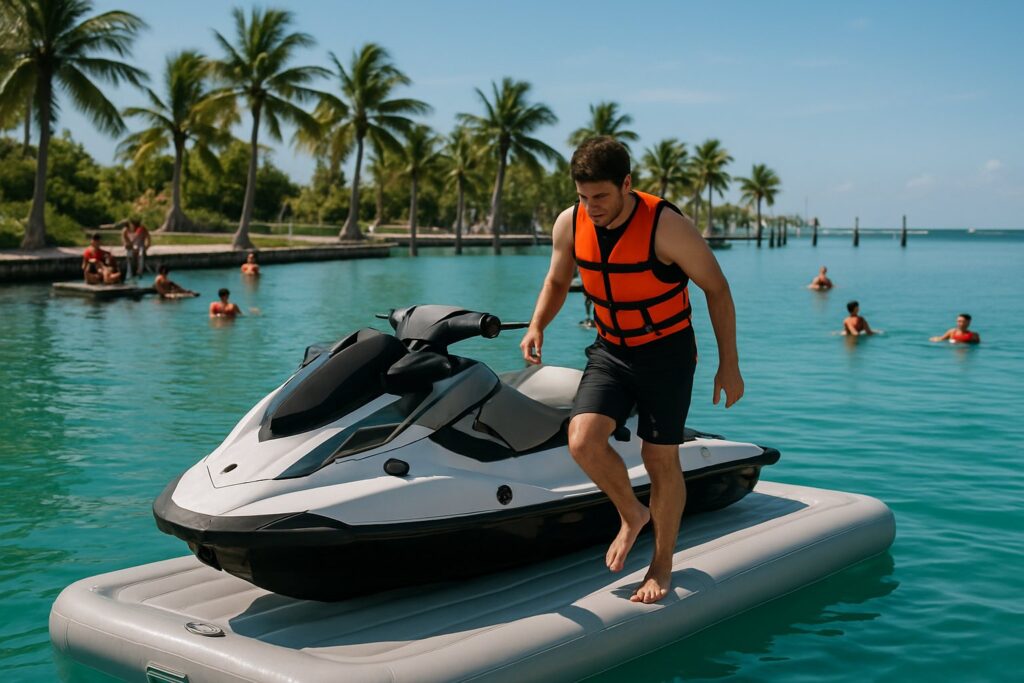
    Rider stepping off a jet ski parked on an inflatable dock at a tropical marina

    In short: inflatable jet ski docks cost about $180 to $670 on Amazon (October 2026), roll up for storage, and hold the ski in the water beside or inside a U or E shape; none of the listings we checked publishes a weight rating for parking a ski on top. Rigid drive-on docks cost about $1,700 to $2,700 each, carry a stated capacity and keep the hull dry, but they are heavy, permanent and need anchoring like a small dock. Pick inflatable for occasional, sheltered use and easy storage; pick drive-on if the ski lives at the dock all season.

    Prices change often. The prices below are what we saw at the maker or a major retailer in October 2026; check the current price before you buy.

    Our top picks

    Best inflatable U dock

    LOSKIA U-Shaped Inflatable Jet Ski Dock 8.5 ft

    • 8.5 x 8 ft, 6 in drop-stitch
    • Hand pump, 2 mooring ropes
    • 1-year warranty
    Check price on Amazon
    Biggest deck for one ski

    Paradise Pad U-Shaped Jet Ski Dock

    • 6.5 x 9 ft
    • Slot 4 ft wide x 4 ft deep
    • Stainless D-rings
    Check price on Amazon
    For two skis

    GIRISHIP E-Shaped Jet Ski Dock 15 x 8 ft

    • 180 x 96 x 6 in
    • Two slots
    • Half-year warranty
    Check price on Amazon
    Lowest price

    ACWYENN L-Shaped Inflatable Jet Ski Dock

    • 2 ft wide, 6 in thick
    • 5 to 10 psi
    • 12 D-rings
    Check price on Amazon
    Rigid drive-on for small skis

    Wave Armor Sport PWC Port

    • 59 in x 11 ft
    • 700 lb capacity
    • Foam-filled polyethylene
    See it at the store
    Rigid drive-on, highest rating

    Candock JetRoll Drive-On Dock

    • 2,000 lb incl. ski and people
    • 12 wheels, bow stop
    • 7-year warranty
    See it at the store

    Jet ski docks compared

    DockTypeSizeStated capacityAbout (Oct 2026)
    LOSKIA U dockInflatable, U shape8.5 x 8 ft, 6 in“Multiple adults” (no lb figure)$339
    Paradise Pad U dockInflatable, U shape6.5 x 9 ft, slot 4 x 4 ftNot published$550
    GIRISHIP E dockInflatable, E shape, 2 slots15 x 8 ft, 6 inNot published$665
    ACWYENN L dockInflatable, L shape2 ft wide, 6 inNot published$179
    Wave Armor SportRigid drive-on port59 in x 11 ft700 lb$1,725
    Candock JetRollRigid drive-on port152 x 76 x 12 (as listed)2,000 lb incl. ski and people$2,399
    EZ Dock EZ Port 2iRigid drive-on port168 x 58.5 in1,700 lb flotation (brochure)Dealer quote

    Inflatable PWC docks and drive-on docks are different things

    Most listings for a “jet ski floating dock for sale” mix the two, so read the product type before the price. An inflatable PWC dock is a drop-stitch deck, usually 6 in thick, cut into a U, E, T or L shape. The ski floats in the slot or alongside, tied to D-rings, and the soft sides keep the hull off your boat or pier. It is portable and cheap, but the sellers we checked give no rating for driving a ski up onto the deck, and Paradise Pad describes its own T-shaped model as “more as a temporary dock and not a long term dock.”

    A drive-on dock (also called a PWC port or waverunner dock) is a rigid, foam-filled or air-chambered polyethylene shell with rollers or a ramp. You drive the bow up onto it at low speed and the ski sits out of the water. Makers publish a capacity, and these ports connect to modular docks. The two we checked weigh about 180 and 350 lb, and they need proper anchoring. We go deeper in drive-on vs inflatable jet ski docks.

    The best jet ski docks

    1. LOSKIA U-Shaped Inflatable Jet Ski Dock: best inflatable U dock

    The LOSKIA dock is an 8.5 x 8 ft U of 6 in drop-stitch PVC with a non-slip EVA top, heavy-duty D-rings and carry handles. It weighs 39 lb and comes with a dual-action hand pump, two mooring ropes, a storage bag and a repair kit, with a one-year warranty. The seller says it “safely supports multiple adults” but gives no pound figure, and says nothing about pulling a ski up onto it, so treat it as a slip the ski floats in. It was $339 on Amazon in October 2026.

    • Good: complete kit; light enough for one person to carry deflated.
    • Watch out: no published load rating; the listing is new, with very few reviews.
    • Best for: one ski tied up next to a pontoon or a lake house for the weekend.

    Check the LOSKIA jet ski dock price on Amazon

    2. Paradise Pad U-Shaped Jet Ski Dock: biggest deck for one ski

    Paradise Pad’s U dock is 6.5 x 9 ft and 6 in thick, with a jet ski opening 4 ft wide and 4 ft deep, plenty of stainless D-rings and carry handles. A hand pump, storage straps and a repair kit are in the box. The listing calls it “great for temporary docking” and says it protects the ski from banging into your boat. Paradise Pad says it is a family-owned US brand with US-based customer service. It was about $550 on Amazon.

    • Good: the slot size is published, so you can check it against your ski’s beam.
    • Watch out: no weight rating; the maker frames it as temporary docking.
    • Best for: a slim ski that should sit inside a protected slot at anchor.

    Check the Paradise Pad jet ski dock price on Amazon

    3. GIRISHIP E-Shaped Jet Ski Dock: for two skis

    If there are two skis in the family, the GIRISHIP is an E shape of 180 x 96 x 6 in (15 x 8 ft) with two slots, an EVA deck, D-rings and handles, plus two mooring ropes, a storage bag and a repair kit. The package weighs about 66 lb. The warranty is half a year, the shortest here, and there is no weight figure. It was $665 on Amazon.

    • Good: one dock for two skis, with a center walkway.
    • Watch out: big sail area in wind; short warranty; first listed in May 2026.
    • Best for: two-ski families at a sheltered lake.

    Check the GIRISHIP jet ski dock price on Amazon

    4. ACWYENN L-Shaped Inflatable Jet Ski Dock: lowest price

    The ACWYENN is a narrow, 2 ft wide L of 6 in drop-stitch with EVA over the whole top. It inflates to 5 to 10 psi with the included hand pump and has 8 stainless D-rings on top and 4 underneath for tying a ski, a boat or a second dock. It comes in left and right versions, so you can make a slip on whichever side you need. One-year warranty, $179 on Amazon.

    • Good: cheapest way to get a soft, walkable edge beside the ski.
    • Watch out: narrow footing; it is a bumper and walkway, not a deck to lounge on.
    • Best for: pairing with an existing dock or a second L to form a slip.

    Check the ACWYENN jet ski dock price on Amazon

    5. Wave Armor Sport PWC Port: rigid drive-on for small skis

    This is a rigid dock, not an inflatable one. The Sport is 59 in wide and 11 ft long, a rotomolded, UV-protected polyethylene shell filled with marine-grade EPS foam, weighing about 180 lb, with a 700 lb capacity. Wave Armor says it is “specifically designed for smaller, lightweight PWCs” such as the Sea-Doo Spark and Yamaha EX series, or stand-ups. For scale, Sea-Doo lists the Spark Trixx at 443 to 473 lb dry. Connection kits are sold separately and delivery needs a forklift. $1,725 from Wave Armor; its larger Pro and Pro Maxx ports run $2,299 to $2,699.

    See it at Wave Armor

    6. Candock JetRoll: rigid drive-on with the highest stated load

    Also rigid. The JetRoll is rotomolded medium-density polyethylene, fully foam-filled, about 350 lb, with 12 wheels and a bow stop included. The dealer lists a 2,000 lb load capacity including watercraft and people, and a seven-year limited warranty. It ships by freight in 5 to 10 business days. $2,399 at Boat Lift and Dock.

    See it at Boat Lift and Dock

    Also worth a call: EZ Dock’s EZ Port 2i (168 x 58.5 in, rollers that adjust to the hull, “designed for today’s larger three-seater models”) and Jet Dock’s Universal PWC Dock (HDPE, 60 x 160 in, lifetime limited warranty) are sold through dealers by quote only. For yachts, Jobe’s Infinity PWC Dock is a 345 x 250 cm, 20 cm thick inflatable U that links to other Infinity modules; Yachtbeach, NautiBuoy and Henshaw build inflatable jet ski docks for superyachts on request. Those are in our yacht docks section, and you can request more information on custom builds.

    How to choose a jet ski dock or waverunner dock

    • Measure the ski first. Check its beam and dry weight on the maker’s spec page and compare them with the slot size (inflatable) or the port’s stated capacity and fit list (rigid).
    • Ask about the load. No inflatable listing we checked gives a rating for a ski on the deck. If you want the ski out of the water, buy a drive-on port with a published capacity.
    • Season or weekend? A ski that stays at the dock all summer is better off on a rigid port. For weekend trips, a rented lake house or a dock that rides along on the boat, inflatable wins on storage.
    • Plan the anchoring. Both kinds need it. See how to anchor a floating dock.
    • Count the extras. Rigid ports often need separate connection kits; inflatables need a good pump (a hand pump works, but slowly).
    Custom built: request information

    FunAir Toy Island

    by FunAir

    • Stated capacity: Up to 4 jet skis or dinghies, or 2 Seabobs plus guests (maker)

    Full specs and sources

    Request more information
    Custom built: request information

    Henshaw Jet Ski Dock (single and twin)

    by Henshaw Inflatables

    • Thickness: About 100 mm double-wall drop-stitch top

    Full specs and sources

    Request more information

    Jobe Infinity PWC Dock

    by Jobe

    • Size (as stated): 345 x 250 cm
    • Thickness: 20 cm

    Full specs and sources

    See it at Nootica
    Custom built: request information

    NautiBuoy Jet-Ski Dock

    by NautiBuoy Marine

    Full specs and sources

    Request more information

    More on the subject: the jet ski docks hub, our earlier guide to a floating dock for a jet ski, what a floating dock costs and the best floating docks for swimming and boarding. Not sure which type fits? Try the dock finder.

    Jet ski dock questions

    Can I drive my jet ski onto an inflatable dock?

    Only if the maker says so and gives a rating. One seller (FBSPORT) markets a T dock you can “drive your jet ski directly onto,” but publishes no weight figure, and that listing was unavailable when we checked. Every other inflatable here is a slip or bumper: the ski floats beside or inside it.

    Is a waverunner dock the same as a jet ski dock?

    Yes. WaveRunner is Yamaha’s name for its personal watercraft, and buyers use “jet ski dock,” “waverunner dock” and “PWC dock” for the same products. What matters is the fit list and capacity, not the brand on the ski.

    How much does a jet ski floating dock cost?

    In October 2026 we saw inflatable PWC docks from $179 to $665 on Amazon and rigid drive-on ports from $1,725 (Wave Armor Sport) to $2,699 (Wave Armor Pro Maxx Wide Body), with a double in-line port at $5,199. EZ Dock and Jet Dock price by dealer quote. Installation, connectors and anchoring are often extra.

    Can I leave an inflatable jet ski dock out all season?

    Check the warranty and the maker’s wording. Paradise Pad describes its docks as temporary, and warranties on these listings run from half a year to one year. Rigid ports are built to stay in through the season, though ice is another matter: plan to take any dock out where ice moves.

    Do I need a permit for a jet ski dock?

    It depends where you are. In US navigable waters, the Army Corps of Engineers treats boat docks as structures that need a Department of the Army permit unless exempt or covered by a general permit, and many states and lake owners have their own rules. Check with your state agency and lake authority before you install anything that stays.

  • Floating Dock Types: Inflatable vs Rigid Plastic vs Wood

    Floating Dock Types: Inflatable vs Rigid Plastic vs Wood

    Every lake has that one dock everyone ends up on: the kids cannonballing off the end, someone fishing from the corner, a boat nosed in alongside, a cooler in the shade. Whether it’s made of wood, plastic or air, the thing that makes it work is the same: it floats. A floating dock rides on the water instead of standing on posts, so it rises and falls with the lake. This guide explains how a floating dock works and compares the three kinds you’ll find, inflatable drop-stitch, rigid modular plastic and wood on floats, so you can see when each one wins.

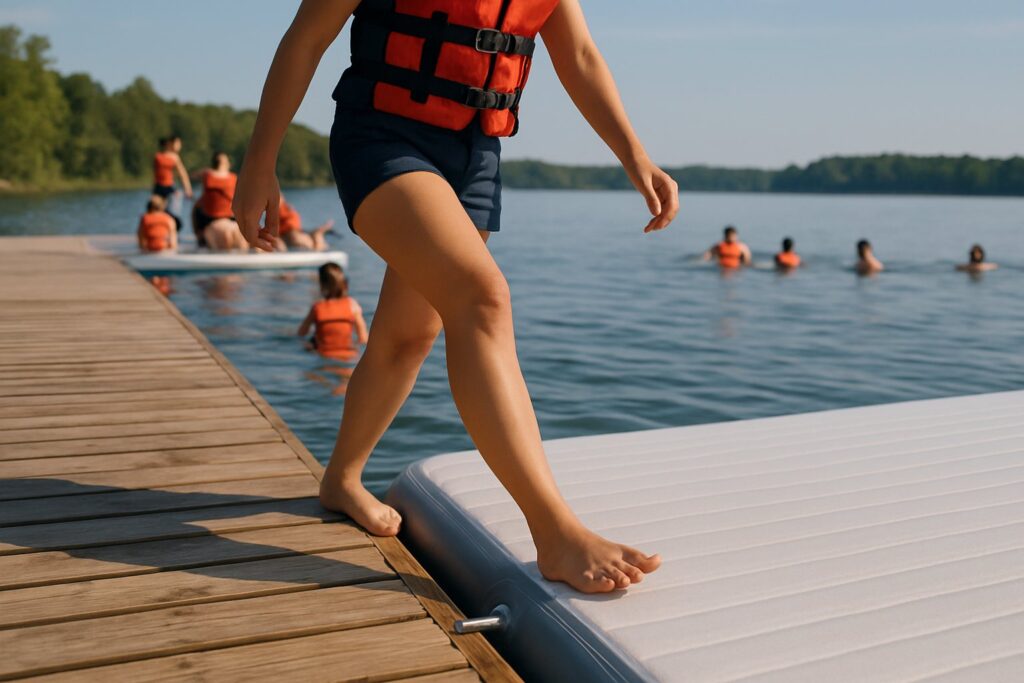
    Woman stepping from a wooden dock onto an adjoining inflatable dock

    In short: a floating dock is a deck held up by buoyant floats (air chambers, foam-filled shells or an inflatable hull) and held in place by anchors, pipes or lines. Inflatable docks are usually the least expensive and the most portable, for day use and seasonal fun. Rigid plastic modular docks generally cost more but are built to stay out all season. Wood docks on floats look classic and can be built to any shape, with more upkeep.

    What is a floating dock?

    A floating dock is a platform that floats on the water’s surface and is held in position, rather than built on posts driven into the lake bed. The two big advantages: it stays the same height above the water when the level goes up or down, so stepping into a boat is always the same easy step, and it can go where the water is too deep, too soft or too changeable for a fixed pier. Floating docks range from a 10 ft inflatable deck you pump up for the weekend to long modular walkways at marinas. Our platform types guide shows where each kind fits in the wider family of floating platforms.

    How does a floating dock work?

    It’s buoyancy. Anything in the water is pushed up by a force equal to the weight of the water it pushes aside. The U.S. Geological Survey puts the weight of a cubic foot of fresh water at about 62.4 lb near freezing, a little less when warm; ocean water, with salt dissolved in it, is denser. So a float that pushes aside a lot of water gets a lot of lift, and as you step on, the dock sinks a little deeper until the lift matches the load. That’s why makers list a buoyancy or weight rating for each float or section, and why you should stay within the number they state, not one you work out yourself.

    The three kinds get their lift in different ways:

    • Inflatable: the whole dock is an air-filled drop-stitch hull, pumped hard (the makers we checked state about 5 to 15 psi) so it stays flat.
    • Rigid modular plastic: molded polyethylene sections. Connect-A-Dock says its float chambers trap air on the water’s surface for extra buoyancy; other makers, such as Wave Armor, fill their shells with foam.
    • Wood on floats: a timber frame and deck bolted to separate floats, usually polyethylene shells filled with foam, such as Taylor Made’s dock floats.

    Then something has to keep it from drifting off: anchors and chain or rope, pipes or pilings that the dock slides up and down on, or a hinged gangway to shore. Rigid kits usually come with connectors for pipe anchoring, and the pipe itself may be sold separately, so check what’s in the box. For inflatables, our guide on how to anchor an inflatable platform covers the options.

    Inflatable vs rigid vs wood floating docks compared

    Inflatable drop-stitchRigid modular plasticWood on floats
    Maker-stated rating, examples1,800 lb, 10 adults, for a whole 10 x 10 ft dock (RAVE)690 lb per 60 x 45 in section (Connect-A-Dock 1000 Series)335–1,200 lb approximate flotation per float, by size (Taylor Made; buoyancy, not a deck rating)
    Height above waterAbout 6 in (dock thickness)About 8 in (1000 Series); 17 in (2000 Series)Depends on the build
    Weight to handleAbout 35–83 lb for the decks we checked; rolls upAbout 110 lb per section (Connect-A-Dock 1000 Series)Floats plus lumber and hardware
    SetupMinutes: pump, tie, anchorBolts together with hand tools; pipe or anchor installA building project
    Stays out all season?Mostly a seasonal or day dockYes; maker advises removal where ice shiftsYes, if built and anchored for it
    Typical costFrom several hundred to around two thousand dollars at the makers’ list pricesEven a short starter kit can run to several thousand dollarsFloats bought per piece, plus lumber, hardware and labor

    Price ranges are from makers’ and retailers’ listings checked in October 2026 and change often.

    Inflatable floating docks: when they win

    An inflatable dock wins when you want a floating dock sometimes: on the boat, at a rented cabin, at a lake where you can’t install a structure, or as a swim deck for the summer. It goes from a bag to a 100 sq ft deck in minutes, usually costs much less than a rigid dock of similar size, and is soft on hulls and shins. Makers publish clear figures: RAVE rates a 6 in thick 10 x 10 ft dock for 1,800 lb or 10 adults, and Island Hopper rates a 10 x 6 ft dock with corner bumpers, built to tie up alongside a boat, for 1,500 lb. The trade-offs: it moves more underfoot than a heavy rigid dock, needs pumping and checking, and many are designed to come in rather than stay out all year. For boat use specifically, see boat swim platforms. Our inflatable docks page goes deeper, and what is drop-stitch explains why they’re so stiff.

    Rigid modular plastic docks: when they win

    A rigid plastic dock wins when the dock lives at the water: a lake house, a pond you own, a busy shoreline. Sections clip or bolt together into straight runs, L and T shapes, and add-ons like kayak or jet ski ports (see modular platforms). Connect-A-Dock’s 1000 Series sections are 60 x 45 x 10 in, weigh about 110 lb and are rated for up to 690 lb each, with the deck about 8 in above the water; its 2000 Series sections are rated for up to 2,500 lb with the deck about 17 in up. The maker says freezing won’t harm the dock but recommends taking it out for winter where ice shifts, and says no sanding or sealing is needed. The trade-offs are cost (even a short starter kit can run to several thousand dollars) and that it’s a permanent structure that may need a permit.

    Wood floating docks: when they win

    Wood wins when you want a dock that looks like it belongs at an old lake cabin, or a size and shape no kit offers. The deck is timber; the lift comes from floats underneath. Taylor Made’s dock floats, for example, are UV-resistant polyethylene shells filled with EPS foam, with approximate flotation from 335 to 1,200 lb depending on size and an 8-year flotation warranty; the maker notes they are not designed to attach to each other, so the frame does that job. Some lake authorities set rules on floats. The Tennessee Valley Authority, for one, requires flotation commercially made for marine use, bans bare (unencased) foam for new work, and requires existing unencased foam to be replaced by December 31, 2031. The trade-offs: you (or a builder) design and build it, the wood needs care over time, and the floats must be sized correctly for the deck. Ask the float maker or a dock builder rather than guessing.

    Living with each type: a season, step by step

    Spring. An inflatable comes out of its bag, gets pumped to the maker’s psi and is tied off in an afternoon. A rigid modular dock goes back in, or simply stays where it wintered if the maker and your lake allow it; check the connectors and anchoring first. A wood dock gets its yearly look: loose boards, fasteners, and floats sitting level.

    Summer. The inflatable needs a pressure check on hot days and a rinse after salt water, and it should come in before storms. Rigid and wood docks mostly just sit there, which is their great strength, though anchors and lines still deserve a look after a big blow.

    Fall. The inflatable is cleaned, dried, deflated and stored cool and out of the sun. Rigid docks are pulled or left according to the maker’s advice for ice on your water. Wood docks on lakes that freeze often need a plan, too; ask the float maker or a local dock builder.

    Many families end up with both: a permanent rigid or wood dock at the shore and an inflatable that clips alongside for swimming or goes out on the boat. If you’re working out which inflatable, how to choose an inflatable platform walks through size and the maker’s rating; for kayak and paddle-board access off any dock, see launch platforms.

    Which floating dock should you choose?

    • Weekends, the boat, or a place you don’t own: inflatable.
    • Your own lake or pond frontage, used all summer: rigid modular plastic, if the budget allows. See floating docks for ponds and lakes.
    • A custom shape or a classic look, and you like building: wood on marine floats.
    • A dock that grows with you: rigid or inflatable modular platforms that add sections over time.
    • A jet ski that lives on the water: a rigid drive-on port; see floating dock for a jet ski.
    • Work, staging or commercial use: none of these consumer products. Use an engineered system with documented ratings; see commercial platforms and work platforms.

    Two things apply to all of them. Permanent docks are structures: under federal rules, the Army Corps of Engineers regulates structures, including boat docks, in navigable U.S. waters, and states and lake authorities add their own rules, so check before you build. And around any dock, the U.S. Coast Guard urges wearing a USCG-approved life jacket; on a recreational boat that’s underway, federal rules require children under 13 to wear one unless they’re below decks or in an enclosed cabin. Our safety checklist covers the rest.

    For a short list of inflatable picks, see BoatSlide’s best inflatable docks.

    Floating dock questions

    What’s the difference between a floating dock and a fixed dock?

    A fixed dock stands on posts in the lake bed and stays at one height, so when the water drops the step down into a boat gets bigger. A floating dock rides on the water and keeps the same height above it.

    Are inflatable docks as stable as plastic docks?

    A properly pumped drop-stitch dock is firm enough to stand and step on, but it is lighter and moves more with waves and when people crowd one edge. Heavy rigid sections, anchored on pipes or chains, move less.

    How is a floating dock held in place?

    With anchors and chain or rope, with pipes or pilings that the dock slides on as the water changes, or by tying it to shore or a fixed pier. Inflatable docks use their D-rings and anchor points; follow the maker’s instructions.

    Can a floating dock stay in over winter?

    It depends on the dock and the lake. Connect-A-Dock says freezing won’t harm its docks but recommends removal for winter where ice shifts. Inflatable docks are generally dried, deflated and stored; follow the maker’s instructions.

    Do I need a permit for a floating dock?

    Often, for a permanent one. Federal rules count boat docks as structures in navigable waters, and many states, counties and lake authorities have their own permits. A portable inflatable used for the day is a different case, but check local rules either way.

    Which floating dock is best for fishing?

    For a spot you fish all season, a heavier rigid or wood dock moves less when you cast. For trips, an inflatable you can pack works. Our fishing platforms page goes further.

    Can I connect an inflatable dock to my existing dock?

    Many people tie one alongside as a swim deck, using the inflatable’s D-rings and the maker’s instructions. Keep lines snug enough to stop it slamming in waves, and bring it in before storms.

    Keep exploring

    Go deeper on inflatable docks, see how a drop-stitch hull stays stiff in what is drop-stitch, plan a pond or lake dock with floating docks for ponds and lakes, browse the inflatable docks and guides categories, or begin at Start here.

  • Floating Docks for Ponds and Lakes: Kits vs Inflatable

    Floating Docks for Ponds and Lakes: Kits vs Inflatable

    It starts with a small wish. You want somewhere to sit with your feet over the water at sunrise, a spot where the kids can cast a line without wading through mud, a place to jump from on a hot July afternoon. A floating dock for a pond or lake gives you exactly that: a flat, steady deck that rises and falls with the water instead of standing on posts. This guide explains the two main ways to get one (a floating dock kit you assemble, or an inflatable dock you pump up), how to tell which suits your water, the anchoring basics and the permits to check before anything goes in.

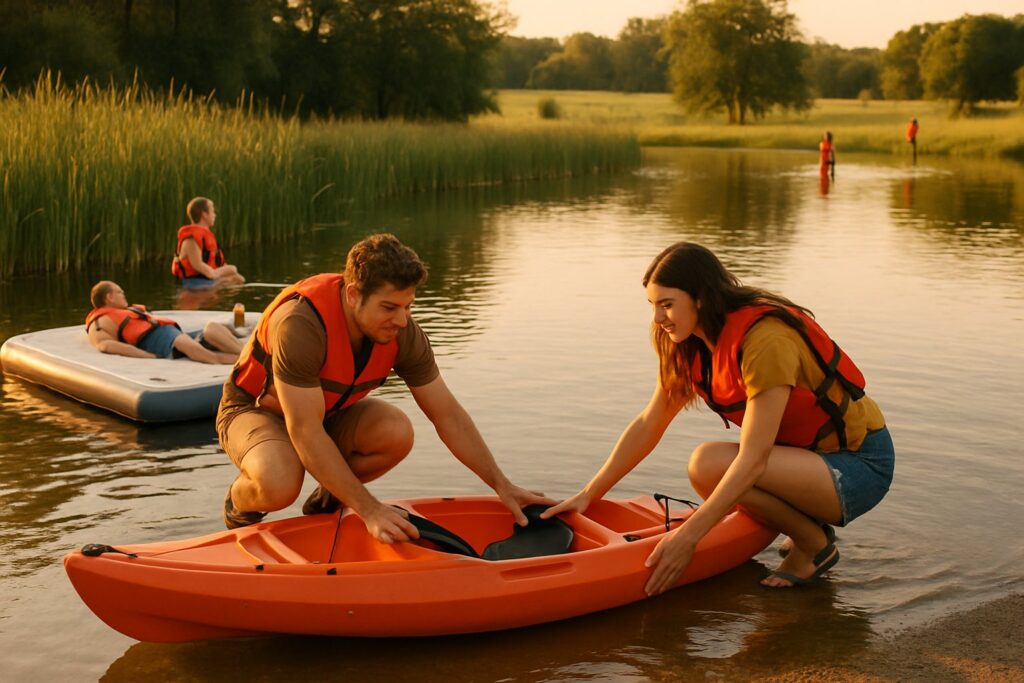
    Small inflatable dock on a farm pond with a couple launching a kayak

    In short: for a dock that stays out all season at a pond or lake house, a floating dock kit (plastic float sections or float drums under a deck) is the usual choice. For something you can set up for the day, move or store in a garage, an inflatable dock is lighter and usually less expensive to start with. Either way, anchor it the way the maker says and check your state and local rules first.

    If you’re new to the different kinds of floating platforms, our platform types guide gives the full picture; this article focuses on docks that live at a pond or lake.

    Pond or lake: what changes

    The same dock can feel very different on a quiet farm pond and on a busy lake, so start with the water, not the product.

    • Ponds are usually small, sheltered and calm. There is little wind fetch and no boat wake, so a lighter dock stays steady. The catches: ponds are often shallow near the bank, the bottom can be soft mud, and the water level can drop a lot in a dry summer. A floating dock handles level changes far better than a fixed one, as long as its anchoring lets it move up and down.
    • Lakes bring wind, chop and passing boats. A dock that is fine on a pond can bounce and tug at its anchors on a lake, so weight, thickness and solid anchoring matter more. Lakes also bring more rules: shared shorelines, navigation channels and, on some lakes, a utility or agency that manages the shoreline.
    • Depth. Check how deep the water is where the dock will sit, at the lowest level you expect. Makers state minimums for some products: RAVE asks for at least 4 ft under its inflatable docks, and Aquaglide asks for at least 4.8 ft for one of its large anchored lounge decks. Jumping needs more depth than that, so keep diving off any dock out of the plan unless you know the water is deep enough.
    • Winter. If your pond or lake freezes, plan to take the dock out. Connect-A-Dock, for example, says freezing will not harm its floats but recommends removing the dock for winter where ice shifts.

    Floating dock kits vs inflatable docks

    “Floating dock kit” covers two things. Some kits are complete systems of molded plastic float sections that lock together into a deck. Others are the parts to build your own: foam-filled float drums that bolt under a wood or aluminum frame you build or buy separately. An inflatable dock is different again: one drop-stitch PVC panel, often 6 in thick, that you pump up hard and tie down (our drop-stitch explainer shows why it stays flat). For a deeper look at the materials, see our inflatable vs rigid floating docks comparison.

    OptionWhat you getCapacity, as makers state it (examples)SuitsTypical cost
    Plastic float-section kitMolded sections that lock together, plus connectors, cleats and often a gangway hingeUp to 690 lb per 60 x 45 in section (Connect-A-Dock 1000 Series)Season-long pond or lake dockEven a short starter kit can run to several thousand dollars
    Float drums under your own frameFoam-filled floats; you build or buy the frame and deckingAbout 335–1,200 lb flotation per float, by size (Taylor Made)DIY builders, custom shapesPriced per float, plus lumber, hardware and labor
    Inflatable dock, large square (about 10 x 10 ft)One drop-stitch deck, usually with a hand pump1,800 lb, up to 10 adults (RAVE)Swimming and lounging, movableFrom several hundred dollars up, at makers’ list prices
    Inflatable dock, boat-size (about 10 x 6 ft)One smaller drop-stitch deck, often with bumpers1,500 lb (Island Hopper)Small ponds, boats, day useFrom several hundred dollars up, at makers’ list prices

    Cost ranges are from makers’ and retailers’ listings checked in October 2026 and change often. Buoyancy and capacity figures are not the same thing as “how many people can safely stand on it.” Use the people count and weight limit the maker states for the finished dock, and for a DIY build, follow the float maker’s sizing guidance rather than adding up drum ratings yourself.

    When a floating dock kit wins

    Choose a kit when the dock will stay in from spring to fall, when you want to tie up a boat, canoe or kayak, or when you want to walk out from the bank to deeper water. Connected plastic sections like Connect-A-Dock’s 1000 Series sit with the walking surface about 8 in above the water, and the maker says each section supports up to 690 lb. Kits usually include connectors and fittings for pipe anchoring, but the pipe for the pilings may not be in the box, so check and budget for it. Kits cost more up front, but there is nothing to pump and no seams to watch. If you want to grow the dock later, see how sections combine into L, T and square layouts on the modular platforms page.

    When a DIY float-drum build wins

    If you are handy and want a particular size or shape, float drums under your own frame are the most flexible route. Taylor Made, for example, makes its dock floats with a UV-resistant polyethylene shell filled with EPS foam and lists approximate flotation by size: 450 lb for a 24 x 48 x 12 in float and 600 lb for the 16 in tall version, up to 1,200 lb for its largest, with an 8-year flotation warranty. Lower floats suit a deck that sits close to the water but carry less each, so you need more of them. The maker also notes its floats are not designed to attach to each other; the frame holds everything together. You will also need a frame, decking, hardware and an anchoring plan, and the result is only as good as the build, so follow the float maker’s instructions closely.

    When an inflatable dock wins

    Choose inflatable when you want a swim platform out in the pond rather than a walkway from the bank, when you rent or might move, or when you need to pack it away after the weekend. A 10 x 10 ft inflatable gives 100 sq ft of deck; RAVE rates its dock of that size for 1,800 lb, or up to 10 adults or 14 children, and gives it two stainless steel anchor points. A boat-size 10 x 6 ft deck is lighter to carry (Island Hopper lists 53 lb for its own and rates it for 1,500 lb). Many come with a hand pump. They are softer underfoot than a hard dock and they need air checks, but they roll up for the winter. See more on the inflatable docks page.

    Getting from the bank to the dock

    On a pond, the trickiest part is often the first few feet: soft mud, reeds and a bank that drops off. Section kits and DIY docks often connect to shore with a hinged gangway or ramp, so the dock can rise and fall while the walkway pivots. An inflatable dock more often sits out in the water as a swim deck than joined to the bank, and people swim or paddle out to it. If you want an easy way to launch a kayak or paddle board from the dock, look at launch platforms, which add a low entry point.

    For a short list of inflatable picks, see BoatSlide’s best inflatable docks.

    Anchoring basics

    A floating dock must stay put sideways while still moving up and down with the water. How you do that depends on the dock and the bottom, and the maker’s instructions come first.

    • Pipe pilings are common for section docks near the bank. Section docks use pole anchoring connectors made for pipe driven into the bottom, so the dock slides up and down the pipe as the level changes.
    • Weights and lines suit docks farther out and most inflatables. Tie only to the anchor points or D-rings the maker provides. One large Aquaglide lounge deck shows how much this can take for a big platform left out all summer: at least 4,400 lb of total anchor weight across four anchor rings, at least 4.8 ft of water and at least 3.3 ft from shore.
    • Leave slack for level changes. On a pond that drops in summer, a tight line can pull a dock down at one corner. Check lines after storms and dry spells.
    • Use corrosion-resistant hardware. Connect-A-Dock recommends stainless steel or other non-corrosive materials for anchoring.

    Our step-by-step guide on how to anchor an inflatable platform covers anchor types, rope and scope in more detail.

    Permits: check before you build

    Rules depend on where the water is and who manages it, so treat this as a list of who to ask, not legal advice.

    • Federal: on navigable waters of the United States, the U.S. Army Corps of Engineers requires a permit under Section 10 of the Rivers and Harbors Act for structures, and its rules list boat docks and permanent mooring structures as structures. Many small private docks are covered by general permits, but you need to confirm that with your Corps district.
    • State: each state sets its own rules. Minnesota is a clear example: the DNR says no permit is needed for a dock on shoreline you own if, among other conditions, it is no more than 8 ft wide, no longer than needed to reach usable depth, not a hazard to navigation, lets water flow freely underneath, and follows local government guidelines.
    • Local: counties, towns, lake associations and HOAs often add their own rules on size, placement and swim rafts, and some lakes are managed by a utility or agency with a shoreline permit of its own.
    • Private ponds: a pond entirely on your land often has the fewest rules, but check with your county or state anyway, especially if a stream flows through it.

    Safety on a pond or lake dock

    Docks make swimming feel easy, which is part of the danger. The U.S. Coast Guard points out that most boating-related drownings happen on nice days, that adult life jackets may not work for children, and that child-size life jackets are available. Keep a properly fitted, Coast Guard approved life jacket on young children and weak swimmers, stay within the maker’s stated capacity, and keep someone watching the water whenever kids are swimming. Our inflatable platform safety checklist covers weather, inspection and kids in more detail.

    Care through the season

    • After storms and dry spells: check anchor lines, pipe fittings and connectors, and re-level the dock if one corner sits low.
    • Inflatables: check the pressure against the maker’s psi, especially on hot days, and rinse off algae and grit so they don’t wear the surface.
    • Wood decks: look for loose boards and fasteners, and keep floats sitting level under the frame.
    • End of season: lift out where ice will shift, or follow your maker’s winter advice; clean, dry and store inflatables out of the sun.

    How to choose, in five steps

    1. Measure the depth where the dock will sit, at the lowest water level you expect.
    2. Decide on its job: a walkway from the bank and boat tie-up (kit), or a swim and sun deck out in the water (inflatable or a free-floating kit dock).
    3. Check the rules with your state, county and lake association.
    4. Plan the anchoring before you buy, including pipe, weights or lines not in the box.
    5. Plan for winter: where it goes, and whether you can lift it out.

    If you’ve settled on an inflatable, how to choose an inflatable platform goes through size and the maker’s rating in more detail. For what you’ll do once it’s in, see our pages on fishing platforms and family lake days.

    Pond and lake dock questions

    What is the best floating dock for a small pond?

    For a dock that stays out all season, a short floating dock kit or a small DIY deck on float drums is the usual choice. For a swim deck you can take in after the weekend, a 10 x 6 ft or 10 x 10 ft inflatable dock works well on calm water. Check the depth first; some makers state a minimum, such as RAVE’s 4 ft for its inflatable docks.

    Do I need a permit for a floating dock on my pond?

    It depends on the state, the county and whether the water counts as navigable or public. A pond fully on your land often needs little, but rules vary, so check with your state natural resources agency and county before you build.

    How much weight does a dock float hold?

    Each float has a buoyancy rating from its maker; Taylor Made, for example, lists about 335 to 1,200 lb depending on size, with 600 lb for a 24 x 48 x 16 in float. Buoyancy is not the same as a safe load for people. Size your build with the float maker’s guidance.

    Can I leave a floating dock in over winter?

    Where the water freezes, makers generally advise taking it out. Connect-A-Dock says its floats are not harmed by freezing but recommends removal where ice shifts. Inflatable docks are generally cleaned, dried, deflated and stored out of the sun; follow the maker’s instructions.

    Is an inflatable dock stable enough for a lake?

    On calm days, a drop-stitch dock inflated to the maker’s pressure is firm enough to stand, sit and climb onto. Wind and boat wakes make any inflatable move more than a heavy kit dock, so anchor it at the maker’s points and bring it in when storms are coming.

    Would a floating mat work instead of a dock on a pond?

    For play, yes, as long as the water is deep enough for the maker’s minimum. A foam mat flexes and isn’t something to tie a boat to or set a chair on. Our inflatable platform vs floating mat guide compares the two.

    Can I tie a jet ski to a pond or lake dock?

    You can tie one alongside a sturdy dock, but if the jet ski lives on the water, a drive-on port is the usual answer. See floating dock for a jet ski.

    Keep exploring

    Weigh the materials in inflatable vs rigid floating docks, read more about inflatable docks, browse the inflatable docks and uses categories, or go back to Start here.

  • Floating Dock for Jet Ski: Inflatable vs Drive-On Ports

    Floating Dock for Jet Ski: Inflatable vs Drive-On Ports

    The best part of a jet ski day is the bit nobody films: idling back to the cabin at golden hour, sliding up to something solid, and stepping off dry instead of wading in and dragging the ski off the sand. A floating dock for jet ski owners gives your PWC a place to rest that rises and falls with the lake, and gives you a clean step on and off. There are two very different kinds: soft inflatable docks that roll up into a bag, and rigid drive-on ports you power onto and that stay out all season. This guide compares them: how each works, the shapes and sizes, what makers state about weight, what they cost, and how to look after them.

    Rigid drive-on jet ski port next to an inflatable jet ski dock

    In short: an inflatable jet ski dock (U, L, T or E-shaped drop-stitch, listed from under $200 to around $670 in October 2026) is a portable place to tie up and step off for the day. A drive-on PWC port (rotomolded plastic with rollers or wheels, about $1,700 to $2,700 per port at list) lets you drive the ski partly out of the water and leave it there all season. Pick inflatable for travel and day use, drive-on for a home dock.

    Two kinds of floating dock for jet ski owners

    Inflatable jet ski docks are 6 in thick drop-stitch PVC, the same construction as inflatable paddle boards, pumped hard with a hand pump. They come in shapes that wrap around the ski: a U with a slot you nose into, an L you tie alongside, a T, or a big E with two slots. They have an EVA foam top for grip, D-rings for mooring lines, and soft edges that work as a fender. Most roll up into a bag that fits in a trunk. Our drop-stitch explainer shows why a pumped-up deck this thin can still feel firm.

    Drive-on PWC ports are rigid floating cradles made of rotationally molded polyethylene. You idle up, give a little throttle, and the hull rides up a set of rollers or wheels until a bow stop catches it. The ski sits mostly out of the water, and you back off to launch. They attach to an existing floating or fixed dock (or float on their own, anchored) and are designed to stay in the water for the season. Wave Armor, for example, describes its smallest port as foam-filled polyethylene with 12 adjustable wheels and a rubber bow stop; EZ Dock says the adjustable roller system on its EZ Port 2i adapts to different hull shapes.

    Inflatable vs drive-on: how they compare

    Inflatable jet ski dockDrive-on PWC port
    What it isDrop-stitch PVC, 6 in thick, EVA topRotomolded polyethylene, often foam-filled, with rollers or wheels
    Where the ski sitsIn the water, tied in a slot or alongsideMostly out of the water on the port
    SetupPump up, tie off, deflate and pack afterInstalled and connected to a dock or anchored; stays out
    Portable?Yes, rolls into a bag; a U-shaped one we saw weighs 39 lbNo; one maker lists 180 lb for its smallest port and 350 lb for a larger one
    Weight ratingThe listings we checked state none in poundsStated by makers, for example 700 lb for Wave Armor’s smallest port and 1,700 lb flotation capacity for EZ Dock’s EZ Port 2i
    Typical price, Oct 2026Under $200 to around $670About $1,700 to $2,700 per port at list, before installation
    Best forDay trips, rentals, lake houses without a dock, boat-side dockingA home or marina dock where the ski lives all summer

    The same air-vs-plastic trade-off applies to docks in general; inflatable vs rigid floating docks goes deeper on stability, cost and how long each lasts.

    Inflatable jet ski dock shapes explained

    The shape decides how you dock, so it’s worth picking before anything else.

    • U shape: a deck with a slot you nose the ski into, so there’s dock on three sides. U docks we saw were around 8 x 8 ft, and one maker gives its slot as 4 ft wide and 4 ft deep. The U also acts as a buffer around the hull.
    • L shape: a long, narrow arm (about 2 ft wide on the one we looked at) with a short foot. You tie the ski alongside. It’s more of a big fender and step-off than a place to hang out, and it comes in left- and right-hand versions.
    • T shape: a stem with a crossbar, which gives you more edge to tie up along and step off from.
    • E shape: two slots with a deck between them, for two skis side by side; the one we saw was 15 x 8 ft.

    All of them tie off with lines to D-rings; look for rings on top and underneath so you can run lines to both the ski and an anchor.

    Sizing the dock to your ski

    Start with two numbers from your owner’s manual: the ski’s width (beam) and its dry weight. Sea-Doo, for example, lists its Spark at 46 in wide and 443 to 473 lb dry depending on version, and larger three-seat models are wider and heavier. For a U or E dock, compare the beam with the slot width: a 46 in hull in a 48 in slot leaves only about an inch each side, so check the seller’s slot size carefully. For a drive-on port, compare dry weight plus fuel and gear with the maker’s stated capacity, and check which hulls the maker designed it for. Wave Armor, for instance, says its smallest port is made for smaller, lightweight PWCs such as the Sea-Doo Spark and Yamaha EX series and stand-up models, while EZ Dock says its EZ Port 2i is designed for today’s larger three-seaters.

    Floating jet ski dock price

    Here are the ranges we found in October 2026. Inflatable jet ski docks at a major retailer ran from under $200 for a narrow L-shaped step-off, through about $340 to $550 for U shapes, to around $670 for a large two-slot E. Rigid drive-on ports cost a lot more: Wave Armor’s list prices ran from $1,725 to $2,699 per single port, with an inline double port at $5,199. EZ Dock doesn’t publish prices; it sends buyers to a local distributor for a quote.

    The sticker price isn’t the whole bill for a rigid port. Wave Armor notes that connection kits and accessories for its smallest port are bought separately, and one dealer we checked lists installation, anchoring equipment and shipping as extras. If you don’t already have a floating dock to attach it to, budget for that or for anchoring the port on its own. Inflatable docks usually include a hand pump, ropes and a repair kit; anchors and an electric pump are extra.

    How docking works, step by step

    At an inflatable dock: approach slowly into the wind or current, ease alongside or nose into the slot, shut the engine off, then step onto the middle of the deck rather than the edge. Run a bow line and a stern line to the D-rings so the ski can’t swing, and keep the dock itself anchored so it doesn’t drift with the ski attached. Never leave the engine running while people are on the dock or swimming nearby.

    At a drive-on port: line up straight, idle in, and give just enough throttle for the hull to ride up the rollers or wheels until the bow stop. Shut down, clip the bow, and step off onto the dock. To launch, push off or back down gently. Follow the maker’s instructions for your port; EZ Dock, for one, describes a built-in bow designed to keep the ski from overshooting.

    Care and the off-season

    Inflatable docks last longest when they come in after use. Makers of drop-stitch docks give similar care instructions; RAVE’s manual, for example, says to wash with mild soap and fresh water, avoid solvents and power washers, dry it completely, and store it rolled loosely in a cool, shaded place, off concrete and away from rodents. Keep it at the stated pressure while it’s out, since sun-warmed air raises the pressure. Inflatable jet ski dock warranties we saw ran from half a year to one year.

    Rigid ports are made to stay out longer. EZ Dock says its EZ Port 2i is built to withstand harsh sun, freezing temperatures and salt water. Where ice shifts in winter, some polyethylene dock makers advise taking sections out; ask your dealer what they recommend for your lake.

    What to check before you choose

    • Your ski’s weight and hull. Find the dry weight in your owner’s manual and compare it with the port’s stated capacity. Some ports are made for smaller skis, others for bigger three-seaters. If an inflatable dock states no limit, ask the seller.
    • The slot size. For U and E shapes, measure your ski’s beam and compare it with the slot.
    • Day use or all season. One inflatable jet ski dock seller describes its docks as great for temporary docking. If the ski will live on the water, a drive-on port is the product built for that.
    • What it connects to. Ports usually bolt or clip to an existing dock with connection kits (Wave Armor sells kits for other brands). Inflatables tie off with lines to D-rings and need their own anchors; our anchoring guide explains how.
    • Warranty. We saw half a year to one year on inflatable jet ski dock listings. Rigid port warranties vary by maker and dealer; ask.
    • Local rules. A port that stays out is a structure. In navigable U.S. waters the Army Corps of Engineers regulates structures, and states and lake authorities have their own rules. Ask before you install.

    One safety note for every jet ski day: PWC rules are set by each state. In Virginia, for example, the operator and every rider must wear a USCG-approved life jacket (inflatable life jackets are not allowed), the operator must attach the engine cut-off lanyard to themselves, their clothing or their life jacket, and PWCs may not be operated between sunset and sunrise. Check your own state’s rules, keep the engine off when people are swimming around the dock, and run through our inflatable platform safety checklist if the dock doubles as a swim spot.

    For more on how inflatable docks hold a boat and feel underfoot, see our inflatable docks page. For kayaks and SUPs as well as skis, launch platforms compares ramps, rollers and low decks, and if you’d like to build a dock layout that a port clips onto, modular platforms explains connectors and shapes. Planning a dock for your own shoreline? Read floating docks for ponds and lakes. Running jet ski rentals? Our rental and tour operator page covers commercial use. For a short list of picks, see BoatSlide’s best inflatable docks.

    Jet ski dock questions

    Can you drive a jet ski onto an inflatable dock?

    Some sellers say you can drive onto their inflatable docks, but none of the listings we checked gives a weight rating in pounds. Most inflatable jet ski docks are designed so the ski floats in the slot, tied off. To drive the ski up and out of the water, a rigid drive-on port with rollers is the product made for it.

    How much does a floating jet ski dock cost?

    In October 2026 we saw inflatable jet ski docks from under $200 to around $670 at a major retailer, and rigid drive-on ports from about $1,700 to $2,700 per port at one maker’s list prices, before connection kits, installation, anchoring and shipping.

    What size floating dock do I need for a jet ski?

    For a U or E dock, the slot must be wider than your ski’s beam, with some room to spare; for a port, its stated capacity must cover your ski’s dry weight plus fuel and gear, and the maker should list your hull type. Check both numbers in your owner’s manual before you choose.

    Can one dock hold two jet skis?

    Yes. E-shaped inflatable docks have two slots with a deck between them. On the rigid side, makers sell double ports and you can connect two single ports to a dock.

    Do drive-on jet ski ports work in salt water?

    EZ Dock says its EZ Port 2i is built to withstand salt water as well as sun and freezing temperatures. Check each maker’s statement; some hardware differs between fresh and salt water.

    Can I leave my jet ski on an inflatable dock overnight?

    Inflatable jet ski docks are sold mostly for day and temporary use. Overnight wind and wakes can work a ski against the dock, so a trailer, a lift or a drive-on port is safer for long stays.

    Is a PWC lift the same as a floating port?

    No. A floating port floats and rises and falls with the water. A lift is usually a frame standing on the lake bed that raises the ski with a crank or motor. Lifts suit fixed docks in shallow water; ports suit floating docks and changing water levels.

    Keep exploring: browse every article in inflatable docks, see all nine kinds side by side on floating platform types, find ideas for paddling and riding on water sports and fitness, or go back to Start here.

  • Kayak Launch for Docks: Kayak, SUP and Jet Ski Launch Platforms

    Kayak Launch for Docks: Kayak, SUP and Jet Ski Launch Platforms

    The hardest part of a paddle is often the first ten seconds: one foot on a fixed dock, one foot in a kayak that slides away, a paddle in your teeth. A kayak launch for a dock fixes that moment. It is a low, guided platform that holds the craft steady while you sit down, then lets you push off. Jet skis have their own version, the drive-on port, and stand-up paddlers want something low enough to step down onto the board. This page is about equipment and weight: what each launch is built to hold, how you get in and out, and what to check before you choose one.

    Inflatable launch platform with a kayak, paddle board and jet ski

    In short: match the launch to your craft first (its width, its weight with gear, and for a jet ski its dry weight), then to your dock (fixed or floating, and how high it sits above the water). Use only the capacity and craft sizes the launch maker states, and check that the maker allows the way you plan to attach it.

    Start with your craft: what to check for each

    Every launch is designed around a craft. A kayak launch cares about the width of the hull and where you sit; a jet ski port cares about the weight of a machine that is several hundred pounds before anyone climbs on. Look up your craft’s numbers on its maker’s spec sheet before you compare launches.

    CraftWeight to look upWhat to check on the launch
    Kayak or canoeHull weight from the maker, plus seat, gear and any pedal driveMaximum craft width (one floating launch takes 34 in and under), entry width, grab bars, whether the launch floats or adjusts to water level
    Fishing or pedal kayakThe rigged weight, not just the bare hullThe launch maker’s stated kayak weight limit (one lift-style launch lists 250 lb standard and 350 lb heavy-duty), entry width
    Stand-up paddle boardBoard weight plus rider, as the board maker rates itA low deck close to the water, a guided slot or edge you can kneel from, and paddle notches
    Jet ski (PWC)Dry weight from the PWC maker (Sea-Doo lists 443 to 473 lb for its 2027 Spark X Trixx), plus fuel and gearThe port or ramp maker’s stated watercraft weight (EZ Dock gives its EZ Port 2i a 1,700 lb flotation capacity), length, rollers, bow stop

    Your own weight matters in a different way. On a kayak launch you are lowering yourself into a seat, so what counts is how well the launch holds the boat still and how many handholds it gives you. On a jet ski port you step on and off the deck, so check that the walking surface is slip-resistant and wide enough to stand beside the craft.

    Kayak launch for a dock: kayak and SUP launches

    A kayak launch is a cradle that sits beside your dock. You slide the kayak in, it rests at water level between guide rails, you sit down while holding the bars, and you pull yourself out along the rails. The best ones solve the two problems of a normal dock: the boat floats away from you, and the dock is too high above the water to sit down safely. There are two main kinds.

    Floating launches are molded polyethylene and float, so they rise and fall with the water and the step-down stays the same all season. As an example of what makers state, YAKport lists its launch at 48 x 60 x 22 in outside with a 34 in wide inside slot, 99 lb, in UV-protected polyethylene, with guide rails on both sides, grab bars with paddle notches and an optional overhead handle. EZ Dock’s EZ Launch is a bigger one-piece unit at 58.5 x 168 x 25 in, with built-in handholds, a V-shaped entry that centers the kayak, entries on both sides and paddle notches.

    Lift-style launches sit beside a fixed dock on a frame that you raise or lower as the water level changes. One sold for fixed docks, the Golden Kayak Launch, is listed as welded aluminum with stainless steel cables and a brake winch, in 3, 5 and 7 step versions with entry widths from 34 to 56 in, rated by its maker for kayaks up to 250 lb (standard) or 350 lb (heavy-duty).

    Stand-up paddle boards launch most easily from something low. Kayak launches take SUPs too: YAKport’s instructions are to rest the board’s fins over the edge of the launch into the water, then back out. An inflatable platform anchored in open water is also low to the water, which makes kneeling onto a board easy. Before you tie an inflatable deck beside a dock as a launch, read its manual: RAVE, for example, tells owners of its Aqua Dock not to connect it directly to docks, piers or other hard objects. See inflatable docks for how those decks are meant to be used.

    Jet ski launch platforms: ports and shore ramps

    A jet ski needs a platform built for its weight. A drive-on port is a floating cradle with rollers: you idle up, ride onto it and the craft sits out of the water; to launch, you push off and it rolls back in. EZ Dock’s EZ Port 2i, for example, measures 168 x 59 x 15 in, has a 1,700 lb flotation capacity and adjustable rollers that adapt to different hull shapes, with a built-in bow stop so you don’t overshoot. It connects to EZ Dock sections or an existing dock, or it can be secured to the shore or lakebed without a dock.

    A shore ramp does the same job from a beach: rollers and a winch pull the PWC up out of the water. Aluminum shore ramps sold online are listed at about 11 to 15 ft long with stated limits of about 1,000 to 1,200 lb, and some include a winch and strap; check the stated craft length as well as the weight. Our floating dock for jet ski guide compares ports, ramps and U-shaped inflatable jet ski docks in more depth.

    Launch types compared

    Launch typeForGetting in and outWater levelWhat makers state (examples)
    Floating kayak launchKayak, canoe, SUPSlide in, sit down between rails, pull out along themFloats, so the step-down stays the sameA maximum craft width (34 in on one model); weight limit not always given
    Lift-style launchKayak, canoe, SUP at a fixed dockSteps down to a cradle at water levelRaised or lowered with a winch250 lb or 350 lb kayak by model on one listing; 34 to 56 in entry
    Anchored inflatable deckSUP, swimmers, small kayaksKneel or sit down from a low deckFloatsThe deck maker’s people and weight rating; some say not to attach to hard docks
    Drive-on PWC portJet skiDrive on, step off; push off to launchFloats1,700 lb flotation capacity on one model
    Shore rampJet ski, from a beachWinch the craft up onto rollersOn the beachAbout 1,000 to 1,200 lb and a maximum craft length

    How launches are built

    Floating launches and ports are molded polyethylene, the same family of material as plastic dock sections, with UV protection added because they sit in the sun all season. Lift-style launches are aluminum frames with stainless steel cables. Shore ramps are aluminum with stainless hardware and soft, nonmarking rollers, including a keel roller under the center of the hull. Inflatable decks are drop-stitch; our what is drop stitch explainer covers why they’re firm enough to kneel on but not designed as hard-dock attachments.

    Installing and attaching a launch

    How a launch attaches depends on your dock. YAKport says floating dock installations use a set of metal hinges and fixed dock installations use pole connectors with 2 in schedule 40 galvanized steel pipe, which isn’t included, and that the launch has three connection points on one side and two on the other for different anchoring options. EZ Dock’s launch and port connect to its own dock sections with the same couplers as the dock, or to an existing dock. If your dock is a modular system, a launch or port is often just one more section; see modular platforms. If the launch floats on its own, it still needs anchoring against wind and waves; our guide on how to anchor an inflatable platform covers anchors and line.

    A launch or port that stays in all season is part of your dock, so the same local rules apply. Structures in navigable waters can need a U.S. Army Corps of Engineers permit, and states and lake associations add their own rules, so check before you install. Our floating docks for ponds and lakes guide has more on permits and shore access.

    Care, winter and lifespan

    Polyethylene launches need little more than a rinse; EZ Dock says rain is normally all its products need to stay clean, and it uses UV-stabilized material for a longer life in the sun. Rollers, hinges, pins and winch cables are the parts to check each season, since they carry the load. Where lakes freeze, ask the maker whether to take the launch out for winter; one floating-dock maker says ice damage usually comes from the ice moving during the spring thaw. Inflatable decks used for launching come out of the water after each outing: rinse, dry, deflate and store them out of the sun. Warranties vary by maker and aren’t always published, so ask for the terms in writing.

    What a launch costs

    In October 2026, floating and lift-style kayak launches sold online were listed at roughly $2,000 to $2,200, and aluminum PWC shore ramps at roughly $900 to $1,000. Dock-system launches and drive-on ports are usually priced through dealers, often with installation. Budget for mounting hardware (pipe for a fixed-dock kit, for instance) and anchoring on top.

    How to choose a kayak launch system

    • Measure the widest point of your craft. A slot that’s too narrow simply won’t take the boat. Makers state widths like 34 in and under, or entry widths of 34 to 56 in by model.
    • Weigh it the way you paddle it. Use the rigged weight of a fishing or pedal kayak, and compare it with the launch maker’s limit, not a guess.
    • Know your dock. Fixed or floating, and how high above the water. A floating launch keeps the same step-down as the level changes; a winch launch needs adjusting.
    • Count the handholds. Grab bars on both sides and an overhead bar make the sit-down and stand-up moments far steadier.
    • Check the attachment kit. Floating and fixed docks use different hardware, and some kits need pipe you buy separately.
    • Plan for the life jacket. The Coast Guard treats a SUP used outside a swimming, surfing or bathing area as a vessel, so a life jacket is required, and kayaks and canoes need one for each person aboard.

    Who needs a launch, and what to compare it with

    A launch suits anyone who paddles or rides from the same dock often, especially older paddlers, kids and anyone with a heavy fishing kayak. If you mostly launch swimmers rather than craft, a boat swim platform or a low inflatable dock may be all you need. Paddling, yoga and fitness ideas are under water sports and fitness, and anglers will find more on fishing platforms. Rental businesses and watersports centers launching many craft a day should read rental and tour operators.

    Launch platform questions

    Can a kayak launch go on a fixed dock?

    Yes. Floating launches attach to fixed docks with pole connectors (YAKport’s kit uses 2 in pipe), and lift-style launches are made for fixed docks, with a winch to follow the water level. Floating docks use hinges or the dock system’s own couplers.

    How heavy a kayak can a launch hold?

    Only the launch maker can answer that. One lift-style launch is rated for kayaks up to 250 lb (standard) or 350 lb (heavy-duty); some floating launches give a width limit instead of a weight. If you can’t find a number, ask the maker before you buy.

    Can I launch a paddle board from a kayak launch?

    Usually, yes. Kayak launch makers list stand-up paddle boards along with kayaks and canoes; the board still has to fit the stated width, and YAKport says to rest the fins over the edge and back out.

    What’s the difference between a jet ski port and a shore ramp?

    A port floats at your dock and you drive on and push off. A shore ramp sits on the beach and a winch pulls the craft up onto rollers. Both should be chosen by the maker’s stated watercraft weight and length.

    Can I use an inflatable dock as a kayak launch?

    An anchored inflatable deck sits low and is easy to kneel from, so many people step onto a board from one. Follow the platform maker’s rules on where and how to attach it; some, like RAVE for its Aqua Dock, say not to connect it directly to docks or other hard objects.

    How much does a kayak launch cost?

    Kayak launches sold online were listed at roughly $2,000 to $2,200 in October 2026; dock-system launches are priced through dealers. Add mounting hardware and anchoring.

    Do I need a permit for a kayak launch or jet ski port?

    Possibly, if it stays in the water as part of your dock. Federal, state and local rules can apply, so check with your local permitting office or lake association first.

    Keep exploring: go back to all platform types, read our guide to choosing an inflatable platform and the safety checklist, browse every use in the uses category, or if you’re new here, start here.

  • Inflatable Docks: Tie Up, Step Aboard and Choose the Right One

    Inflatable Docks: Tie Up, Step Aboard and Choose the Right One

    You idle up to the lake house, cut the engine, and instead of jumping into knee-deep mud or hopping awkwardly onto a fixed pier, you step onto a firm, flat deck that rides at the same height as the water. Lines go on the D-rings, the cooler comes off, the kids climb out, and the boat sits there, fenders against a soft edge, until sunset. That’s what an inflatable dock is for: somewhere to tie up, step on and off, and hang out, that you can roll up and take home. This page is about docking: how an inflatable floating dock holds a boat or jet ski, how it feels underfoot, how it’s built, how it connects to shore, how to look after it, and whether it can stay out all season.

    Man tying a small sailing dinghy to an inflatable dock

    In short: an inflatable dock is a 6 to 8 in thick drop-stitch platform pumped hard (makers state anywhere from about 3.5 to 15 psi for their own models) so you can stand and step on it. Boat-style docks around 10 x 6 ft tie alongside a boat; U, L and T-shaped docks are made for jet skis; 10 x 10 ft decks suit a lake shore. Use the tie-down points and limits the maker gives, and treat most of them as seasonal, not permanent, docks.

    Can you tie up to an inflatable dock?

    Yes, within limits, and that’s what the D-rings are for. A good inflatable floating dock has stainless D-rings on several sides so you can run lines to a boat’s cleats or to anchors. RAVE’s 10 x 10 ft dock, for example, has 8 D-rings plus 2 dedicated anchor points underneath; Island Hopper’s 10 x 6 ft boat dock has stainless side D-rings and rubber bumpers on all four corners, which the maker says absorb impact from a boat hull, dock posts and the shoreline.

    Makers are cautious about what you tie to. RAVE’s owner’s manual warns that tethering its dock to boats, docks or other hard objects increases the potential for injury, tells you to keep it away from engines and propellers, and says not to connect it directly to docks, piers or other hard objects. So read your own manual before you tie a boat alongside. And an inflatable dock is not a mooring for leaving a boat unattended in wind and waves: it floats on the surface and moves with the water, so treat it as a place to tie up while you’re there. For a jet ski that lives on the water, rigid drive-on ports exist; our guide to the floating dock for a jet ski compares both.

    Matching the dock to your boat or jet ski

    Makers design different shapes for different jobs. This table shows the shapes and size classes sold for each kind of craft, from maker pages and retail listings we looked at in October 2026. It describes what each shape is pitched for; it is not a load or mooring rating. Always check the maker’s own limits for your boat and conditions.

    What you’re dockingShapes makers sellSize classes seenThicknessAttachments to look for
    Jet ski / PWCU, L, T and E shapes that wrap the hullU shapes around 8 x 8 ft with a slot about 4 ft wide; E shapes up to about 15 x 8 ft with two slots; narrow L step-offs about 2 ft wide6 inBumper edges, D-rings top and bottom, mooring ropes
    Ski boat, pontoon, small cruiserRectangular boat dock alongside or off the sternAbout 10 x 6 ft6 inCorner bumpers, side D-rings, grab handles
    Yacht or sailboat swim deckLong docks and swim-step extensions10 x 6 ft and longer6 inLadder, handles on every side, a way to join two docks
    Lake shore or private pierSquare decks and anchored lounge decksAbout 7 x 7 to 10 x 10 ft; lounge decks about 15 x 15 ft6–8 inAnchor points, handles for climbing out of deep water

    How an inflatable dock is built

    The core is a single drop-stitch chamber: top and bottom skins of coated fabric joined by thousands of threads, so the dock stays flat when pumped hard. Most docks are 6 in thick; some, like BOTE’s, are 8 in. Makers build the skin differently: Island Hopper describes heat-welded PVC with a reinforced 1000-denier outer fabric and no glued edges or corners, Aquaglide a 15 cm single-layer drop-stitch with welded seams, and RAVE a high-grade drop-stitch PVC. On top sits a non-slip foam pad, usually EVA, either across the whole deck or in zones. Around it you’ll find handles (RAVE puts ten neoprene-covered ones on its 10 x 10 ft dock), stainless D-rings, anchor points and, on boat docks, corner bumpers.

    Shape follows the job. Squares give the most room per foot of edge and suit a lake house. Rectangles about 6 ft wide fit off the back of a boat; Island Hopper points out that a 6 ft beam is what lets its dock be launched off smaller boats where a 10 ft platform couldn’t. U, L, T and E shapes leave a slot or a long edge for a jet ski. Weight goes up with size: makers list about 35 lb for a 7 x 7 ft deck and 53 to 83 lb for 10 x 6 to 10 x 10 ft docks, so the bigger ones are a two-person carry.

    How stable is it underfoot?

    Stepping from a boat onto a dock is where people slip, so the feel underfoot matters more than any spec. Drop-stitch construction joins the top and bottom skins so a properly pumped dock stays flat instead of bulging like a pool float (our page on what drop-stitch is explains why). Three things make it firmer: the right pressure (RAVE states 5 psi for its 10 x 10 ft dock, BOTE 6 to 10 psi depending on size, Island Hopper 8 to 15 psi), a non-slip foam top such as EVA, and a wider deck. It still rides the water: it rises with a wake and dips if everyone stands on one edge, and RAVE’s manual reminds owners that a floating product is not a stable surface and can shift quickly. A heavy rigid dock moves less, which our inflatable vs rigid floating docks comparison covers.

    Setting up and inflating

    Most docks come with a double-action hand pump, a carry strap or bag and a repair kit. Unroll the dock on a flat surface clear of sharp objects, or on a flat part of the boat with the motor off, as RAVE’s manual describes. Island Hopper says its 10 x 6 ft dock inflates in about 8 minutes with the included hand pump; bigger, higher-pressure docks take longer, and an electric pump that stops at a set pressure takes the effort out. Pump to the pressure printed for your model and no higher: RAVE says not to inflate its dock beyond 5 psi to avoid damage. If you inflate on land, carry it to the water with two or more people.

    Connecting to shore or a fixed dock

    At a lake house, the usual approach is to anchor the dock off the shore or beside a pier, rather than lashing it tight to a hard structure, because makers like RAVE warn against connecting directly to docks and piers. Use the anchor points so the wind can’t swing it. Some makers set minimums: RAVE asks for at least 4 ft of water under its docks; Aquaglide’s anchored lounge deck needs at least 4.8 ft of water, 3.3 ft from shore, and a total anchor weight of 4,400 lb, and the maker recommends a dock and mooring specialist. Our anchoring guide walks through anchor types, rope and scope, and floating docks for ponds and lakes covers smaller water. Placing any structure in public water can need a permit; in navigable U.S. waters the Army Corps of Engineers regulates structures, so check with your state and local authority before you set up a permanent spot.

    Can it stay out all season?

    Some are built to be anchored in place, but most are built to come in. Aquaglide’s lounge deck is designed for an anchored installation with heavy weights. RAVE, on the other hand, tells owners to deflate and store its dock when it’s not in use, and one jet ski dock seller describes its inflatable docks as made for temporary docking. If you keep a dock out for days at a time, keep it at the maker’s pressure (air expands as it warms in the sun), rinse off grime, check D-rings and seams, and bring it in before storms. RAVE also notes that keeping full pressure while it’s on the water discourages muskrats from chewing the vinyl. The National Weather Service says to get out of and away from lakes and other water immediately when lightning threatens.

    Care, storage and lifespan

    RAVE’s owner’s manual gives a routine that works for any inflatable dock. Carry it to land, or deflate it on a flat part of the boat, without dragging it. Wash it with mild soap and fresh water; never use petroleum-based cleaners, solvents or a power washer, which the maker says will damage it beyond repair. Let each side dry in the sun for 15 minutes or more, towel off what’s left, then fold and roll it loosely. Store it completely dry in a cool, dry, shaded place, off bare concrete and in a container rodents can’t chew through. For small holes, the included kit’s patches go on with glue and need a day to cure; for large tears or seam failures, contact the maker.

    How long will it last? No maker gives a number of years, and sun, storage and how it’s handled make the biggest difference. Warranties show what makers stand behind: Island Hopper gives five years with registration, RAVE a limited lifetime warranty for personal use, Aquaglide three years against manufacturing defects on its lounge deck, and BOTE two years. Read the terms: several cover personal use only.

    What an inflatable dock costs

    From makers’ own price lists in October 2026, drop-stitch docks from 10 x 6 ft to 10 x 10 ft were listed at roughly $750 to $1,000, and a large anchored lounge deck at about $2,000. Jet ski docks from lesser-known brands at a major retailer ran from under $200 for a narrow L-shaped step-off to around $670 for a large two-slot E shape. Budget too for an electric pump if you don’t want to hand-pump to high pressure, anchors and line, and a ladder if you’ll climb up from deep water. Whatever the price, compare the maker’s stated rating, warranty and minimum water depth before anything else; how to choose an inflatable platform walks through that.

    Who an inflatable dock suits, and who should pick something else

    An inflatable dock suits you if you want a firm place to step on and off a boat or jet ski for the day, you have no fixed dock or want a second one further out, you’ll take it home or store it at the end of the season, or you travel with the boat and need something that rolls into a bag. It’s also a good fit for renters and second-home owners who can’t build anything permanent.

    Pick something else if the boat or ski needs to live on the water all summer (a rigid drive-on port or a fixed dock is made for that), if you want a dock that stays in place for years with minimal setup (look at rigid modular platforms), if the main point is a protected swim spot behind a yacht (see boat and yacht swim platforms), or if kids just want something soft to run and bounce on (a floating mat is cheaper and simpler). And if you need to carry crews, tools or equipment, no recreational dock is the answer; that’s what engineered work platforms are for.

    Compare with other platform types

    An inflatable dock sits in the middle of the family. A boat swim platform is the same idea shaped and fitted to travel with a boat, with the focus on how many people fit and what they do at anchor. Launch platforms trade deck space for easier entry and exit from kayaks, paddle boards and jet skis. Modular platforms connect into bigger or odd-shaped layouts; note that not every inflatable dock links up (RAVE says its 10 x 10 ft dock doesn’t connect to its other products, while its Aqua Mat Deluxe models have connection features). For the soft alternative, read inflatable platform vs floating mat, and for the permanent one, inflatable vs rigid floating docks. All nine types are side by side on floating platform types.

    Before you choose an inflatable dock

    • Count the D-rings and where they are. You want points on the boat side, the anchor side and underneath.
    • Check the edge. Bumpers or soft rails protect gelcoat when the boat rocks against it.
    • Use the maker’s limit. Go by the stated weight and people count, never a guess from the size. If none is stated, ask.
    • Check the minimum depth in the manual against the water where it will sit.
    • Read what it may be tied to. Some makers say not to connect directly to docks, piers or other hard objects.
    • Plan the pump. Hand pumps come with most; an electric pump makes 10 to 15 psi much easier.
    • Wear life jackets. The U.S. Coast Guard urges everyone to wear a USCG-approved life jacket, and federal law requires children under 13 to wear one on a vessel underway (state rules can differ). Our safety checklist covers the rest.

    For a short list of picks, see BoatSlide’s best inflatable docks.

    Inflatable dock questions

    Can I leave my boat tied to an inflatable dock overnight?

    Makers sell these docks for tying up while you’re aboard or nearby, not as unattended moorings, and some advise against tethering to boats at all. Wind, wakes and storms can push a boat against a floating dock all night. Use your proper mooring or slip overnight.

    Is it easy to step from a boat onto an inflatable dock?

    Easier than from a ladder, because the deck sits low and flat on the water. Pump it to the maker’s pressure, keep the foam top clean, and step onto the middle rather than the edge.

    How thick should an inflatable dock be?

    Six inches is the common thickness for boat, lake and jet ski docks, and some docks, such as BOTE’s, are 8 in. Thicker docks generally flex less, but pressure and width matter too.

    How long does it take to set up?

    Island Hopper says about 8 minutes to inflate its 10 x 6 ft dock with the included hand pump, plus a few minutes to anchor or tie off. Bigger, higher-pressure docks take longer, and an electric pump speeds things up.

    How much does an inflatable dock cost?

    In October 2026, makers listed 10 x 6 to 10 x 10 ft drop-stitch docks at roughly $750 to $1,000 and a large anchored lounge deck at about $2,000. Jet ski docks from lesser-known brands started under $200.

    How long does an inflatable dock last?

    Makers don’t give a lifespan in years. Warranties run from two years to a limited lifetime for personal use. Cleaning with mild soap, drying fully, and storing it shaded, cool and away from rodents make the biggest difference.

    Can I connect two inflatable docks together?

    Only if the maker designed them to connect. Some models have link points; others, such as RAVE’s 10 x 10 ft dock, don’t connect to other products. If you want to grow a layout over time, look at modular platforms.

    Can an inflatable dock be used as a work platform?

    No. A recreational dock’s stated capacity is for people relaxing and swimming. Construction, inspection or maintenance access needs an engineered platform with documented ratings; see work platforms.

    Keep exploring: browse all inflatable docks articles, see the jet ski side in floating dock for jet ski, hold your dock in place with how to anchor an inflatable platform, or go back to Start here for the big picture.

  • Best Inflatable Kayaks for Boats 2026: 6 Picks (and Folding Kayaks for Yachts)

    Best Inflatable Kayaks for Boats 2026: 6 Picks (and Folding Kayaks for Yachts)

    The boat is anchored in a quiet bay, lunch is done, and there’s a little beach and a mangrove creek just too shallow to take the tender into. That’s the moment for a kayak: two of you paddling off to explore while the rest of the crew swims and naps. An inflatable kayak (or a folding one) makes that easy to bring along, because it packs into a bag or box that fits in a locker, and it won’t scratch the gelcoat when you launch from the swim platform. Here are the kayaks that make the most sense on a boat or yacht in 2026, compared by packed size, weight, capacity and price, with tips on choosing one.

    Prices change often. The prices below are what we saw at the maker or a major retailer in October 2026; check the current price before you buy.

    Our top picks

    Best for two

    Sea Eagle 370 Pro

    • 3 people or 650 lb
    • 32 lb
    • Packs to 31 x 19 x 8 in
    Check price on Amazon
    Best value

    Intex Excursion Pro K2

    • 2 people, 400 lb
    • Paddles and pump included
    • About $310
    Check price on Amazon
    Best folding kayak for yachts

    Oru Inlet

    • 20 lb
    • Folds to 42 x 10 x 18 in
    • No pump needed
    Check price on Amazon
    Toughest

    Sea Eagle 380x Explorer

    • 1000-denier hull
    • 3 people or 750 lb
    • Rated to Class IV
    See it at the store

    Kayaks for boats compared

    KayakLength / weightPacked sizeCapacityAbout (Oct 2026)
    Advanced Elements AdvancedFrame Sport10’5″ / 26 lb30 x 17 x 8 in1 person, 250 lb$330–570 (sellers vary)
    Sea Eagle 370 Pro12’6″ / 32 lb31 x 19 x 8 in3 people or 650 lb$449
    Intex Excursion Pro K212’7″ / 48 lb (maker)Not stated2 people, 400 lb$310
    Oru Inlet (folding)9’8″ / 20 lb42 x 10 x 18 in275 lb$899
    Oru Lake (folding)9′ / 17 lb42 x 10 x 18 in250 lb$499
    Sea Eagle 380x Explorer12’6″ / 40 lbNot stated3 people or 750 lb$1,060–1,150 (Pro package)

    The best kayaks to keep on your boat

    1. Advanced Elements AdvancedFrame Sport: best overall for one paddler

    Most inflatables wander from side to side; the AdvancedFrame Sport doesn’t, because aluminum ribs in the bow and stern give it a real shape and help it track straight. It’s 10’5″ long and 32″ wide, weighs 26 lb, and carries one paddler up to 250 lb (maximum paddler height about 6’2″). Four separate air chambers add a margin of safety, and the whole thing packs to about 30 x 17 x 8 in, small enough for most cockpit lockers. The version with a pump was $329.99 at Advanced Elements’ parent company (sold out when we checked); other retailers ask about $430–570.

    • Good: paddles more like a hard-shell kayak; light and compact.
    • Watch out: one seat only; price varies a lot between sellers.
    • Best for: solo exploring from the boat in calm bays and along the shore.

    Check the AdvancedFrame Sport price on Amazon

    2. Sea Eagle 370 Pro: best for two and the family

    The Sea Eagle 370 is the classic “kayak in a bag” for boats: 12’6″ long and 2’10” wide, it weighs 32 lb and carries three people or 650 lb, so two adults and a child, or one paddler with a cooler, fit. It packs to 31 x 19 x 8 in and inflates in about 8 minutes. The hull is 38-mil PVC and Sea Eagle rates it for up to Class III rapids, so a rocky beach landing won’t worry it. The Pro package adds two deluxe seats, two 7’10” paddles, a foot pump, a carry bag, a repair kit and an inflation gauge, for $449.

    • Good: big capacity for its weight and pack size; a complete package.
    • Watch out: wide and soft, so it’s slower and more affected by wind than a framed kayak.
    • Best for: couples and families who paddle together.

    Check the Sea Eagle 370 Pro price on Amazon

    3. Intex Excursion Pro K2: best value

    For about $310 from Intex, the Excursion Pro K2 gives you a full two-person setup: two adjustable bucket seats, two 86-inch aluminum paddles, a high-output pump, a carry bag, two removable skegs (for deep or shallow water), footrests, fishing-rod holders and stainless D-rings. It measures about 151 x 37 in (12’7″), is rated for two people and 400 lb, and is built from 3-ply laminated PVC that’s tougher than Intex’s pool-toy kayaks. Intex lists it at 48 lb; some retailers quote less, so plan for the heavier figure.

    • Good: the most kayak for the money; a full kit for two.
    • Watch out: the heaviest here; packed size not stated, so check your locker.
    • Best for: lake boats and casual paddling on a budget.

    Check the Intex Excursion Pro K2 price on Amazon

    4. Oru Inlet: best folding kayak for yachts

    Oru kayaks don’t inflate at all: they unfold, origami-style, from a box into a hard-sided boat, so there’s no pump and nothing to puncture on oysters or coral. The Inlet is 9’8″ long and 31″ wide, weighs 20 lb, carries up to 275 lb, and folds into a box of about 42 x 10 x 18 in that slides into a yacht’s lazarette or a sailboat’s quarter berth. Oru says setup takes about 3 minutes (reviewers say 3–5 the first few times). It’s made of UV-treated double-layer polypropylene, fits paddlers up to about 6’2″, and costs $899 with a 3-year warranty.

    • Good: no pump, no inflating; a crisp hard-shell feel; tidy flat box.
    • Watch out: the box is long (42 in); a big open cockpit means you’ll get splashed in chop.
    • Best for: yachts and sailboats where a pump and wet inflatable are a nuisance.

    Check the Oru Inlet price on Amazon

    5. Oru Lake: lightest

    The Lake is Oru’s simplest and least expensive kayak: 9 ft long and 32″ wide, 17 lb, up to 250 lb, and Oru says it sets up in about a minute (retailers say 1–3). It folds to the same 42 x 10 x 18 in box size as the Inlet. It’s designed for calm water, which is exactly what a sheltered anchorage usually is. Price: $499, or $699 for the Lake Sport with extra comfort features (18 lb).

    • Good: the lightest and fastest to set up here.
    • Watch out: made for calm water only; short and slower over distance.
    • Best for: short paddles from the boat to the beach and back.

    Check the Oru Lake price on Amazon

    6. Sea Eagle 380x Explorer: toughest

    If your kayak will be dragged over rocks, coral rubble and shell beaches, the 380x is built for it. The hull is 1000-denier reinforced PVC with a removable 4-inch drop-stitch floor, and Sea Eagle rates it for whitewater up to Class IV. It’s 12’6″ long and 39″ wide, weighs 40 lb, and carries three people or 750 lb, the most in this guide, with room for snorkel gear and a cooler. The Pro package was about $1,149 at Sea Eagle and about $1,060–1,100 at other dealers; the Pro Carbon package costs more.

    • Good: very stable and very durable; huge capacity.
    • Watch out: 40 lb and bulky packed; the most expensive inflatable here.
    • Best for: larger yachts and owners who explore rough shorelines.

    See it at Sea Eagle

    How to choose an inflatable kayak for your boat

    • Start with your storage space. Inflatables pack into a squarish bag (about 30 x 17 x 8 in for the AdvancedFrame Sport); Oru folding kayaks need a long, flat space of about 42 x 10 x 18 in. Measure the locker first.
    • Solo or tandem? A single is lighter and easier to handle off a swim platform. A tandem like the Sea Eagle 370 takes two adults, or one adult with a child and gear.
    • Think about the pump. A 12V electric pump that runs off the boat battery makes inflatables much quicker; a folding Oru needs no pump at all.
    • Leave capacity to spare. Add paddlers, a dry bag, snorkel gear and a cooler, and stay comfortably under the rating.
    • Rinse and dry before packing. Salt and sand wear seams and valves, and a kayak packed wet can grow mildew in a closed locker.
    • Bring a life jacket and a whistle. Wear a PFD, keep the kayak in sight of the boat, and stay out of channels and away from running props.

    Rounding out the boat’s toy box? See all our yacht toys guides, add an inflatable dock to make launching easier, and see our floating swim platforms for the people who’d rather stay and swim.

    Kayak questions

    How do you get into a kayak from a boat?

    From the swim platform: tie the kayak alongside or have someone hold it, sit on the platform’s edge, put your feet in the middle of the kayak, and lower yourself onto the seat, keeping your weight low and centered. Getting back out is the same in reverse.

    Are inflatable kayaks safe in the sea?

    Good ones are, in reasonable conditions. Look for several separate air chambers (the AdvancedFrame Sport has four; the Sea Eagle 380x has three) so one leak doesn’t sink you. Stay close to the boat or shore, watch the wind, and always wear a life jacket.

    Inflatable or folding kayak: which is better on a yacht?

    Inflatables pack into smaller, softer bags and carry more people for the money. Folding kayaks like Oru need no pump and feel more like a hard kayak, but the box is long and they suit calm water best. On a yacht with a long lazarette, many owners prefer folding; on a smaller boat, an inflatable usually fits better.

    How long does an inflatable kayak take to set up?

    Sea Eagle says the 370 inflates in about 8 minutes with its foot pump. Oru’s Lake unfolds in a minute or two and the Inlet in about 3. Add a few minutes for seats and fins.

    Can I leave an inflatable kayak inflated on deck?

    For a few days at anchor, yes, if it’s tied down so the wind can’t take it. Strong sun makes the air expand, so let out a little pressure on hot days, and pack it away, rinsed and dry, before a long passage.

  • Best Inflatable Paddle Boards for Boats 2026: 6 Picks That Pack Small

    Best Inflatable Paddle Boards for Boats 2026: 6 Picks That Pack Small

    Early morning at anchor, before anyone else is up: the water is flat as glass, coffee in hand, and you step off the swim platform onto a board and paddle along the shoreline while the cove wakes up. Later the same board becomes the kids’ diving platform and the dog’s sun deck. An inflatable paddle board is what makes that possible on a boat, because it rolls into a backpack that fits in a locker and pumps up hard enough to stand on. Here are the iSUPs that pack small and work well from a boat in 2026, with their sizes, rider limits, pumps and prices, and how to choose one for your boat.

    Prices change often. The prices below are what we saw at the maker or a major retailer in October 2026; check the current price before you buy.

    Our top picks

    Best overall

    Red Paddle Co 10'6 Ride MSL

    • 32 in wide, 4.7 in thick
    • Riders up to 220 lb
    • 5-year warranty
    See it at the store
    12V pump included

    iRocker All Around 11' Ultra 2.0

    • 12V electric pump in the box
    • 290 lb capacity
    • 21.4 lb board
    See it at the store
    Best value

    Atoll 11'

    • Full kit with carbon-wrapped paddle
    • 315 lb recommended max
    • 21 lb board
    See it at the store
    Most stable

    Gili Komodo 10'6

    • 33 in wide
    • Rated to 340 lb
    • Full kit with paddle
    See it at the store
    Lightest everyday board

    BOTE Breeze Aero 10'8

    • About 20 lb board
    • 26 lb packed bag
    • 250 lb capacity
    See it at the store
    Packs smallest

    Red Paddle Co 11' Compact MSL

    • Folds into a 75-liter backpack
    • Paddle included
    • Riders up to 242 lb
    See it at the store

    Paddle boards for boats compared

    BoardSizeBoard weightRider limitPumpAbout (Oct 2026)
    Red Paddle Co 10’6″ Ride MSL10’6″ x 32″ x 4.7″about 20–22 lb220 lbTitan II hand pump$949 (no paddle)
    iRocker All Around 11′ Ultra 2.011′ x 32″ x 6″21.4 lb290 lb12V electric$799–869
    Atoll 11′11′ x 32″ x 6″21 lb315 lbHand pump$550
    Gili Komodo 10’6″10’6″ x 33″ x 6″21 lb340 lbHand pump$549 list
    BOTE Breeze Aero 10’8″10’8″ x 33″ x 6″20 lb250 lbHand pump$420–670 (sellers vary)
    Red Paddle Co 11′ Compact MSL11′ x 32″ x 4.7″about 20 lb242 lbTitan II hand pump$1,499–2,099 (sources disagree)

    The best paddle boards to keep on your boat

    1. Red Paddle Co 10’6″ Ride MSL: best overall

    Red bills the 10’6″ Ride as the world’s favorite paddleboard, and it’s an easy one to recommend for a boat. It’s 10’6″ long, 32″ wide and 4.7″ thick, made from Red’s MSL laminated drop-stitch, and sits low on the water so it feels steady for new paddlers. Red’s US store lists the board at 21.9 lb (one retailer says 20 lb) and rates it for riders up to 220 lb. The standard package includes the ATB backpack bag, the Titan II hand pump, twin fins, a repair kit and a phone case; the paddle is an add-on. It’s $949 with a five-year warranty.

    • Good: stiff and stable for its thickness; the longest warranty here.
    • Watch out: paddle not included in the base package; lowest rider limit in this list.
    • Best for: owners who want one board that lasts many seasons.

    See it at Red Paddle Co

    2. iRocker All Around 11′ Ultra 2.0: best for boats with a 12V outlet

    Pumping a board to 15 psi by hand on a hot deck is nobody’s favorite job. The iRocker All Around 11′ Ultra 2.0 ships with a 12V electric pump, so you plug it into the boat’s socket and get on with lunch. The board is 11′ x 32″ x 6″, weighs 21.4 lb, and is rated to 290 lb, so a parent and a small child can ride together. iRocker uses a woven drop-stitch for extra stiffness and twin fins for straight tracking. The maker listed it at $869; Paddling Magazine’s buyer’s guide lists an MSRP of $799.

    • Good: electric pump in the box; high rider limit.
    • Watch out: 11 ft is long to handle on a small swim platform; iRocker aims it at paddlers about 5’9″ and taller.
    • Best for: boats with a 12V socket near the stern.

    See it at iRocker

    3. Atoll 11′: best value

    Atoll’s 11-footer is a complete kit for about $550: an 11′ x 32″ x 6″ board weighing 21 lb, a carbon-wrapped fiberglass paddle, a dual-action hand pump, a 10 ft coil leash, an 8-inch fin, a repair kit and a backpack with a front pouch. Atoll recommends a maximum rider weight of 315 lb and says it has tested the board with more than 500 lb spread over several riders. Its seams are heat-welded rather than glued, and the split fin box lets the board fold more compactly for storage.

    • Good: a better paddle than most kits at this price; high weight rating.
    • Watch out: hand pump only; warranty not stated on the product page.
    • Best for: getting a solid, full-size board on board without paying premium-brand prices.

    See it at Atoll

    4. Gili Komodo 10’6″: most stable

    At 33″ wide and 6″ thick, the Komodo is built for wobbly first-timers, yoga on a calm cove, or a paddler with a dog or child up front. It’s 10’6″ long, the board weighs 21 lb (37 lb for the whole kit), and Gili rates it to 340 lb, the highest here. The kit includes a fiberglass and nylon paddle, a hand pump, a backpack, a coiled leash and snap-in fins. Expect 7–10 minutes of pumping to reach 15 psi. List price is about $549, with a two-year warranty on the board.

    • Good: very stable; the highest weight rating in this guide.
    • Watch out: the 37 lb kit is the heaviest to carry; it was listed as unavailable on Amazon when we checked, so buy from Gili.
    • Best for: families, dogs and beginners.

    See it at Gili Sports

    5. BOTE Breeze Aero 10’8″: lightest everyday board

    BOTE’s Breeze Aero is a grab-and-go board: 10’8″ x 33″ x 6″, about 20 lb, and rated to 250 lb. Packed with its 3-piece paddle, center fin, repair kit and hand pump, the travel bag measures 38 x 18 x 12 in and weighs about 26 lb, which is easy to stow in a lazarette or a dinghy locker. It inflates to 10–15 psi and works with BOTE’s MAGNEPOD accessories (a magnetic cup holder is handy at anchor). Prices vary by seller and color: we saw about $669 at a BOTE dealer and around $420 on Amazon.

    • Good: light, wide and stable; a small, light bag.
    • Watch out: BOTE suggests a bigger board if you weigh within 50 lb of the 250 lb limit.
    • Best for: lighter paddlers and kids, and boats with little storage.

    See it at Pack & Paddle

    6. Red Paddle Co 11′ Compact MSL: packs smallest, for yachts

    Where locker space is precious, the Compact is the clever one. A flexible hinge in the middle lets the board fold as well as roll, so the whole kit (board, Titan II pump, 5-piece paddle, click-in fins, repair kit, phone case) fits in a 75-liter backpack of about 22 x 16.5 x 12.6 in. The board is 11′ x 32″ x 4.7″, weighs about 20 lb and takes riders up to 242 lb; Red suggests it for paddlers with some experience. Red’s US store showed $1,499 with a five-year warranty, while Paddling Magazine lists $2,099, so check the price.

    • Good: the smallest pack size for a full-length board; paddle included.
    • Watch out: the most expensive board here; rated for intermediate paddlers.
    • Best for: yachts, sailboats and anyone flying to meet the boat.

    See it at Red Paddle Co

    How to choose an inflatable paddle board for your boat

    • Measure your locker first. Most iSUP bags are about 38 x 18 x 12 in. If that won’t fit, look at a folding design like the Red Compact.
    • Width beats length for boat use. 32–33 in wide boards are steady when you step on from a swim platform, with kids, or in a little chop. Around 10’6″–11′ is the all-round sweet spot.
    • Leave room in the weight rating. Add your weight, a child or dog, and a dry bag, and stay well below the limit. A board near its limit sits low and feels sluggish.
    • Think about the pump. A 12V electric pump that runs off the boat battery saves a lot of sweat. If your board comes with a hand pump, many 12V SUP pumps are sold separately; check the valve fits.
    • Store it right. On a long trip, leave it inflated and tied down on deck; otherwise rinse off salt water, dry it, and roll it loosely. Keep it out of a baking-hot locker.
    • Leash and life jacket. Use the leash in open water. Outside swim areas the US Coast Guard treats a paddle board as a vessel, so carry a life jacket.

    Want more to do at anchor? Pair your board with a floating water mat or an inflatable dock to launch from, and browse all our yacht toys guides.

    Paddle board questions

    Can you launch a paddle board from a boat?

    Yes. Put the board in the water from the swim platform, hold it alongside, and kneel on it first in the middle, then stand once you’re clear of the boat. Make sure the engine is off and the board is clear of the props before anyone climbs on.

    How long does it take to inflate an iSUP?

    With a hand pump, about 7–10 minutes to 15 psi (Gili’s figure for the Komodo), and the last few psi are the hardest. A 12V electric pump does the work for you while you get the rest of the gear ready.

    Can two people ride one paddle board?

    An adult and a child, often yes, if the total is within the rating: the Gili Komodo is rated to 340 lb, the Atoll to 315 lb and the iRocker to 290 lb. Two adults on one board is usually more swim than paddle.

    Can I leave my paddle board inflated on the boat?

    For a few days, yes: tie it down securely on deck so wind can’t lift it, and keep it out of direct sun when you can. For longer storage, rinse, dry and deflate it, and roll it loosely.

    Is an inflatable board as good as a hard board?

    For a boat, it’s better: it packs into a bag, doesn’t ding the hull, and is softer to fall on. A good inflatable at full pressure feels close to rigid, though a hard board still glides a little better.

  • Best Sea Scooters 2026: 6 Picks to Keep on Your Boat

    Best Sea Scooters 2026: 6 Picks to Keep on Your Boat

    The anchor is down in clear water, someone has already found the snorkel bag, and the kids are hanging off the swim platform asking what’s under the boat. Hand them a sea scooter and the reef or the sandbar suddenly comes to them: a small battery-powered propeller you hold out in front of you that pulls you along at walking-to-jogging pace, on the surface or a few feet down. This guide compares the sea scooters that make sense to keep on a boat in 2026, by weight, speed, run time, depth and price, with a note on the Seabob for owners who want the luxury version.

    Prices change often. The prices below are what we saw at the maker or a major retailer in October 2026; check the current price before you buy.

    Our top picks

    Best overall

    Sublue MixPro 2026

    • Up to 60 min
    • 3 speeds, up to 4.0 mph
    • 7.8 lb, 131 ft rated
    Check price on Amazon
    Best value

    Sublue Mix 2026

    • Up to 45 min
    • 7.7 lb
    • Same 122 Wh battery as MixPro
    Check price on Amazon
    Smallest to stow

    Geneinno S2

    • About 5.8 lb
    • 97 Wh airline-friendly battery
    • About 45 min
    Check price on Amazon
    Fastest small scooter

    Yamaha Seawing II

    • Up to 5 mph
    • 8.15 lb
    • About 40 min
    See it at the store
    For divers on a yacht

    Sublue Navbow+

    • Depth, temperature and compass screen
    • Up to 4.5 mph
    • 131 ft rated
    Check price on Amazon
    Best for kids

    Asiwo Mako

    • Floats, surface only
    • Up to 60 min (slow speed)
    • Ages 12+, 265 lb buoyancy
    Check price on Amazon

    Sea scooters compared

    ScooterWeightTop speedRun time / depthAbout (Oct 2026)
    Sublue MixPro 20267.8 lb4.0 mphup to 60 min / 131 ft$699–729
    Sublue Mix 20267.7 lb3.6 mphup to 45 min / 131 ft$449–499
    Geneinno S2about 5.8 lb2.7 mphabout 45 min / 98 ft$380–400
    Yamaha Seawing II8.15 lb5 mph40 min / 100 ft$695–995 (sellers disagree)
    Sublue Navbow+7.5 lb + 2.4 lb battery4.5 mphup to 60 min / 131 ft$1,199
    Asiwo Mako (kickboard)5.7–7 lbabout 3.4 mphup to 60 min / surface$269

    The best sea scooters for boat owners

    1. Sublue MixPro 2026: best overall

    The MixPro is the scooter we’d leave in the cockpit locker for the whole season. It weighs 7.82 lb with its battery, measures about 18 x 9 x 9 in, and has three speeds (2.7, 3.4 and 4.0 mph). Sublue rates it to 131 ft (40 m) and up to 60 minutes of run time from a removable 122 Wh battery that recharges in two hours or less, which is easy to do from the boat’s inverter between morning and afternoon swims. A floater comes off if you want it to sink rather than float, and there’s a mount for a phone or action camera. Sublue recommends it for ages 14 and up and confident swimmers, with adult supervision below that.

    • Good: long run time for its size; fast charge; spare batteries swap in seconds.
    • Watch out: US orders come with one battery (EU orders get two); a second one is extra.
    • Best for: families and couples who snorkel at anchor most weekends.

    Check the Sublue MixPro 2026 price on Amazon

    2. Sublue Mix 2026: best value

    The Mix is the MixPro’s simpler sibling: 7.7 lb, two speeds (2.7 and 3.6 mph), the same 131 ft depth rating and the same removable 122 Wh battery, with up to 45 minutes of run time. It also has a detachable floater and takes an action camera. Sublue listed it at $449 on sale ($499 regular). Because the batteries are shared, a boat with one Mix and one MixPro can swap batteries between them.

    • Good: most of the MixPro for about $250 less.
    • Watch out: shorter run time and one fewer speed; no age guidance stated on the maker page.
    • Best for: a second scooter so two people can ride together.

    Check the Sublue Mix 2026 price on Amazon

    3. Geneinno S2: smallest to stow and fly with

    If space on board is tight, or you fly to meet a charter, the S2 is the one to pack. It weighs about 5.8 lb (one retailer says 5.9), is roughly the size of a 15-inch laptop, and its 97 Wh battery stays under the 100 Wh airline limit. Twin motors give two speeds, about 2.0 and 2.7 mph, for about 45 minutes, and it’s rated to 98 ft (30 m). An app shows speed, depth and battery, retailers list a child safety lock, and there’s a GoPro-style mount. We saw it for about $380–400 at major retailers.

    • Good: lightest full sea scooter here; airline-friendly battery.
    • Watch out: the slowest of the group, so it struggles more against current.
    • Best for: small boats, charter guests and travelers.

    Check the Geneinno S2 price on Amazon

    4. Yamaha Seawing II: fastest of the small scooters

    Yamaha’s compact scooter has two gears, up to 4.3 mph in low and 5 mph in high, from twin motors, which is quick enough to feel like a ride rather than a tow. It weighs 8.15 lb with its lithium-ion battery, is rated to 100 ft (30 m), runs about 40 minutes and recharges in about three hours. It’s neutrally buoyant in salt water, has a small OLED display for gear and battery, and takes an action camera. Prices vary a lot: we saw it from about $695 at one big retailer to $995 at another, so shop around.

    • Good: top speed; a well-known brand with dealers in many boating areas.
    • Watch out: the shortest run time here, and a three-hour charge.
    • Best for: adults who want speed for short snorkel runs from the boat.

    See it at Treshers

    5. Sublue Navbow+: best for snorkelers and divers on a yacht

    The Navbow+ is the step up for owners who dive off the swim platform. Its OLED screen shows heading, depth, water temperature, battery and speed mode, with a built-in compass. Three modes run at 2.2, 3.4 and 4.5 mph; Sublue quotes about 45 minutes in the slowest mode, 20 in Sport and 8 in Turbo, and up to 60 minutes in normal mixed use. It’s rated to 131 ft. The body weighs 7.5 lb plus a 2.4 lb, 158 Wh battery that charges in about 3.5 hours. It lists at $1,199.

    • Good: real dive information on the screen; strong pull.
    • Watch out: the 158 Wh battery needs airline approval to fly; Turbo drains it fast.
    • Best for: certified divers and keen snorkelers.

    Check the Sublue Navbow+ price on Amazon

    6. Asiwo Mako: best for kids

    For younger swimmers who just want to zip around the boat, a floating electric kickboard is a gentler start than a diving scooter. The Mako stays on the surface (Asiwo says it isn’t for diving), and you hold it like a kickboard with your head up. It has three speeds, the fastest about 5 ft per second, and runs 60, 35 or 18 minutes depending on speed. It supports up to 265 lb, a guard covers the propeller, and letting go of a button stops it. Asiwo recommends it for ages 12 and up with adult supervision. The maker lists 5.7 lb; the Amazon listing says 7 lb. Price: $269.

    • Good: floats, stops instantly, and costs the least here.
    • Watch out: surface only; full speed lasts under 20 minutes.
    • Best for: kids and teens playing around the swim platform.

    Check the Asiwo Mako price on Amazon

    The luxury option: Seabob

    On many yachts the “sea scooter” is a Seabob, a ride-on water sled you lie on, in a different league from the handheld scooters above. The current F9 weighs about 21 kg (46 lb), reaches up to 15 km/h on the surface and dives to 30 m, with about an hour of riding per charge; one US dealer lists it at about $11,500. The older, bigger F5 SR (about 35 kg, up to 22 km/h on the surface) sells for about €15,000 and up in Europe and about $17,500–20,000 in the US. Buy through an authorized dealer, and plan for space in the tender garage and a dedicated charger.

    How to choose a sea scooter for your boat

    • Count minutes, not miles per hour. Most families care more about run time than top speed. Quoted times are at the slowest setting; at full speed expect a fraction of them.
    • Plan your charging on board. Most chargers want household AC, so you’ll need shore power, a generator or an inverter. A spare battery doubles your day.
    • Check the battery size if you fly. Under 100 Wh (like the Geneinno S2) is usually fine in carry-on; 100–160 Wh needs airline approval.
    • Match it to the swimmer. Diving scooters are for confident swimmers; Sublue suggests 14+ for the MixPro. Younger kids do better on a floating kickboard on the surface.
    • Rinse and store dry. Rinse in fresh water after every salt-water day, charge the battery partway for storage, and keep it out of a hot locker.
    • Respect the boat. Engine off and props still before anyone rides near the stern, and a dive flag up when people are under water.

    Building a full toy box for the boat? See our yacht toys guides, add a floating swim platform for a place to rest between rides, and see our boat slides for the kids who’d rather fly than snorkel.

    Sea scooter questions

    How long does a sea scooter battery last?

    Most handheld models are rated for 40 to 60 minutes at a moderate speed: 60 for the Sublue MixPro, 45 for the Mix and Geneinno S2, 40 for the Yamaha Seawing II. Run it at full speed and that time drops a lot; the Navbow+ lasts about 8 minutes in Turbo.

    Can kids use a sea scooter?

    Yes, with supervision and the right model. Sublue recommends the MixPro for ages 14 and up, and Asiwo the Mako kickboard for 12 and up. For younger children, stay on the surface, in calm water, with a life jacket and an adult in the water.

    How deep can a sea scooter go?

    The scooters here are rated to 98–131 ft (30–40 m), which is deeper than recreational snorkelers will ever go. The depth rating is about the scooter’s seals, not a safe depth for you: only scuba-certified divers should take one below snorkeling depth.

    Can I take a sea scooter on a plane?

    Usually, in carry-on. Lithium batteries under 100 Wh, like the Geneinno S2’s 97 Wh, are normally allowed. The Sublue Mix and MixPro (122 Wh) and Navbow+ (158 Wh) need airline approval first. Check your airline before you travel.

    Does a sea scooter work in salt water?

    Yes, all the models here are made for the sea as well as lakes and pools. Rinse the scooter and battery contacts in fresh water after each salt-water day and let them dry before charging.