This article contains affiliate links: if you buy through them we may earn a commission, at no extra cost to you. Read our affiliate disclosure.
The first afternoon breeze on a lake is the test. A dock that was sitting nicely off the beach at breakfast starts to swing, drags a little, and by three o’clock it is nosing into the neighbor’s lift. Many floating dock problems come back to the same thing: anchoring a floating dock properly, with enough weight, the right lines and the right spot. This guide covers how to anchor a floating dock, inflatable or rigid, using the figures makers actually publish, and it tells you where they publish nothing.
In short: follow your maker’s numbers first. Aquaglide asks for at least 1,100 lb of total anchor weight on its Docking Station and 4,400 lb on its C Lounge; RAVE suggests about 150 to 200 lb for its 10 x 10 ft Aqua Dock, depending on the lake and bottom. Use anchors suited to your bottom, lines with enough scope (boating guides use 5:1 to 7:1 for boats), a bridle where the dock has several anchor rings, and keep the dock away from piers, boats and other hard objects. Rigid docks are pinned with pipes, deadweights, piling brackets or stiff arms.
Start with what your dock maker says
Makers publish very different anchoring figures, because their docks are very different. These are the ones we found, as the makers state them:
| Dock | Anchor points | Anchor weight | Depth and distance |
|---|---|---|---|
| Aquaglide Docking Station (14 ft 9 in x 10 ft 5 in) | 5 anchor rings | At least 1,100 lb (500 kg) total | At least 4 ft deep, 10 ft from shore |
| Aquaglide C Lounge (14.7 ft) | 4 anchor rings | At least 4,400 lb (2,000 kg) total | At least 4.8 ft deep, 3.3 ft from shore |
| RAVE Aqua Dock 10 (10 x 10 ft) | 2, one at each end on the bottom | About 150 to 200 lb, depends on lake and bottom (RAVE FAQ) | At least 4 ft deep |
| Rigid sections (EZ Dock, Connect-A-Dock) | Pipe collars, pole connectors, brackets | Set by dealer for the site | Site specific |
Two things stand out. First, Aquaglide’s figures are far higher than most owners expect, and Aquaglide says its weight recommendations are for anchoring in extreme weather, waves or other abnormal conditions, and advises a dock and mooring specialist for the install. Second, no consumer dock maker we checked publishes a wind or wave limit. That is why the maker’s anchor weight is the number to respect, and why you should bring the dock in, or stay off it, when weather turns.
Floating dock anchors: the main types
- Deadweight anchors. Anything heavy that sits on the bottom: concrete blocks, filled anchor bags or purpose-made weights. Aquaglide’s Lakefront Anchor Bag holds about 110 lb (50 kg) when filled with sand, and several bags can share one line to reach a large total.
- Mushroom anchors. Cast bowls that settle into soft bottoms. A 10 lb SeaSense mushroom is sold for sandy, muddy or weedy bottoms and small boats; on its own it is far below the totals above, so it suits small, light setups or as one of several anchors.
- Pipes and poles. For rigid kits in shallow water: Connect-A-Dock’s kit has pole anchoring connectors for Schedule 40 pipe (not included), and the dock slides up and down the pipe as the water changes.
- Stiff arms and piling brackets. Rigid arms from the shore or brackets on pilings that hold the dock in place while letting it rise and fall. EZ Dock lists pipes, deadweight anchors, piling brackets and stiff arms as its options, with fresh and saltwater hardware.
Match the anchor to the bottom. The BoatUS Foundation notes that lightweight fluke anchors hold best in hard sand or mud, not in very soft mud or grass, and that plow anchors work in sand, rock, weeds and grass but poorly in soft bottoms. For a dock that stays put for weeks, deadweight is the usual answer, because it does not depend on digging in.
Lines, scope and chain
Scope is the length of line compared with the depth of water. For anchoring boats, the BoatUS Foundation teaches 7:1, or 5:1 for a small boat with a light anchor in good weather, and a state boating course adds 7 to 8 ft of galvanized chain at the anchor end to lower the angle of pull. Docks are moored rather than anchored like boats, and makers set their own line arrangements, but the idea holds: a short, steep line lifts the anchor; a longer line with some chain keeps it on the bottom. Allow for the dock swinging in a circle and keep that circle clear of swimmers’ routes, boats and other docks.
Use marine line rated well above the load. Better Boat’s 3/8 in double-braided nylon, for example, lists an 820 lb working load and a 4,035 lb breaking load. The working load is the figure to plan with. A shock cord near the dock absorbs movement and stress; RAVE sells an anchor connector kit with a 6 ft shock cord, 15 ft of nylon rope, galvanized chain and a foam float.
SeaSense Mushroom Anchor 10 lb
- Vinyl-coated cast iron
- Sandy, muddy, weedy bottoms
- About $32
Better Boat 3/8 in Nylon Anchor Line, 100 ft
- 820 lb working load
- 4,035 lb breaking load
- Stainless thimble
RAVE Sports Anchor Connector Kit
- 6 ft shock cord
- 15 ft nylon rope, chain
- Foam marker float
What a bridle does
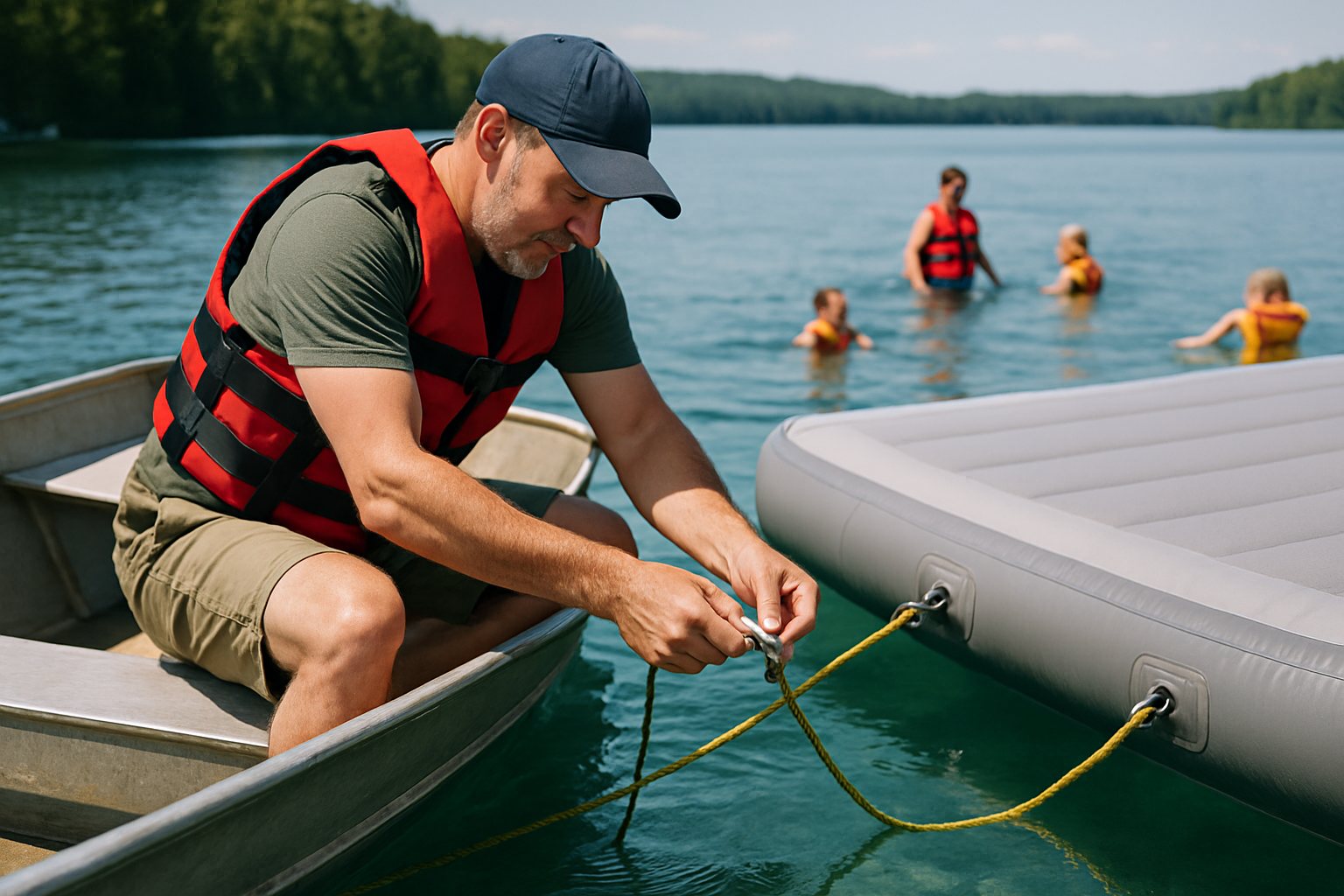
A bridle is a set of short lines that run from several anchor rings on the dock to one point, often a swivel, where the main anchor line attaches. It spreads the pull across the dock instead of yanking one corner, and the swivel lets the dock turn with the wind without twisting the line. In one of its lakefront manuals, Aquaglide describes a single vertical mooring line to the center swivel of a 4-way bridle with an appropriate weight, and tells owners to secure the swivel and connections so they cannot loosen in rough weather. Aquaglide’s Docking Station has five anchor rings and ships without a bridle, so buy or make one rated for the job.
How to anchor a floating dock, step by step
- Read the manual. Note the anchor weight, anchor points, minimum depth and distance from shore.
- Pick the spot. Check depth with a weighted line at the lowest water you expect, and leave room for the dock to swing clear of piers, lifts, boats and swim lanes.
- Place anchors first. Aquaglide’s instructions say to install anchors and mooring lines before inflating its product. Lower weights from a boat; never throw them.
- Attach the bridle or lines to every anchor point the maker provides, using shackles or locking carabiners.
- Set the length so the dock floats flat at today’s level with some slack for waves and level changes.
- Check after an hour and after the first wind. If it has moved, add weight. For sites with strong wind, current or swell, Aquaglide suggests up to 50% more weight or holding power.
Keep it away from hard objects
It is tempting to tie an inflatable dock to the end of a pier. RAVE’s manual says not to connect its Aqua Dock directly to docks, piers or other hard objects, and Aquaglide says never to tie its lakefront product to a dock. Anchor it on its own instead. If you tie a dock off a boat for the afternoon, do it at anchor with the engine off, and remember the CDC’s advice to stay at least 20 ft from boats running an engine or generator because of carbon monoxide.
Local rules
Anchoring is also a legal matter in many places. Illinois’s statewide dock permit requires docks to be securely anchored so they do not break loose and become a floating hazard in high water or wind. Minnesota’s boating guide says swimming rafts and similar structures not attached to shore may not stay in the water between sunset and sunrise without a county sheriff’s permit, with a light or reflectors. Check your state and lake rules before you leave a dock out overnight.
Next steps: floating dock installation, a floating dock on a river (current changes everything), portable docks, floating docks for ponds and lakes, the Setup and Care guide, and the lake docks hub. Words like scope, bridle and freeboard are in the glossary.
Anchoring questions
How much weight do I need to anchor a floating dock?
Whatever your maker states. The figures we found range from about 150 to 200 lb (RAVE, 10 x 10 ft inflatable) to 1,100 lb (Aquaglide Docking Station) and 4,400 lb (Aquaglide C Lounge). We do not calculate anchor weight from size; if your maker publishes nothing, ask them, or a local dock and mooring installer.
One anchor or two?
Use every anchor point the maker provides. RAVE’s dock has two, one at each end; Aquaglide’s Docking Station has five. Two or more anchors stop the dock spinning and spread the load.
Can I use cinder blocks as floating dock anchors?
People do, but no dock maker we checked specifies them. Makers sell purpose-made weights instead; Aquaglide says its sand-filled anchor bag is unlikely to damage boats or inflatables. Whatever you use, reach the maker’s total weight.
How deep should the water be?
RAVE and Aquaglide ask for at least 4 ft under the docks above, and 4.8 ft for the C Lounge. If people will jump, look for more.
How do I anchor a dock where the water level changes?
Leave slack, check often, or use hardware that slides: pipes through collars, piling brackets or stiff arms on rigid docks. For big swings, see our river guide.
Leave a Reply