This article contains affiliate links: if you buy through them we may earn a commission, at no extra cost to you. Read our affiliate disclosure.
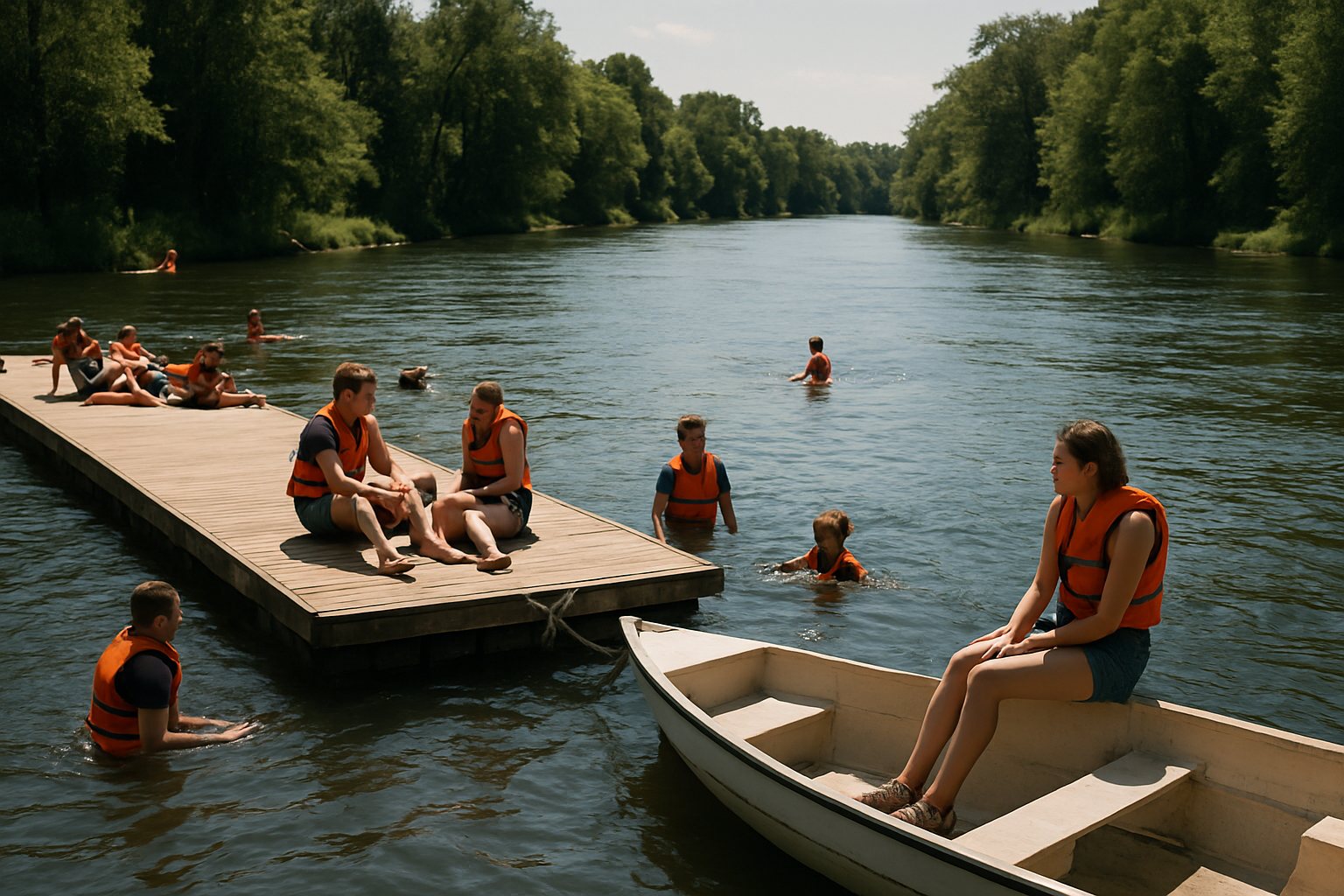
A river house in June is hard to beat: the boat tied up out front, kids fishing off the end, the water sliding past all day. Then the spring rains come upstream, the river rises a few feet overnight, and a log the size of a canoe drifts down and lodges against the dock. A floating dock on a river lives with three things a lake dock rarely sees: constant current, floating debris and big changes in water level. This guide explains what each one means for the dock you choose, how it is held in place, the rules that apply on rivers, and when an inflatable dock is the wrong tool.
In short: on a river, use a rigid floating dock held by hardware that lets it rise and fall but not drift (pipes in collars, piling brackets or stiff arms), with a hinged gangway for level changes. Consumer inflatable docks are a poor fit for current: RAVE tells owners not to use its dock in currents, and Aquaglide says sites with strong currents should consider up to 50% more anchor weight. States such as Iowa and Illinois require river docks to be securely anchored so they do not become floating hazards in high water. Check federal, state and local rules before you install.
Why a floating dock on a river is different
- Current never stops. On a lake, wind loads a dock now and then. On a river, the water pushes on it all the time, and harder when the river is high.
- Debris arrives with the current. Branches, logs and trash catch on the upstream edge, add load and can puncture or scrape.
- The level moves. Rivers can rise and fall several feet with rain upstream or dam releases, so lines and gangways that fit in the morning can be too short or too long by evening.
- Ice moves too. Where rivers freeze, ice shifting in the thaw is what damages docks; Candock says most ice damage happens then.
Inflatable docks and river current
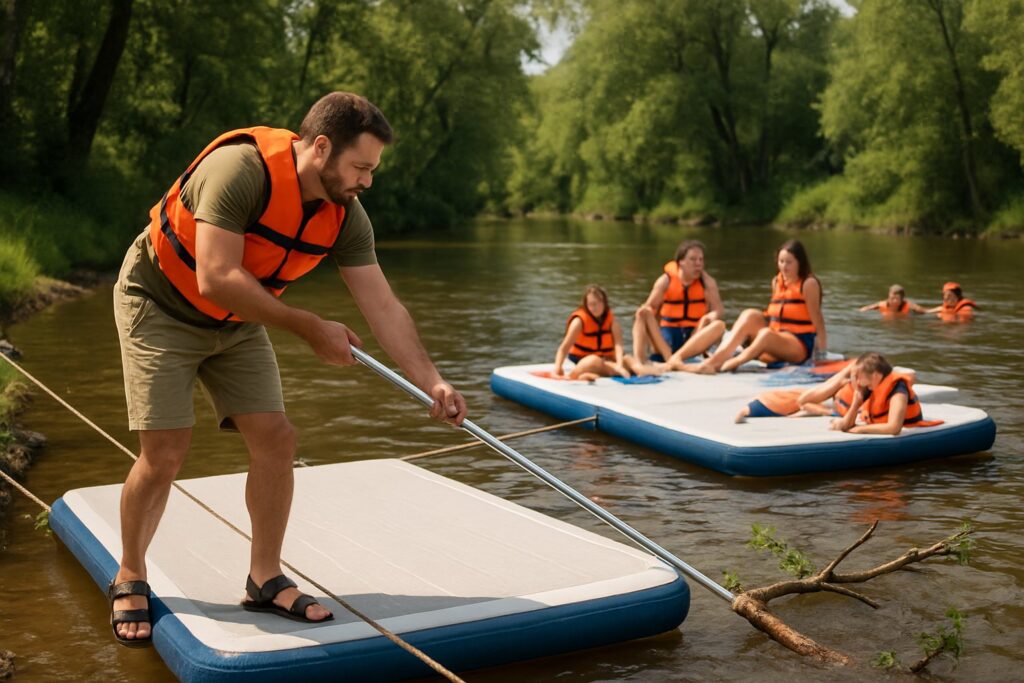
We like inflatable docks on lakes and at anchor, but we are cautious about them on moving water, and the makers are too. RAVE’s owner’s manual for its Aqua Dock tells users never to use it in high winds, waves or currents, and not to connect it directly to docks, piers or other hard objects. Aquaglide, writing about its anchored lakefront products, says sites with strong tides, currents, winds or swell should consider up to 50% more weight or holding power. None of the consumer dock makers we checked publishes a current, wind or wave limit, so there is no number to work to.
If you use an inflatable on a river at all, keep it to slack water: a backwater, a still side channel or a cove where the current is barely moving, on a calm day, attended, and out of the water when the river is up. For a dock that lives on the river all season, look at rigid docks.
Holding a river dock in place
River docks are usually held by hardware that controls sideways movement while letting the dock float up and down. EZ Dock lists pipes, deadweight anchors, piling brackets and stiff arms as its anchoring options, with hardware for fresh and salt water.
| Method | How it works | River notes |
|---|---|---|
| Pipes in collars | Pipes set in the bottom pass through collars on the dock (Connect-A-Dock kits have pole anchoring connectors for Schedule 40 pipe) | Pipe length must cover the high-water mark; best in shallower water |
| Piling brackets | Brackets slide on fixed pilings | Pilings are a construction job and often need a permit |
| Stiff arms | Rigid arms hinge between shore and dock | Hold the dock off the bank as the level changes |
| Deadweights and lines | Heavy weights on the bottom with lines or chain | Lines must be long enough for high water without letting the dock swing into the bank or channel |
Rigid modular docks are designed with wave loads in mind: EZ Dock says its couplers are designed to break before the dock section in strong wave action, so the repair is a coupler, not a section. Ask the dealer to size the anchoring for your river, depth and current, and get it in writing.
Planning for rising and falling water
- Know your range. Find the nearest US Geological Survey streamgage and look at its history. USGS WaterAlert sends email or text notifications when water conditions cross thresholds you choose, which is a simple way to know when to check the dock.
- Hinge the gangway. A gangway hinged at both ends follows the dock up and down; EZ Dock offers wood, polyethylene (up to 18 ft) and aluminum gangways.
- Check low water too. Make sure the dock still floats at the lowest level you expect and does not settle onto rocks.
- Have a high-water plan. Know in advance whether you will pull the dock, swing it in to the bank or leave it; Iowa makes riparian owners responsible for retrieving a dock that becomes a navigation hazard.
Debris and inspections
After every rise, walk the dock: clear branches from the upstream side, look at lines, chain and shackles for chafe, and check couplers, cleats and nuts. Candock, for example, asks owners to check the nuts on cleats, ladders and connecting pins occasionally. Keep a repair kit for anything soft on the dock, such as an inflatable swim pad or fenders. Never go out on a dock in flood: the National Weather Service warns that 6 in of fast-moving flood water can knock over an adult.
Better Boat 3/8 in Nylon Anchor Line, 100 ft
- 820 lb working load
- 4,035 lb breaking load
- Stainless thimble
RAVE Sports Anchor Connector Kit
- 6 ft shock cord
- 15 ft nylon rope
- Galvanized chain, float
JLF Inflatable Repair Kit with HH-66 Cement
- Five PVC patches
- 1 oz vinyl cement
- Valve wrench
River dock permits and rules
Rivers are more likely than ponds to be navigable waters. In US navigable waters, the Army Corps of Engineers treats piers and boat docks as structures that need a Department of the Army permit unless they are exempt or covered by a general permit. States add their own rules, and some are written with rivers in mind:
- Iowa: “All river docks must be securely anchored to prevent them from becoming floating hazards during times of high river flows,” and the riparian owner is responsible for retrieving and removing a dock when needed to prevent or remove a navigation hazard.
- Illinois: its statewide permit for minor private docks requires a dock to be securely anchored against high water or winds, to project no more than 50 ft and never more than a quarter of the waterway’s width, to stay within navigation limits, and to be no more than 10 ft wide.
These are examples, not your rules. Check with your state natural resources agency, county, any river authority or water management district, and the Corps district office before you buy.
Choosing a dock for a river
- Tell the dealer it is for a river, with the depth range and how fast the current runs at your bank.
- Prefer rigid modular sections with river-rated anchoring over a single inflatable deck.
- Keep it short and close to the bank; the rules above limit how far you may reach into the channel.
- Plan to remove it before ice moves, as Connect-A-Dock recommends where ice shifts.
FunAir Toy Island
by FunAir
- Stated capacity: Up to 4 jet skis or dinghies, or 2 Seabobs plus guests (maker)
Jobe Infinity Dock
by Jobe
- Size (as stated): 250 x 233 cm
- Stated capacity: 300 kg maximum user weight
- Thickness: 20 cm
Northern Diver FloatDeck
by Northern Diver
- Size (as stated): 1 to 10 m lengths
- Thickness: 8 cm drop-stitch
Related: how to anchor a floating dock, floating dock installation, floating dock kits vs inflatable docks, the modular docks hub and the Setup and Care guide.
River dock questions
Can I put an inflatable dock on a river?
Only in slack water, and check your manual first. RAVE says not to use its inflatable dock in currents, and no consumer maker we checked publishes a current limit.
How do floating docks handle river level changes?
They float up and down, so the anchoring has to slide or flex with them: pipes through collars, brackets on pilings, stiff arms, or lines with enough length. A hinged gangway connects the moving dock to the fixed bank.
Should I take my river dock out before a flood?
If you can do it safely before the water rises, it is often the simplest way to protect the dock and keep it from becoming a hazard downstream. Once the water is up and fast, stay off it.
Do I need a permit for a floating dock on a river?
Often. Many rivers are navigable waters under federal rules, and states such as Iowa and Illinois set conditions for river docks. Check before you install.
Leave a Reply