Category: Dock Types

Inflatable dock types explained: how drop-stitch air docks stay flat and firm, the common straight, L, T and U layouts, portable docks you can pack into a car, and drive-on versus inflatable jet ski docks. Each guide covers sizes, materials, what the dock is good for and its limits, so you can match the dock type to your water and your boat.

  • Drop Stitch Docks Explained: How an Air Dock Stays Flat

    Drop Stitch Docks Explained: How an Air Dock Stays Flat

    Stand on a good inflatable dock for the first time and it surprises you. You expect a bouncy-castle wobble; instead the deck is flat and firm, and you can walk to the edge and dive in the way you would off wood. Pull the valve at the end of the day and the same deck folds into a bag you can carry to the car. The trick is the fabric inside. This guide explains how a drop stitch dock is built, why pressure and thickness matter, how the main makers specify theirs, and where drop-stitch makes sense compared with rigid docks.

    In short: drop-stitch is two layers of airtight coated fabric tied together by thousands of fine threads. Pumped to pressure, the threads pull tight and hold the top and bottom flat and parallel, so the dock behaves like a firm deck instead of a balloon. Consumer drop-stitch docks are usually 6 to 8 in thick at roughly 5 to 15 psi, depending on the maker; yacht docks run to about 20 cm (8 in).

    What is a drop stitch dock?

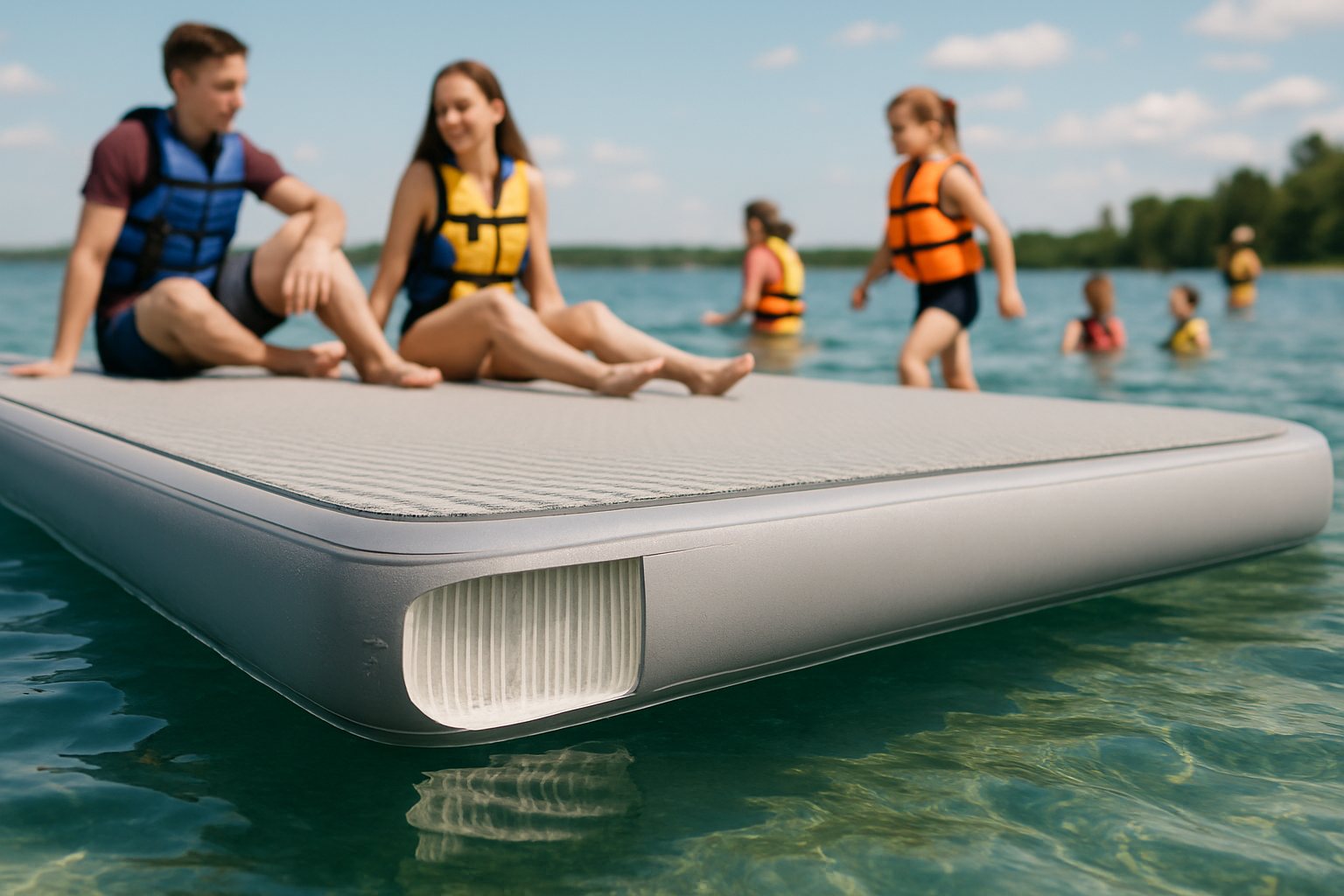
    Drop-stitch fabric is made of two woven layers joined by “drop yarns.” Both outer surfaces are coated with an airtight material, usually PVC or TPU. When the space between them is filled with air, the yarns stop the layers from bulging apart, so the panel holds its shape. The idea is older than paddle boards: Goodyear developed a similar fabric in the 1950s, called it Airmat, and used it in inflatable airplanes. The weaving machines use hundreds of needles, sometimes more than 400, and the finished panels are joined by gluing or welding.

    A drop stitch dock is that fabric made into a large flat chamber, with handles, D-rings and usually a textured foam top so wet feet don’t slip. It is the same construction as an inflatable paddle board, scaled up into a deck. That is why retailers often call it an inflatable dock platform: a platform-like floating deck, used as a dock for swimming, boarding and tying up small craft.

    How a drop stitch dock is built, layer by layer

    LayerWhat it doesExamples makers publish
    Deck padGrip and comfort underfootEVA foam top (Island Hopper, Jobe, VEVOR)
    Outer skinAbrasion, UV and puncture resistance1000-denier reinforced fabric (Island Hopper); 0.80 mm, 28 oz Duratex (Aquaglide); 1.2 mm PVC (VEVOR)
    Drop-stitch coreHolds the deck flat under pressure6 in on most consumer docks; 8 in (BOTE); 20 cm (Jobe, Yachtbeach)
    SeamsKeep the chamber airtightHeat-welded with no glued edges (Island Hopper); welded three-layer seams (Aquaglide)
    ValveInflation and deflationH3 high-pressure valves on several docks (Solstice, Overton’s)
    FittingsAnchoring, tie-off, climbing outStainless D-rings, anchor points, handles, corner bumpers

    Some docks mix materials. Henshaw’s superyacht jet ski docks, for example, have a Hypalon tube base with a double-wall drop-stitch top about 100 mm thick. Northern Diver’s FloatDeck is an 8 cm drop-stitch deck with an EVA surface rated to 0.7 bar (10 psi), sold in lengths from 1 to 10 m that link together.

    Single layer, fusion and double layer

    Paddle board makers describe three ways of finishing drop-stitch, and the same words show up in dock listings. Earth River SUP, which sells boards in the stiffer builds, explains that single-layer drop-stitch (the core with a PVC coating) is the lightest and cheapest but bouncier and easier to puncture; fusion bonds a woven fabric layer to the core for more rigidity; and double layer laminates an extra PVC-coated sheet on top for the most stiffness and puncture resistance, adding a few pounds. It also warns that “triple” or “quad” layer claims are mostly marketing. Few dock makers say which build they use, so if a listing doesn’t, ask, or compare the published fabric weight, seams and warranty instead.

    Thickness and pressure: why they matter

    The two numbers work together. Thickness sets how deep the deck is; pressure sets how tight the threads pull. Makers specify very different pressures for their own products, so there is no universal right number:

    DockThicknessPressure the maker states
    RAVE Aqua Dock 106 in5 psi; do not inflate beyond 5 psi
    BOTE Inflatable Dock 7 / 108 in6-8 psi / 8-10 psi
    Island Hopper Yacht Dock 10 x 66 in8-15 psi
    Solstice 10 x 106 in10 psi recommended (a dealer listing)
    Aquaglide Half Deck 7.510 cm (about 4 in)3.5-5 psi
    Northern Diver FloatDeck8 cm0.7 bar (10 psi)

    For comparison, inflatable paddle boards, which are much narrower, usually run at 12 psi and up. The rule is simple: inflate to the figure printed for your dock, check it with a gauge, and check again after the dock has sat in the sun, because warm air expands. RAVE ties its capacity rating to its 5 psi figure; see inflatable dock capacity explained.

    Drop stitch docks vs other floating docks

    Drop stitch dockRigid polyethylene dockFoam water mat
    FeelFirm, flat, slight giveHard and solidSoft; bends with the water
    WeightAbout 30 to 85 lb (consumer)Hundreds of lb per section (Wave Armor: 380 lb for 60 x 120 in)Light; rolls up
    Packs downYes, into a bagNoRolls
    DamageCan be punctured and patchedFoam-filled floats; maker says punctures shouldn’t sink it (Wave Armor)Can tear
    Best forSeasonal swim and boarding decks, docks carried on boatsDocks that stay in all season, drive-on portsFloating play and lounging

    For more on the rigid side, read inflatable vs rigid floating docks or our EZ Dock and Wave Armor comparisons. If a soft mat is what you want for the kids, our sister site explains drop-stitch for platforms and mats.

    Strengths and limits of drop-stitch

    • Good: light enough for two people to carry, ships by parcel, inflates in minutes (Island Hopper says about 8 minutes for its 10 x 6 ft dock with a hand pump), and stores in a closet.
    • Good: rides high and firm; with bumpers it can sit beside a boat without marking the hull.
    • Watch out: it can be punctured. Most docks come with a patch kit; large tears and seam failures go back to the maker (see inflatable dock repair).
    • Watch out: UV and rodents. RAVE warns that muskrats may chew PVC and suggests keeping full pressure on the water or taking the dock out at night; Aquaglide recommends a UV protectant.
    • Watch out: a light deck needs proper anchoring, and no consumer maker we checked publishes a wind limit.

    Drop stitch docks you can buy now

    6 in drop-stitch

    RAVE Aqua Dock 10 x 10

    • 5 psi
    • 1,800 lb or 10 adults (maker)
    • EVA foam corners
    Check price on Amazon
    Heat-welded

    Island Hopper Yacht Dock 10 x 6

    • 6 in, 8-15 psi
    • 1000-denier outer layer
    • 1,500 lb (maker)
    Check price on Amazon

    And some of the drop-stitch docks in our catalog, from family decks to yacht and dive systems:

    BOTE Inflatable Dock 10 Classic

    by BOTE

    • Size (as stated): 10 x 10 ft x 8 in
    • Stated capacity: 2,100 lb on BOTE's site (1,500 lb at some retailers)
    • Thickness: 8 in

    Full specs and sources

    See it at BOTE

    Jobe Infinity Dock

    by Jobe

    • Size (as stated): 250 x 233 cm
    • Stated capacity: 300 kg maximum user weight
    • Thickness: 20 cm

    Full specs and sources

    See it at Nootica

    Northern Diver FloatDeck

    by Northern Diver

    • Size (as stated): 1 to 10 m lengths
    • Thickness: 8 cm drop-stitch

    Full specs and sources

    See it at Northern Diver
    Custom built: request information

    Henshaw Jet Ski Dock (single and twin)

    by Henshaw Inflatables

    • Thickness: About 100 mm double-wall drop-stitch top

    Full specs and sources

    Request more information

    Browse all styles on the dock types hub, see family decks on lake docks and yacht systems on yacht docks, or look up terms like denier and H3 valve in the glossary.

    Drop stitch dock questions

    What does drop stitch mean on an inflatable dock?

    It means the dock’s air chamber is made of two coated fabric layers held together by thousands of threads. Under pressure the threads keep the deck flat and firm, which is what lets you stand and walk on it.

    How thick should a drop stitch dock be?

    Most consumer docks are 6 in; BOTE’s are 8 in, and yacht docks from Jobe and Yachtbeach are 20 cm. Thicker decks tend to feel stiffer, but the maker’s stated capacity and pressure tell you more than thickness alone.

    What psi should I inflate my drop stitch dock to?

    The figure your maker prints for that model. They vary: RAVE 5 psi, BOTE 6-10 psi by size, Island Hopper 8-15 psi. Don’t go above the maker’s maximum; RAVE warns that over-inflating can damage its dock.

    Is a drop stitch dock the same as an inflatable dock platform?

    Usually, yes: retailers use both names for the same flat drop-stitch deck. Check the listing for thickness, pressure and a stated capacity; a thin, low-pressure pool float sold as a “platform” is a different product.

    Can a drop stitch dock be repaired?

    Small holes, yes, with the maker’s patch kit and the right adhesive for the fabric. RAVE asks owners to contact it for large holes, tears or seam failures, and to let a patch dry for 24 hours before inflating. Our repair guide walks through the steps.
  • Floating Dock Designs: Straight, L, T and U Layouts Explained

    Floating Dock Designs: Straight, L, T and U Layouts Explained

    It’s the first warm Saturday at the lake and three things want a spot at the shoreline at once: the family runabout, a jet ski, and two kayaks that nobody wants to drag over the rocks again. Where each one ties up, and how you walk out to it, is decided long before launch day by the shape of the dock. This guide walks through the floating dock designs that makers actually publish (straight, L, T and U layouts, berths and slips, side and stern entry), what each one is good for, and how the inflatable options fit in.

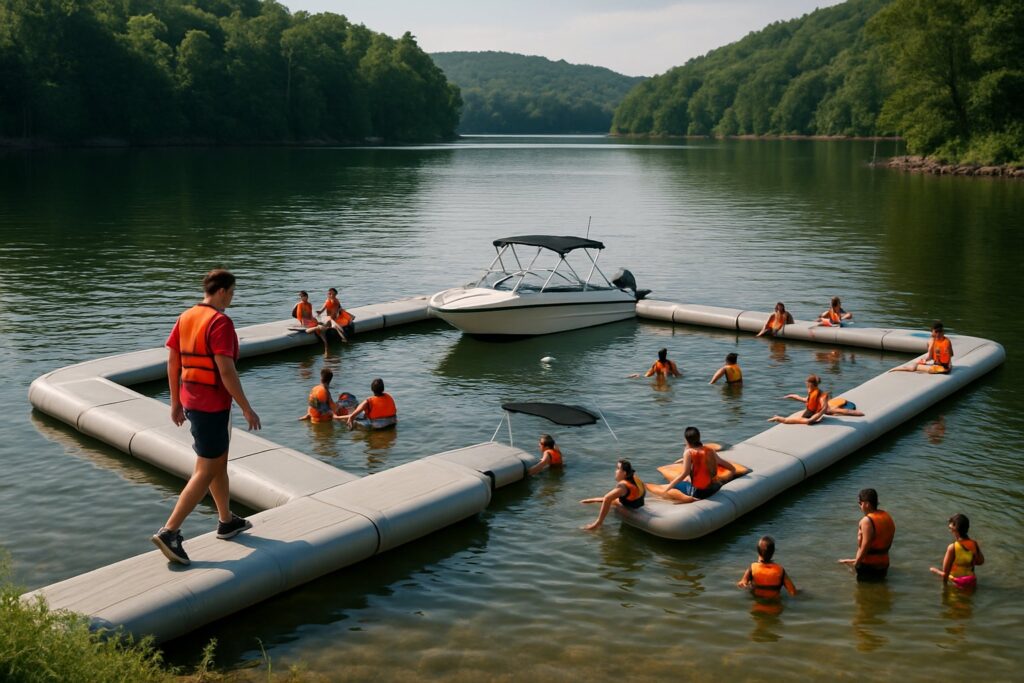
    U-shaped inflatable dock layout forming a slip around a small boat

    In short: a straight dock is the simplest and usually the cheapest layout; an L adds a second side for another boat; a T gives two berths at the far end; and a U wraps two arms around one boat for the most protection. Rigid modular makers such as EZ Dock and Wave Armor sell these shapes as sections and kits. Inflatable docks are mostly single decks that tie alongside or behind a boat, with a few modular and jet ski systems that link into bigger layouts.

    Floating dock designs at a glance

    EZ Dock, the US maker of rotomolded polyethylene docks, describes four basic shapes on its own site, and it is a useful starting vocabulary because dealers across the industry use the same letters. The table sums up what the maker says each shape is for.

    LayoutWhat it looks likeWhat the maker says it suits
    Straight (I)One run of sections from shoreThe simplest design and usually the least expensive; good for sunbathing and fishing; several boats can moor along it
    LA run with one arm turned at the endOwners with at least two watercraft; a long L can hold about three boats
    TA run with a cross piece at the endTwo boats at the head, or one big mooring spot plus room for canoes; quick loading and unloading
    UTwo arms with the boat parked between themHigh-value boats that need more protection and separation from other vessels

    The shapes are not just looks. Each one changes how many boats you can tie up, which side you step aboard from, and how exposed the boat is to passing wakes. Before you pick, count the craft you need to dock (including the toys), note which direction the wind and boat traffic come from, and check how far out you are allowed to build.

    Straight docks: the simple layout

    A straight dock runs from the shore (or from a gangway) out to water deep enough for your boat. It is the easiest to anchor and to take apart, and because it uses the fewest corner pieces it is usually the least expensive shape for a given length. Boats tie along one or both sides. The weak point is protection: the boat lies against the dock with open water on its other side, so wakes push it into the fenders.

    The inflatable equivalent is a long deck such as Island Hopper’s 15 ft Patio Dock, which the listing says can be joined to more units, or Northern Diver’s FloatDeck, a UK drop-stitch deck sold in lengths from 1 to 10 m that links lengthways or sideways. Northern Diver markets FloatDeck for dive prep and as a temporary pontoon; it does not sell it as a permanent dock.

    L-shaped and T-shaped docks

    Turn the end of a straight run and you have an L. The arm gives a second tie-up side and a sheltered corner, so it is the common choice when a family has a boat plus a jet ski or a pontoon plus kayaks. EZ Dock sells a pre-configured 40 ft x 13 ft L kit made of three 60 in x 10 ft sections, two 80 in x 10 ft sections, one corner gusset and 15 coupler sets.

    A T puts a cross piece at the head of the run. EZ Dock lists a T kit that is 15 ft long and 20 ft wide (four 60 in x 10 ft sections, two corner gussets and nine coupler sets) and a much bigger 30 ft x 45 ft T with seven sections and 18 coupler sets. EZ Dock says a longer T can dock two boats, while a shorter one gives one large mooring spot and space for smaller craft. Neither kit page shows a price: EZ Dock sends buyers to a local dealer for a quote.

    U-shaped docks and slips

    A U wraps two arms around a slip, so the boat sits between them with dock on both sides. EZ Dock aims it at owners of high-end boats who want separation from other vessels, and notes that the extra deck leaves room for racks or benches. Its 20 ft x 20 ft U kit is five 60 in x 10 ft sections, two corner gussets and twelve coupler sets. A U takes the most material and the most anchoring, and it needs room on the water: check that the slip is wide and long enough for your boat with fenders on, using the boat’s beam and length from its manual.

    Berths and ports for jet skis and boats

    Many layouts are really built around berths. On rigid docks, a berth is often a drive-on port: a molded cradle that the jet ski or boat rides up onto so it sits out of the water. Wave Armor, for example, sells PWC ports from its Sport model (a 59 in wide, 11 ft long port with a stated 700 lb weight capacity, $1,725 on its site) up to its Pro series, plus “port mount corners” from $925 to $1,225 that join a port to its dock sections. Wave Armor’s own site says ports can stand alone or connect to its docks or, with separate kits, to other brands.

    Inflatable berths exist too, mostly for yachts. Jobe’s Infinity PWC Dock is a U-shaped 345 x 250 cm module with an opening that the jet ski noses into. Henshaw in the UK makes single and twin jet ski docks with a Hypalon tube base and a drop-stitch top. Yachtbeach sells single and duo jet ski docks, NautiBuoy Marine makes a double-bay drive-in jet ski dock with ballast bags that fill on launch, and FunAir’s custom Toy Island holds up to four jet skis or dinghies, with a V-notch for foiling craft. Most of these are quote-only; our jet ski dock guide covers them in detail, and we have a separate piece on the floating dock for a jet ski.

    Jobe Infinity PWC Dock

    by Jobe

    • Size (as stated): 345 x 250 cm
    • Thickness: 20 cm

    Full specs and sources

    See it at Nootica
    Custom built: request information

    Henshaw Jet Ski Dock (single and twin)

    by Henshaw Inflatables

    • Thickness: About 100 mm double-wall drop-stitch top

    Full specs and sources

    Request more information
    Custom built: request information

    NautiBuoy Jet-Ski Dock

    by NautiBuoy Marine

    Full specs and sources

    Request more information

    Northern Diver FloatDeck

    by Northern Diver

    • Size (as stated): 1 to 10 m lengths
    • Thickness: 8 cm drop-stitch

    Full specs and sources

    See it at Northern Diver

    Side entry vs stern entry

    With a boat, the layout question is often simply where the dock touches the hull. A side-entry dock lies along the boat’s side, the way a marina finger pier does. Island Hopper sells its narrow 10 x 3 ft Mini Mate Yacht Dock to sit beside a boat, including in a marina slip, and its 10 x 6 ft Yacht Dock has rubber bumpers on all four corners so the edge does not scuff the hull.

    A stern-entry dock ties off behind the boat, next to the swim platform. That is how most yacht docks are used: Jobe’s Infinity modules attach to each other or to the boat with D-rings and Velcro straps, and Jobe sells an Infinity Gangway, an inflatable walkway between the boat and the platform. RAVE’s manual for its Aqua Dock adds a caution worth applying to any stern setup: tethering a dock to boats or hard objects raises the risk of injury, so keep it clear of engines and propellers and keep the motor off while people are on it.

    Can inflatable docks make L, T or U layouts?

    Only the ones built to link. A lot of consumer inflatable docks are designed as stand-alone decks. RAVE’s manual says its Aqua Dock is meant to be used on its own, not attached to other RAVE products, and Aquaglide tells buyers not to combine its products with other brands. If you want a shape, buy into a system whose maker documents the connection, such as Jobe Infinity, NautiBuoy’s connected Voyager series (“linked in multiple configurations”, per the maker) or Northern Diver FloatDeck, and follow the maker’s layout rather than lashing unrelated decks together.

    For a single family deck, the practical “layouts” are simpler: a square deck anchored off the shore for swimming, or a long deck tied alongside a boat. These two are on sale and easy to buy:

    Square swim dock

    RAVE Aqua Dock 10 x 10

    • 10 x 10 ft, 6 in thick
    • 1,800 lb or 10 adults (maker)
    • 2 anchor points
    Check price on Amazon
    Alongside a boat

    Island Hopper Yacht Dock 10 x 6

    • 10 x 6 ft, 6 in thick
    • 1,500 lb (maker)
    • Rubber corner bumpers
    Check price on Amazon

    Rigid modular vs inflatable layouts compared

    Rigid modular (EZ Dock, Wave Armor)Inflatable (consumer decks)Inflatable systems (Jobe, NautiBuoy, FloatDeck)
    ShapesStraight, L, T, U and custom from sections, wedges, corners and half-roundsOne square or rectangular deckLinked modules, U-shaped jet ski bays, gangways
    BerthsDrive-on PWC and boat portsNone; tie alongsideSingle, twin and multi jet ski docks
    SeasonInstalled for the season or longerInflated for the day or the summerDeployed from a yacht when at anchor
    How you buyDealer quote (EZ Dock); list prices online (Wave Armor)Retail and AmazonMostly dealer or quote

    Wave Armor’s rectangular sections run 2.5 to 5 ft wide and 5 or 10 ft long, with wedges, half-rounds and corner pieces, and H-beam connectors in 24, 31 and 50 in lengths; its site has an online Dock Builder for drawing a layout. For the trade-offs between the two building methods, read inflatable vs rigid floating docks, and for the modular side in depth, see modular docks.

    How to plan your layout

    • List every craft. Boat, jet ski, kayaks, paddle boards. Each one needs a side, a berth or a launch spot; kayaks often do best on a low launch (see kayak launch docks).
    • Measure the water. Depth at the far end at low water, and the bottom type, decide where the berths can go and how the dock is anchored.
    • Check the rules first. Docks in US navigable waters can need an Army Corps of Engineers permit, and states and lake authorities add their own limits. Minnesota, for example, lets a dock go in without a permit only if it is 8 ft wide or less, no longer than needed, and not a hazard, among other conditions.
    • Plan the anchoring with the shape. Every arm adds anchoring. Inflatable makers state their own needs: Aquaglide asks for at least 1,100 lb of anchor weight on its Docking Station.
    • Keep it buildable. Use only the connectors and layouts the maker documents. For a custom yacht or commercial layout, ask the maker; our Request more information form can put you in touch.

    Browse every dock style on our dock types hub, compare real products in the product directory, or start with the lake docks page if this is for a cabin or lake house. Terms like gusset, berth and freeboard are in the glossary. Pricing a rigid layout? Read EZ Dock vs inflatable docks and building a floating dock vs buying inflatable.

    Floating dock layout questions

    What is the most common floating dock design?

    The straight dock. EZ Dock calls it the most straightforward option and usually the least expensive. L and T shapes are the next step up when you need more than one tie-up side.

    Which dock shape is best for two boats?

    EZ Dock suggests an L for owners with at least two watercraft (a long L can hold about three boats) or a longer T with a berth on each side of the head. The right one depends on your shoreline, depth and how boats approach.

    Can I connect two inflatable docks?

    Only if the maker says so. Some systems are built to link (Jobe Infinity, NautiBuoy Voyager, Northern Diver FloatDeck, Island Hopper Patio Dock). Others are stand-alone: RAVE says its Aqua Dock is not meant to attach to other RAVE products, and Aquaglide says not to mix its products with other brands.

    How much does an L- or U-shaped floating dock cost?

    EZ Dock does not publish prices for its kits; it quotes through dealers. Wave Armor lists its sections online, for example $2,295 for a 60 x 120 in section and $1,350 for a 60 x 60 in section when we checked in October 2026, before connectors, anchoring, delivery and installation.

  • Portable Docks: Floating Docks You Can Pack Up and Move

    Portable Docks: Floating Docks You Can Pack Up and Move

    A rented cabin for two weeks in July, a sandbar you anchor at every Saturday, a pond you are not sure you will keep: none of these wants a dock bolted into the lake bed. Portable docks are the answer people look for, floating docks you can carry down to the water, set up in an afternoon and take home again. This guide sorts the options by how portable they really are, with the weights and sizes makers publish: inflatable docks that roll into a bag, modular sections you can carry one at a time, and small docks made to ride along on a boat.

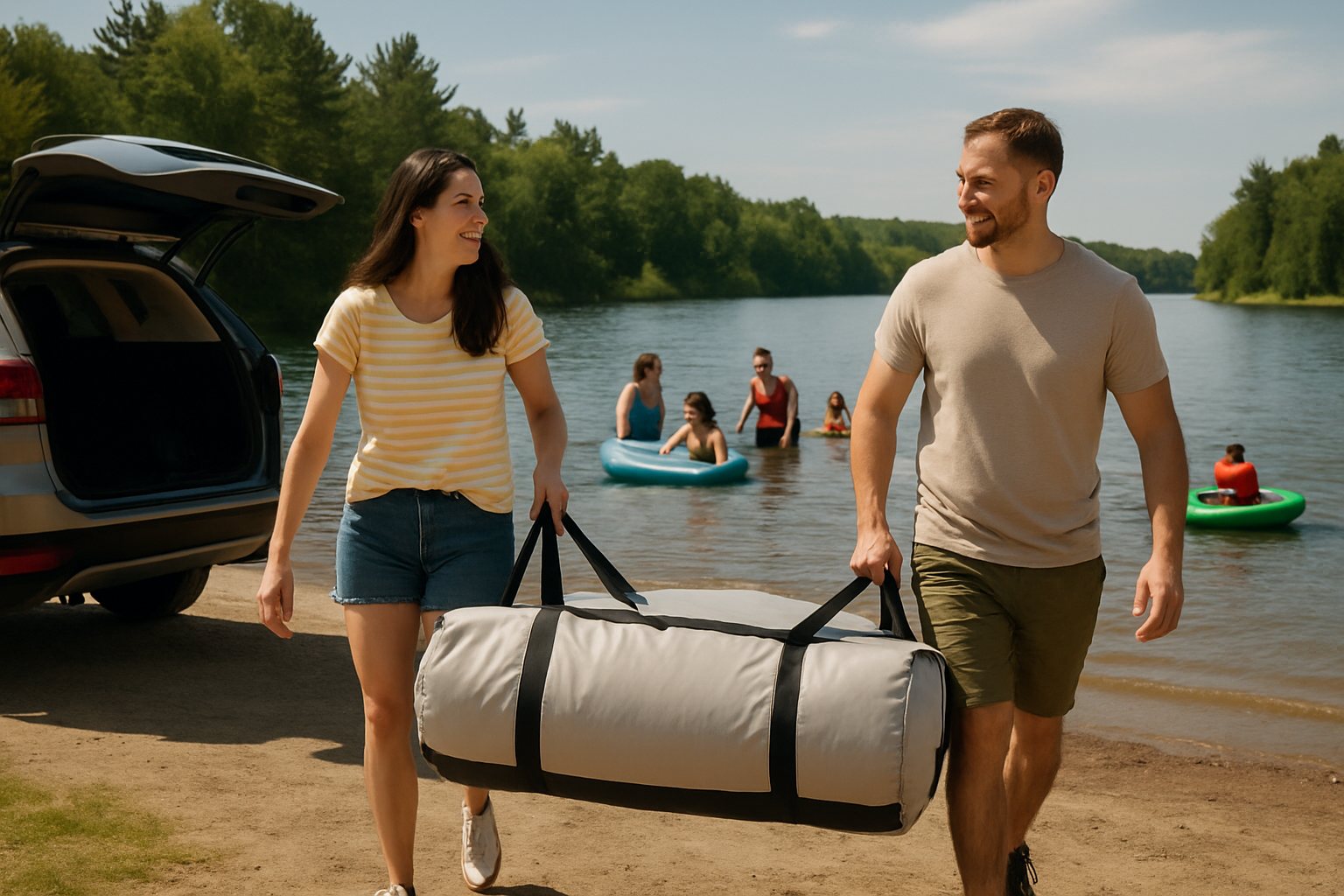
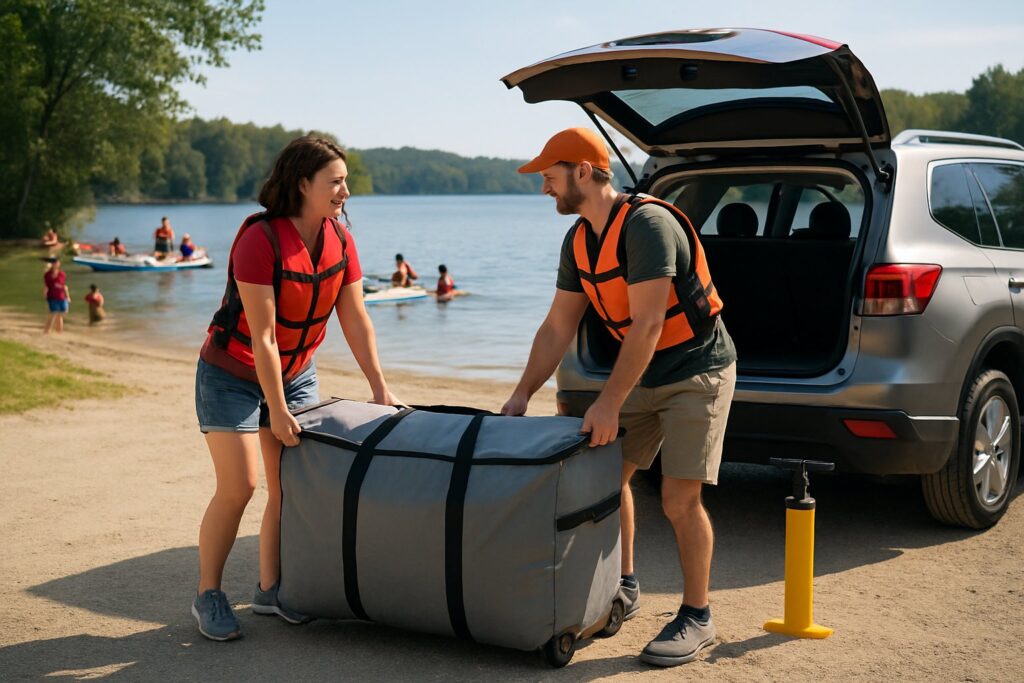
    Couple unloading a packed inflatable dock from their car at a lake

    In short: the most portable docks are inflatable: drop-stitch decks from about 19 lb (AWSUM 6 x 5 ft) to 83 lb (BOTE 10 x 10 ft) that pack into a bag and cost about $170 to $1,550 in October 2026. Modular plastic docks are portable in pieces (a Candock cube weighs 12 lb, a Connect-A-Dock section 110 lb) but take longer to set up and anchor. Whatever you choose, portable still means anchored: bring weights or anchor bags you can fill on site.

    What makes a dock portable?

    • Weight you can carry. Lighter is easier: the docks below run from about 19 to 110 lb per piece, and RAVE asks for two or more people to carry its inflated 68 to 69 lb dock.
    • Packed size. Island Hopper’s 10 x 6 ft Yacht Dock rolls to about 40 x 16 x 14 in.
    • Setup time. Island Hopper says about 8 minutes with a hand pump for that dock; EZ Dock says most rigid docks take a day with two people.
    • Anchoring that leaves with you. Weights and bags, not pipes driven into the bottom.

    Portable docks by weight

    DockTypeSizeWeight (maker or seller)Stated capacity
    AWSUM 6 x 5 ftInflatable6 x 5 ft, 6 in18.8 lb455 lb
    Island Hopper Mini Mate Yacht DockInflatable10 x 3 ft, 6 in32 lb rolled1,000 lb load rating
    BOTE Inflatable Dock 7Inflatable7 x 7 ft, 8 in35 lb1,050 lb
    LOSKIA U jet ski dockInflatable8.5 x 8 ft, 6 in39 lbNot published
    Island Hopper Yacht DockInflatable10 x 6 ft, 6 in53 lb1,500 lb
    WOW Vacation Station 8 x 8Inflatable8 x 8 ft, 6 in53 lb1,200 lb
    RAVE Aqua Dock 10Inflatable10 x 10 ft, 6 in68 to 69 lb1,800 lb or 10 adults
    BOTE Inflatable Dock 10Inflatable10 x 10 ft, 8 in83 lb2,100 lb
    Candock G2 cubeRigid modular19 x 19 x 14 in per cube12 lb per cube150 lb per cube
    Connect-A-Dock 1000 sectionRigid modular60 x 45 x 10 in110 lb per section690 lb per section

    Inflatable portable docks

    An inflatable dock is the most portable dock there is. It is a drop-stitch PVC deck, 6 to 8 in thick when pumped to the maker’s pressure, that deflates and rolls up; Island Hopper gives about 40 x 16 x 14 in for its rolled 10 x 6 ft dock. Small ones, like the AWSUM 6 x 5 ft at 18.8 lb, fit in a car trunk with room to spare. The 10 ft class from known brands (RAVE, Island Hopper, Solstice, WOW, BOTE) weighs about 50 to 85 lb and is stated by its makers at about 1,200 to 2,100 lb. Most come with a hand pump; an electric pump makes moving from lake to lake much easier.

    Lightest to carry

    AWSUM Inflatable Floating Dock

    • 6 x 5 ft, 18.8 lb
    • Seven sizes to 15 x 6 ft
    • Pump, rope, soft ladder
    Check price on Amazon
    Rides along on a boat

    Island Hopper Yacht Dock 10 x 6

    • 53 lb
    • 1,500 lb
    • Corner bumpers
    Check price on Amazon
    Most deck to pack away

    RAVE Aqua Dock 10

    • 10 x 10 ft
    • 1,800 lb or 10 adults
    • 68 to 69 lb
    Check price on Amazon
    Square mid-size

    WOW Vacation Station 8 x 8

    • 8 x 8 ft, 53 lb
    • 1,200 lb
    • Hand pump with gauge
    See it at the store

    Prices seen in October 2026: AWSUM 6 x 5 ft about $170, Island Hopper Yacht Dock $749 and RAVE Aqua Dock $800 on Amazon, WOW Vacation Station $720 at Overton’s. More picks are in the best floating docks.

    Portable docks that ride along on a boat

    Some portable docks are made to travel with the boat rather than the car. Island Hopper says its Yacht Dock’s 6 ft beam lets it deploy off smaller vessels “where a 10-foot platform would be impossible,” with rubber corner bumpers to protect the hull, and its narrow 10 x 3 ft Mini Mate is sold to sit beside a boat, including in a marina slip. Tie them off at anchor with the engine off, keep them clear of the propeller and exhaust, and stay at least 20 ft from boats running an engine or generator, as the CDC advises because of carbon monoxide. Inflatable jet ski docks are portable too; see the best jet ski docks.

    Modular docks: portable in pieces

    Rigid modular docks are portable in a different sense: you can take them apart, move them and rebuild them in a new shape. Candock says you can change the configuration of its 12 lb cubes “as often as you like,” EZ Dock says its sections can be reconfigured or expanded at any time, and Jet Dock calls its drive-on PWC dock “completely modular, expandable and portable.” The trade-off is time and weight per piece (110 lb for a Connect-A-Dock 1000 section) and anchoring with pipes, brackets or stiff arms. They suit a seasonal dock that comes out every fall rather than one that moves every weekend. See floating dock kits vs inflatable docks.

    Which portable dock for which trip

    • A week at a rented cabin: a 10 ft class inflatable with an electric pump. It gives the kids a swim deck and you a place to tie the paddle boards, and it goes home in the trunk.
    • Saturdays at the sandbar: a narrow boat-side dock such as the Island Hopper Yacht Dock or Mini Mate, tied off the stern at anchor.
    • A jet ski that travels with you: an inflatable U or L jet ski dock that packs down to under 40 lb.
    • A summer place you own, out every fall: modular sections you assemble in spring and stack in the barn in October.
    • Daily boat access all season: portable is probably the wrong goal. Look at rigid floating docks in the modular docks section.

    Anchoring a portable dock

    Portable does not mean loose. Makers state anchor weights for their docks: RAVE suggests about 150 to 200 lb for its Aqua Dock, depending on the lake and bottom, and Aquaglide asks for at least 1,100 lb on its large Docking Station. Weights that pack flat are the portable answer: Aquaglide’s Lakefront Anchor Bag holds about 110 lb when filled with sand, so you carry an empty bag and fill it at the beach. Use every anchor point, keep the dock off piers and boats, and check it after the first breeze. Full details in how to anchor a floating dock.

    Packing up and storing

    RAVE’s manual gives a good routine for any inflatable: dry each side in the sun for at least 15 minutes, towel off, fold in thirds and roll loosely, then store somewhere covered, shaded, cool and dry, off concrete and safe from rodents. Clean with mild soap and fresh water, never solvents or a power washer. Carry inflated docks with two or more people and never drag them over sand or rocks.

    Rules for docks that move

    A portable dock can still fall under local rules. Minnesota, for example, says swimming rafts and other structures not attached to shore may not stay in the water from sunset to sunrise without a county sheriff’s permit and a light or reflectors. If you take the dock in every evening, that is easy; if you leave it out, check first.

    Aquaglide Docking Station

    by Aquaglide

    • Size (as stated): 14 ft 9 in x 10 ft 5 in x 6 in
    • Stated capacity: 600 lb (3 adults + 3 children)
    • Thickness: 6 in (15 cm) welded drop-stitch

    Full specs and sources

    See it at Bart's

    BOTE Inflatable Dock 10 Classic

    by BOTE

    • Size (as stated): 10 x 10 ft x 8 in
    • Stated capacity: 2,100 lb on BOTE's site (1,500 lb at some retailers)
    • Thickness: 8 in

    Full specs and sources

    See it at BOTE

    BOTE Inflatable Dock 7 Classic

    by BOTE

    • Size (as stated): 7 x 7 ft x 8 in
    • Stated capacity: 1,050 lb
    • Thickness: 8 in

    Full specs and sources

    See it at BOTE

    Island Hopper Mega Yacht Dock 10 x 10

    by Island Hopper

    • Size (as stated): 10 x 10 ft
    • Stated capacity: 2,000 lb load rating
    • Thickness: 6 in

    Full specs and sources

    See it at Overton's

    RAVE Aqua Dock 10

    by RAVE Sports

    • Size (as stated): 10 x 10 ft x 6 in
    • Stated capacity: 1,800 lb / 10 adults
    • Thickness: 6 in drop-stitch

    Full specs and sources

    See it at Bart's

    Solstice Inflatable Dock 10 x 10

    by Solstice Watersports

    • Size (as stated): 10 x 10 ft x 6 in
    • Stated capacity: 1,650 lb
    • Thickness: 6 in drop-stitch

    Full specs and sources

    See it at Overton's

    Explore more: the lake docks hub, boat docks, floating dock cost, our inflatable docks guide and kayak launch docks. Looking for a floating patio to lounge on rather than a dock? Our sister site covers floating lounges.

    Portable dock questions

    What is the lightest portable dock?

    Of the docks we checked, the AWSUM 6 x 5 ft inflatable at 18.8 lb, per the seller. Lighter usually means smaller and a lower rating.

    Can one person set up a portable dock?

    One person can inflate one, but RAVE says two or more people should carry an inflated dock, and anchoring from a boat is easier with a helper.

    Can I leave a portable dock in the water all summer?

    Some makers expect it to come in. RAVE’s manual says to deflate and store its dock when not in use. Larger docks, like Aquaglide’s Docking Station, are built around heavy anchoring (at least 1,100 lb) and a fixed spot. Check your manual and local rules.

    Are portable docks good for a pond?

    Yes, if it is deep enough: RAVE and Aquaglide ask for at least 4 ft of water under their docks. Shallow farm ponds may suit a small rigid dock better. See floating docks for ponds and lakes.

    Do portable docks work on rivers?

    Current changes the picture; RAVE’s manual says not to use its dock in currents. Read floating docks on a river first.

  • Drive-On vs Inflatable Jet Ski Docks: Which PWC Floating Dock?

    Drive-On vs Inflatable Jet Ski Docks: Which PWC Floating Dock?

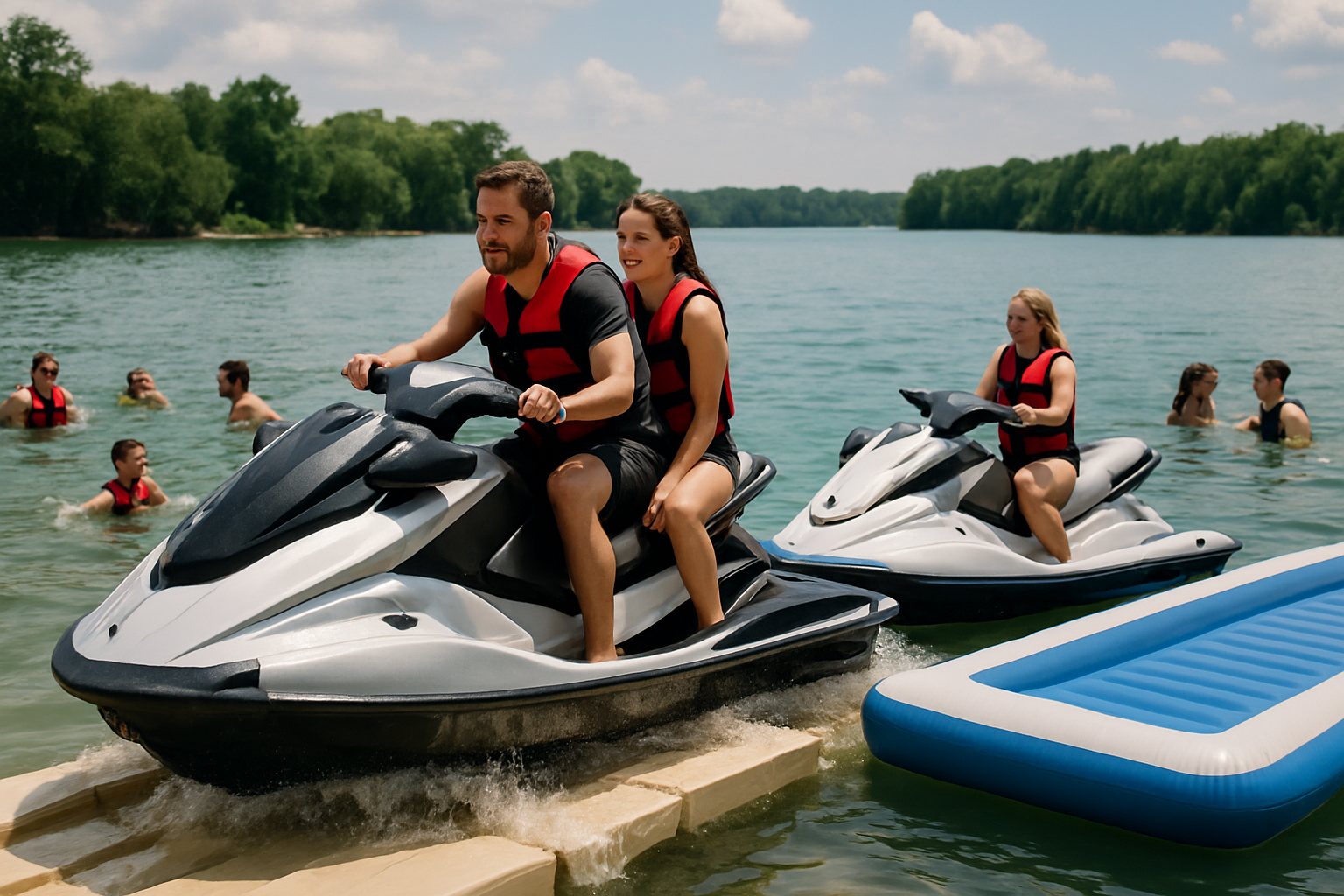
    Two neighbors on the same cove, two answers. One idles his ski up a gray plastic ramp at the end of the dock, it rolls up and stops against the bow stop, and he walks off with dry feet. The other pulls hers into the slot of a soft inflatable U, loops two lines through the D-rings and dives off the deck for a swim. Both own a PWC floating dock, but they bought very different things. This guide explains how a drive-on jet ski dock and an inflatable jet ski dock work, what each costs and carries according to its maker, and which one fits the way you use your ski.

    In short: a drive-on dock is a rigid polyethylene port with rollers or a ramp that lifts the ski out of the water; makers publish a capacity (700 to 2,000 lb on the ones we checked) and prices start around $1,700. An inflatable jet ski dock is a drop-stitch U, E or L that the ski floats in or beside; it costs about $180 to $670, packs into a bag, but the listings we checked give no rating for a ski on top. Season-long mooring points to drive-on; weekends, travel and small budgets point to inflatable.

    How a drive-on jet ski dock works

    A drive-on dock, sold as a PWC port, is a shaped float made of rotomolded polyethylene. Some are filled with foam, like the Wave Armor Sport and the Candock JetRoll; others float on sealed air chambers. The top has a cradle with wheels or rollers. You line up, approach at idle, and the momentum carries the hull up the rollers until the bow stop catches it. To launch, you push the ski back or off the side. EZ Dock says the wheels on its EZ Port 2i “move according to how your PWC sits,” which keeps it centered.

    Because the hull sits out of the water, there is no growth on the bottom and no slapping against a pier when the wake rolls in. Ports bolt to modular dock sections or to an existing dock with connection kits, which are often sold separately, and they are anchored the same way as any rigid floating dock. They are heavy: Wave Armor lists its Sport at about 180 lb and needs a forklift for delivery, and the Candock JetRoll is about 350 lb.

    How an inflatable jet ski dock works

    An inflatable jet ski dock is a deck made of drop-stitch PVC: two skins joined by thousands of threads, pumped hard (the ACWYENN asks for 5 to 10 psi) so it stays flat. It is usually 6 in thick with an EVA foam top, cut into a shape that wraps the ski. A U holds one ski in its slot, an E holds two, and a narrow L makes a soft walkway beside the ski or an existing dock. The ski stays afloat, tied to D-rings, while the soft sides keep it off your boat. Deflated, the whole thing goes in a bag; the LOSKIA U weighs 39 lb.

    The catch is the load question. None of the inflatable listings we read publishes a weight rating for a ski on the deck, and Paradise Pad calls its own T model “more as a temporary dock and not a long term dock.” So we treat inflatables as slips and bumpers, not lifts.

    Drive-on vs inflatable PWC floating dock, side by side

    Drive-on (rigid port)Inflatable PWC dock
    Where the ski sitsOut of the water, on rollersIn the water, in a slot or alongside
    Stated capacity700 lb (Wave Armor Sport) to 2,000 lb incl. ski and people (Candock JetRoll)Not published on the listings we checked
    Weight of the dockAbout 180 to 350 lb (two models checked)About 39 lb (LOSKIA U); 66 lb package (GIRISHIP E)
    Price, Oct 2026$1,725 to $2,699 per single port; EZ Dock and Jet Dock by quote$179 to $665 on Amazon
    Warranty7-year limited (Candock JetRoll); lifetime limited (Jet Dock)Half a year to 1 year
    StorageStays in for the season; out where ice movesDeflates into a bag
    Best forA ski that lives at the dock all summerWeekends, travel, rentals, tight budgets

    Sizing a drive-on jet ski dock to your ski

    Drive-on ports are sized for hull families. Wave Armor builds its Sport “specifically designed for smaller, lightweight PWCs” such as the Sea-Doo Spark and Yamaha EX series, and sells deeper Pro and Pro Maxx ports and a Wide Body version for bigger skis. EZ Dock says the EZ Port 2i suits “today’s larger three-seater models.” Look up your ski’s dry weight on the maker’s site (Sea-Doo lists the Spark Trixx at 443 to 473 lb), add fuel and gear, and ask the dock maker to confirm the fit in writing. Never estimate capacity from the size of the port.

    Sizing an inflatable jet ski dock

    For a U or E, the slot is what matters. Paradise Pad publishes its opening (4 ft wide and 4 ft deep on a 6.5 x 9 ft dock), which lets you compare it with your ski’s beam. If a listing does not give the slot size, ask before you buy. An L is simpler: it only needs to be about as long as the ski so you have somewhere to step.

    Popular picks of each kind

    Inflatable U

    LOSKIA U-Shaped Inflatable Jet Ski Dock

    • 8.5 x 8 ft, 6 in
    • 39 lb, pump and ropes included
    • About $339
    Check price on Amazon
    Inflatable L

    ACWYENN L-Shaped Inflatable Jet Ski Dock

    • 2 ft wide, 6 in
    • 5 to 10 psi
    • About $179
    Check price on Amazon
    Rigid drive-on

    Wave Armor Sport PWC Port

    • 59 in x 11 ft
    • 700 lb capacity
    • $1,725
    See it at the store

    Every model, with prices and the facts behind each one, is in our best jet ski docks guide.

    Anchoring and setup

    Both kinds need to be held in place. A port attached to a dock moves with the dock, so the dock’s anchoring (pipes, deadweight anchors, piling brackets or stiff arms, in EZ Dock’s list of options) has to handle the extra load and the wake. A stand-alone inflatable needs its own anchor and lines; one inflatable dock maker, RAVE, tells owners not to connect its swim dock directly to docks, piers or other hard objects, so read your manual before you tie an inflatable to a pier. Our step-by-step guide on how to anchor a floating dock covers weights, scope and lines, and floating dock installation covers the first day.

    Which one should you buy?

    • You keep the ski at your own dock from May to September: drive-on. The hull stays clean, and the maker states what it carries.
    • You take the ski to different lakes or rent a lake house: inflatable. It fits in the truck with the life jackets.
    • You anchor a boat and the ski comes along: inflatable U or L tied off the boat, well clear of the engine and with the boat’s engine off.
    • Two skis: an inflatable E with two slots, or two ports joined to a modular dock (see modular docks).
    • A yacht carrying skis: neither of these. Look at purpose-built yacht jet ski docks in yacht docks.
    Custom built: request information

    FunAir Toy Island

    by FunAir

    • Stated capacity: Up to 4 jet skis or dinghies, or 2 Seabobs plus guests (maker)

    Full specs and sources

    Request more information
    Custom built: request information

    Henshaw Jet Ski Dock (single and twin)

    by Henshaw Inflatables

    • Thickness: About 100 mm double-wall drop-stitch top

    Full specs and sources

    Request more information

    Jobe Infinity PWC Dock

    by Jobe

    • Size (as stated): 345 x 250 cm
    • Thickness: 20 cm

    Full specs and sources

    See it at Nootica
    Custom built: request information

    NautiBuoy Jet-Ski Dock

    by NautiBuoy Marine

    Full specs and sources

    Request more information

    Keep reading: the jet ski docks hub, floating dock cost, inflatable vs rigid floating docks and terms like drop-stitch and bow stop in the glossary.

    Drive-on and inflatable jet ski dock questions

    Is a drive-on jet ski dock the same as a jet ski lift?

    Not quite. A drive-on dock floats and you drive up onto it. A lift raises the ski with a mechanism; some, like the Patriot Docks PWC lift, stand on legs on the lake bed. Jet Dock calls its floating drive-on dock a “jet ski lift,” so check the product type, not just the name.

    Can a drive-on port go in salt water?

    Many are sold for it. EZ Dock says its products are built to withstand saltwater conditions and offers fresh and saltwater anchoring hardware. Check the specific port and its hardware, and follow the care instructions for wheels and fittings.

    Will an inflatable jet ski dock scratch the hull?

    It is soft PVC with an EVA top, so sellers market it as a bumper that protects the hull. Keep it clean of sand and grit, which is what usually does the scratching, and use enough lines that the ski cannot ride up over the edge in a wake.

    Which lasts longer?

    On paper, the rigid port. Candock gives seven years and Jet Dock a lifetime limited warranty, while the inflatable listings we checked give six months to a year. Real life depends on sun, storage and use; deflate, rinse, dry and store an inflatable out of the sun.

    Do I still need a life jacket at the dock?

    On the ski, yes: state PWC rules, such as Virginia’s, require the operator and every rider to wear a USCG-approved life jacket. At the dock, docks are wet and slippery, and a jacket is a sensible habit for kids and weak swimmers.